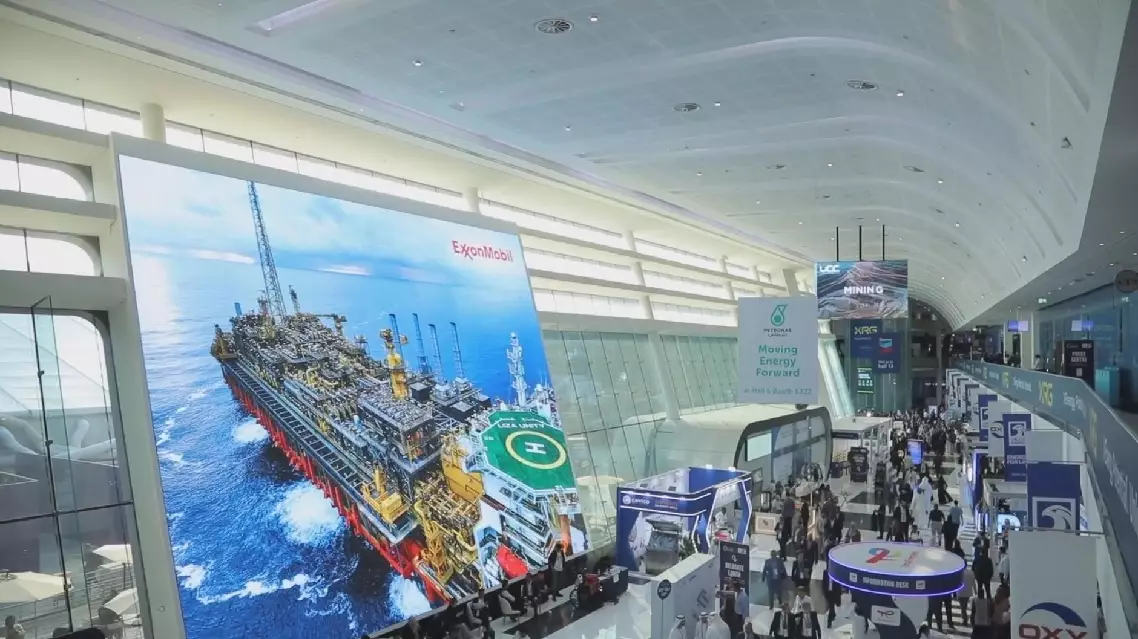
Gulf oil production and exports are gradually recovering from the Iran war, but experts at the Abu Dhabi International Petroleum Exhibition and Conference (ADIPEC) warned that the threat of renewed conflict continues to hang over energy markets, keeping prices elevated and pushing producers and consumers to prepare for further disruptions.
The four-day conference, which runs through Thursday in the UAE capital, has drawn energy companies, government representatives and experts from around the world. Beyond the showcase of the industry's latest technologies, this year's gathering has become an arena for debating how to protect supplies and cushion further price shocks.
The recovery itself remains incomplete, with figures cited at the event showing that oil and gas exports from the Gulf Cooperation Council (GCC) countries are running at about 80 percent of their pre-war volume of nearly 20 million barrels daily.
Even that partial rebound has done little to calm the market, and industry observers said the mere threat of resuming the war is creating deep anxieties, most visible in the price of physical cargoes.
"Each time there is some prospect of peace in the Middle East, you will see that the oil price kind of goes into retreat. If you look at futures in most obvious cases, it's four or five dollars up and down, up and down all the time. But it's the spot market where you really get the real temperature of what the market is feeling and there you still have a 20 to 25 dollar per barrel premium, so something like 130 dollars or 140 dollars in prices," said Gaurav Sharma, an energy market analyst.
To cope with the shock, producers and consumers alike have been forced to adapt. Saudi Arabia swiftly turned to its East-West Pipeline to move crude from the Persian Gulf to the Red Sea coast, while the UAE expanded the use of its pipeline to Fujairah and ship-to-ship transfers, both bypassing the most exposed shipping routes through the Strait of Hormuz. Consumers, for their part, have diversified their supply sources and turned to other tactics.
"We've seen a actually good response from consuming countries. China in particular has been incredible [in] how they've been able to flexibly deal with their imports, to deal with less oil coming from the Middle East. China itself reduced its imports by five million barrels a day, pretty much unprecedented. Nobody thought this was possible. There are tactics that have been very successful in finding other barrels. So if we have another disruption, we are confident that there will be barrels that we'll be able to find as a substitute for this," said Alex Schindelar, president of Energy Intelligence.
Yet for all that adaptability, the margin of safety remains thin. If the war on Iran were to reignite, the substitutes now within reach would come at a far steeper price in both cost and time.
"The problem for a lot of Asian importers is that historically, they’ve been importing crude oil from the Middle Eastern countries at very competitive prices. Then this oil shock happens and they have to look for diversity. They have to go elsewhere, including if I may say the United States. The average time for cargoes from Middle East to reach a major port, say Singapore or Hong Kong, is three to four weeks. For that same comparable cargo to come from the United States, it is three times the time [as long]," said Gaurav Sharma.
Experts warn renewed Middle East conflict could still rattle energy markets