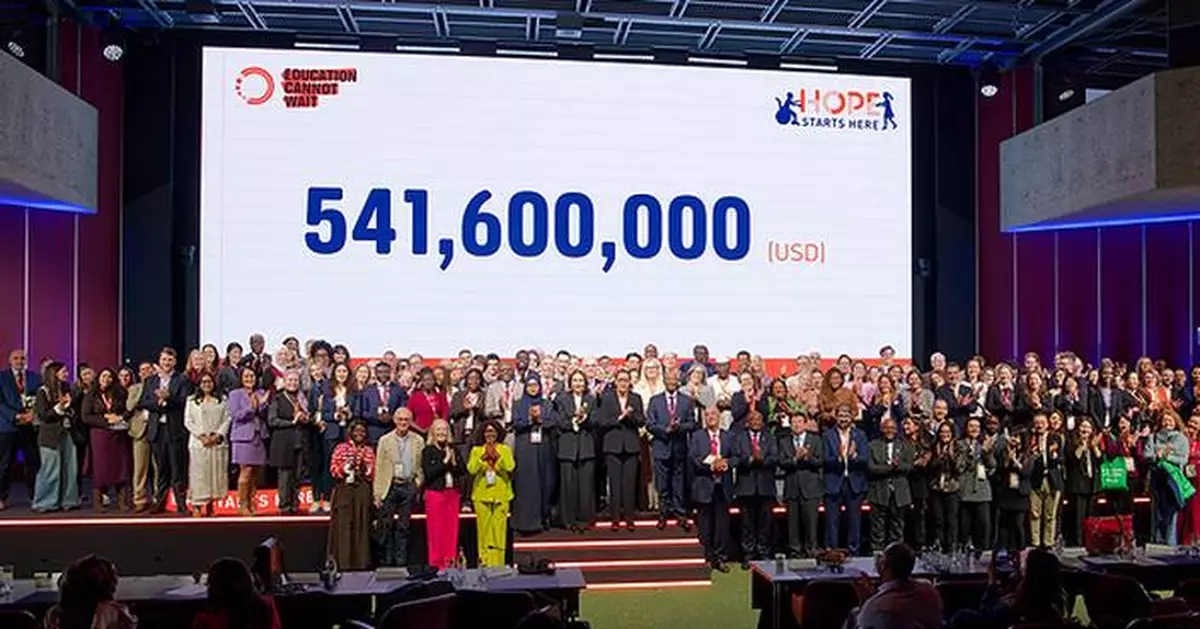
Governments announce US$ 405.8 million in new pledges at Geneva replenishment conference, bringing ECW to 90% of its funding target and opening new pathways for innovative partnerships to support education for crisis-affected children.
GENEVA, Nov. 6, 2026 /PRNewswire/ -- Governments and partners rallied behind the world's most vulnerable children today, announcing US$405.8 million in new pledges to Education Cannot Wait (ECW) at its High-Level Replenishment Conference, hosted by Switzerland in Geneva. Together with US$135.8 million in financial resources already secured through previous multi-year donor commitments, these pledges bring ECW's Hope Starts Here campaign total to US$541.6 million, reaching 90% of its US$600 million target.
ECW expressed its deep gratitude to all governments and partners that stepped forward with financial commitments, reaffirming their solidarity with children affected by conflict, displacement and climate-related disasters at a time of growing humanitarian needs and shrinking international aid budgets.
Germany, the United Kingdom, Norway, Canada, Switzerland, Ireland, EU, and Japan were among the governments whose commitments demonstrated continued international leadership and confidence in ECW's mission. Their collective support sends a powerful message: even in difficult times, the world cannot afford to turn its back on children's education.
The conference marked a defining moment in ECW's tenth anniversary year, renewing the commitment made when the Fund was established in 2016: that children living through crises must not be left behind.
Sigrid Kaag, Chair of ECW's High-Level Steering Group, said: "Education is a fundamental human right, even in times of conflict, displacement and disaster. Today's commitments are a powerful demonstration of international solidarity and a renewal of the promise we made ten years ago: that children caught in crises will not be left behind. That promise must now be translated into action."
Switzerland's leadership in hosting the conference reinforced the importance of collective responsibility and sustained international cooperation to protect children's right to education.
Ambassador Dominik Stillhart, Co-Chair of ECW's Executive Committee, said: "For more than a century, Geneva has been where the world comes together to address its toughest challenges, and one lesson stands out: education cannot be treated as an exception when crises strike. That is why Switzerland hosted this conference and pledged CHF 35 million to Education Cannot Wait for 2027 to 2030. But no country can do this alone. We need governments and partners to step up. Today, our partners chose to keep that promise funded."
Since its establishment, ECW and its partners have reached more than 16 million children in crisis-affected countries. Yet the scale of the challenge continues to grow, with an estimated 258 million school-aged children and adolescents affected by crises worldwide.
The commitments announced in Geneva provide a strong foundation for ECW's 2027–2030 Strategic Plan, which aims to reach 10 million children, half of them girls and including one million children with disabilities. The new strategy will strengthen ECW's ability to respond rapidly to emergencies while providing more sustained support in protracted crises, investing in quality learning, protection, inclusion and the resilience of national education systems.
The conference also signalled growing momentum to explore new approaches to financing education in emergencies. Partnership offers and initiatives involving Porticus, the International Finance Facility for Education (IFFEd), the Education Bridging Fund (EBF) and Swiss cantonal banks highlighted opportunities to complement traditional donor contributions by mobilizing development finance and private capital.
Discussions involving Enosis Capital, BNP Paribas and MetLife Investment Management also explored the potential of an education continuity outcome bond, currently under development, to mobilize investment for children affected by crises. These initiatives, at different stages of development and subject to further design and institutional approvals, could help ECW diversify its financing base and unlock additional resources in the years ahead.
Beyond financing, high-level discussions brought together governments and partners from crisis-affected countries to demonstrate the importance of national leadership, including the integration of refugee and displaced children into national education systems and the need for more predictable financing that connects humanitarian response with longer-term recovery.
For ECW, the Geneva conference represents a major milestone, but not the conclusion of the Hope Starts Here campaign. Building on the confidence and commitments demonstrated by partners, the Fund will now focus on translating this momentum into results for children.
Maysa Jalbout, Director of Education Cannot Wait, said: "Today, our partners have given us more than financial commitments. They have placed their confidence in ECW and entrusted us with an enormous responsibility. We are deeply grateful. But the true measure of today's success will not be how much we have raised. It will be the difference we make in children's lives. Our work starts now."
Looking ahead, ECW will focus on three priorities at the heart of its next strategic period.
First, ensuring that children are learning. Access to education remains essential, but it is not enough. ECW will place greater emphasis on quality learning, alongside children's safety, mental health and well-being, ensuring that investments deliver meaningful and measurable results.
Second, strengthening national and local leadership. ECW will work to bring decisions and resources closer to communities affected by crises, advancing its ambition to channel at least 50% of programme financing through national and local partners by 2030.
Third, broadening the coalition that finances education in emergencies. Government contributions will remain the backbone of ECW's work, complemented by stronger partnerships with philanthropy, businesses, development banks and investors to mobilize additional and more predictable financing.
With the replenishment target now within reach, ECW will continue engaging existing and prospective partners to close the remaining funding gap and build on the momentum generated in Geneva.
Ten years after its creation, ECW enters its next chapter with renewed confidence, an ambitious strategy and a strengthened coalition of partners united by a common commitment: no child should have to wait for a crisis to end before they can learn.
Notes to Editors
About Education Cannot Wait:
Education Cannot Wait (ECW) is the global fund for education in crises. The Fund provides rapid, flexible funding to locally-led education responses that protect learning for refugee, internally displaced and other children, while strengthening systems to sustain learning and resilience in fragile and conflict-affected contexts. ECW works with governments, public and private funders, UN agencies, civil society organisations, and other humanitarian and development aid actors so that no child is left behind.
As global crises intensify and the education financing gap widens, ECW calls on public and private sector partners to scale up investments so millions more crisis-affected girls and boys can learn and rebuild their futures.
Additional information available at: www.educationcannotwait.org
For press inquiries:
Rafik Elouerchefani: ecwcomms@un-ecw.org
** This press release is distributed by PR Newswire through automated distribution system, for which the client assumes full responsibility. **
Global solidarity delivers major boost to Education Cannot Wait as "Hope Starts Here" campaign approaches its US$600 million goal