OMITAMA, Japan (AP) — Defending champion Nasa Hataoka eagled the par-5 17th for a back-nine 30 and an 8-under 64 to take a one-stroke lead Friday after two rounds of the LPGA Tour's Toto Japan Classic.
Hataoka, who won in a playoff last year in a rain-shortened tournament, had a 36-hole total of 12-under 132 Friday.
Miyu Yamashita, who won last week's Maybank Championship in Malaysia, pulled her tee shot on the 18th fairway which resulted in her only bogey of the day to shoot 67 and was in second place.
Ana Belac, who became the first Slovenian player on the LPGA Tour in 2021, was tied for third after a 65 with Fuka Suga (67), two strokes behind.
Belac had eight birdies Friday and only earned her spot in the field when Ariya Jutanugarn withdrew on Monday with an undisclosed injury.
Hataoka, who has five top-10 finishes this season, grew up not far from the Taiheiyo Club Minori Course northeast of Tokyo.
“I don't have a chance to play in front of so many Japanese fans, so I was really happy to be playing so well today," Hataoka said through an interpreter.
The Japan Classic is the last of four tournaments on the LPGA's so-called late-season Asian swing.
Ruoning Yin made a four-foot birdie putt on the 16th hole and won the LPGA Shanghai by one stroke on Oct. 18 to start the swing. In the second tournament a week later in South Korea, Yuri Yoshida won at Pine Beach Golf Links, her first LPGA Tour victory.
See AP’s full golf coverage here

Miyu Yamashita of Japan reacts after tee off on the third hole during the first day of LPGA Maybank Championship in Kuala Lumpur, Malaysia, Thursday, Oct. 29, 2026. (AP Photo/Vincent Thian)

Nasa Hataoka of Japan hits her tee shot on the 2nd hole during the final round of the LPGA BMW Ladies Championship at the Pine Beach Golf Links, in Haenam, South Korea, Sunday, Oct. 25, 2026. (AP Photo/Lee Jin-man)
WELLINGTON, New Zealand (AP) — New Zealand’s election results will be announced Saturday after a tense campaign left the main contenders neck and neck with no clear route to victory for either, as voters evaluated three years of conservative rule.
Analysts don't expect a simple majority for either the governing coalition, led by the center-right National party, or the opposition bloc led by center-left Labour. The uncertainty may reflect voter discontent about both major parties as economic problems linger following international shocks that have buffeted New Zealand’s trade-based economy.
There's also growing support for politicians on the ideological flanks, a global trend that has gathered pace in New Zealand later than elsewhere. An unclear result could throw greater power to minor, more populist parties.
The National leader Christopher Luxon faces a tough fight for a second term as prime minister after facing two confidence votes among his own lawmakers this year. Meanwhile, Labour’s Chris Hipkins seeks a second chance at power after a resounding defeat three years ago.
Voting began Oct. 26 with results due for release after polling places close Saturday evening. New Zealand has a single house of government, and there are no states. The central government, elected for three-year terms, holds ultimate sway over the country’s direction.
Neither major party leader has managed to connect strongly with voters, analysts said.
Luxon’s party won the 2023 election on pledges to reverse New Zealand’s post-pandemic economic malaise. While he highlights trade deals signed during his tenure, economic recovery has been slow and unemployment reached an 11-year high in the September quarter.
New Zealand’s stubbornly steep costs of living send thousands of people each year to live in the country's larger, wealthier neighbor Australia.
“You’ve got an incumbent coalition government which is struggling with the same incumbency problems that we’re seeing in our Western democracies around the world,” said Ben Thomas, a former National government press secretary and now the director of a public affairs firm.
However, Hipkins and his Labour party, who are pledging to ease living costs and fund New Zealand’s struggling public healthcare system, haven’t surged in support either. Neither Labour nor National has recorded more than 30% of the vote in polls close to Nov. 7.
“I think there is a broader mistrust in the electorate of both of our traditional two major parties,” said Thomas.
That sentiment has been a windfall for smaller parties that Luxon or Hipkins would rely upon to form a governing coalition.
New Zealanders don’t elect prime ministers. Instead they cast two votes, one for their preferred party and one to select a local representative.
To govern, a coalition of parties must hold more than half of parliament’s seats. The total number of seats is determined by official calculations on election night based on quirks of the country’s vote.
National in 2023 joined with two right-wing parties, populist New Zealand First and libertarian ACT, to form the country’s most conservative modern government. Detractors of Luxon, a business executive who entered parliament in 2020, note his political inexperience compared to the leaders in his power-sharing deal.
In particular, the minor parties sought to repeal legal recognition of Indigenous Māori rights. About 100,000 people marched on Parliament to oppose one of the measures secured by ACT in its governing deal with Luxon.
The power that the smaller parties won from Luxon, said Bernard Hickey, an economic and political analyst, “created this surprise, I think, for many voters that the tail was wagging the dog for the first time. In fact, there were two tails wagging one dog.”
On Hipkins’ side, the left-wing Green party has also experienced strong support. Another traditional Labour coalition partner is Te Pati Māori, an Indigenous rights group.
Hipkins, a career politician, was thrust into the premiership nine months before the 2023 election when his predecessor Jacinda Ardern quit. Labour hasn't surged in popularity since losing that vote.
“Whoever is in government after November 7 … will have to reckon with much more assertive minor parties that want much greater concessions and much more influence than they’ve had in the past,” Thomas said.
Election deadlocks have previously seen the two blocs race to establish a coalition deal by wooing a minor party that holds the balance of power. Recent polls suggest Saturday’s election could yield such a result if The Opportunity Party is elected to Parliament for the first time.
The group's candidates are centrist, socially liberal technocrats who favor a land tax, universal basic income and pro-environment measures. The party’s new leader, 38-year-old Qiulae Wong, who has worked in business but not in politics, has pledged to negotiate first with whichever party wins the most votes if she holds the tiebreaker role.
Luxon has ruled out governing with Opportunity. Analysts say, however, that both major party leaders would likely answer the phone if Wong held the only path to power on election night.
A loss for a single-term government like Luxon’s would be unprecedented in modern times in a country where second terms are all but guaranteed. Voters in the South Pacific nation of 5 million people had before 2023 favored long alternating stretches of National and Labour-led governments.
That was seen as reflecting a largely contented public who believed the country was going in the right direction. The sentiment lingered in New Zealand long after countries such as the United States and Britain began to experience political fracture; but it swung sharply to a negative mood for the first time five years ago in the pandemic era as global tumult increased.
Thomas, the analyst, said that the public is “certainly more polarized than ever.”
Officials aim to release results on election night from 95% of votes cast. A final tally is due on Nov. 27.
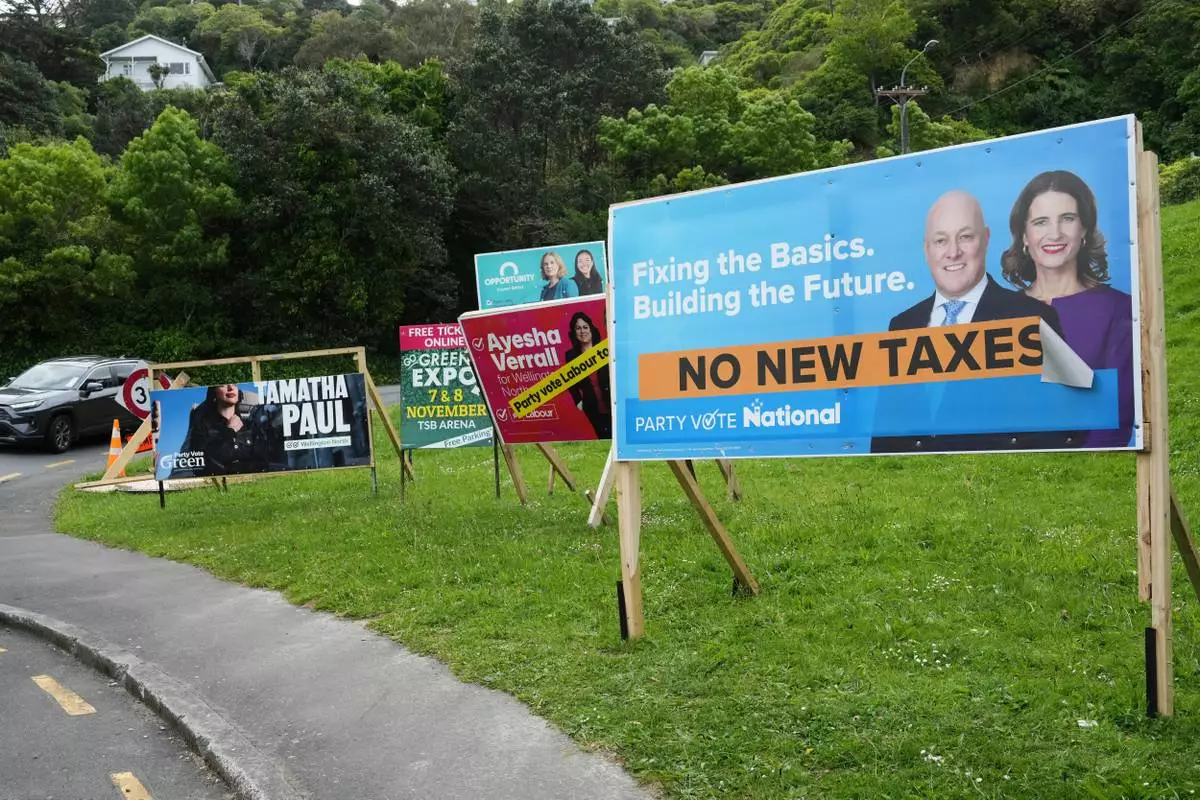
Political party billboards are seen in a suburb of Wellington, New Zealand, Saturday, Oct. 31, 2026. (AP Photo/Charlotte Graham-McLay)

The Opportunity Party leader Qiulae Wong poses for a portrait outside Parliament in Wellington, New Zealand, Friday, Oct. 30, 2026. (AP Photo/Charlotte Graham-McLay)
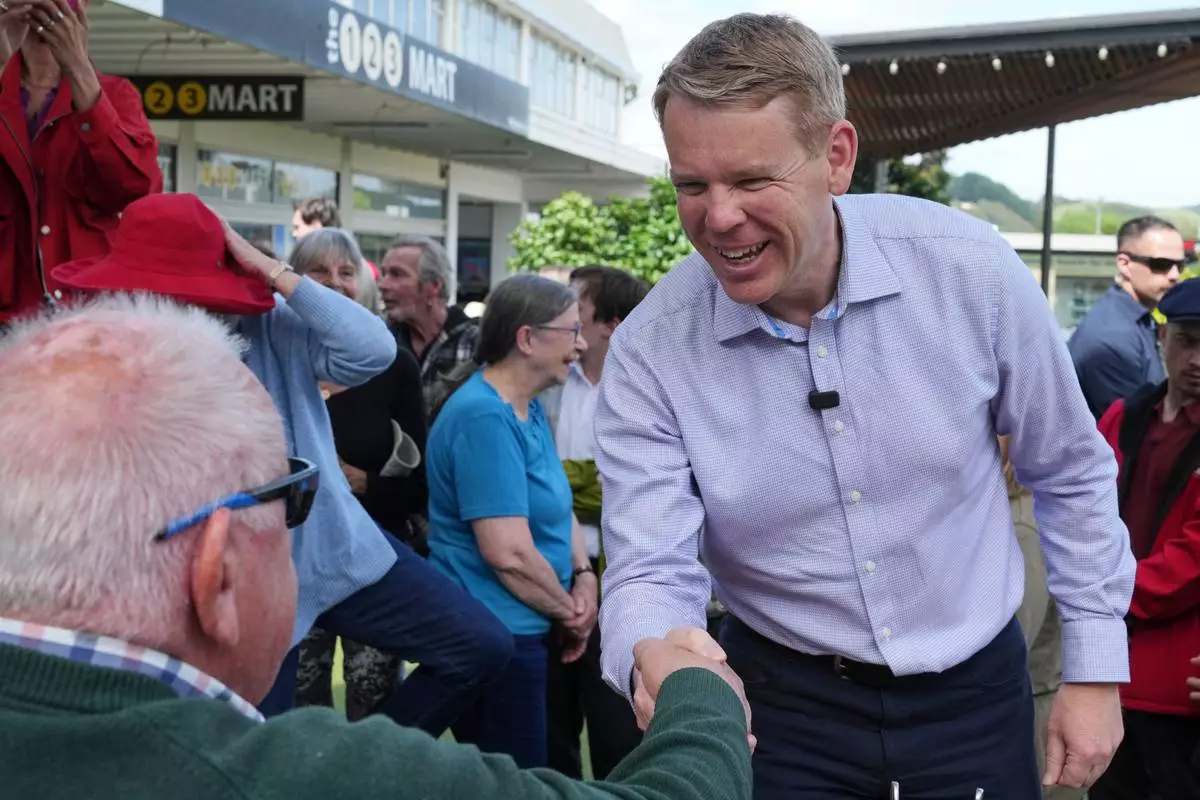
Labour Party leader Chris Hipkins shakes hands with a supporter at a shopping center while campaigning for election in Waikanae, New Zealand, Wednesday, Nov. 4, 2026. (AP Photo/Charlotte Graham-McLay)
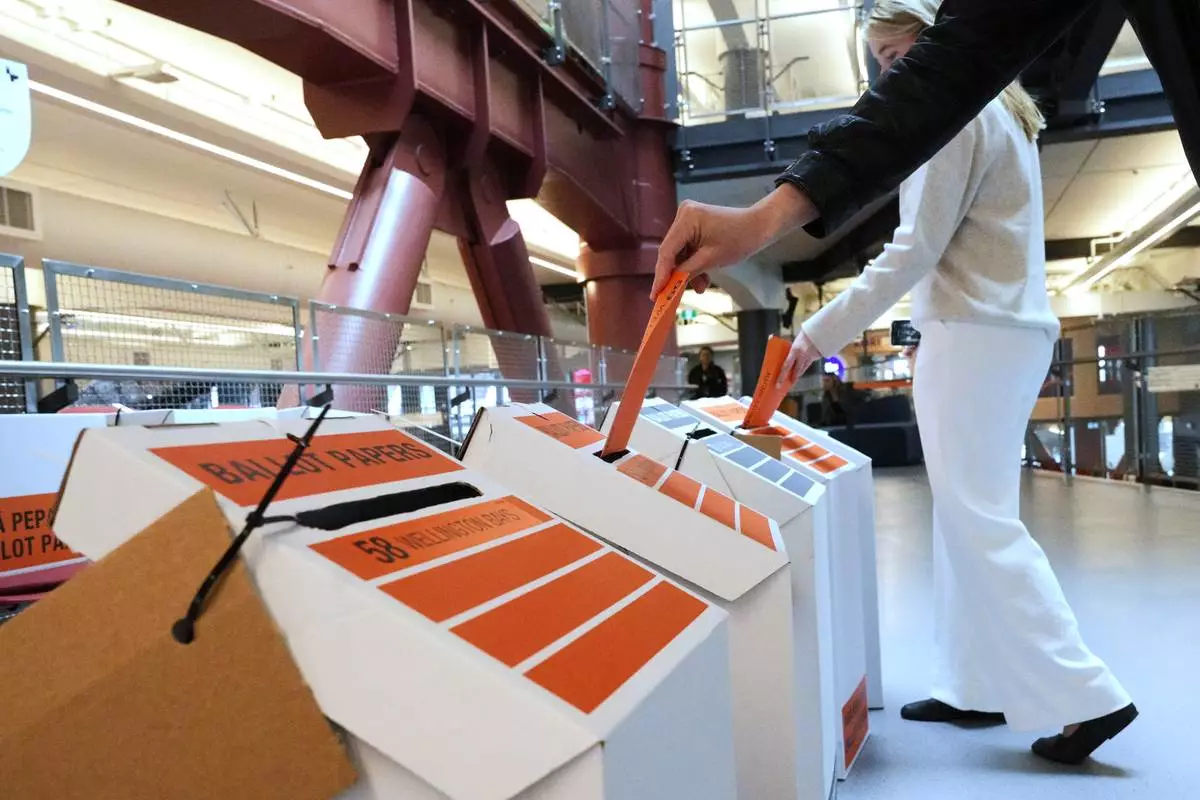
People place their voting papers in ballot boxes at a voting booth in Wellington, New Zealand, Monday, Nov. 2, 2026. (AP Photo/Charlotte Graham-McLay)