MUNICH--(BUSINESS WIRE)--Nov 6, 2026--
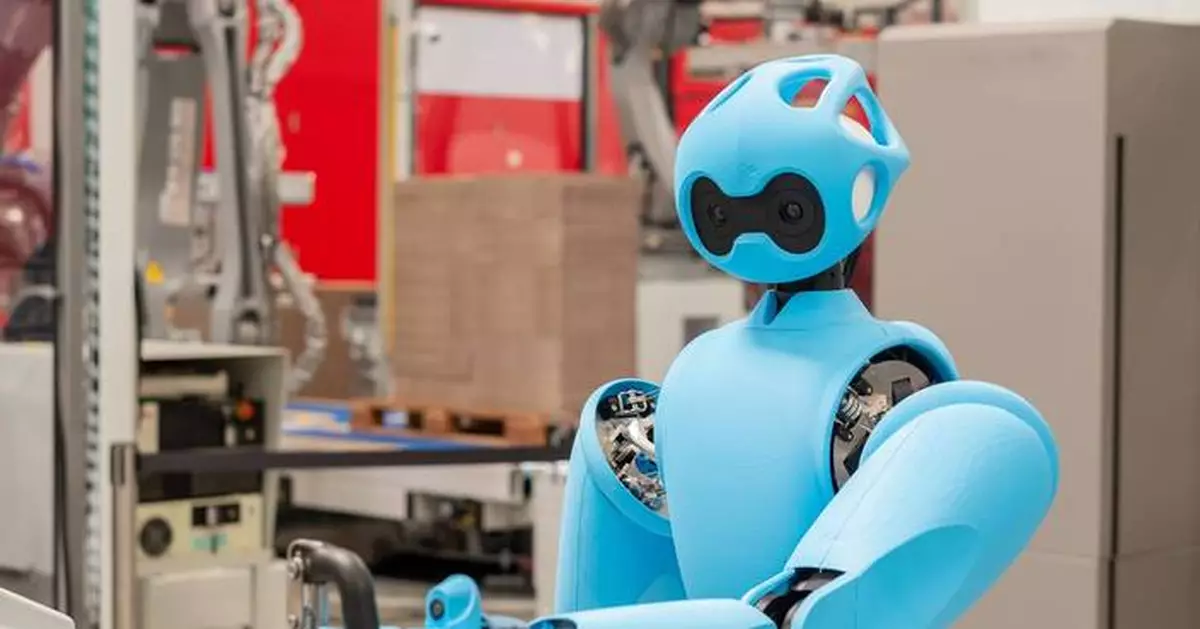
Swiss robotics company Embodied AI today unveils AIR at Humanoid Europe 2026, a humanoid robot built to share the factory floor with people. As many as 1.9 million US manufacturing jobs could go unfilled by 2033, according to Deloitte and The Manufacturing Institute. AIR takes on the repetitive manual tasks that change too often for conventional robots, so the people already on the line can focus on work that needs their skill.
This press release features multimedia. View the full release here: https://www.businesswire.com/news/home/20261106661068/en/
Embodied AI went from research to an industrial humanoid in 9 months, and signed contracts with major OEMs globally with just a fraction of the spending needed by other robotics companies to achieve this. AIR is now being tested with global manufacturers, and the company is starting plans for scaled production.
The market appetite is growing. Some 22% of manufacturers plan to use physical AI, such as humanoid robots, within two years, more than double today’s 9%, according to the Manufacturing Leadership Council. But Deloitte found that more than 80% of factory task hours are expected to stay human-driven. The opportunity is in helping those people, not replacing them.
Yet most humanoids today are still demonstrations, and most industrial robots are built for heavy-duty tasks, so they work behind cages, away from the people who know the job best. AIR is built to be safe and to complete the high-dexterity tasks that currently are still performed manually. It goes onto the factory floor as it is, next to the team already there.
AIR is designed with a tendon-driven architecture. Motors, gearboxes and electronics sit in its torso. Its arms are light and moved by tendons, so they carry almost no mass and give way on contact. It runs on wheels rather than legs, because factory floors are flat and wheels are more stable. Safety comes from how it is built, not from software holding it back. AIR is designed under ISO/TS 15066:2016 with CE marking planned for 2027.
To learn and guarantee factory uptime, AIR starts every job under the control of a human operator, so it is productive from its first shift. Every run is recorded, and Embodied AI’s own AI stack learns from those demonstrations until AIR can do the task itself, typically within a month. The operator then stays on hand to cover for anything it hasn’t seen before. What one robot learns, the next can use.
Embodied AI’s AI stack is already proven in paid factory deployments with its two-arm industrial cell. When a leading consumer electronics manufacturer tested five funded startups on a cable-handling task, none met its targets. Embodied AI met them all, reaching 98% reliability against a 90% goal.
“Hallucination of AI models is acceptable in the digital space because humans review, reject, or correct the output before acting on it. In robotics, however, incorrect actions have immediate and irreversible physical consequences. When AI is used to taking physical actions, errors can cause severe damage or endanger human lives. Safety and reliability are non-negotiable requirements of physical AI to enter the real world at scale. These are the principles that guided the design of AIR,” said Francesco Stella, co-founder and CEO of Embodied AI.
AIR’s arm design grew out of Stella’s PhD at EPFL, the Swiss Federal Institute of Technology in Lausanne and one of Europe’s leading technical universities. Stella, 28, previously also researched at MIT CSAIL. He co-founded the company with CTO Kai Junge and COO Max Polzin, both robotics PhDs with backgrounds at Cambridge, ETH Zurich and EPFL.
The company is backed by Faber, which led its first round, along with TechShop, Look AI Ventures, Plug and Play, and Vento.
Embodied AI will unveil AIR at Humanoid Europe 2026 on November 6 at 16.00 CET.
About Embodied AI
Embodied AI is a Swiss robotics company and EPFL spin-out building robots safe enough to work beside people. Its technology combines compliant hardware, onsite learning and AI trained on real manufacturing data. It is headquartered in Lausanne with an office in Rome. www.embodiedai.ch
Notes to editors:
Sources
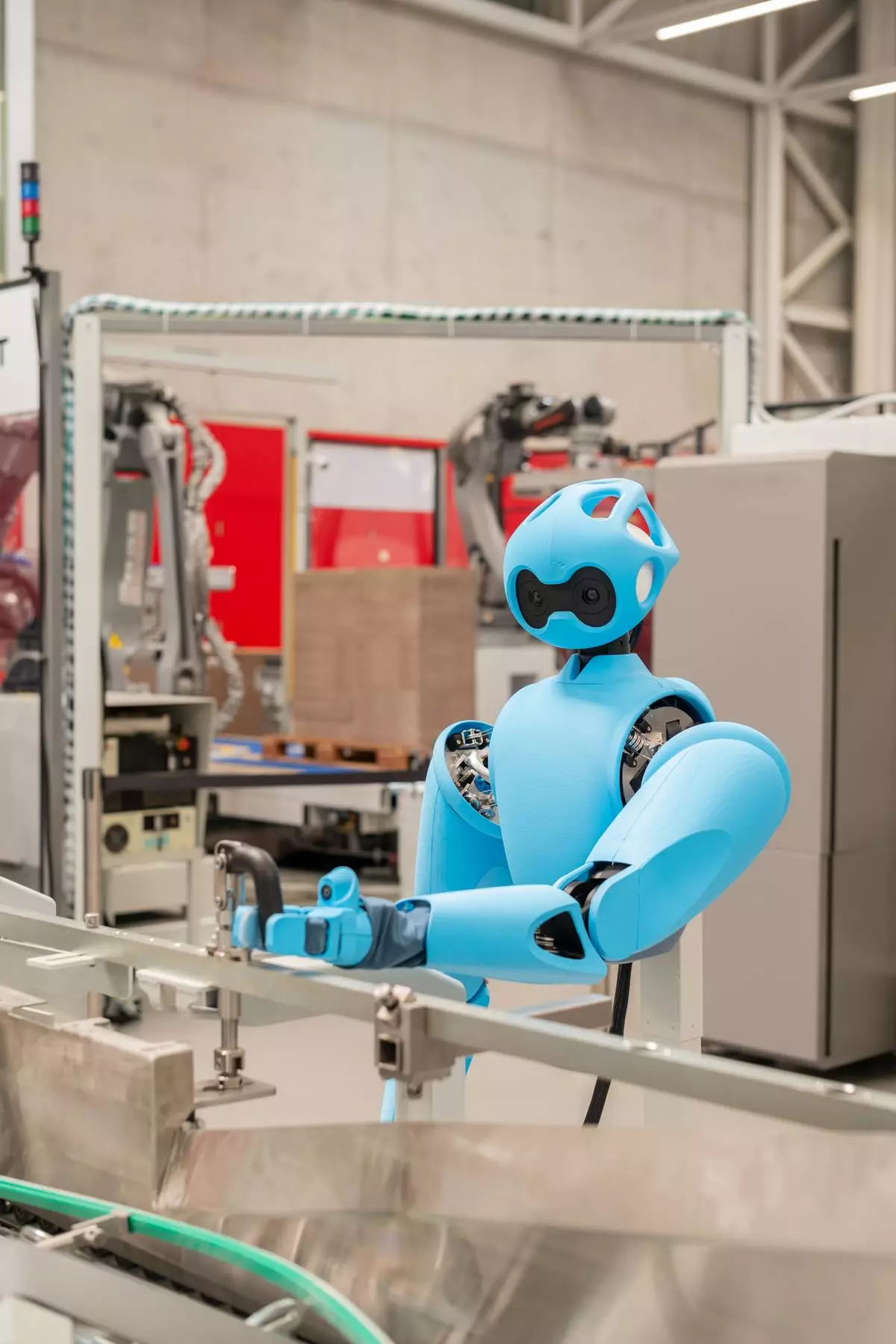
AIR, a physically safe humanoid robot that learns on the job, from Embodied AI
ROME (AP) — Pope Leo XIV is kicking off a three-nation tour of Latin America on Friday with a visit to Uruguay, the region’s least Catholic and most secular country, three weeks after undergoing lung cancer surgery that had put the entire trip into question.
Leo is due to arrive in Montevideo after a 13½-hour flight from Rome. He has a packed three-day itinerary in Uruguay including a visit to a neighborhood plagued by gang violence, a Mass in Paysandú, around 375 kilometers (230 miles) from the capital, and another Mass in the city of Florida, about 100 kilometers (60 miles) away from Montevideo.
The Uruguay leg is the first stop on what will be the longest and farthest trip of his pontificate, all being undertaken as the 71-year-old pope continues his recovery. The trip will also bring him to neighboring Argentina and finally back home to Peru, where Leo served as a missionary priest and bishop for two decades.
“His stamina is fantastic. The way that he's singing is incredible. And you can only sing if your lungs are really strong,” said María Montserrat Alvarado, the Vatican's new communications chief. She noted that Leo has passed the 14-day convalescence period required by doctors after his Oct. 13 surgery and is eager to get on the road.
“His doctors are very confident and he'll have plenty of medical care on board should something happen, but we don't see that in his prognosis or even in the way that he's acting,” she said.
In Uruguay, which hasn’t had a papal visit since 1988, Leo is expected to try to remind the 3.5 million people of their strong Catholic heritage stemming from the times of Spanish colonial rule. He's likely to propose the faith anew as an answer to today’s challenges and problems.
Upon arrival, Leo will meet with President Yamandú Orsi, leader of the center-left alliance that assumed power in Uruguay in March 2025, and then deliver his welcome address to government officials and diplomats. He finishes the long day with a vespers service at the city's cathedral.
Leo will find in Uruguay a country unlike any other in Latin America, which is home to around 40% of the world's 1.4 billion Catholics. Uruguay is considered the most secular country in the region, where only a fraction of people who identify as Catholic actually go to Mass regularly.
Uruguay was the first country in the world to legalize marijuana for recreational use, the second country in Latin America to decriminalize abortion, and the third country in the Americas to legalize same-sex marriage.
More recently, it became the first country in the region to approve assisted dying legislation despite the strong opposition of the Catholic Church, evidence of Uruguay’s entrenched, church-state separation that prohibits any mention of God in oaths of office.
Leo is expected to recall the church's opposition to abortion and euthanasia as part of his broader argument about upholding human dignity in all phases of life.
Uruguayan church officials have marveled at the apparent enthusiasm that the visit has provoked, with reports that tickets to Leo’s prayer vigil at Montevideo’s Centenario Stadium were snapped up after two days.
“It seems that the pope’s presence is shifting something here and is gradually breaking down this veil that has always sought to obscure and diminish the presence of the Catholic tradition that lies at the country’s foundation,” said Guzmán Carriquiry, the Uruguayan former head of the Vatican’s pontifical commission for Latin America.
“I believe this pope will stir up questions in the hearts of Uruguayans — disturbing questions — questions about meaning and, we hope, questions about faith,” he said.
Carriquiry said that he expects Leo will seek to revive the Catholic roots of Uruguay, especially when he travels to the city of Florida on Sunday to mark an important Catholic feast day.
The Nov. 8 feast commemorates the Virgin of the Thirty-three, a small wooden icon of the Virgin Mary that is intricately connected to Uruguay’s independence movement. According to tradition, 33 independence patriots acquired the Guaraní statue and had it with them when independence was declared from the Brazilian empire in Florida on Aug. 25, 1825.
“So the number 33 is an ecclesiastical symbol, a national symbol,” said Carriquiry, who was also Uruguay’s ambassador to the Holy See. “And so the pope will speak there about the Catholic tradition that lies at the origin of Uruguay — that stems from Uruguay and gave rise to Uruguay — in order to revive and renew the Catholic tradition in the hearts of Uruguayans.”
Andrew Chesnut, chair of Catholic studies and an expert in the Latin American church at Virginia Commonwealth University, said that he wasn’t surprised that Leo’s visit had generated enthusiasm and that he will be welcomed warmly.
“But that’s not necessarily going to translate into folks in the pews,” he said. “If the overarching goal is trying to revitalize Catholicism in the most Catholic region on Earth, Uruguay is kind of a lost cause, and it has been for decades.”
Associated Press religion coverage receives support through the AP’s collaboration with The Conversation US, with funding from Lilly Endowment Inc. The AP is solely responsible for this content.
This story has been corrected to show that the last name of the Vatican’s new communications chief is Alvarado, not Alvar.
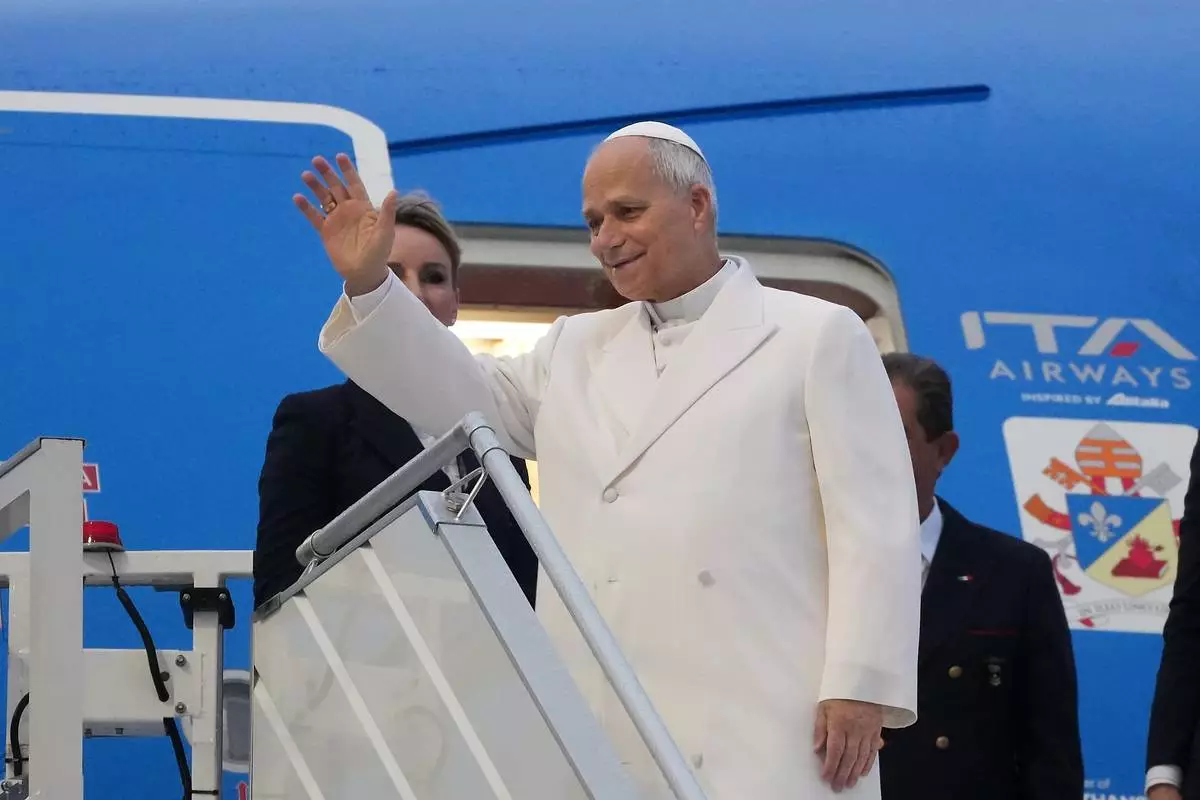
Pope Leo XIV departs from Rome's Leonardo da Vinci International Airport in Fiumicino, near Rome, for Montevideo, Uruguay, at the start of his twelve-day apostolic journey to South America, Friday, Nov. 6, 2026. (AP Photo/Gregorio Borgia)
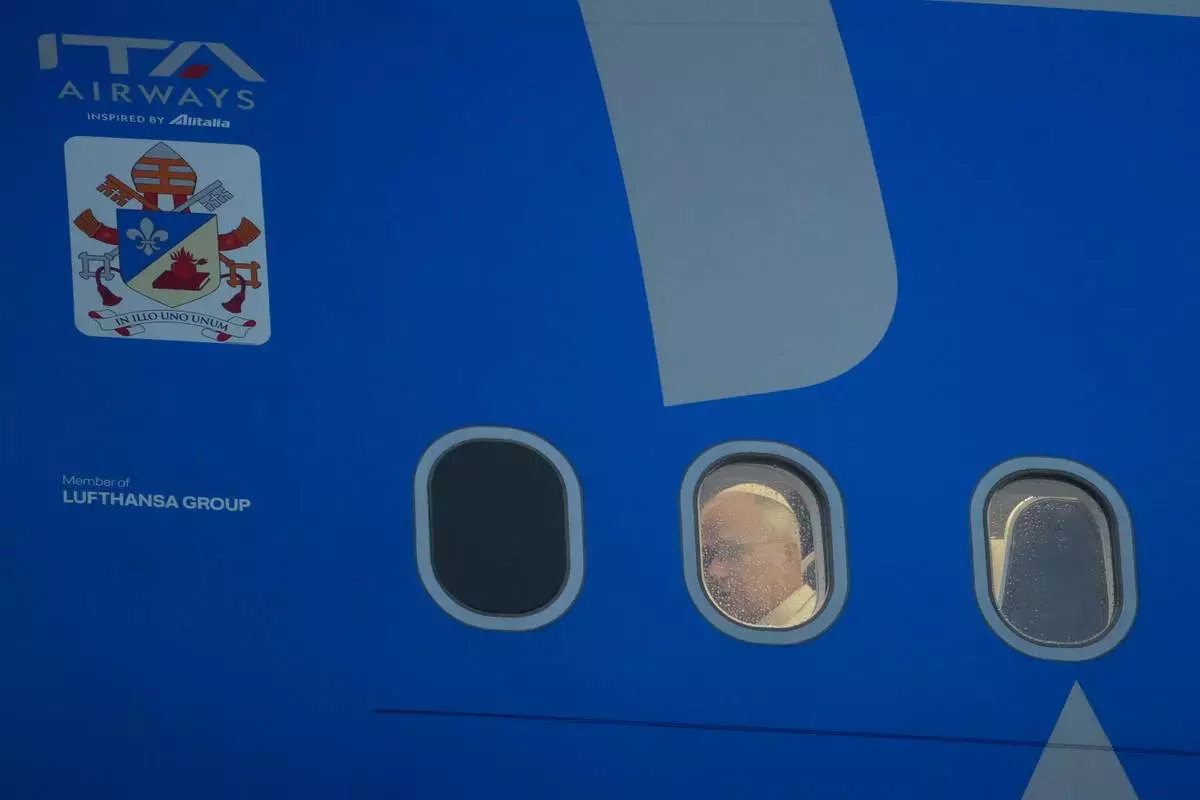
Pope Leo XIV departs from Rome's Leonardo da Vinci International Airport in Fiumicino, near Rome, for Montevideo, Uruguay, at the start of his twelve-day apostolic journey to South America, Friday, Nov. 6, 2026. (AP Photo/Gregorio Borgia)
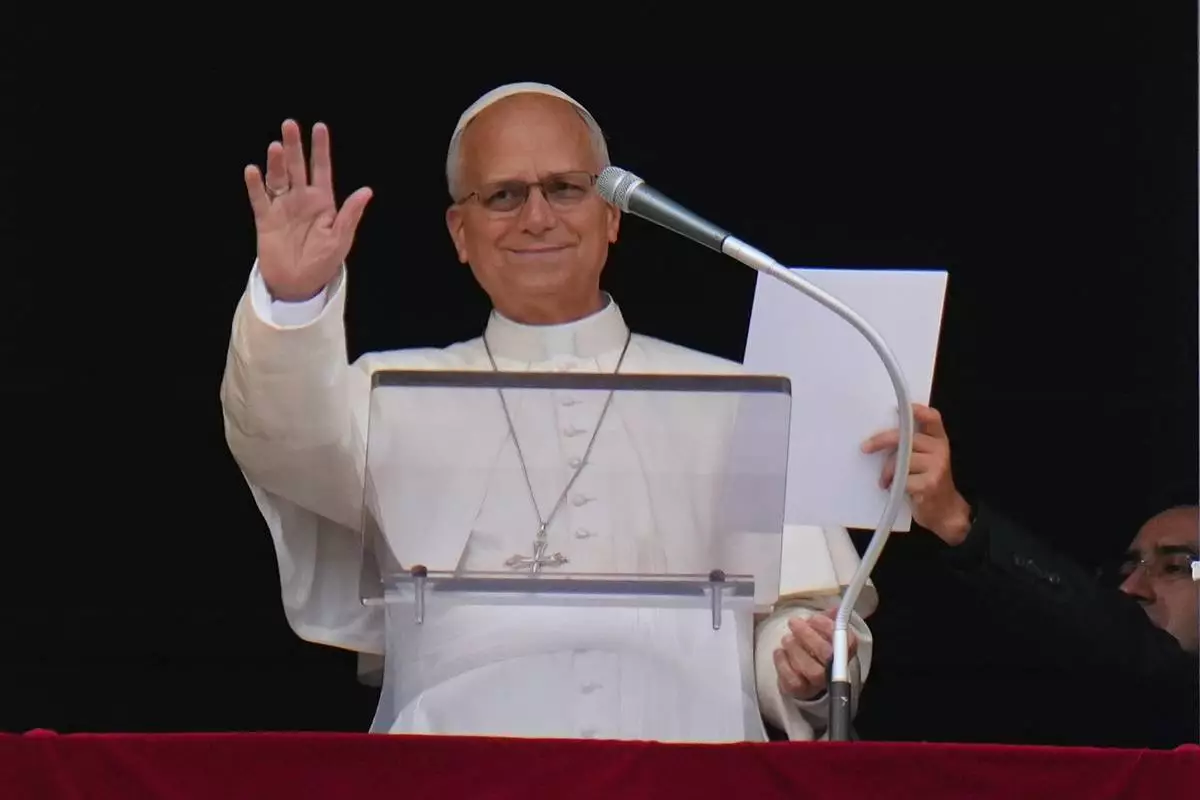
Pope Leo XIV appears at the window of the Apostolic Palace overlooking St. Peter's Square at the Vatican for the Angelus noon prayer on All Saints' Day, a feast celebrated across much of the Christian world, Sunday, Nov. 1, 2026. (AP Photo/Alessandra Tarantino)
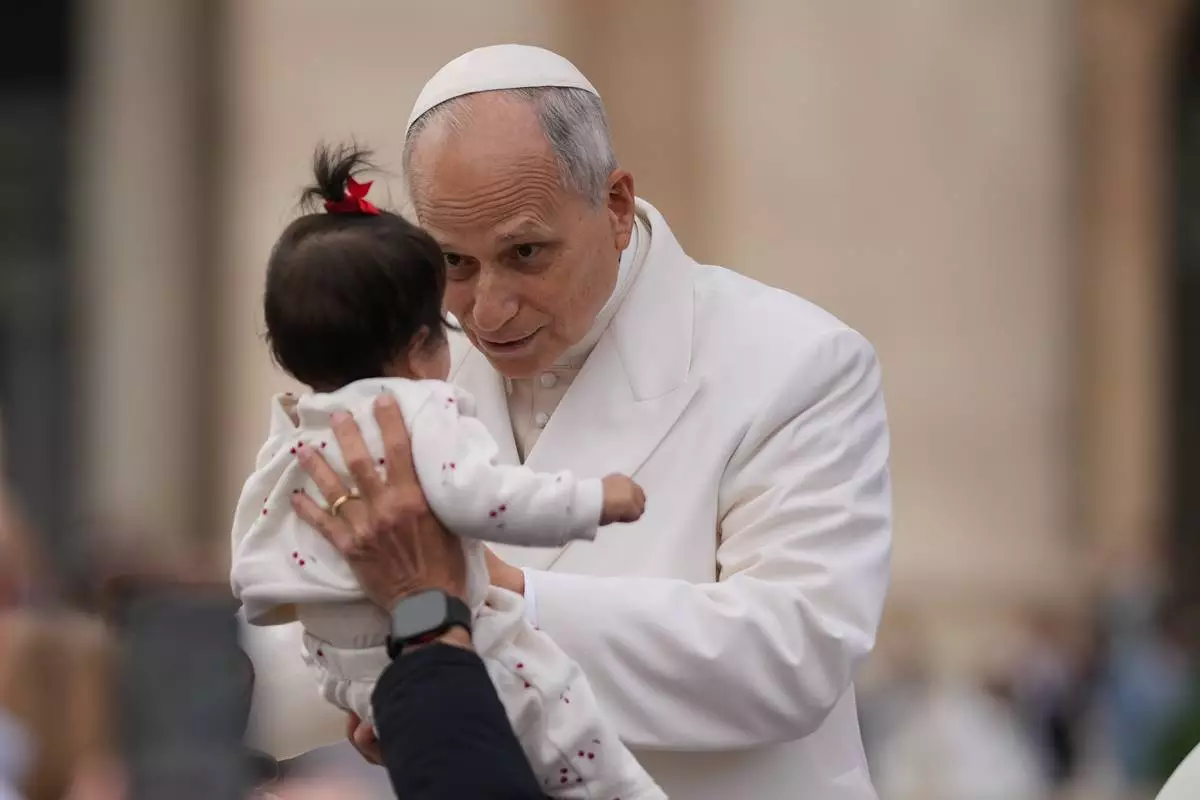
Pope Leo XIV blesses a new born after his weekly general audience in St. Peter's Square at The Vatican, Wednesday, Nov. 4, 2026. (AP Photo/Andrew Medichini)
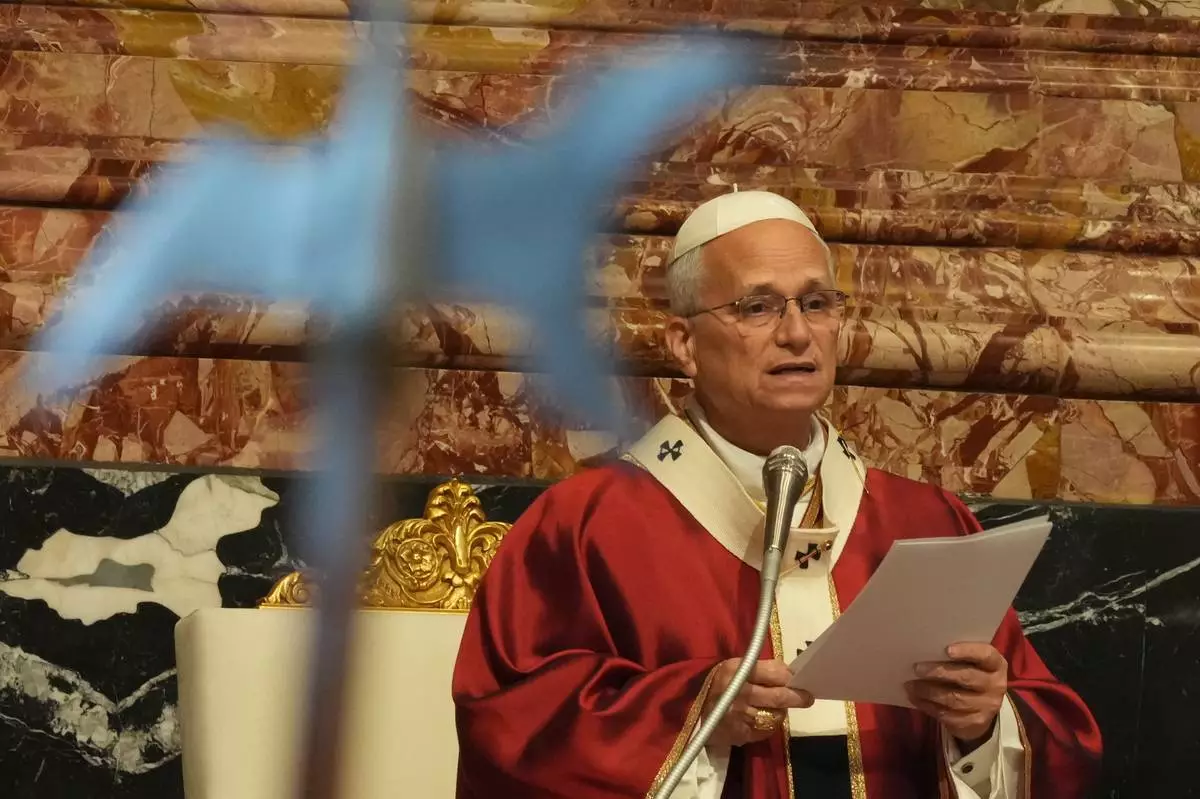
Pope Leo XIV celebrates a mass in memory of cardinals and bishops who died during the past year, in St. Peter's Basilica, at the Vatican, Thursday, Nov. 5, 2026. (AP Photo/Andrew Medichini)
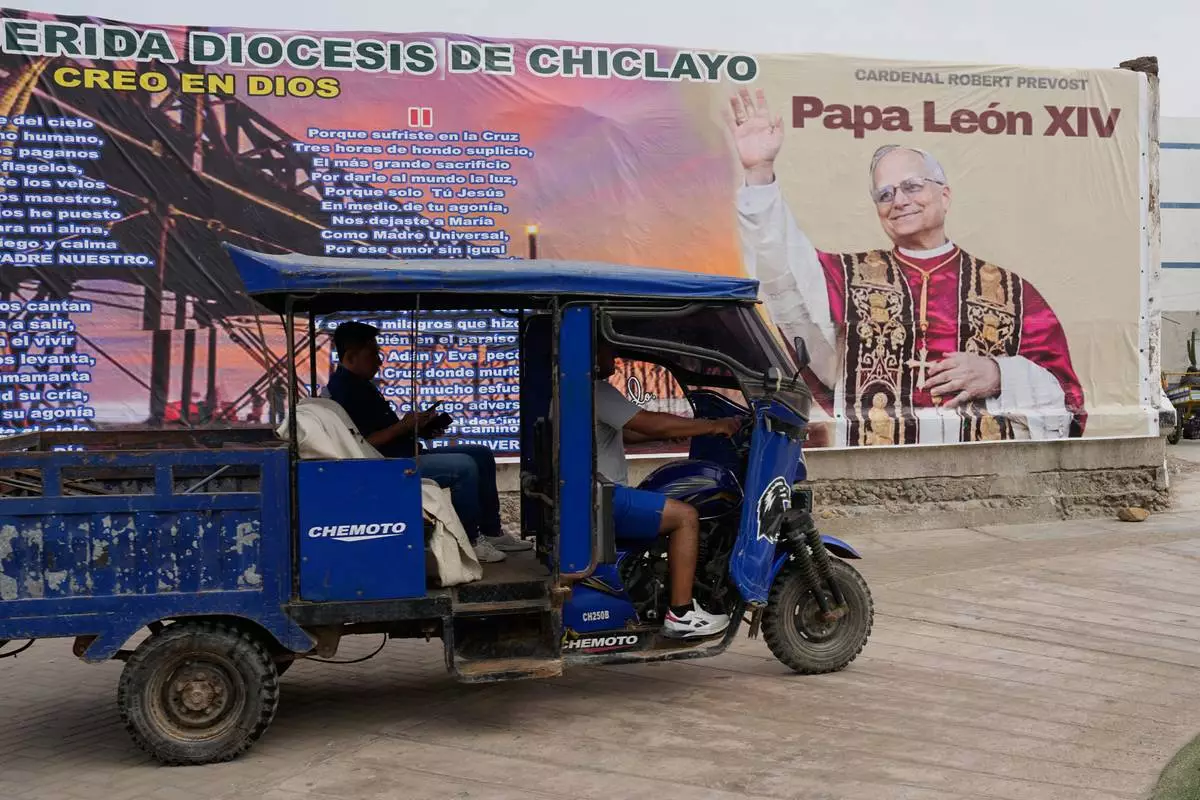
A mototaxi pass drives past a banner of Pope Leo XIV at Pimentel beach in Chiclayo, Peru, Thursday, Nov. 5, 2026, ahead of his planned trip to Uruguay, Argentina, and Peru from November 6 to 17. (AP Photo/Martin Mejia)