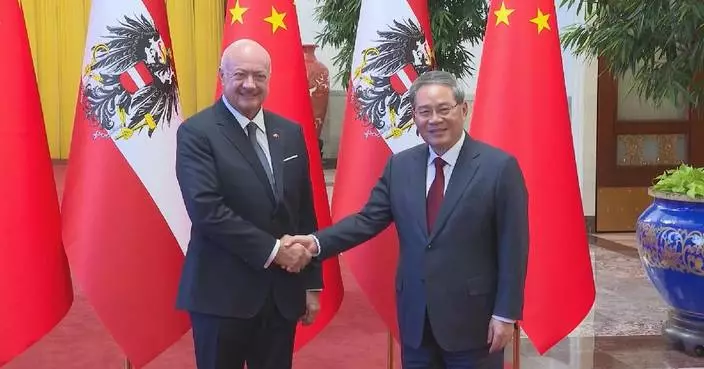
Chinese Premier Li Qiang held talks in Beijing on Friday with Austrian Chancellor Christian Stocker, who is on an official visit to China.
As supporters and beneficiaries of multilateralism and free trade, China and Austria should resolutely advance open cooperation to galvanize their respective development and inject positive energy into the world economy, Li said.
China is willing to strengthen dialogue and communication with Austria, respect each other's core interests and major concerns, expand all-round cooperation, and bring more tangible benefits to the people of both countries, Li added.
He said China stands ready to share more market opportunities with Austria, import more high-quality Austrian goods, and foster the expansion and upgrading of bilateral trade.
The premier also called on both sides to expand cooperation in areas such as new energy, artificial intelligence, digital economy and advanced manufacturing.
China supports more Chinese enterprises investing in Austria, and hopes Austria will provide them with a fair, just and non-discriminatory business environment, Li said.
Both sides should strengthen exchanges and cooperation in such fields as culture, tourism and education, strengthen two-way personnel exchanges, and constantly enhance mutual understanding and friendship, he said.
It is hoped that Austria, as a member state of the European Union, will continue to play an active role in promoting the European side to adhere to a rational and pragmatic policy towards China, Li said, adding China is willing to enhance cooperation with Austria in multilateral fields such as the United Nations (UN) to jointly promote world peace and prosperity.
Stocker said Austria is committed to promoting the friendly strategic partnership between the two countries and is willing to enhance mutual understanding with China, deepen practical cooperation in fields such as economy and trade, artificial intelligence and tourism, and strengthen communication and coordination on multilateral affairs.
Austria advocates stronger dialogue and consultation in a spirit of mutual trust, and is willing to make positive efforts to advance EU-China relationship, Stocker added.
After their talks, the two leaders witnessed the signing of documents on cooperation in economy and trade, social security and other areas.

Chinese premier holds talks with Austrian chancellor
A China-led international standard on brain-computer interfaces (BCIs) reference architecture has been officially released, marking another major achievement for the country in international BCI standardization, according to the Standardization Administration of China (SAC) on Friday.
The first international standard in the BCI field led by China, on BCI terminology, was officially released last year.
The standard, published by the International Organization for Standardization and the International Electrotechnical Commission, addresses four core questions, namely what a BCI is, how it is used, what functions it has and how it can be implemented. It sorts out typical implementation models and builds a complete technical framework covering concepts, applications, functions and implementation.
It was drafted under the leadership of Chinese experts, together with experts from countries including Italy, the Republic of Korea, Britain, India and the United States.
"People's definition of brain-computer interfaces has also been evolving. In the early days, it was mainly about reading out intentions. After two or three decades of development, it is no longer just reading out. Simply put, it reads out signals, interprets them, and then regulates, intervenes in and influences them, forming a closed loop of reading and writing signals," said Pan Gang, one of the drafters of the international standard.
The standard groups the uses of BCIs into five categories. The first is real-time sensing of brain states such as attention, fatigue and cognitive load, which can be used for safety warnings in settings such as industrial operations.
"For patients with severe physical injuries or who cannot communicate, we use brain-computer interfaces to connect with external robots, including externally controlled wheelchairs, to carry out daily functions such as typing and drinking water," said Yu Yuntao, chair of the standardization technical subcommittee on BCIs.
BCIs can also be combined with rehabilitation robots and similar devices for neurorehabilitation training, helping patients with spinal cord injuries or strokes regain motor function. Through methods such as neurofeedback, they can help healthy people regulate attention and train cognition, improving or extending their existing abilities.
Combined with eye movement, voice, gestures and muscle signals, BCIs can also enable more accurate and flexible multimodal human-machine interaction.

China-led global standard sets framework for brain-computer interfaces