BERLIN (AP) — Germany's government wants to keep the men's hockey world championships in the country “as planned” after the reinstatement of Russia last week caused nearly half of the 16 teams to threaten a boycott.
The German hockey federation has hinted it could give up hosting rights for the event in Duesseldorf and Mannheim in May rather than deal with uncertainty over extra security and higher costs.
Seven European nations' hockey federations, including those in Finland and Sweden — though not Germany — have said they will compete in the championships but will boycott games against Russia.
“It needs to be our aim to hold the tournaments as planned,” German government spokesperson Stefan Kornelius said Friday. “That would, however, not in fact be possible given the boycotts if Russia is to participate. Therefore we now want to explore options through discussions to enable us to still have the tournament take place.”
Russia had been excluded from International Ice Hockey Federation events since its invasion of Ukraine in 2022. A Court of Arbitration for Sport ruling last week compelled the IIHF to let Russia back in.
Besides the boycott plans, the IIHF has come under pressure from major sponsors threatening to end their agreements or refuse to have their logos displayed if Russia plays.
Russia has said it expects to be awarded wins by forfeit if other countries refuse to play. The Russian Foreign Ministry has also criticized the Canadian government's plans to exclude Russia from the world junior championship there starting next month.
The women’s world championship starting Friday in Denmark has not been affected by the CAS ruling and is going ahead without Russia.
Canadian Prime Minister Mark Carney received the backing of Wayne Gretzky in his decision to bar Russians from competing at the world junior tournament in Alberta.
"Nobody likes war, right?" Gretzky said, speaking in Toronto on Friday. “We definitely don’t want to see this. We hope it ends. We wish it didn’t start. I understand the stance the prime minister is taking, and good for him.”
Gretzky is the NHL's all-time points leader. From Brantford, Ontario, his family's lineage has roots to present-day Ukraine, Belarus and Poland.
“He's made that stance, and he's made it clear,” Gretzky said in reference to Carney. “I think a lot of the players and the people of Canada feel the same way.”
See AP’s full sports coverage here

FILE - Germany's Leon Gawanke, right, celebrates with the team after scoring the sixth goal during the 2026 IIHF Men's Ice Hockey World Championship preliminary round group A game between Germany and Hungary, in Zurich, Switzerland, Friday, May 22, 2026. (Claudio Thoma/Keystone via AP, file)
NEW YORK (AP) — Tesla’s Cybertruck, the hulking, stainless-steel pickup that inspired devotion and derision with its science-fiction looks, will cease production next year.
CEO Elon Musk announced the model’s demise Friday with a curt post on X, his social media site, simply noting production of the vehicle “will be winding down” around the middle of 2027 at its facility outside Austin, Texas. Musk said the move was to allow increased production of its Cybercab robotaxi.
For the Cybertruck, a pet project of Musk who insisted it was Tesla’s best product, it marks an unceremonious end to one of the auto industry’s most ballyhooed debuts.
“Few vehicles in history have generated as much attention,” said Armen Hareyan, whose Torque News site covers autos. “The Cybertruck became a cultural symbol – loved, mocked and impossible to ignore.”
The Cybertruck rolled onto the scene in a dramatic unveiling in 2019, when a Tesla designer hurled a metal ball at the vehicle to demonstrate its supposedly unbreakable glass, only to see it shatter. He repeated the stunt on another window of the truck only to shatter that one, too.
Even as some critics scoffed, Musk was steadfast.
“I just wanted to make a futuristic battle tank — something that looks like it could come out of ‘Blade Runner’ or ‘Aliens’ or something like that but was also highly functional,” he told Automotive News. He called it “a better sports car than a Porsche 911” and “a better truck than an F-150.”
It struck some as the perfect vehicular reflection of the brash, convention-busting Musk.
“A really controversial vehicle unveiled by a controversial individual into a market where none of the electric trucks have been able to really capture demand,” said Spencer Penn, a former Tesla executive who left the company before the Cybertruck’s launch and now heads procurement software firm LightSource.
Penn remembered watching the unveiling and feeling initially revolted by the sight of the Cybertruck, calling its appearance “madness.” But the more he looked at it, the more his opinion changed. He signed up for a pre-sale reservation, though ended up not getting a Cybertruck when Musk’s promises of a price tag under $40,000 went unmet and the first trucks sold for double or more. Penn called the Cybertruck part of Tesla’s adventurous spirit that drives innovation.
“Some of these bets work and some of these bets don’t,” he said.
While the decision to end Cybertruck production may be driven by sales realities, it's also a reflection of Tesla’s shift to autonomous vehicles, on which Musk is betting the company’s future.
Musk once forecast he’d make 250,000 Cybertrucks a year. Kelley Blue Book estimated Tesla sold just 20,237 of the vehicles last year, down about half from the year prior. Sales through the end of September this year were down another 28%, according to Kelley Blue Book.
If the imposing, sharp-angled, dystopian appearance of the Cybertruck weren’t enough to turn many potential buyers away, Musk did so himself by allying with a panoply of right-wing figures, most notably U.S. President Donald Trump. He alienated some customers as his image morphed from eccentric innovator to polarizing force trading his billions for political influence.
Once-passionate Tesla drivers rushed to sell off their cars, or slapped stickers on the bumper declaring, “I bought this before Elon went crazy.” Organizers staged demonstrations outside Tesla showrooms and urged investors to dump shares of the company’s stock. Anger spilled into violence, with Molotov cocktails hurled at Tesla vehicles, charging stations set ablaze, and dealerships covered in graffiti.
Lovers of the Cybertruck became targets, too, subjected to shouts of “Nazi!” and extended middle fingers.
Ross Blankenship is one of them. When he first laid eyes on the Cybertruck, he felt transported to a world from his childhood, when he would play “Halo,” the sci-fi video game. He had to have it.
“I had that sort of child in me wanting to be part of something cool that would change the future of automotive,” Blankenship said in a call from his Cybertruck as he drove through Sunnyside, Colorado. Even as Blankenship found he agreed with Musk on politics, he hated seeing a vehicle he loved turned into a political symbol. “I never bought it for any other reason than the fascination with the future technology of trucks … so that was a little heartbreaking.”
He would buy another Cybertruck again in a heartbeat, calling its end “a sad moment.”
Matt Sedensky can be reached at msedensky@ap.org and https://x.com/sedensky
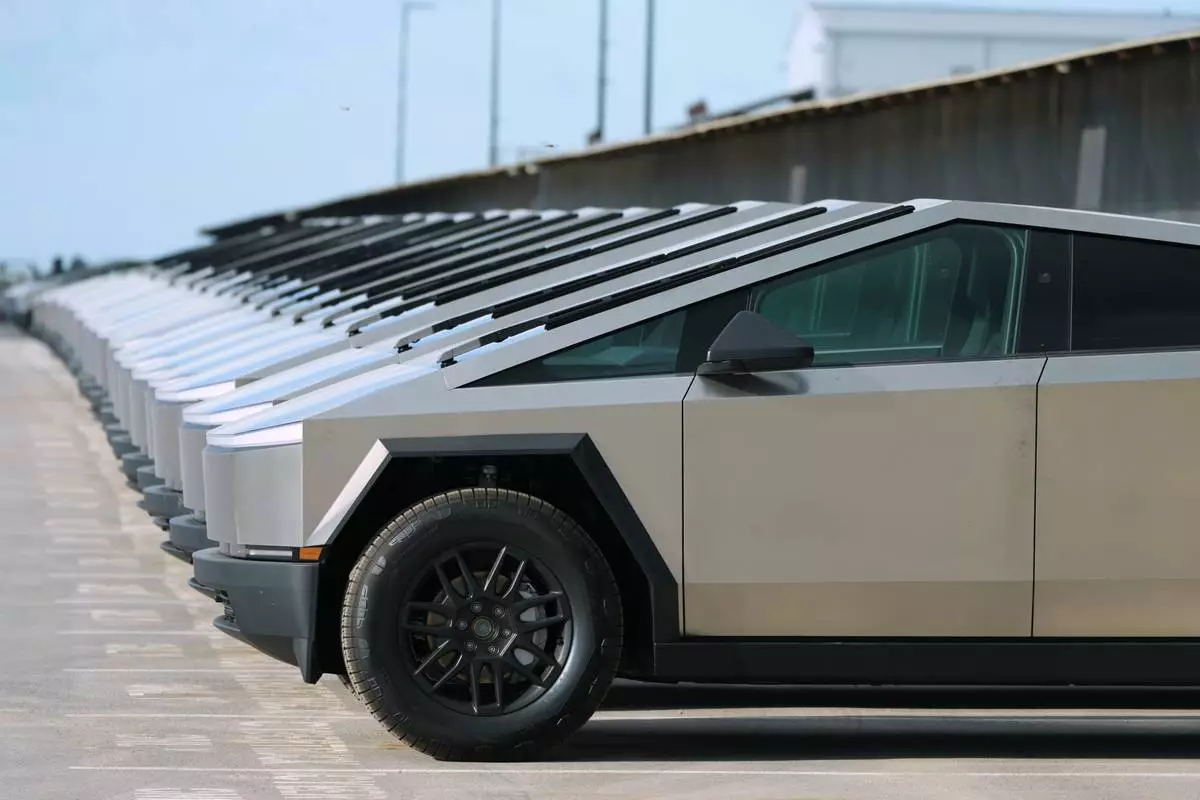
FILE - New Tesla Cybertrucks are seen at SpaceX's Starship facility in Starbase, Texas, Monday, Oct. 13, 2025. (AP Photo/Eric Gay, File)