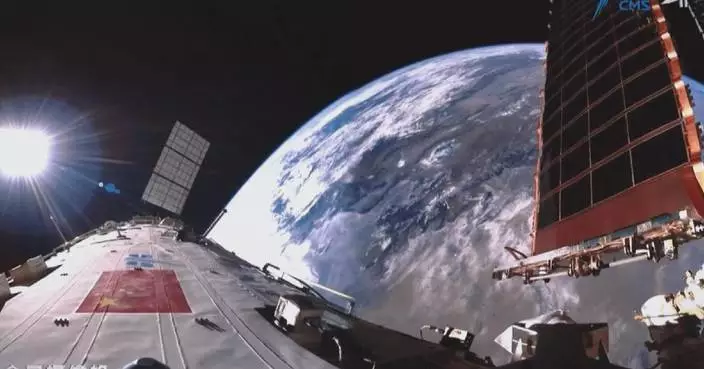
The China Manned Space Agency (CMSA) on Saturday unveiled the logo for the Shenzhou-24 crewed spaceflight mission.
According to the CMSA's official description, the logo uses the Earth as its visual background, with the main image showing the Shenzhou-24 crewed spacecraft docking with the Chinese space station in orbit.
The design is built on a symmetrical layout formed by two semicircles in different colors: the upper semicircle in deep blue symbolizes the vast sky and the dream of spaceflight, while the lower red semicircle represents the passion and conviction behind building China into a space power.
Embedded in the lower semicircle is a design based on an ancient Chinese dragon-pattern jade pendant, a traditional arched jade ornament.
The design is intended to signify in-depth integration of traditional culture and modern technology, and to reflect the firm steps of China's space workers in carrying forward tradition, pursuing innovation and reaching for the stars.
Stars dot both sides of the Earth, highlighting the depth of the universe.
An artistically styled "2026" and "SZ-24" are arranged symmetrically, marking the mission's year and designation.
The Shenzhou-24 is expected to be launched in late November for a six-month spaceflight mission. The Shenzhou-24 crew will maintain a continuous human presence on the Chinese space station known as the Tiangong, taking over from the Shenzhou 23 crew. A Pakistani astronaut will join the Shenzhou-24 crewed flight mission as a payload specialist, the China Manned Space Agency said on Saturday.

China unveils logo for Shenzhou-24 crewed spaceflight mission
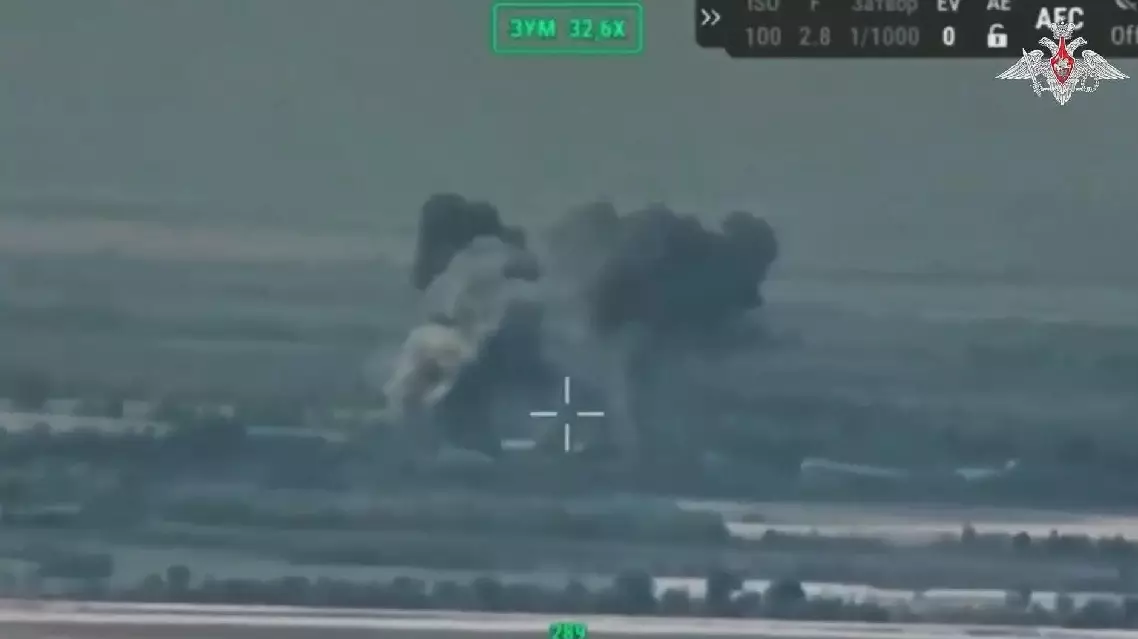
Russia on Friday said its forces launched one massive strike and 11 group strikes against Ukraine in the past week, while Ukrainian authorities reported on the same day that Russian airstrikes from Thursday evening to the early morning of Friday damaged energy infrastructure in several parts of the country.
According to a report by the Russian Ministry of Defense, the 12 strikes hit Ukrainian defense industry enterprises, logistics centers, power and transport infrastructure facilities used by the Ukrainian Armed Forces, production and storage facilities of cruise missiles, ground robotic systems, unmanned aerial vehicles, ammunition depots, and temporary deployment areas of Ukrainian armed formations and foreign mercenaries.
Additionally, multiple Ukrainian port facilities used to receive, store and distribute military cargo were disabled, the report said.
Russian air defense systems also shot down one guided aerial bomb, four Flamingo long-range cruise missiles, six Neptune long-range cruise missiles, two U.S.-made HIMARS MLRS projectiles, and 5,315 fixed-wing unmanned aerial vehicles in the past week, according to the report.
Ukraine's Air Force said in a social media post on Friday that Russian forces launched 227 attack drones into Ukraine overnight from Thursday evening to Friday morning. As of 8:00 Friday, Ukrainian air defense and electronic warfare units had shot down or suppressed 196 of the drones, while 22 sites across Ukraine came under attack.
The Kiev Regional Military Administration said on the same day that residential buildings and energy infrastructure in the region were hit by airstrikes, leaving three people injured. The Kirovohrad Regional Military Administration also reported sustained Russian air assaults on the region overnight, resulting in damage to local energy infrastructure.
Russia claims 12 strikes in past week, Ukraine reports damaging of energy facilities