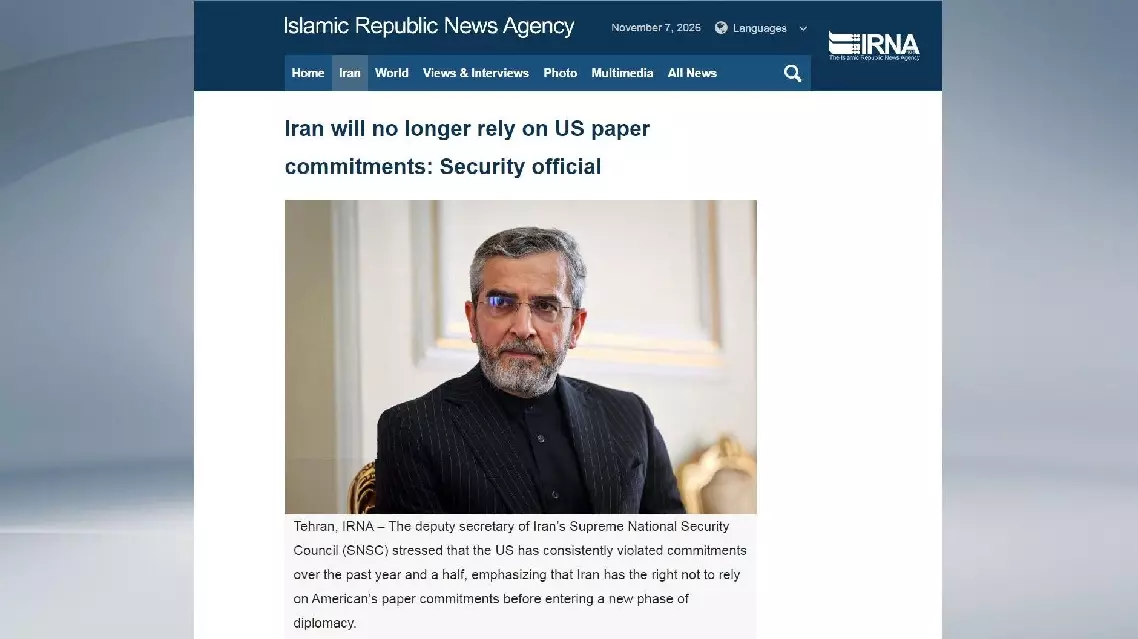
A senior Iranian security official said on Friday that Iran needs to see practical measures by the United States rather than mere "paper commitments" before entering a new phase of diplomacy.
"It is Iran's right not to settle for the U.S. paper commitments for entering a new phase of diplomacy. We need to see practical measures from the Americans, actions that are quite self-evident," Deputy Secretary of Iran's Supreme National Security Council (SNSC) Ali Bagheri Kani said in an interview with state-run IRIB TV.
"Whenever such measures are implemented, the ground will be prepared for a new breakthrough," Bagheri Kani added.
He stressed that the United States must be compelled to implement Iran's proposed seven-condition plan for reopening the Strait of Hormuz, "after which further steps can be pursued."
Bagheri Kani added that the United States had disrupted four diplomatic processes over the past 18 months through "hostile actions and breach of promises."
Also on Friday, Saudi Arabia's Al Arabiya cited Iranian sources in its reporting that Iran had taken a positive stance toward the new proposal put forward by the mediators and is awaiting concrete measures from the U.S. to build mutual trust. The source also stated that Iran remains open to negotiations that would ensure its legitimate demands are met.
Separately, Iranian Army spokesman Mohammad Akraminia said that the sole path to reopening the Strait of Hormuz is for the United States to meet Iran's seven conditions, the semi-official Tasnim news agency reported on Friday.
Akraminia warned that any repeated aggression, adventurism or other malicious action in the West Asia region would definitely not lead to the strait's reopening.
Speaking about the recent meeting between Iran's supreme leader Mojtaba Khamenei and senior military commanders, Akraminia said the leader has outlined several strategic directives, including a swift response to any enemy aggression without geographical restrictions.
Iranian forces would regard all U.S. enemy assets, both tangible and intangible, as potential targets without geographical limitations in the event of aggression, the spokesman said.
Mojtaba Khamenei also called for stronger military intelligence, greater indigenous defense capabilities, the use of emerging technologies, and a comprehensive update of the military target database to include all physical and non-physical assets of the U.S.-Israeli adversary, according to the spokesman.
Iran must see US take practical measures before entering new diplomatic phase: senior official