MADRID (AP) — Spain has been looking to break through into the elite level of women’s flag football for some time now, having been ranked among the top 10 in the world and being a perennial contender in Europe.
It still doesn’t have a spot at the 2028 Los Angeles Olympics, though, when the sport will make its Olympic debut.
All of Spain’s focus now is on securing that berth and being a part of flag football's showcase event. And having the NFL in the country this week is certainly helping.
The Cincinnati Bengals will take on the Atlanta Falcons on Sunday at Real Madrid’s Santiago Bernabeu Stadium for the NFL's second regular-season game in Spain. The games, along with the league's push to develop flag football everywhere, have helped the sport gain traction.
“The NFL has been a huge part of this, because people have started talking about this sport on the news," Spain wide receiver and defensive back Olga Sotillo told The Associated Press. "It’s been given more importance now, it’s no longer just a niche sport. If someone important or a professional league is telling you something, you’re more likely to pay attention. So I think that’s been key.”
The NFL has been trying to develop flag football both in the U.S. and abroad for some time. On Monday, the league and TMRW Sports unveiled Premier Flag, a professional league for men and women set to launch in the summer of 2027.
In Spain, the NFL launched school programs and youth competitions to help boost the game and attract new audiences.
Sunday’s game is the seventh of nine NFL regular-season games being played this year outside the United States, a record for the league. And more are planned going forward, with the NFL saying it hopes to have each team playing at least one game abroad every year.
“It allows us to bring new fans into the sport, all the way to young people playing this sport, in our case, flag football,” said Gerrit Meier, managing director and head of NFL international. “For us, it’s part of a greater vision, part of a greater strategy. We want to be a global sports property, we want to be truly a global sport.”
The Chicago Bears, who have Spain as one of their designated international markets through the NFL’s Global Markets Program, have promoted a series of flag football clinics in the country, some with participation by Spanish national team players.
Next Monday, Spain’s women’s team will play a friendly against Britain at the training facilities of Real Madrid, the same place where the Falcons have been practicing this week.
“Flag football, and football in general, for men and women, has become a very big thing in America and in all countries, so I just want you all to have fun doing it and go ball for everybody to see,” Falcons running back Bijan Robinson said. “I know you’re going to be great because everybody in America be killing out there, so I know you'll be killing here, too.”
Spain, ranked seventh in the world, missed out on its first opportunity to qualify for the Olympics during the world championship in Germany in August, when it came close to ousting world No. 1 Mexico in the quarterfinals to keep its chances alive. Spain lost 27-26, having rallied from 20-6 down to lead with about two minutes remaining. The Spaniards ultimately finished eighth.
Mexico went on to finish third and secure the second and final Olympic spot from the tournament. Canada was the other team to qualify after it reached the final against the United States. The Canadians beat the U.S., which had an automatic Olympic berth secured as host.
Spain’s second opportunity to try to qualify will begin at next year’s European championship, when the top two eligible teams will advance to the Olympic Q-Series in June 2028, which will determine the remaining three women’s berths.”
“We are really excited,” Sotillo said. “We’ve seen in the world championship what we are capable of doing, which is to compete against some of the biggest powers in the sport.”
Spain beat Oceania champion Australia 39-25 and lost 52-31 to the U.S. in the group stage of the tournament in Dusseldorf.
Spain finished sixth at the 2024 world championship, when it narrowly lost 18-14 to the U.S. in the quarterfinals.
Flag football was among five sports given Olympic status for the 2028 Games back in 2023, with the game played five-on-five in two 20-minute halves, no tackling and an emphasis on speed and elusiveness. Defenders stop the ball carrier by pulling a flag from their belt.
Six women’s teams and six men’s teams, with 10-player rosters each, will participate in Los Angeles.
See AP’s full NFL coverage here

A child takes part in a flag football clinic in Madrid, Friday, Nov. 6, 2026. (AP Photo/Manu Fernandez)

A child takes part in a flag football clinic in Madrid, Friday, Nov. 6, 2026. (AP Photo/Manu Fernandez)

Children take part in a flag football clinic in Madrid, Friday, Nov. 6, 2026. (AP Photo/Manu Fernandez)
Bomb threats targeted dozens of flights across Europe this week following a string of hoaxes that caused flight diversions and forced airlines to scramble to keep passengers safe and air traffic disruptions minimal.
Fake bomb threats are relatively common, but it is unusual to see so many in such a short period. No suspicious items were found and no one has been injured, but the threats raised concerns because they came on the heels of other European disruptions — including attacks on supermarket refrigeration systems and drone incursions.
With unanswered questions hanging over the continent — it was not known whether the threats were linked, who sent them or what they hoped to achieve — security experts were to meet in Brussels next week to discuss measures to deal with the hoaxes.
Here's what to know:
The hoaxes have led to plane searches and diversions, and, in some cases, emergency landings and military escorts.
Still, the European air traffic authority insisted that overall, the threats caused minimal disruption to aviation.
Separately, three broadcasters — the Irish national broadcaster RTE, the U.K.-based Sky and NOVA TV, a private broadcaster in Bulgaria — also received security threats on Friday, a possible sign the menace was spreading beyond the skies.
And on Saturday, Italian Foreign Minister Antonio Tajani said his personal data had been disseminated on the dark web, an encrypted part of the internet, and that he has been exposed to “threats and intimidation.”
Italian Premier Giorgia Meloni blamed pro-Russian hackers for the leak.
Tajani, who is also a vice premier in Italy’s government, did not specify what kind of information had been shared, but suggested that the cyberthreat was ongoing. He did not indicate who might be responsible for the cyberattack but reiterated the Italian government’s support for Ukraine.
It remains unclear who is behind the airline threats, which come at a time of increased geopolitical tensions and warnings from authorities that Russia may be ramping up its so-called hybrid threats in Europe — a mix of covert and indirect attacks attributed to Moscow and meant to destabilize European countries.
Authorities haven’t attributed the threats to any group or state actor, and no evidence has emerged linking the hoaxes to a government. An email containing the threat sent Thursday to airport authorities in Rome and reviewed by The Associated Press purported to come from a group describing itself as anti-feminist and claiming it was targeting a “feminist regime.”
Another European airport received a threat with similar wording, but it was unclear if it came from the same sender.
In Amsterdam, meanwhile, the Dutch Marechaussee military police detained a man on Thursday night at Amsterdam’s Schiphol Airport in connection with a threat to a flight that was about to leave for Prague, Marechaussee spokesperson Doron Wallin said Saturday.
It was not clear if the threat was linked to other recent hoaxes. Wallin said the Marechaussee regularly deals with fake bomb threats. The aircraft flew on to Prague later in the evening and the man was released the following day.
Matthew Borie of Osprey Flight Solutions, which advises airlines on flight threats, said he had several hypotheses for the incidents — ranging from a single threat triggering copycat incidents to an individual or a group making multiple threats, and “hybrid warfare” operations by state actors or their supporters.
The focus on Europe means “there could be a Russian angle,” said Borie, the company’s co-founder and chief intelligence officer. “We need to keep in mind, though, that Iranian hybrid warfare is just as active in certain pockets of Europe as well.”
His message for travelers?
“Don’t be alarmed,” he said, noting that national authorities have “coordinated response mechanisms,” including, at times, the deployment of NATO fighter jets to escort such planes.
Jacob Funk Kirkegaard, a senior fellow at the Bruegel think tank in Brussels, said the threats were “stress-testing” how European governments and airport officials respond, and whether their responses were coordinated.
The idea behind the threats “appears to be to sow chaos, uncertainty, about the reliability of air traffic across Europe” and could have “cascading effects” — such as economic damage and costs related to inspection, investigation and the cleaning of aircraft.

Police car seen in front of Sofia's Vasil Levski Airport in Bulgaria, Thursday, Nov. 5, 2026, as three Ryanair flights bound for Sofia, had to make emergency landings because of bomb threats on board. (AP Photo/Valentina Petrova)
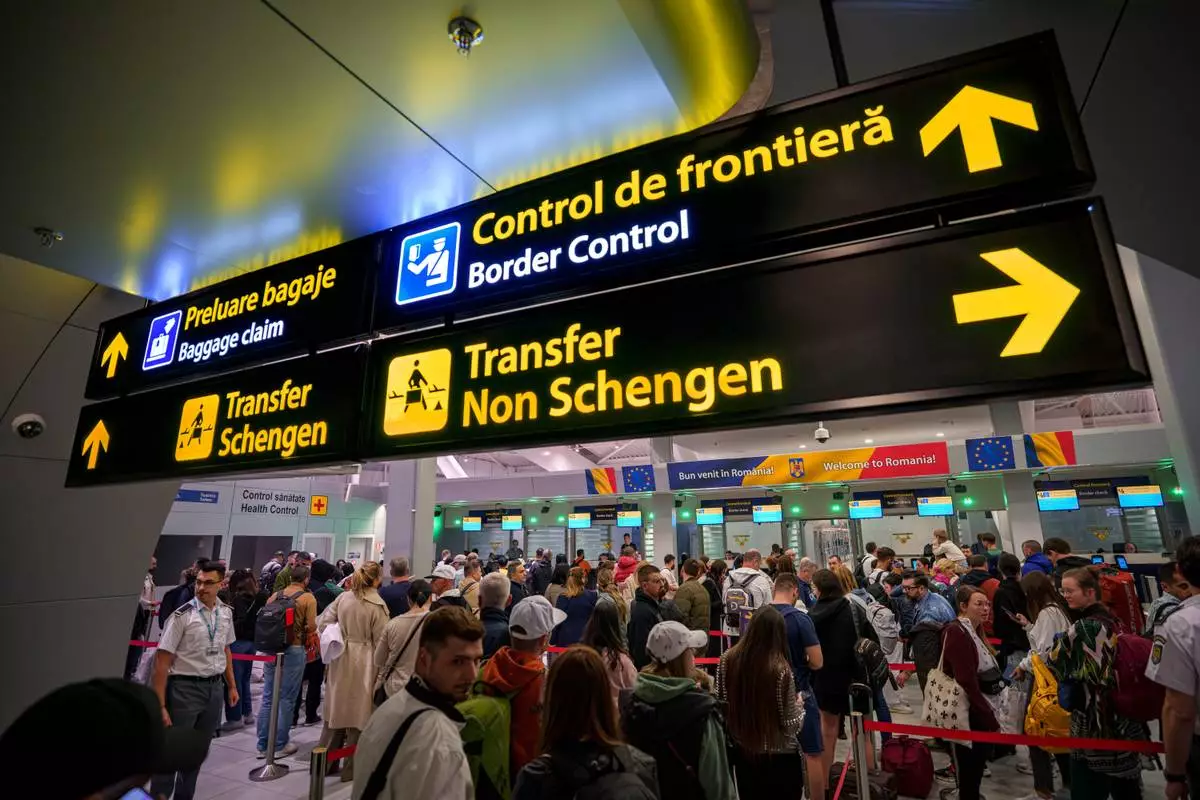
FILE - Passengers arriving at the Henri Coanda International Airport pass under a Schengen Information sign, in Otopeni, near Bucharest, Romania, on March 31, 2024. (AP Photo/Andreea Alexandru, File)

An airplane seen at Sofia's Vasil Levski Airport in Bulgaria, Thursday, Nov. 5, 2026, as three Ryanair flights bound for Sofia, had to make emergency landings because of bomb threats on board. (AP Photo/Valentina Petrova)