MUNICH--(BUSINESS WIRE)--Nov 10, 2026--
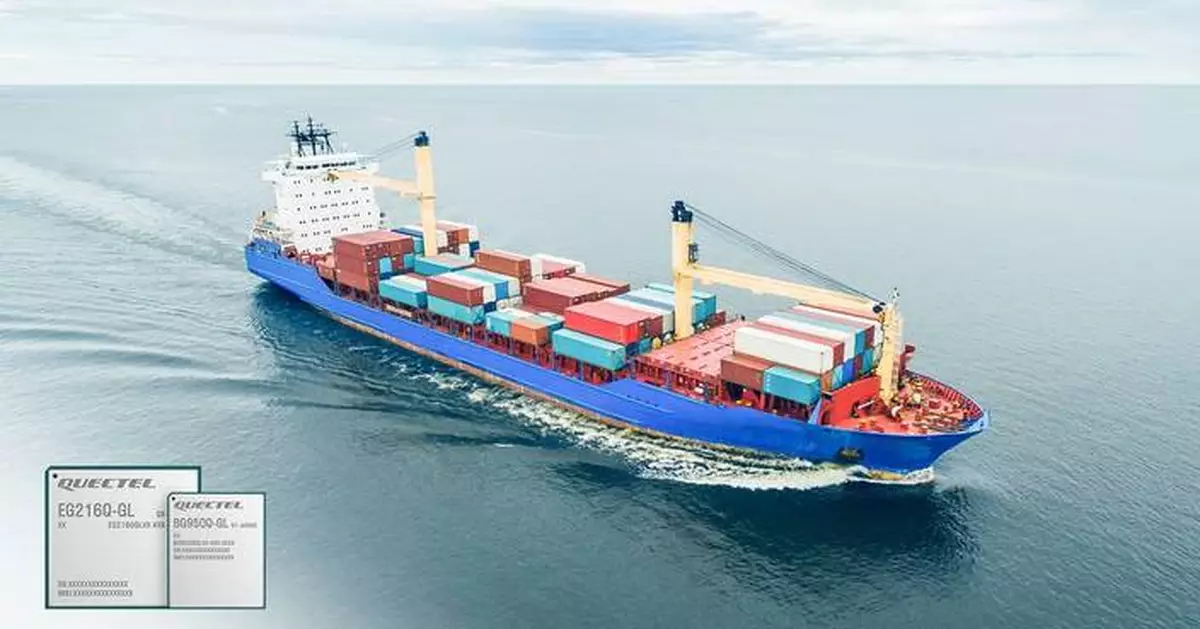
Quectel Wireless Solutions, a global end-to-end IoT solutions provider, today announced the EG216Q-GL and BG950Q-GL, two next-generation global cellular IoT modules based on Qualcomm technology.
This press release features multimedia. View the full release here: https://www.businesswire.com/news/home/20261110650568/en/
Built in Quectel’s widely adopted EG2 and BG95 form factors, the modules give device makers a direct route from established legacy platforms to a more cost- and power-optimized generation. Customers can reuse the board designs and development work they already have.
The EG216Q-GL is an LTE Cat 1bis module for customers whose designs use Quectel’s EG2-footprint modules. These include the EC2x series, EC200A series, EG25-G, EG25-GL, EG21-G and EG21-GL, as well as the UC200A-GL.
Because it shares their form factor, manufacturers can upgrade while keeping their existing layouts. It delivers up to 10 Mbps downlink and 5 Mbps uplink over a single main antenna. Built-in Wi-Fi scan supports location awareness without relying on GNSS alone.
The module is suited to commercial telematics, payment terminals, asset tracking, remote monitoring and control, smart safety systems, and smart metering and grid equipment. For the businesses running those devices, that means continuous fleet and asset visibility, reliable card payments where Wi-Fi is unavailable, and remote diagnostics that cut site visits.
The BG950Q-GL, meanwhile, is an ultra-low-power LTE Cat M1/Cat NB2 module. It is pin-to-pin compatible with Quectel’s BG95 series, BG95xA and BG950S LPWA modules, its EG91 and EG95 LTE modules, and its BC35-G and BC95 R2.0 NB-IoT modules. Its compact 23.6 mm × 19.9 mm × 2.2 mm LGA package supports fully automated, high-volume manufacturing.
It is built for devices that must run for years on a battery, such as smart meters, asset and personal trackers, personal safety wearables, and wireless POS terminals. Lower power draw means longer device life, fewer battery changes and maintenance visits, and a lower cost per connected device over its lifetime.
“Our customers have invested heavily in designs built around the EG2 and BG95 footprints. The EG216Q-GL and BG950Q-GL let them carry that investment forward onto a more cost-and power-efficient platform. They can respond to rising component costs by upgrading their products rather than redesigning them,” said Delbert Sun, Vice General Manager, Product Department, Quectel Wireless Solutions.
Industry research identifies Cat 1bis as the fastest-growing cellular IoT technology by volume, forecast to reach roughly 43% of module shipments by 2030*. Moving to a more cost-optimized generation now helps customers manage those pressures and puts their products on a platform with a long future.
Quectel supports customers with reference designs, evaluation tools, technical support and its antenna portfolio to shorten design-in time.
Visit Quectel at Electronica 2026 at stand C2.601 to see the full end-to-end IoT solutions portfolio from Quectel.
About Quectel
Quectel’s passion for a smarter world drives us to accelerate IoT innovation. A highly customer-centric organization, we are a global end-to-end IoT solutions provider backed by outstanding support and services.
With a worldwide team of over 10,000 professionals, we lead the way in delivering end-to-end IoT solutions, spanning cellular, GNSS, satellite, Wi-Fi and Bluetooth modules, high-performance antennas, value-added services and full turnkey offerings including ODM services and system integration.
With regional offices and support across the globe, our international leadership is devoted to advancing IoT and helping build a smarter world.
For more information, please visit: www.quectel.com or LinkedIn
* https://iot-analytics.com/cellular-iot-market-h1-2026-module-shipments/
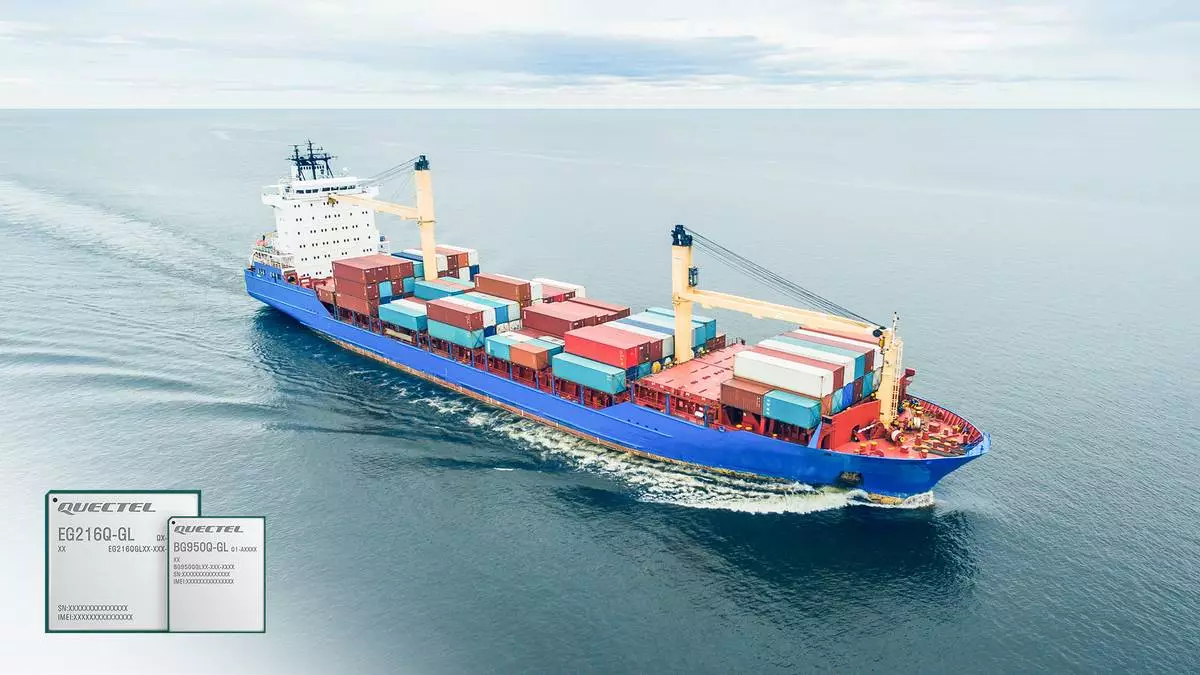
Quectel launches EG216Q-GL and BG950Q-GL to give IoT device makers a more cost-efficient, lower-power upgrade path
ABU DHABI, United Arab Emirates (AP) — Three-way talks between Russia, Ukraine and the United States opened Tuesday in Abu Dhabi, the head of Kyiv’s delegation said.
“We have moved to a trilateral negotiation format involving Ukraine, the United States and Russia” after initial Ukrainian discussions with NATO and European envoys, Rustem Umerov, the head of Ukraine’s Foreign Intelligence Service, said on social media.
The U.S. is renewing a push to end the war between Moscow and Kyiv after three rounds of negotiations earlier this year. The conflict, Europe's biggest since World War II, began after Russia's all-out invasion on Feb. 24, 2022.
The two-day session in Abu Dhabi, the first such meeting since February, will focus on security guarantees.
U.S. President Donald Trump’s son-in-law, Jared Kushner, said on X that he and fellow envoy Steve Witkoff were working on a “negotiated solution that can deliver lasting peace and create the conditions for a sovereign, secure, and prosperous Ukraine within a more stable European security environment.”
Umerov said that the day began with a meeting between the Ukrainian team, the U.S. envoys and representatives from the United Kingdom, France, Germany, Italy, NATO and the European Commission.
“Next, we will move to a trilateral format involving Ukraine, the United States and Russia,” Umerov said in a social media post.
Russian state news agency RIA Novosti reported Tuesday that the Russian delegation had arrived at the site of the talks.
The Russian and Ukrainian governments remain far apart on key elements of any prospective deal to end the full-scale war, now nearing its five-year mark.
Russian President Vladimir Putin wants Ukraine to pull its troops back from Donetsk, Luhansk, Zaporizhzhia and Kherson — the four regions that Moscow illegally annexed in September 2022 but never fully captured. He also demands that Ukraine abandon its bid to join NATO, accept strict limits on its military and drop restrictions on the Russian language and the Moscow-affiliated Orthodox Church in Ukraine.
Putin wants a comprehensive peace deal on those conditions and won’t agree to a general halt in hostilities, arguing that it would only allow Ukrainian troops to rest and replenish their weapons stockpiles. He has warned that Russia will achieve its goals by force if Kyiv refuses to meet its conditions for peace.
Ukrainian President Volodymyr Zelenskyy, who was visiting Denmark on Tuesday, rejects Putin’s demands to voluntarily cede territory that Russia hasn't been able to take on the battlefield. Zelenskyy also rejects any limits on Ukraine's military or its arrangements with Western partners, which Kyiv sees as essential security guarantees to stop Moscow from invading again.
Ukraine argues that an immediate ceasefire is the necessary first step toward negotiating a wider settlement and says a direct meeting between Putin and Zelenskyy is the only way territorial issues can be settled.
The Russian and Ukrainian delegations include senior officials who have attended previous rounds of talks.
Russia’s chief negotiator is Putin aide Vladimir Medinsky, who has led Moscow’s team since the first direct peace talks with Ukraine in Istanbul in March 2022. The Russian delegation also includes deputy foreign ministers Sergei Ryabkov and Mikhail Galuzin, military intelligence chief Igor Kostyukov and deputy chief of the General Staff’s operational department, Yuri Zhigarlovsky.
Apart from Umerov, the Ukrainian delegation also reportedly includes Zelenskyy’s chief of staff, Kyrylo Budanov, his deputy, Sergiy Kyslytsya, and Davyd Arakhamia, the parliamentary faction leader of Zelenskyy’s Servant of the People party.
Last week, Trump declared that some kind of grand deal about European security was in the works, describing it as “a big agreement” that is “going to involve more than Ukraine.”
Kushner said Monday on X that a “comprehensive and lasting settlement will also require direct engagement between Russia and our European partners on the broader security arrangements that affect them.” The discussions in Abu Dhabi will set the stage for “that engagement to begin in the near future, as part of a broader multilateral process,” he said.
Moscow has praised the broad approach.
“We can only welcome the (U.S.) negotiators on President Donald Trump’s request proposing to put the issue of collective security on top of the agenda of the talks on a Ukrainian settlement,” Russian Foreign Minister Sergey Lavrov said.
Just before Moscow launched the all-out invasion in 2022, it demanded that NATO roll back its deployments in the alliance’s member countries in Central and Eastern Europe, seeing their presence as a security threat. Similar demands will likely be part of any comprehensive peace deal proposed by Russia.
Kushner said that before the start of the three-way talks, he and Witkoff will meet separately with envoys from Ukraine, the European Union, NATO, Germany, France, the United Kingdom and Italy to “continue the close consultation and coordination we have undertaken on European security and Ukraine’s postwar future over the past several weeks.”
Some in the EU see Washington's proposals as too accommodating to Moscow.
Russia has objected to the Europeans’ involvement in the three-way talks, but said that EU representatives could join at a later stage.
While the ground battles have morphed into a war of attrition along the 1,200-kilometer (about 750-mile) front line, Russia and Ukraine have ramped up their long-range strikes with drones and missiles.
Russia has intensified its air campaign against Ukraine’s power grid, seeking to weaken the country’s resolve as winter sets in. Moscow has relied on ballistic missiles and jet-powered drones, taking advantage of Ukraine’s shortage of U.S.-made Patriot interceptors.
Ukraine, meanwhile, has escalated its drone strikes on Russian oil refineries.
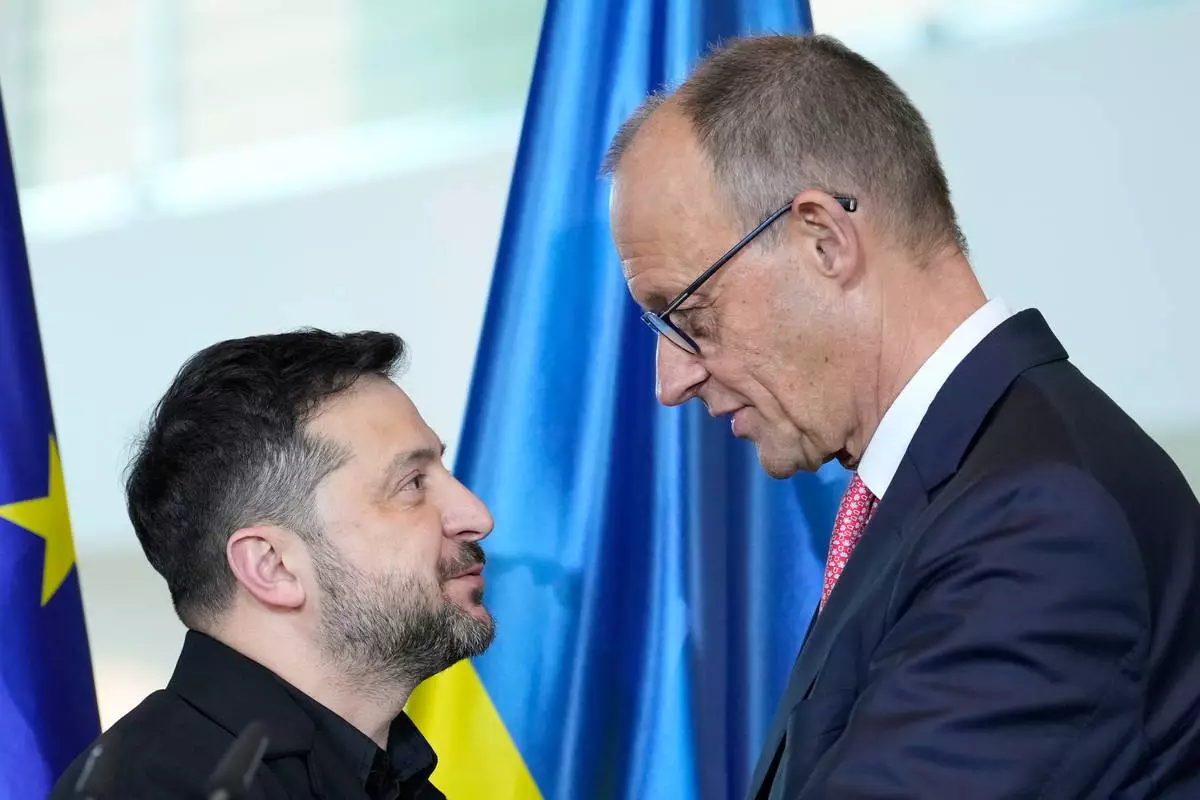
German Chancellor Friedrich Merz, right, and Ukrainian President Volodymyr Zelenskyy attend a press conference in Berlin, Germany, Tuesday, Nov. 3, 2026. (AP Photo/Ebrahim Noroozi)
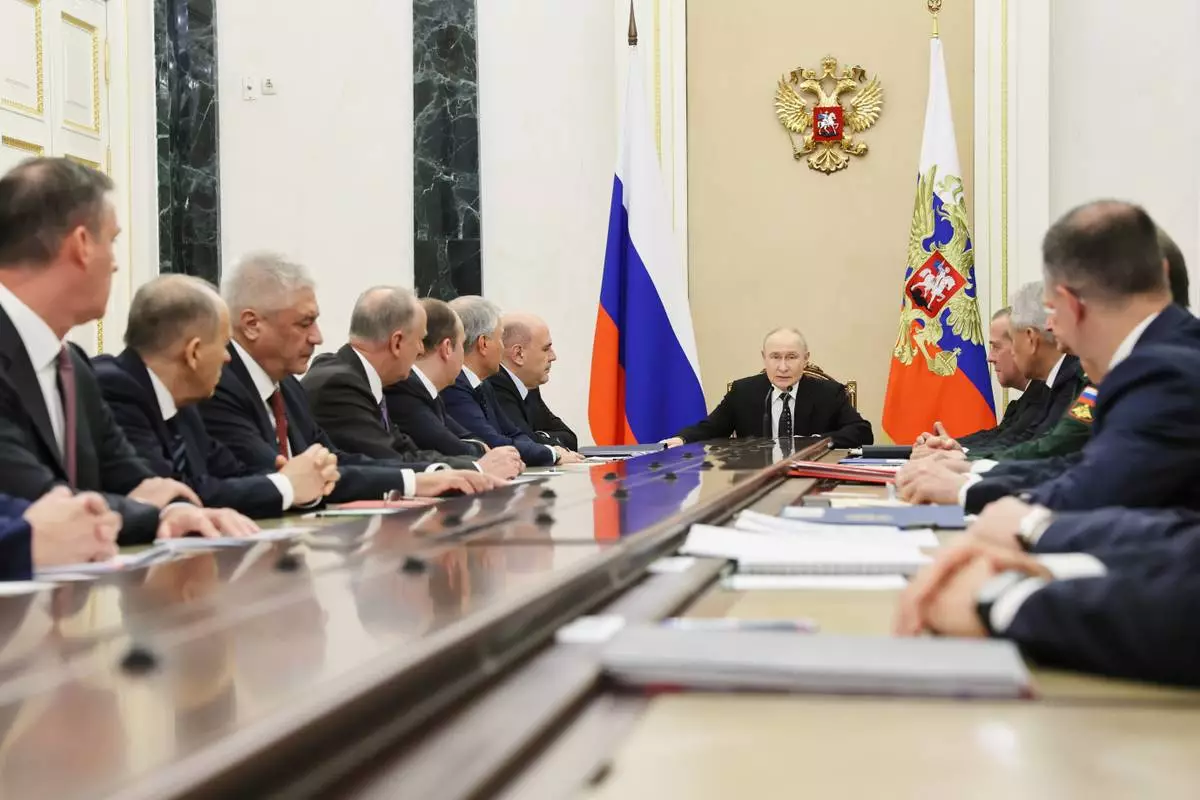
Russian President Vladimir Putin, center, chairs the Security Council meeting in Moscow, Friday, Nov. 6, 2026. (Alexei Babushkin, Sputnik, Kremlin Pool Photo via AP)
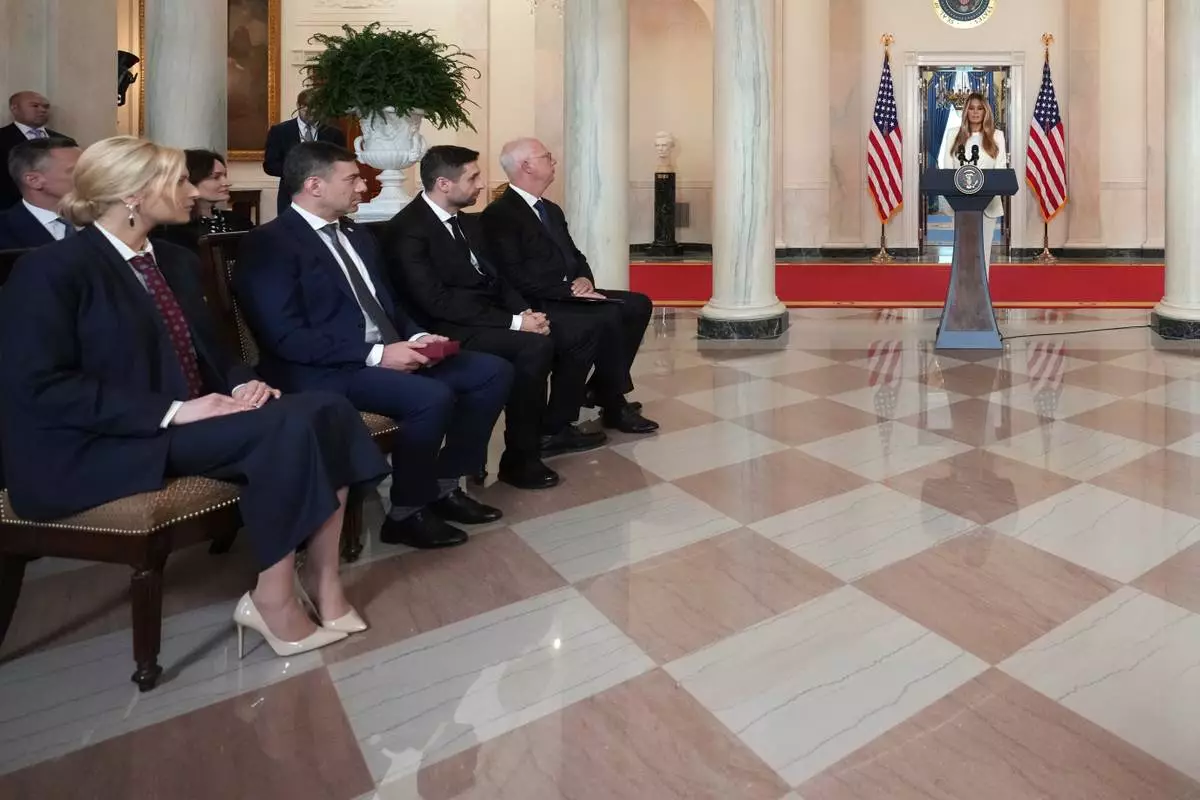
First lady Melania Trump speaks as Russia's Commissioner for Human Rights Yana Lantratova, from left, Ukraine's human rights ombudsman Dmytro Lubinets, Davyd Arakhamia, lawmaker with President Zelenskyy's Servant of the People's party, and Russian Presidential Envoy Kirill Dmitriev listen during a meeting with Russian and Ukrainian representatives in the Grand Foyer of the White House, Thursday, Nov. 5, 2026, in Washington. (AP Photo/Alex Brandon)
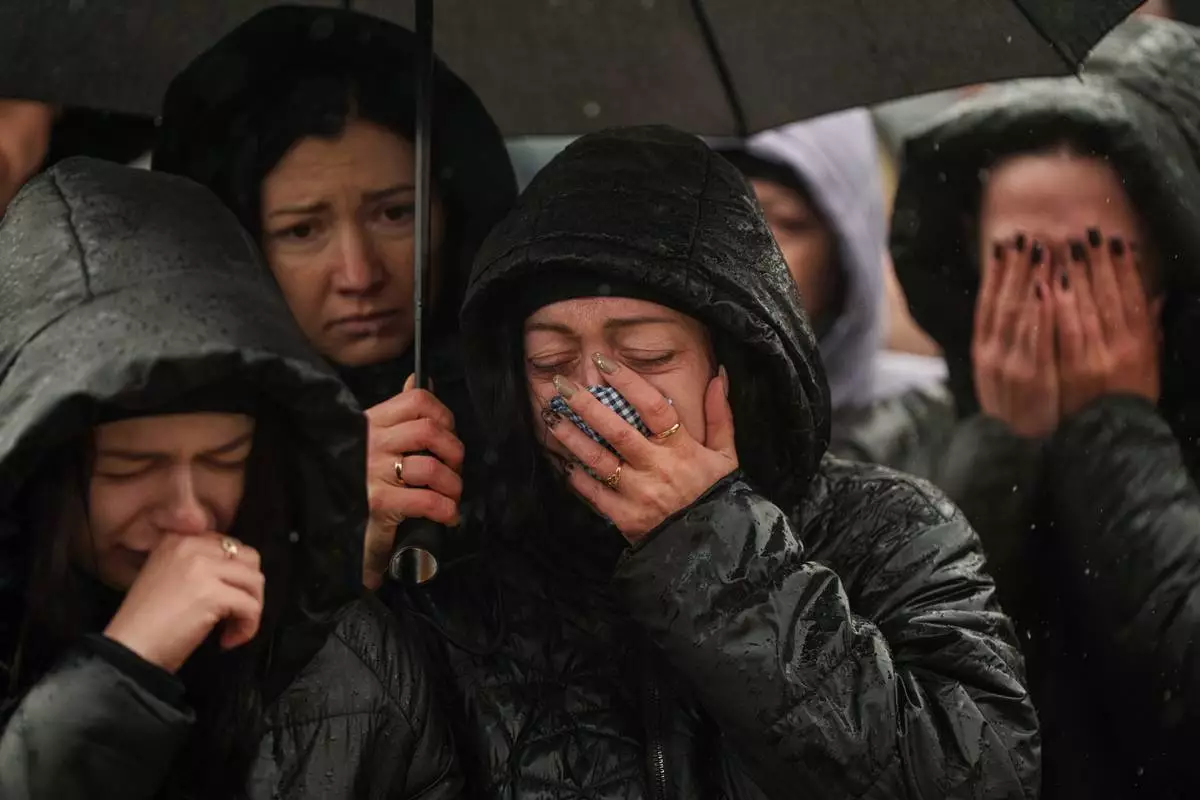
Family members cry beside the coffins of police officers Dmytro Besedin, Mykhailo Buzhenko, Mykola Balanda and Mykhailo Romanov, killed in a Russian airstrike that destroyed an underground school, and Serhii Berezhko and Oleg Dubetskyi, killed in an FPV drone attack in Komyshuvakha, during a farewell ceremony on Khortytsia Island in Zaporizhzhia, Ukraine, Saturday, Nov. 7, 2026. (AP Photo/Evgeniy Maloletka)
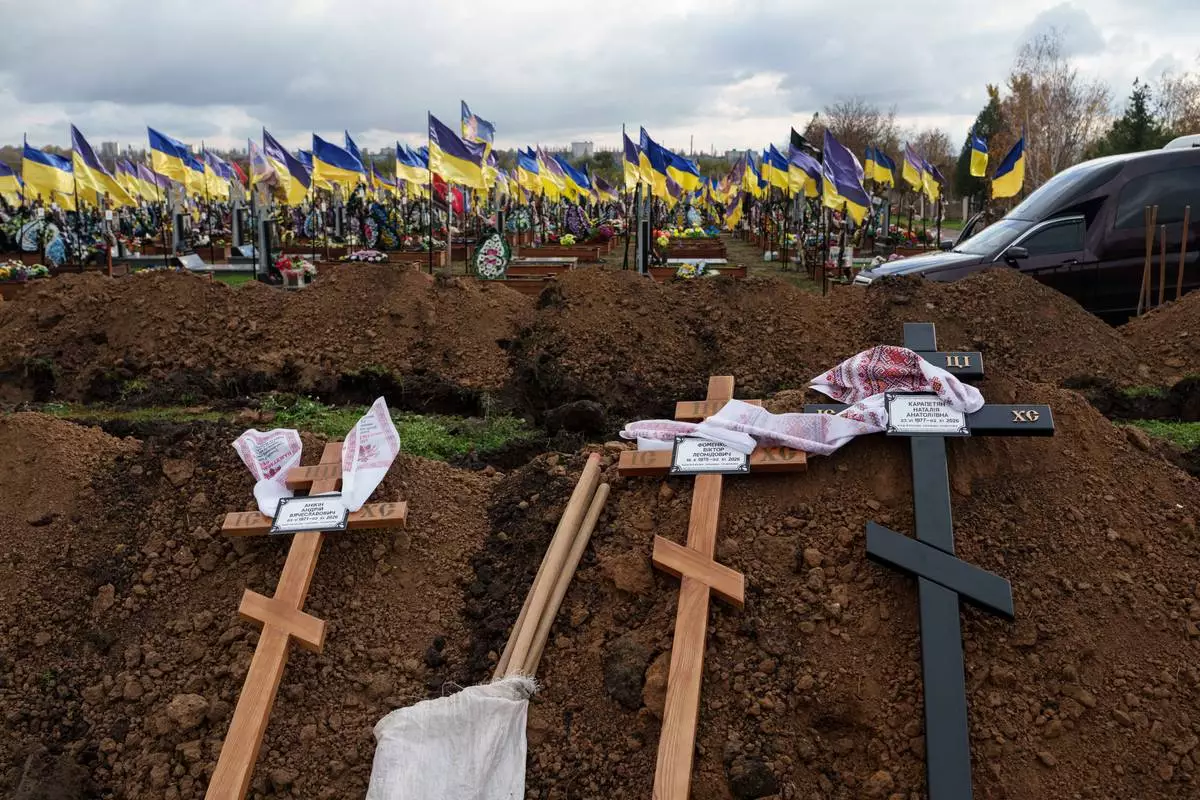
Crosses bearing the names of Viktor Fomenko, Natalia Karapetian and Andrii Anikin, killed in a Russian airstrike that destroyed an underground school in Komyshuvakha, lie in a cemetery in Zaporizhzhia, Ukraine, Saturday, Nov. 7, 2026. (AP Photo/Evgeniy Maloletka)