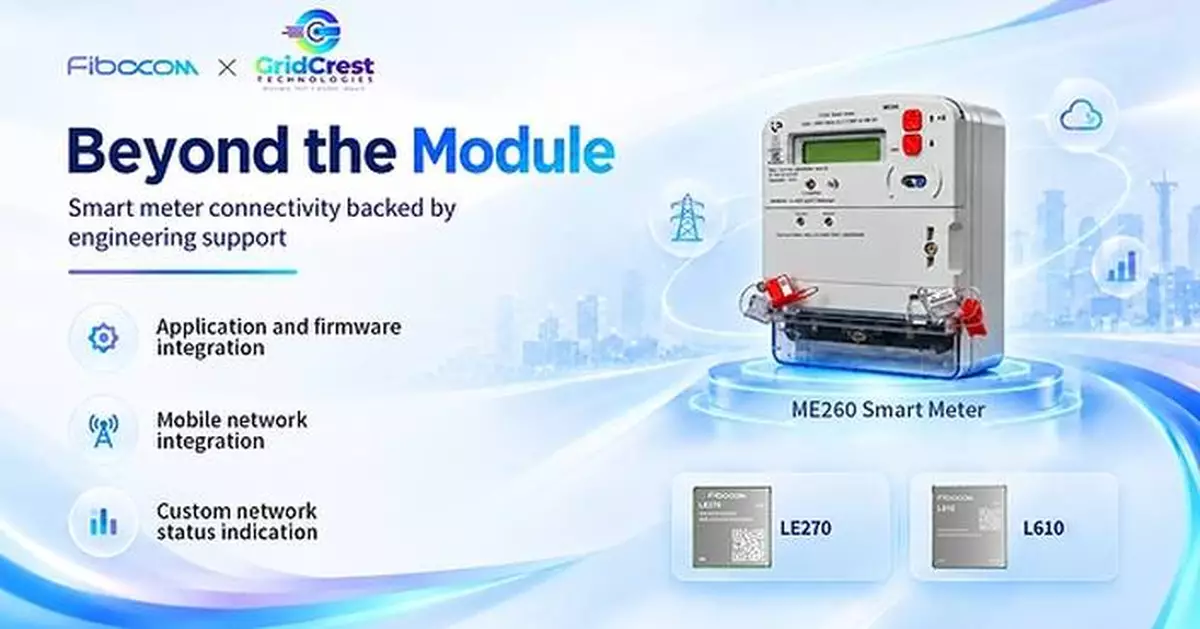
VIENNA, Nov. 10, 2026 /PRNewswire/ -- Fibocom, a global provider of wireless communication modules and solutions, joins GridCrest Technologies, an India-based provider of integrated smart metering solutions, to showcase the ME260 single-phase smart electricity meter at Enlit Europe 2026. GridCrest has adopted Fibocom's LE270-IN and L610-IN LTE Cat.1 bis modules as alternative connectivity options, with Fibocom also providing customized engineering support throughout product integration and testing.
GridCrest offers a comprehensive portfolio covering smart meters, communication technologies, utility software platforms, and operational services. Backed by the engineering and manufacturing capabilities of Kaynes Group, the company develops smart metering solutions for utilities, supporting the modernization of electricity metering infrastructure.
For smart meter manufacturers, selecting a cellular module is only part of the development process. Reliable communication also depends on compatibility between application software and module firmware, consistency during production, and proper integration with mobile operator networks. These requirements call for close technical collaboration across different stages of product development.
During the ME260 integration process, Fibocom worked closely with GridCrest to address several engineering challenges.
During production testing, GridCrest encountered a compatibility issue between the application software and module firmware. Through multiple rounds of testing, Fibocom's engineering team traced the issue to a mismatch between the application and its corresponding Open Base firmware baseline, and worked with GridCrest to resolve it.
During operator-network testing, duplicate PDN connection requests were identified, resulting in additional network traffic. Fibocom worked closely with GridCrest and the operator's IoT team to trace the issue to the application's API usage logic, providing technical guidance on network attachment and PDN request handling. Fibocom also delivered customized network status indication functionality to meet GridCrest's specific requirements.
These efforts demonstrate the importance of engineering expertise in smart meter development, particularly where application software, cellular connectivity and operator networks must work together.
Designed for residential electricity metering, GridCrest's ME260 supports energy measurement, load profile recording, event alerts and anti-tamper functions. With Fibocom's cellular modules, metering and event data can be transmitted over mobile networks to utility head-end systems (HES), supporting remote meter reading and subsequent meter data management.
Both the LE270-IN and L610-IN support major LTE bands used in India, offering different connectivity configurations. The LE270-IN features a compact design and optimized power consumption, while the L610-IN supports both LTE and GSM connectivity. This flexibility allows GridCrest to select modules based on meter design and network requirements.
"Successful smart meter integration involves much more than choosing the right connectivity hardware," said Madan Mohan, CEO of GridCrest Technologies. "Fibocom's engineers worked closely with our team to troubleshoot software integration issues, support production testing and address operator-network requirements. Their responsiveness and technical expertise have been valuable in bringing our product forward."
"Smart meters are designed for long service lives and deployment across widely distributed locations. This places specific demands on software compatibility, production consistency and network interoperability," said Kony Li, General Manager of Fibocom MTC Business Unit. "Our experience in smart metering goes beyond wireless module development to understanding how connectivity performs throughout the device integration process. We will continue working closely with energy industry partners to turn this engineering expertise into practical solutions for their evolving requirements."
About Fibocom
Fibocom, founded in 1999, is China's first wireless communication module company listed on both the A-share and H-share markets. Fibocom leverages wireless communication and artificial intelligence as its core technologies to provide integrated hardware and software solutions that empower industry applications. These solutions accelerate the transformation from "Connect Everything" to "Intelligent Connectivity" across diverse industries.
Fibocom's one-stop solutions encompass cellular communication, AI, automotive, and GNSS modules, as well as AI toolchains, supporting industry-side and mainstream large model integration, and providing AI Agent, global connectivity, and cloud services, driving the digital intelligence upgrades in industries such as robotics, consumer electronics, low-altitude economy, intelligent transportation, smart retail, and smart energy.
** This press release is distributed by PR Newswire through automated distribution system, for which the client assumes full responsibility. **
Beyond the Module: Fibocom and GridCrest Showcase Smart Meter Collaboration at Enlit Europe 2026