MUNICH, Nov. 11, 2026 /PRNewswire/ -- As artificial intelligence, multimedia interaction and digital applications across industries develop rapidly, more devices are evolving from terminals focused solely on connectivity into devices with computing, interaction and intelligent application capabilities.
At the same time, AI capabilities are gradually moving onto end devices. Traditional wireless modules centered on connectivity are evolving into platforms that combine computing, multimedia and intelligent application capabilities, creating new opportunities for AIoT device innovation.
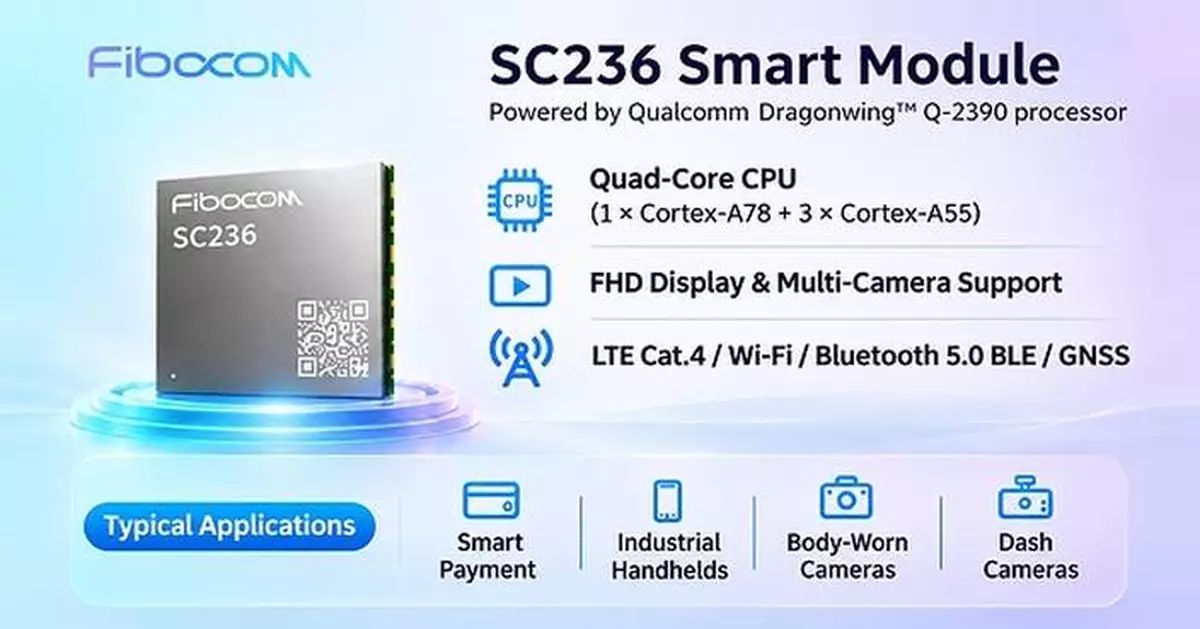
At electronica 2026, Fibocom is introducing its SC236 smart module. Built on the Qualcomm Dragonwing™ Q-2390 processor, SC236 combines computing, multimedia processing and wireless connectivity to provide AIoT devices with integrated capabilities spanning connectivity, computing and application hosting, helping customers develop smart devices for the future.
SC236 has entered the product introduction stage, with mass production planned for the fourth quarter of 2026.
Computing Capabilities Enable Smarter Devices
Traditional wireless communications modules primarily provide device connectivity. As AI and intelligent applications increasingly extend to end devices, however, demand for local computing and application processing capabilities is growing.
SC236 features a quad-core processor architecture comprising three Cortex-A55 cores and one Cortex-A78 core, together with an integrated Adreno 704 GPU. This high-performance computing architecture enhances on-device processing capabilities, providing a foundation for devices to run a wider range of local applications.
Compared with traditional connectivity-focused modules, SC236 further strengthens local processing capabilities, enabling devices to support more intelligent application functions and helping devices across industries evolve from "connected" to "intelligent."
Multimedia Capabilities Expand AIoT Application Possibilities
As visual interaction, human-machine interaction and video applications continue to develop, smart devices require more capable displays, cameras and multimedia processing.
SC236 provides multimedia processing capabilities, supporting displays at up to FHD resolution (1920 × 1080 at 60 fps) and multiple-camera applications to meet requirements such as video capture and human-machine interaction.
For devices such as wireless smart payment terminals, industrial handhelds, body-worn cameras and dash cameras, SC236 combines computing, multimedia and wireless connectivity to deliver richer interactive experiences and intelligent application capabilities.
An Open Software Environment Accelerates Product Development
To meet the diverse development needs of customers across industries, SC236 runs the Android operating system and uses an LCC+LGA package, offering greater flexibility in software development and hardware design.
For wireless connectivity, SC236 supports LTE Cat 4 cellular communications, as well as Wi-Fi, Bluetooth 5.0 BLE and multi-constellation GNSS positioning.
Working with Ecosystem Partners to Advance AIoT Innovation
Edward Ai, Senior Director of Product Marketing at Qualcomm Technologies, said:
"As devices across more industries become increasingly intelligent, demand for computing capabilities, intelligent interaction and reliable connectivity continues to grow. Qualcomm Dragonwing platforms address the needs of a wide range of intelligent edge devices, helping device manufacturers develop next-generation products with higher performance and richer application experiences. We are pleased to continue working with Fibocom to bring this platform to more IoT device applications."
Thales Zhang, Vice President and Head of the Global Marketing and Computing Business Group at Fibocom, said:
"As AI capabilities continue to extend to end devices, devices across industries are evolving from connectivity-focused terminals into devices with local computing and intelligent interaction capabilities. Built on the Qualcomm Dragonwing Q-2390 processor, the SC236 smart module combines connectivity, computing and multimedia capabilities to provide customers with an integrated development solution for AIoT devices, helping enable more intelligent devices across industries."
Looking ahead, Fibocom will continue to advance the integration of wireless connectivity and smart device capabilities, accelerating the deployment of AI technologies in more devices across industries.
About Fibocom
Fibocom, founded in 1999, is China's first wireless communication module company listed on both the A-share and H-share markets. Fibocom leverages wireless communication and artificial intelligence as its core technologies to provide integrated hardware and software solutions that empower industry applications. These solutions accelerate the transformation from "Connect Everything" to "Intelligent Connectivity" across diverse industries.
Fibocom's one-stop solutions encompass cellular communication, AI, automotive, and GNSS modules, as well as AI toolchains, supporting industry-side and mainstream large model integration, and providing AI Agent, global connectivity, and cloud services, driving the digital intelligence upgrades in industries such as robotics, consumer electronics, low-altitude economy, intelligent transportation, smart retail, and smart energy.
** This press release is distributed by PR Newswire through automated distribution system, for which the client assumes full responsibility. **
Fibocom Showcases SC236 Smart Module at electronica 2026, Combining Computing and Connectivity to Enable Smarter AIoT Devices
New Nighthawk r3 processor will be built to execute 10,000 quantum operations, enabling larger and more complex computations as IBM advances its roadmap toward fault tolerance
Clients and partners including E.ON, Algorithmiq, and Q-CTRL have run more than 34 billion circuits on Nighthawk r2, reporting speedups of up to 19x beyond previous IBM quantum processors
Enhanced IBM Quantum Platform unites quantum with classical computing in one environment
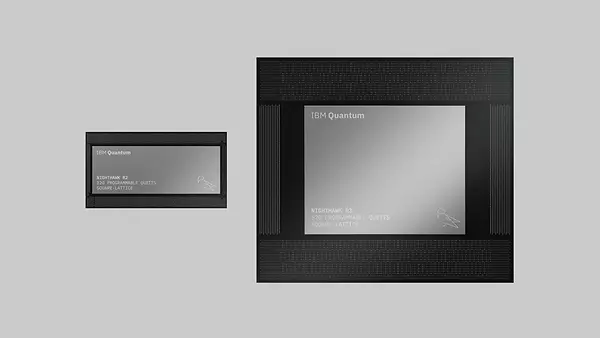
YORKTOWN HEIGHTS, N.Y., Nov. 11, 2026 /PRNewswire/ -- IBM (NYSE: IBM) today announced IBM Quantum Nighthawk r3, its next-generation processor, will be built to accurately execute 10,000 quantum operations across 520 qubits to tackle larger, more complex problems while maintaining the speed and quality demonstrated by the current generation Nighthawk available today.
In 2027, IBM plans to link two Nighthawk r3 processors into a single system with more than 1,000 qubits.
To be at the frontier of quantum computing, industry-relevant applications demand both computational quality and speed. Speed matters because a quantum computer delivers its answer in samples: each run of a quantum circuit returns one result. Applications increasingly require circuits executing thousands of quantum operations on approximately 100 qubits or more, generating millions to billions of samples. Scale and quality enable increasingly complex computations, but speed determines whether these demanding workloads can be completed in practical timeframes and at a reasonable cost.
"Useful quantum computing hinges on whether results can be delivered with accuracy and speed, both are fundamental," said Jay Gambetta, Director of IBM Research and IBM Fellow. "Nighthawk is already showing us what that looks like today. As we scale this architecture to larger and more powerful quantum computers, the capabilities of quantum computation will reach new levels as we integrate more closely with classical resources and march ahead to fault tolerance."
Nighthawk r2: Delivering Speed for Real-World Workloads
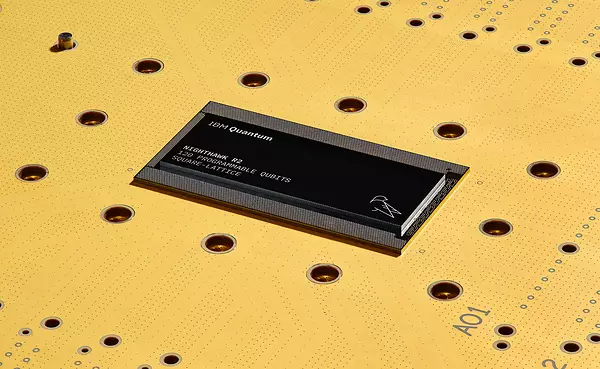
Introduced in September, IBM Quantum Nighthawk r2 delivers up to 100,000 samples per second while supporting accurate computations with more than 7,500 quantum operations on 120 qubits. Its high-speed qubit reset technology dramatically reduces the time between circuit executions, enabling applications to collect the millions or billions of samples needed for complex computations far more efficiently.
Clients and partners including E.ON, Algorithmiq, and Q-CTRL have executed 34 billion circuits on Nighthawk r2 to date, reporting performance improvements of up to 19x while maintaining the quality needed for scientific computation.
The results are already demonstrating value across industries. E.ON reported a 15x speedup on Nighthawk r2 in quantum machine learning for energy grid optimization. IBM used Nighthawk r2 for a 12x speedup of an experiment ran earlier this year with Oak Ridge National Laboratory, which simulated real magnetic materials and produced results consistent with neutron scattering experiments. Both of these speedups were achieved over previous work on IBM Quantum Heron. Quantum Elements and ParityQC are also among the partners reporting significant performance improvements on their own Nighthawk r2 workloads.
The quantum advantage experiments IBM and its partners published in July were first run on IBM Quantum Heron, with circuits and results openly available for independent testing through the community-led Quantum Advantage Tracker. An experiment with Algorithmiq to simulate a heterogeneous quantum material has now been extended to Nighthawk r2, leveraging its speed and connectivity to execute circuits 8 times faster than the original experiment on Heron. At the same time, the new circuits are significantly more challenging for classical computers to simulate, requiring an estimated 240 times more memory to achieve comparable accuracy when using leading classical tensor-network methods.
Nighthawk r3: Scaling to More Than 1,000 Qubits
Building on the performance demonstrated by Nighthawk r2, Nighthawk r3 will extend the same high-speed architecture to larger quantum computers. The new processor is designed to support 10,000 quantum operations on 520 programmable qubits, with 2,034 total physical qubits. It retains r2's square-lattice connectivity and fast operations while introducing 10 chip-to-chip interconnects, called l-couplers, designed to connect processors into larger systems.
IBM has already demonstrated two critical technologies that enable this modular approach. This year, IBM connected Nighthawk r1 processors using four l-couplers, achieving 99.3 percent quantum state transfer fidelity and progressing toward its 99.9 percent target. IBM also connected two cryogenic modules into a single system for the first time, reaching operating temperature in under five days and cooling below 15 millikelvin.
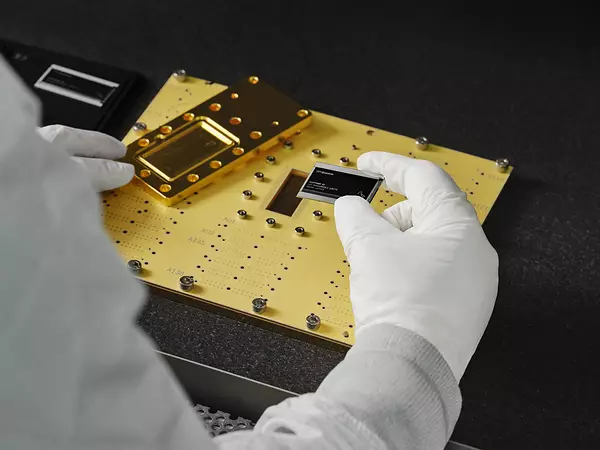
Together, these advances demonstrate critical progress in modularity and provide confidence in IBM's ability to scale Nighthawk to larger quantum computers. In 2027, IBM plans to connect two Nighthawk r3 processors into a single 1,040-qubit system, extending its high-performance architecture to larger and more complex computations.
Quantum Meets Classical on the IBM Quantum Platform
Advancing quantum computers requires continued progress in how they work alongside classical compute to handle errors. Industry-relevant workloads will demand layers of quantum error correction and error mitigation techniques alongside noise learning and post-processing. As quantum workloads scale, they will call for more classical resources, and the challenge now is how to best scale this integration.
To unite these paradigms, IBM Quantum Platform is bringing high-performance (HPC) classical and quantum computing together into a single managed environment. Users can now integrate quantum workflows directly with a range of classical compute – whether from their laptop or a powerful supercomputer – or with the HPC and classical resources that are newly available on the platform.
Users are seeing promising results from these integrations. For example, using the new environment, IBM and RIKEN* scientists executed their original sample-based quantum diagonalization (SQD) workflow roughly 5 times faster while performing 100 times more computations than in the original study. Cleveland Clinic and RIKEN also leveraged the platform to automatically process 608 million samples for modeling biologically relevant structures, 33 times faster than without workflow automation.
Enhanced capabilities will also fuel breakthroughs in quantum error correction. IBM Quantum Platform offers pulse-level capabilities to give researchers precise control over how they can detect, understand, and better correct errors within quantum and classical architectures. This helps them better time operations, reset qubits faster, and extract more information from quantum measurements – giving researchers the visibility to improve error correction at its most fundamental levels.
IBM recently launched a new co-design platform for quantum error correction with Oak Ridge National Laboratory and AMD that physically co-locates Nighthawk with ORNL's Umbra High-Performance Computing (HPC) system, powered by AMD Instinct™ MI355X GPUs and 5th Gen AMD EPYC™ CPUs.
About IBM
IBM is a leading global hybrid cloud and AI, and business services provider, helping clients in more than 175 countries capitalize on insights from their data, streamline business processes, reduce costs and gain the competitive edge in their industries. Thousands of governments and corporate entities in critical infrastructure areas such as financial services, telecommunications and healthcare rely on IBM's hybrid cloud platform and Red Hat OpenShift to affect their digital transformations quickly, efficiently and securely. IBM's breakthrough innovations in AI, quantum computing, industry-specific cloud solutions and business services deliver open and flexible options to our clients. All of this is backed by IBM's legendary commitment to trust, transparency, responsibility, inclusivity and service.
For more information, visit https://research.ibm.com.
Media contacts:
Brittany Forgione
IBM
Brittany.forgione@ibm.com
Erin Angelini
IBM
edlehr@us.ibm.com
* This project is supported by NEDO (New Energy and Industrial Technology Development Organization), an organization under the jurisdiction of Japan's Ministry of Economy, Trade and Industry (METI)'s "Research and Development of Quantum-Supercomputers Hybrid Platform for Exploration of Uncharted Computable Capabilities" (Project Leader: Mitsuhisa Sato) as part of the "Project for Research and Development of Enhanced Infrastructures for Post 5G Information and Communications Systems (JPNP20017)."
** This press release is distributed by PR Newswire through automated distribution system, for which the client assumes full responsibility. **
IBM Quantum Nighthawk Demonstrates New Levels of Speed and Quality, with Plans to Scale Beyond 1,000 Qubits in 2027
IBM Quantum Nighthawk Demonstrates New Levels of Speed and Quality, with Plans to Scale Beyond 1,000 Qubits in 2027
IBM Quantum Nighthawk Demonstrates New Levels of Speed and Quality, with Plans to Scale Beyond 1,000 Qubits in 2027