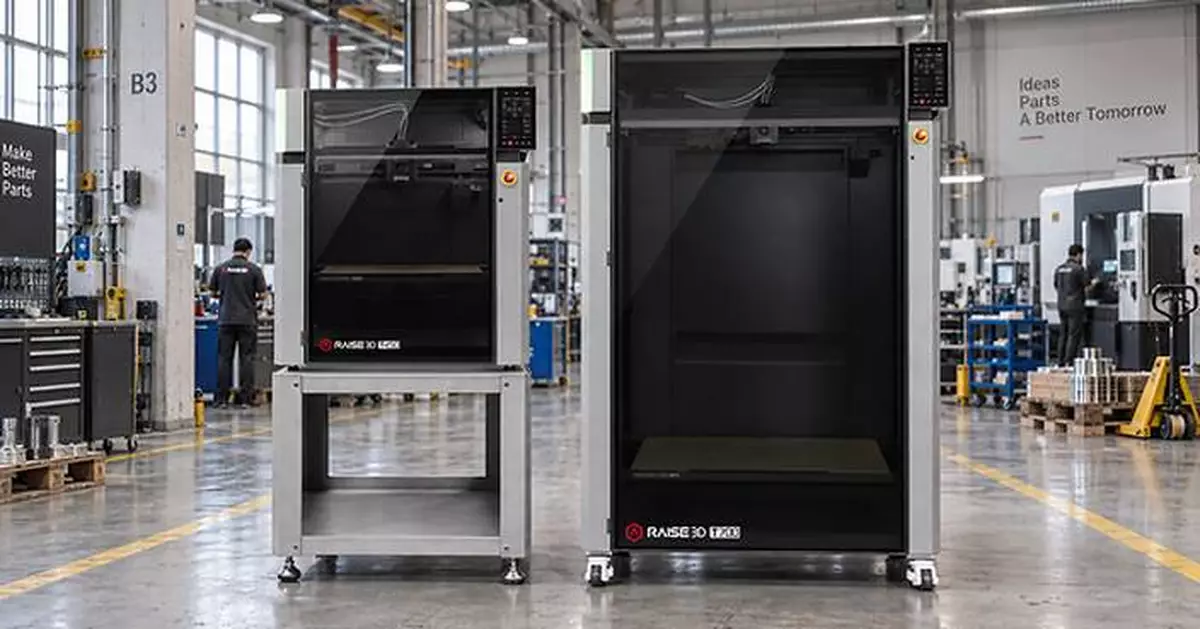
The T450 and T700 offer build volumes of 450 × 350 × 400 mm and 700 × 500 × 1,000 mm, starting at US$4,999 / €4,999 and US$15,999 / €15,999, with actively heated chambers and fiber-ready nozzles; both debut at Formnext 2026.
FRANKFURT, Germany, Nov. 11, 2026 /PRNewswire/ -- Raise3D today introduced the T450 and T700, the most affordable large-format industrial 3D printers with an actively heated chamber, extending its T Series to build volumes of 450 × 350 × 400 mm and 700 × 500 × 1,000 mm. Both will be shown for the first time at Formnext 2026 in Frankfurt from November 17 to 20.
Raise3D also announced a 100 mm build-height increase for its RMS220 selective laser sintering (SLS) printer, enabled by a software update, and introduced the B520 automated sandblaster for polymer powder bed parts. Raise3D completed a US$15 million funding round in November 2026, supporting development across large-format FFF, SLS and DLP, hardware-software integration, application development, and expansion into new applications and markets.
What Makes the Best Large-Format 3D Printer for Production?
Two questions decide the machine: whether the part can be produced in one piece, and whether the printer can run long jobs in a factory environment while continuing to make parts that meet specification. Both put pressure on motion control across a large working area and on process stability over multi-day prints, which is what the T Series is built around.
T450 and T700: Build Volume and Specifications
| Model | Build volume (W × D × H) | Build volume | Heated chamber | Standard nozzle | US price | Europe price |
| T450 | 450 × 350 × 400 mm | 63 L | up to 70°C | 0.4 mm | US$4,999 | €4,999 |
| T700 | 700 × 500 × 1,000 mm | 350 L | up to 60°C | 0.6 mm | US$15,999 | €15,999 |
Model
Build volume (W × D × H)
Build volume
Heated chamber
Standard nozzle
US price
Europe price
T450
450 × 350 × 400 mm
63 L
up to 70°C
0.4 mm
US$4,999
€4,999
T700
700 × 500 × 1,000 mm
350 L
up to 60°C
0.6 mm
US$15,999
€15,999
The T450 suits jigs and fixtures, casting patterns, large prototypes and production aids. The T700 suits large tooling, patterns and other large-format applications. Both use fused filament fabrication (FFF) and share one tech platform.
T450 and T700 Highlights
- Big parts in one piece: build volumes of 450 × 350 × 400 mm and 700 × 500 × 1,000 mm, so suitable jigs, tooling and patterns do not have to be split, bonded and finished.
- Steady motion across a long span: a 4MD CoreXY system with four frame-mounted motors, designed to reduce vibration, surface ringing and the risk of layer shifts.
- High-flow extrusion: TwinFlow™ feeds two filament paths into one nozzle, reaching up to 600 mm/s and 80 mm³/s under the reference test conditions[1], and switches to two materials for soluble supports or dual-color parts.
- Actively heated chamber: Air Flow Manager 2 adjusts the chamber by material, holding up to 70°C on the T450 and 60°C on the T700 for large ABS and nylon parts, and switching to directed cooling with an automatic top vent for lower-temperature materials such as PLA.
- Fiber-ready hot end: a 420°C nozzle and 120°C build plate, with a copper-chromium-zirconium base and solid silicon carbide tip for compounds such as PET CF, PPA CF and PPS CF.
- Built for long runs: camera monitoring, spaghetti, flow and run-out detection, power-loss recovery and an emergency stop, with RFID material identification, mesh leveling and ideaMaker support.
CEO Edward Feng said:
"Larger build areas open up applications that were previously limited by size. A scoliosis brace is one of them. It has to be printed in one piece, because a brace that is split into sections and bonded back together does not have the strength a brace needs to hold the spine. Adolescent idiopathic scoliosis affects around 1 to 3 percent of teenagers, and a build area that is too small only covers a child's torso. On the T450, an adolescent brace fits inside the 450 × 350 mm build area with room to spare, so it comes off the machine as a single part. The same reasoning applies to tooling, patterns and production aids."
Application Example: Battery Cell Transport Trays
Power-battery manufacturing puts that constraint at a different scale. Jigs and fixtures must suit different products and production lines, and conventional machining can involve long lead times and design constraints, particularly for high-mix, low-volume requirements.
For cell-transport trays, Raise3D used the T450 and T700, alongside material, structural design and process optimization. Production time fell from about 40 days to 10 days, and tray weight from about 8 kg to 2 kg, reductions of approximately 75% in both. The gain came from the combination of build area, extrusion throughput and material choice, which is the combination the T Series is built around.
From FFF to SLS: RMS220 Adds 100 mm of Build Height
Work with production customers has shown that the limit on part size is not specific to FFF. The same pressure appears in selective laser sintering (SLS), where build height decides how tall a part can be and how many parts fit in one build.
Raise3D's RMS220 SLS printer now offers a build volume of 220 × 220 × 450 mm (approximately 21.8 L), up from 220 × 220 × 350 mm (17 L). The additional 100 mm of Z height increases build height and build volume by approximately 30%, and is enabled through a software update on existing machines, without a hardware change.
The taller build space allows suitable components that previously exceeded the 350 mm height to be produced in a single build and provides more room for nesting.
B520: Automated Sandblasting for Powder Bed Parts
The same customer conversations surfaced a second constraint, one that comes after the print. Print services often run powder bed parts from more than one machine brand, and all of those parts need cleaning and surface treatment.
The B520 is an automated sandblaster for polymer powder bed parts. Its enclosed workstation combines automatic blasting, air blow-off and ionization, and a manual mode allows operators to reach deep recesses and shielded areas. Suitable parts can be processed as a programmed batch. The independent system supports the RMS220 as well as third-party SLS, MJF, SAF and HSS equipment, and its standard and large baskets have internal volumes of 24.8 L and 75.5 L, respectively.
The RMS220 update widens what can be built in one cycle; the B520 addresses what happens to those parts afterwards.
Availability and Pricing
The T450 is priced at US$4,999 in the United States and €4,999 in Europe; the T700 at US$15,999 and €15,999. Prices for the two industrial 3D printers exclude configuration, tax, shipping and service terms, which are set in the regional quotation. Deliveries of the T450 begin by the end of December 2026, with the T700 expected by the end of January 2027. Buy T450/ T700 now.
Join Raise3D at Formnext 2026
Both printers will be at Formnext 2026 in Frankfurt from November 17 to 20, in Hall 12.1, Stand D21.
| [1] The reference test conditions for TwinFlow™'s maximum volumetric flow of 80 mm³/s: Raise3D Hyper Speed ABS V2 filament, 250°C nozzle temperature and a 0.4 mm nozzle, printing a single-wall smooth structure. Actual performance depends on material, nozzle, layer height, model and print settings. |
[1] The reference test conditions for TwinFlow™'s maximum volumetric flow of 80 mm³/s: Raise3D Hyper Speed ABS V2 filament, 250°C nozzle temperature and a 0.4 mm nozzle, printing a single-wall smooth structure. Actual performance depends on material, nozzle, layer height, model and print settings.
About Raise3D
Raise3D develops 3D printers, materials, software and additive manufacturing solutions for professional and industrial applications. With offices in the United States, Europe and Asia, the company has built an ecosystem integrating FFF, DLP and SLS technologies to support workflows from prototyping to end-product production. Its quality and environmental management systems are certified to ISO 9001:2015 and ISO 14001, respectively. To Learn more, visit www.raise3d.com.
Watch the Raise3D T450 video.
** This press release is distributed by PR Newswire through automated distribution system, for which the client assumes full responsibility. **
Raise3D Launches the T450 and T700, the Most Affordable Large-Format 3D Printers with an Actively Heated Chamber