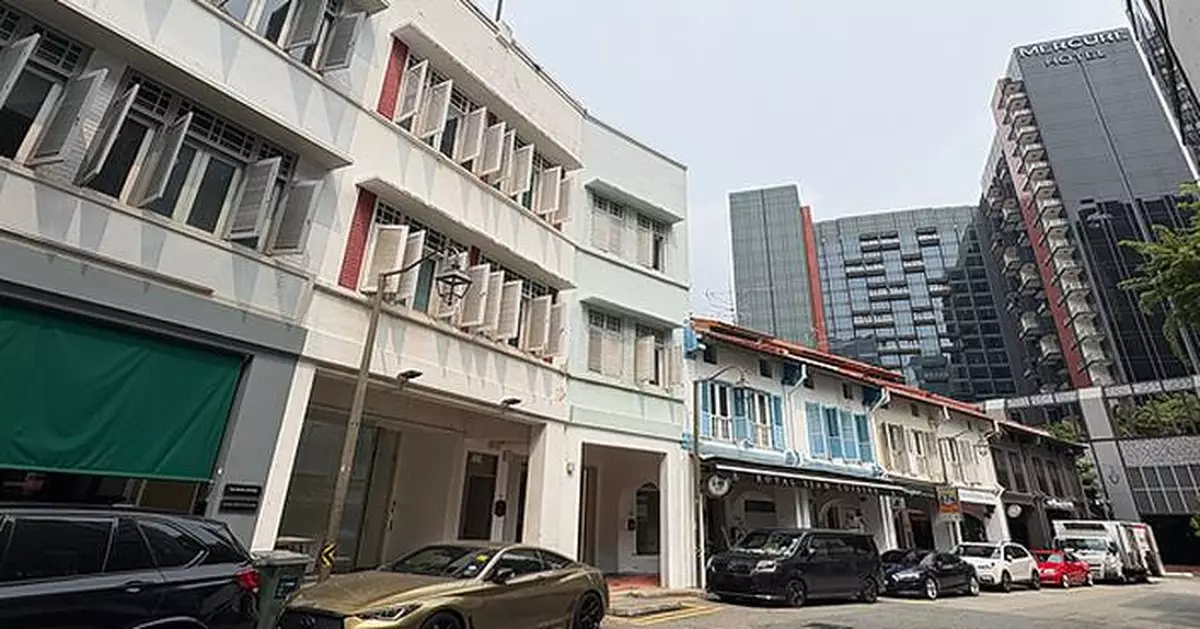
SINGAPORE, Nov. 12, 2026 /PRNewswire/ -- Brilliance Capital has been appointed the exclusive marketing agent for the sale of 14 Gemmill Lane, a fully tenanted three-storey commercial building with attic and passenger lift in the tightly held Telok Ayer–Club Street precinct. The property is offered for sale by Expression of Interest (EOI) at a guide price of S$23 million, which closes on Monday, 18 January 2027 at 3.00 pm.
Sitting on a land area of approximately 2,702 sq ft with a gross floor area of approximately 7,662 sq ft, the building is held on a 99-year leasehold tenure commencing 15 January 1996, with about 68 years remaining, and is zoned "Commercial" under the URA Master Plan 2025. It comprises eight units: a ground-floor commercial unit of approximately 2,616 sq ft, six one- and two-bedroom apartments of approximately 398 to 657 sq ft across the second and third storeys, and a three-bedroom penthouse of approximately 1,216 sq ft in the attic. Every unit is currently leased, providing purchasers with immediate recurring rental income from a diversified tenant base, without the concentration risk of a single-tenant building.
While the property lies within the Chinatown–Telok Ayer Conservation Area, it is classified as an Envelope Control Site within a Historic District and is not a conserved building. This distinction gives an owner considerably more flexibility for internal reconfiguration, upgrading works and future repositioning than a conserved shophouse would allow, subject to prevailing planning guidelines. Combined with full commercial zoning and upper floors approved for residential use, the building offers a degree of optionality that is seldom found within the precinct.
The building has been well maintained, having undergone a series of asset enhancement works between 2018 and 2026, including lift upgrading, waterproofing, façade improvements and unit renovations, which reduces near-term capital expenditure for an incoming owner. A nine-person passenger lift serves every floor, a feature that remains relatively rare among shophouses in the precinct and one that strengthens its appeal to residential and lifestyle occupiers alike.
Shophouses in Singapore's city centre have become increasingly difficult to acquire as owners hold on to what are widely regarded as defensive, scarce assets. Against this backdrop, the opportunity to acquire an entire standalone building in the Telok Ayer–Club Street precinct, where few buildings change hands, is uncommon. Against recent sale benchmarks, 14 Gemmill Lane presents a compelling entry point. The guide price of S$23 million translates to approximately S$3,002 psf on gross floor area.
Ms. Sammi Lim, Founder and Executive Director of Brilliance Capital, said: "Standalone buildings in the Telok Ayer–Club Street precinct very rarely come to market, and it is even rarer to find one that is fully let, served by a lift and not subject to conservation constraints. 14 Gemmill Lane suits investors seeking a stable and reliable rental income stream, as well as family offices and businesses looking to secure a permanent base of their own, with potential naming and signage rights to the building." She added: "Shophouse supply has been very thin this year, yet prices in the core districts have continued to rise, which tells us that demand for quality assets remains firm. Given Singapore's reputation as a safe haven, we are also seeing more buyers willing to consider well-located leasehold properties for the entry price and yield they offer. Over time, an owner may be able to create further value through tenant-mix optimisation, residential-led repositioning such as urban co-living, or other alternative uses, subject to authority approvals."
Mr. Mark Tan, Associate Director of Brilliance Capital, added: "Despite uncertainty over the direction of interest rates, we believe investor appetite for quality Singapore real estate remains strong. Borrowing costs are still significantly below their 2023 peak, while the strength and stability of the Singapore dollar continue to underpin confidence in Singapore as an investment destination. Investors are placing greater emphasis on sustainable rental income, capital preservation and long-term value. Recent major property transactions in the CBD and city-fringe locations, together with competitive bids for development sites, also reflect continued confidence in Singapore's property market and its longer-term prospects. We expect keen interest from buyers who have been waiting for the right asset in a prime location, and from businesses and investors looking to establish a long-term base in Singapore"
Strategically located between Club Street, Amoy Street, Telok Ayer Street and Cross Street, the property is approximately a three-minute walk from Telok Ayer MRT station on the Downtown Line, five minutes from Chinatown MRT interchange on the Downtown and North-East Lines, and six minutes from Maxwell MRT station on the Thomson–East Coast Line, with Raffles Place and Tanjong Pagar stations also within walking distance, giving access to five MRT lines in all. It is a short walk from Raffles Place and Shenton Way, Singapore's financial and commercial heart, and is surrounded by the precinct's well-known restaurants and bars, Far East Square, Amoy Street Food Centre and Maxwell Food Centre. This catchment of office professionals, expatriates, residents and visitors underpins resilient leasing demand for both the commercial and residential components.
Combining genuine scarcity, full occupancy, a rare passenger lift, non-conserved flexibility and an attractive entry price relative to recent transactions, the asset is expected to attract strong interest from private investors, hospitality operators, family offices and owner-occupiers seeking a long-term foothold in Singapore's CBD. The property is offered for sale by Expression of Interest through the exclusive marketing agent, Brilliance Capital Pte. Ltd., with the exercise closing on Monday, 18 January 2027 at 3.00 pm.
Note to editors:
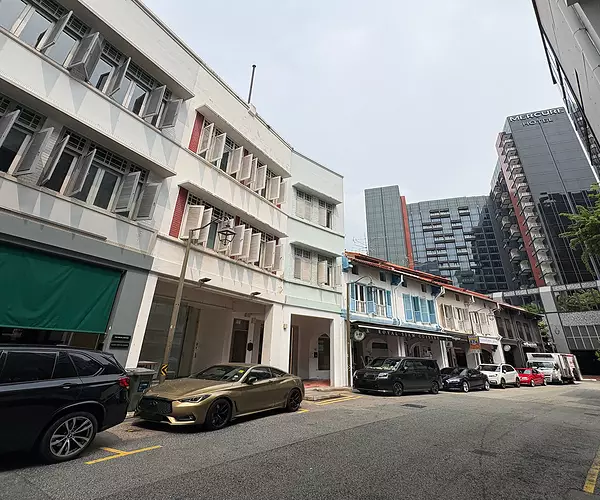
High-resolution photograph of 14 Gemmill Lane is enclosed.
About Brilliance Capital Pte. Ltd.
Brilliance Capital is a full-service real estate agency that assists and advises ultra-high net worth individuals, local and foreign family offices, as well as property developers, publicly listed companies, and local and overseas private funds on the purchase and sale of real estate assets. Founded and led by Sammi Lim, the firm engages the industry's most elite professionals, and boasts a dynamic team of agents specializing in the sale and leasing of the entire spectrum of properties which include residential condominiums, landed houses, commercial properties, industrial assets, collective sales, as well as consultancy and advisory services.
** This press release is distributed by PR Newswire through automated distribution system, for which the client assumes full responsibility. **
Rare Fully Tenanted Standalone Building at 14 Gemmill Lane in the Telok Ayer-Club Street Precinct Launched for Sale by Expression of Interest
HONG KONG, Nov. 12, 2026 /PRNewswire/ -- "AI delivers breadth and efficiency; humans provide depth and decision-making." On November 2, at the Hong Kong FinTech Week 2026 × StartmeupHK panel, Jieyong Lyu, Founding Partner and Chief Executive Officer of Alpha2Fund, described how the firm puts human-machine collaboration to work in quantitative research.
Founded in 2015, Alpha2Fund focuses on quantitative investment strategies and manages approximately RMB 60 billion in assets. It has offices in Beijing, Shanghai and Hong Kong, and in 2025 obtained Type 4 (advising on securities) and Type 9 (asset management) regulated activity licences from the Securities and Futures Commission (SFC) of Hong Kong.
Lyu's central view is that large language models (LLMs) have sharply improved the efficiency of quantitative research without changing how alpha is generated. The more widely available the tools become, the more crowded similar strategies become. What is genuinely scarce is the distinctive capabilities honed through accumulated data, live-trading validation and risk-management discipline.
This Wave of AI Is Different
Lyu divides the development of AI into several phases. The earliest stage was that of rule-based expert systems, epitomized by Deep Blue's 1997 victory over world chess champion Garry Kasparov. Around 2016–2017, AlphaGo set off another wave of enthusiasm, and quantitative investment became one of the fields where AI was put to work. With ChatGPT's launch in late 2022 and the LLM wave of 2023, "AI" in the narrow sense now mostly means LLMs.
"AI is nothing new to quantitative investing; we have been using machine learning for years," Lyu said. "But this wave really is different."
What makes it different? In his view, LLMs have for the first time made technical capabilities available on demand. Whether a piece of research could move forward used to depend heavily on how many engineers and how much computing power a team had. Compute requirements have not changed, but the skill requirements for engineers have shifted. The focus of competition among institutions has shifted from "whether we can build it" to "what we build, and how we judge it."
Democratized Tools Do Not Mean Democratized Alpha
For Lyu, the democratization enabled by LLMs takes two forms.
First, the democratization of tools. Running an experiment used to be hard, especially a coding-heavy one: setting up the environment and writing code both required substantial expertise. With AI coding tools, the barriers to writing code and processing data have fallen sharply.
Second, the democratization of knowledge. No professor or scientist can match an LLM, whose stock of knowledge is a superset of any individual's. Even someone in a remote mountain village, as long as they can connect to AI, can access the world's most advanced knowledge.
In quantitative investing, however, that democratization does not hold.
"Quantitative investing is a deeply research-driven pursuit, much like scientific exploration in universities and research institutes," Lyu said. "AI has brought enormous change, but much of what is essential, above all the insight and understanding that only humans have, cannot be replaced by machines."
He summed up Alpha2Fund's approach in one phrase: human-machine collaboration, each offsetting the other's weaknesses.
In practice, Alpha2Fund uses AI to widen research coverage and iterate faster. The critical decisions, whether a signal is effective and whether it should enter the portfolio, remain in human hands. AI does not make risk-management decisions, and agents do not execute trades on their own.
Lyu argues that however advanced the tools become, the only way to earn excess returns is to build something others have not built; if a firm only builds what others have already built, profits are usually hard to come by. If AI makes every institution smarter, alpha does become scarcer and strategies do become more crowded, but the crowding is concentrated in similar strategies. Genuinely differentiated capability, by contrast, becomes harder to replicate.
2010–2026: A Market-Tested Path for Quantitative Investing in mainland China
Looking back at how quantitative investing developed in mainland China, Lyu traces the starting point to April 2010, when CSI 300 index futures were listed. The arrival of derivatives and hedging tools led the industry to call that year "Year One" of quantitative investing.
Before that, investment in mainland China was dominated by discretionary strategies. With few investment tools to draw on, portfolios largely rose and fell with the market. Quantitative investing brought the first real change: it made tracking a broad-based index while seeking excess returns a repeatable process, and with hedging added on top, it became possible to earn returns less correlated with market moves.
Over sixteen years, a nascent strategy has grown into a large-scale industry. Lyu attributes that growth to four conditions:
First, a clear direction. Quantitative investing was a model imported from overseas, and it was also a model mainland investors genuinely needed. It gave them more choices: those seeking excess returns had a way to track an index; those seeking lower volatility had a hedged approach with lower correlation to the market. A model brought back from mature overseas markets happened to match long-unmet demand in mainland China. The direction was right from the start.
Second, a solid engineering foundation. Quantitative investing places heavy demands on engineering: data, backtesting and trading systems each rest on engineering capability. Mainland China's education system has produced a large supply of STEM talent, and years of growth in the internet industry have developed a pool of experienced engineers. Moving into quantitative finance, they could apply their engineering experience almost seamlessly, and the industry's foundations grew steadily stronger.
Third, a virtuous cycle between the market and talent. When investors earn positive returns, the wealth effect draws talent. More and more top professionals who built their careers at leading global institutions have chosen to return to mainland China, bringing back methods, engineering expertise and perspectives, and the industry's intellectual base has deepened. As industry standards rise, investors get better service. Once this loop starts turning, the industry's growth reinforces itself.
Fourth, accommodating yet prudent regulation. Compared with mature overseas markets, quantitative investing is still new in mainland China, and regulators have developed a clear understanding of it and monitored it closely: they have gradually adapted the rules to the industry's development while leaving room for innovation. An emerging industry that develops within clear rules can achieve more sustained and stable growth.
Looking ahead, the industry still faces multiple uncertainties. "Views on mainland China's economic environment differ, but I personally remain very optimistic," Lyu said. "In a relatively favorable environment, this positive cycle can continue."
Hong Kong: A Launchpad for Global Expansion
On Hong Kong's role, Lyu was direct: with its strong links to mainland China, Hong Kong is a gateway for mainland quantitative firms expanding internationally. In his view, Hong Kong's value comes down to three things:
First, capital channels. Hong Kong has a mature and open environment for cross-border capital flows, providing access to institutional capital from Europe, the US and elsewhere. It is the first stop for entering international markets.
Second, talent. Hong Kong has a clear edge in its concentration of financial and international talent. In international competition, talent comes first, and Hong Kong offers substantial opportunities for collaboration on that front.
Third, policy and compliance. Alpha2Fund obtained its SFC Type 4 (advising on securities) and Type 9 (asset management) licences in 2025, the basis for conducting asset management business in Hong Kong. A clear compliance framework and legal system are essential to a firm's long-term global expansion.
"We hope to use Hong Kong as our international platform for long-term growth," Lyu said. Drawing on Hong Kong's cross-border capital access, talent pool and compliance regime, Alpha2Fund will turn the quantitative research capability it has built up in mainland China over the years into a lasting competitive advantage, through differentiated positioning and adaptation to local markets. Rooted in Hong Kong, the firm will compete in the global asset management market.
** This press release is distributed by PR Newswire through automated distribution system, for which the client assumes full responsibility. **

Alpha2Fund's Jieyong Lyu: AI Democratizes Tools, Yet the Source of Alpha Remains Unchanged