JUNEAU, Alaska (AP) — Alaska voters have elected a Democrat for governor for the first time since 1998, part of a national midterm elections wave that gave the party sweeping wins in state governments across the country.
Former state lawmaker Jonathan Kreiss-Tomkins defeated three Republicans, including one endorsed by President Donald Trump. His victory means Democrats will control the governor's office in 30 states, including several they flipped after years of Republican control in places such as Iowa, Georgia, Ohio and Texas.
Kreiss-Tomkins, often referred to as JKT, completed a political comeback three years after leaving the state House. He traveled throughout Alaska to build his coalition and focused on affordability, advocated for full funding of public schools and called for all oil and gas producers to pay corporate income tax. He also sought a moratorium on new data centers until state lawmakers pass regulations for their development.
He said Alaska had become “broken” under eight years of outgoing Republican Gov. Mike Dunleavy and needed a change. He cited among other issues a state ferry system that he said has been left in shambles, with routes to many communities cut drastically. The ferry is a key mode of transportation for southeast Alaska communities not connected by roads, some of which also have limited air service.
Kreiss-Tomkins, 37, emphasized a willingness to work across party lines and said he wanted a Cabinet with Republicans, Democrats and independents.
“If they’re competent, if they’re service-minded, if they’re entrepreneurial, if they’re problem-solvers, you’re on the team. Game on,” he said during a candidate forum last month. “Let’s go, and let’s get Alaska back on track.”
Republican U.S. Sen. Lisa Murkowski, who has at times been at odds with her party, including Trump, endorsed Kreiss-Tomkins a week before the election. She said Kreiss-Tomkins “understands that governing requires listening to people with different perspectives and finding common ground to solve the problems all of us face.”
Three former governors including Democrat Tony Knowles, independent Bill Walker and Republican Frank Murkowski, the senator’s father, also endorsed him.
In a statement declaring victory earlier Friday, Kreiss-Tomkins said voters wanted change and “a government that works across party lines to move Alaska forward. Our administration will not waste a single day getting to work to solve problems for Alaska.” He said his campaign had more than 10,000 donors.
His campaign did not immediately respond to requests for comment after The Associated Press called the race.
He defeated Republicans Bernadette Wilson, Dave Bronson and Treg Taylor. Trump had endorsed Wilson, a business owner, and criticized the other Republican candidates for staying in the race. Bronson is a former mayor of Anchorage, Alaska’s largest city, while Taylor was a state attorney general under Dunleavy.
Bronson congratulated Kreiss-Tomkins on social media and wished him success. A message seeking comment from Wilson's campaign was not immediately returned.
Many Republicans saw ranking as their party’s best shot of retaining the governor's seat. It was a message that conflicted with that of Trump, who has consistently complained about Alaska’s unusual voting method, including during a rally in Alaska in October.
Kreiss-Tomkins finished first in August’s open primary, followed by a second Democrat, Tom Begich, who withdrew from the race. Begich’s campaign at the time said it had concluded that the “strongest path to victory is to bring Democratic voters, donors and resources together behind one candidate.” Wilson finished third in the primary.
Kreiss-Tomkins said compromise “is a virtue, not a dirty word,” and said he saw the mission of the new governor as working with lawmakers to resolve longstanding problems in the state.
The state’s last Democratic governor, Tony Knowles, left office in 2002 after serving back-to-back terms. Walker served from 2014 to 2018.
Kreiss-Tomkins will be sworn in Dec. 7. His lieutenant governor is Zac Johnson, an independent.

FILE - An advertising blimp for Alaska gubernatorial candidate Jonathan Kreiss-Tomkins is seen, Nov. 1, 2026, in Wasilla, Alaska. (AP Photo/Lindsey Wasson, File)

FILE - Alaska gubernatorial candidate Jonathan Kreiss-Tomkins, a Democrat, speaks to people outside a convention center in Juneau, Alaska, June 6, 2026. (AP Photo/Becky Bohrer, File)
PARIS (AP) — In a contest of who has the firmer handshake, it's not a stretch to suggest, as he does, that French judo great Teddy Riner would get the better of Donald Trump if ever they were to meet as presidents of their respective countries.
But that's a big “if.”
Even with five Olympic gold medals under his black belt and more than 3.3 million followers on his socials, Riner's newly announced bid for the presidency of France is likely to be a harder contest than many of the judokas he crushed.
The list of celebrities who successfully campaigned for elected office is shorter in France than in the United States, where Trump, Ronald Reagan, Arnold Schwarzenegger, Jesse Ventura, two-time NBA champion Bill Bradley, former Buffalo Bills quarterback Jack Kemp and others turned small-screen, big-screen and sporting stardom into political power.
Two-time Olympic champions David Douillet, in judo, and Jean-François Lamour, in fencing, and Guy Drut, the 110-meter hurdles champion at the Montreal Olympics in 1976, won seats in France's parliament in retirement and served as sports ministers. But Riner is aiming to be the first celebrity to hold France's top office since World War II hero Gen. Charles de Gaulle.
To appear on the ballot for the first round of voting in April, Riner needs a minimum of 500 elected officials to sponsor his candidacy, a requirement designed to not be easy.
The measure, intended to limit the size of the field and filter out fanciful candidacies, is an indication of how France has traditionally regarded running the country as a serious business. It has been in place since the 1981 election and was one of the barriers that foiled a presidential bid by comedian and actor Coluche that year.
“In France, there are complex hurdles to entry for people who don’t come from the establishment,” said François Hourmant, a professor of political science at Angers University who has studied celebrity culture in French and North American politics.
“Moving from the tatamis to the political arena isn’t that simple, and isn’t something everyone can do,” he said in a phone interview with The Associated Press.
A thicket of cameras that greeted the 37-year-old on Friday, when he made his first campaign stop at a hospital in the northern suburbs of Paris, testified to the star power that Riner brings to the race.
Looking fighting fit in a dark suit and open-neck shirt, he towers over everyone from the height of his 2.04-meter (6-foot, 8-inch) frame. His imposing physicality and easy charisma translate readily to television.
But the policy proposals Riner plans to bring to the campaign remain unclear. He describes himself as neither left nor right on the political spectrum and says France “needs common sense” and not “a professional politician who recites lessons and squabbles all day long.”
In a two-minute, 37-second video that launched his campaign Monday and in an interview with the newspaper Le Parisien, Riner spoke of problems that he sees in France, among them “fear,” “anger,” a “social divide” and people unable “to envisage a future.” But he offered few solutions or blueprints for building what he called “the France that we want.”
Outside the hospital after meeting staff members, Riner said he is still working on his campaign platform and didn't answer questions, responding with a “have a good rest of the day, au revoir” before heading back to his car.
Far-right candidate Marine Le Pen, widely seen for now as the favorite to succeed President Emmanuel Macron in May, took a gentle swipe during a campaign stop of her own on Friday, saying she couldn't form an opinion about Riner's bid without knowing anything about his platform.
As a dominant judoka whose mantra was “Never let anyone steal your beefsteak,” Riner told the AP in 2013 that he would sometimes wrestle up to five people at once in training to make it more challenging. As a fledgling politician, he says he is steeled for more rough-and-tumble.
“When you know how to take punches, you also know how to throw them,” he told Le Parisien.
The rise of Le Pen and the challenge she faces from the other end of French politics from far-left leader Jean-Luc Mélenchon together suggest a swath of French voters want deep and disruptive change.
But analysts believe many also want a seasoned hand to deal with the multitude of domestic and international challenges that France faces, including its record public debt and the threat to European security posed by Russian President Vladimir Putin and his war in Ukraine.
“Teddy Riner certainly embodies renewal, but he doesn’t necessarily embody experience. So that is probably one of his main disadvantages,” said Mathieu Gallard, research director at the Ipsos polling institute.
Riner, who is Black, was born on the French Caribbean island of Guadeloupe and grew up in Paris. Both Gallard and Hourmant said the potential that Riner is more likely to understand and combat discrimination could attract people of color in an election where Le Pen's party and others on the far right are again seeking to focus on immigration.
“But again, is that enough to translate into votes,” Gallard asked.
“Teddy Riner’s skin color will be a political issue for some people,” Hourmant said. For some, “it may be a reason to support him, seeing a racialized candidate from the overseas territories. For others, it will be a deterrent.”
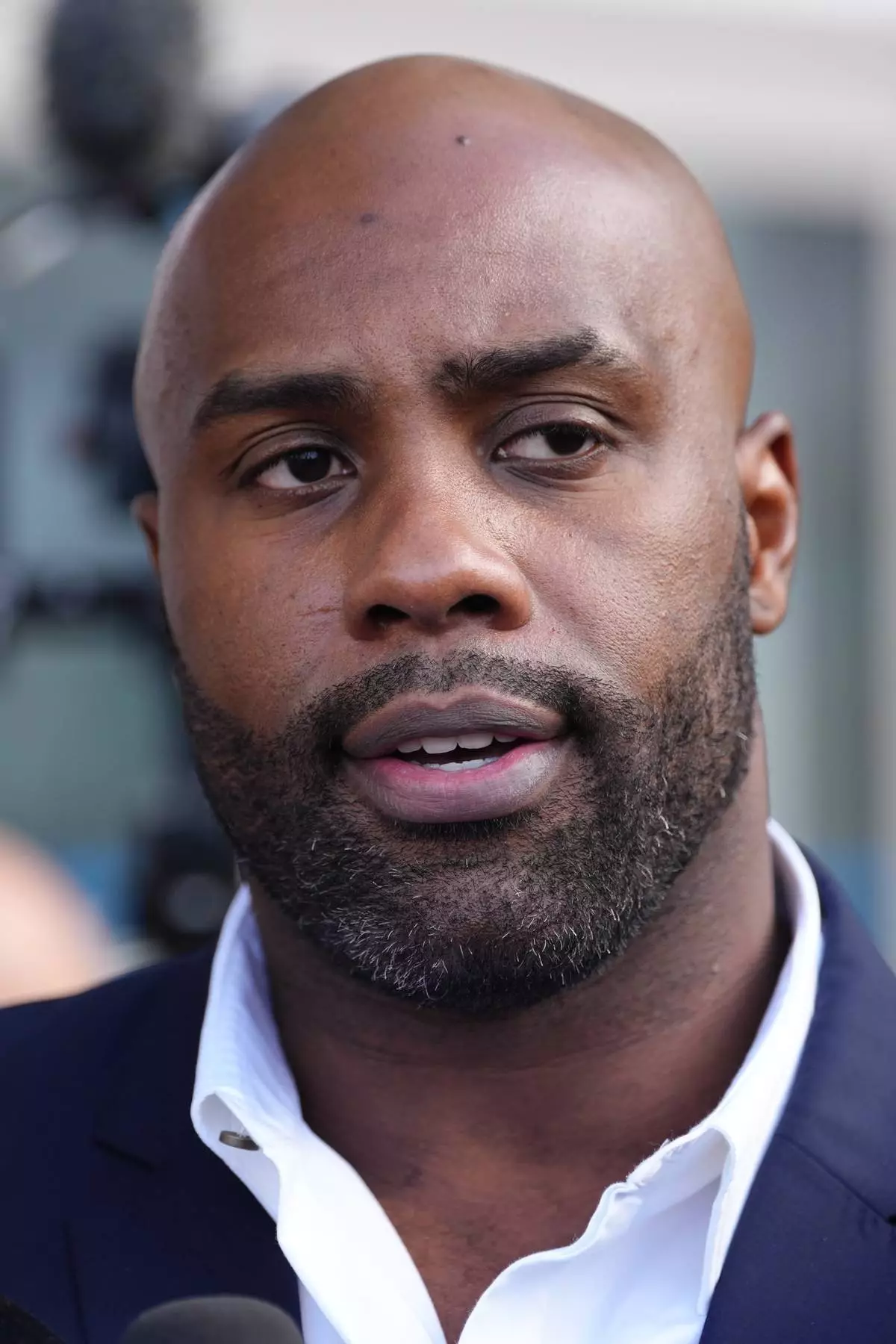
French judo champion and 2027 French presidential candidate Teddy Riner speaks to the press after visiting Delafontaine Hospital in Saint-Denis, outside Paris, Friday, Nov. 13, 2026. (AP Photo/Aurelien Morissard)
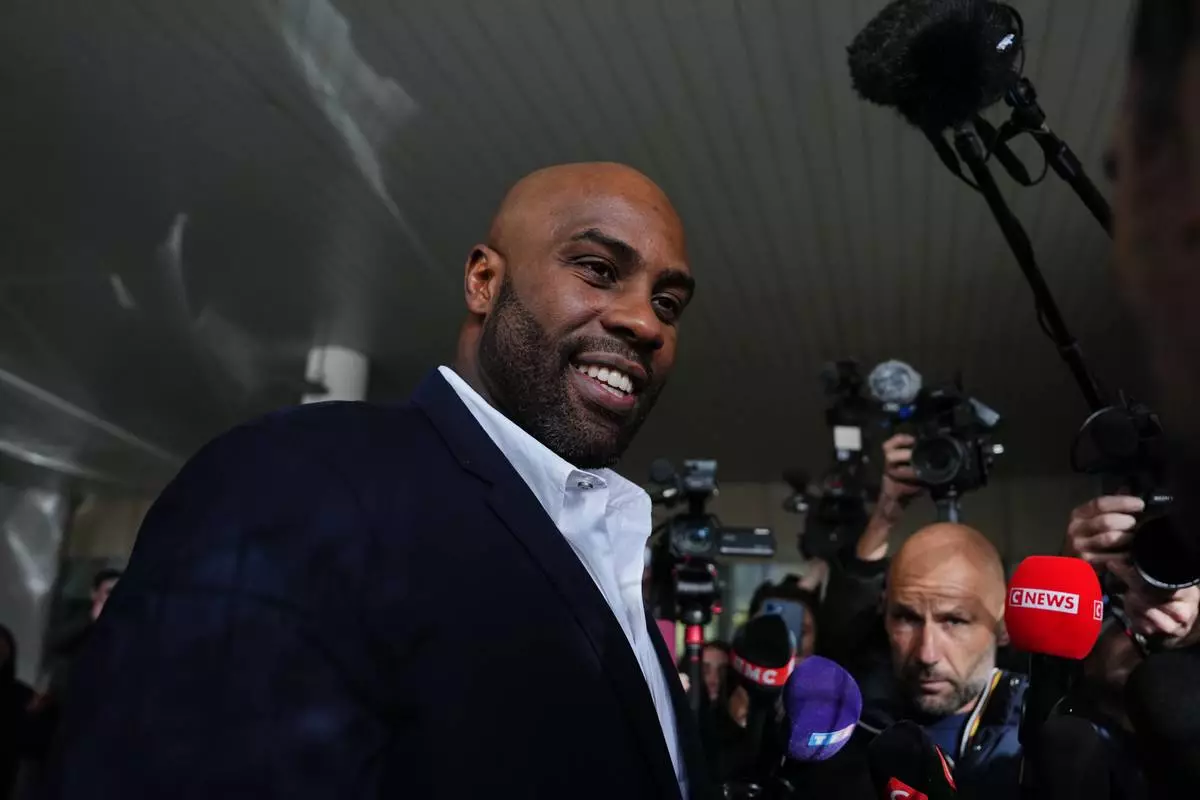
French judo champion and 2027 presidential election candidate Teddy Riner speaks to the media upon arriving for a visit to Delafontaine Hospital in Saint-Denis, outside Paris, Friday, Nov. 13, 2026. (AP Photo/Aurelien Morissard)
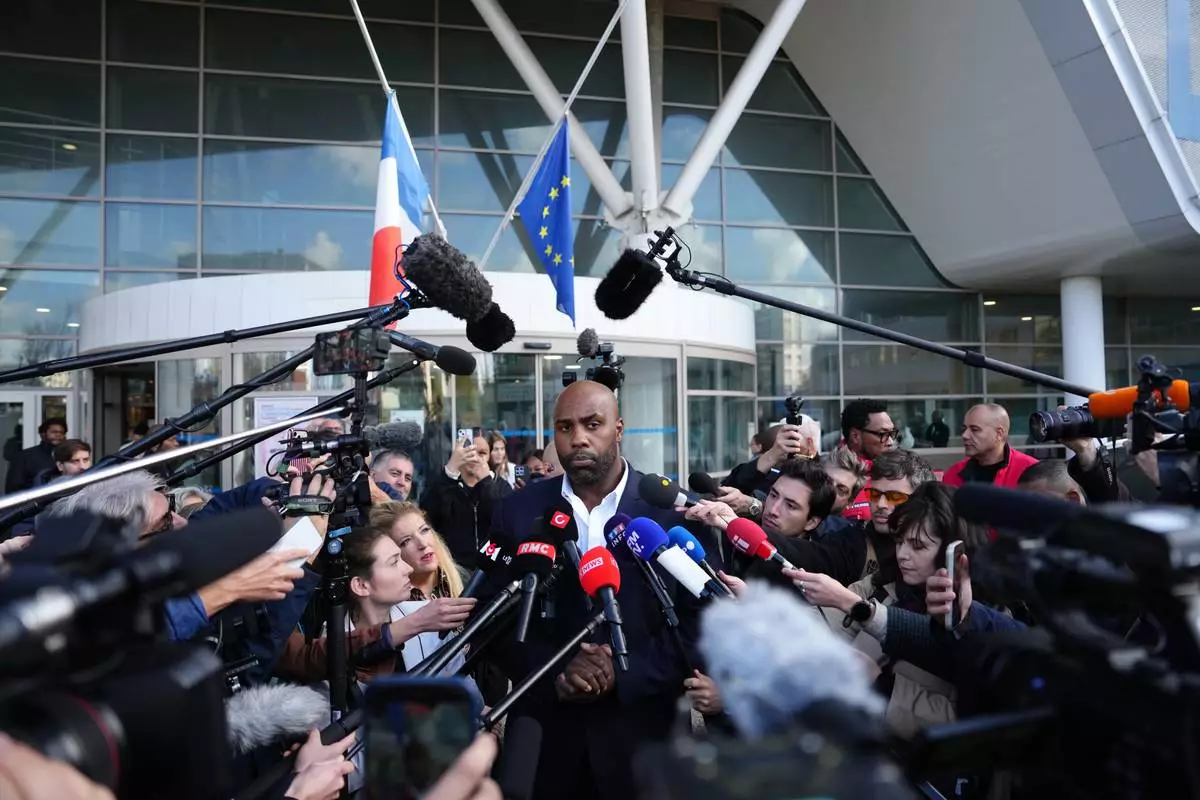
French judo champion and 2027 French presidential candidate Teddy Riner speaks to the press after visiting Delafontaine Hospital in Saint-Denis, outside Paris, Friday, Nov. 13, 2026. (AP Photo/Aurelien Morissard)