Spanning heavy industrial machinery and fresh agricultural produce, APEC-backed trade links are forging a dynamic cross-Pacific supply chain that drives operational efficiency and raises living standards on both sides of the ocean.
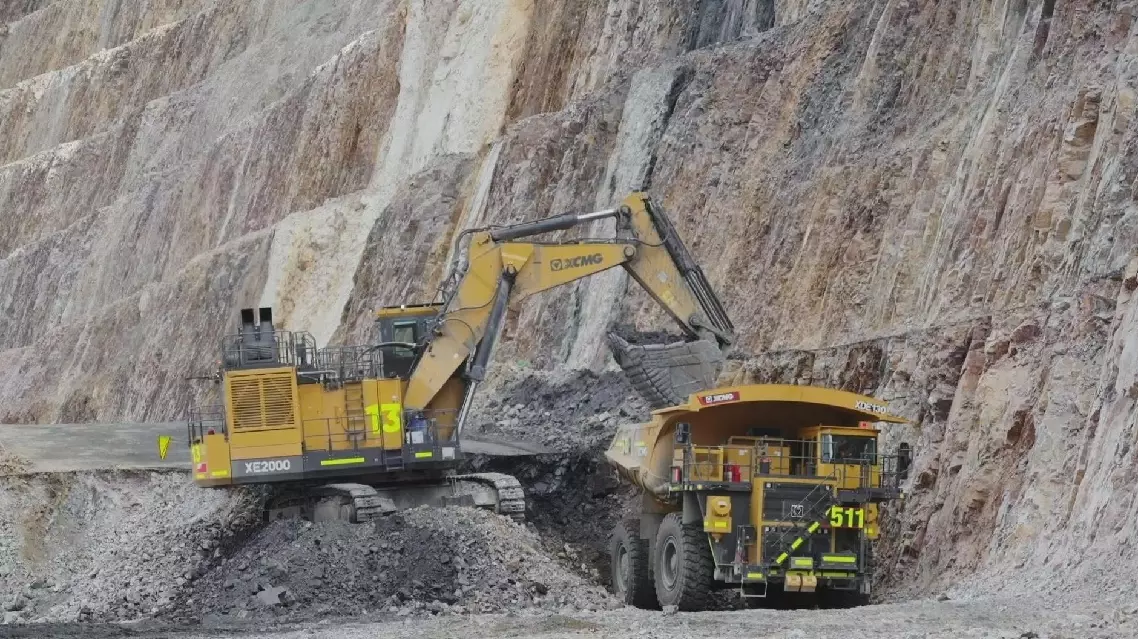
High in the Peruvian Andes, at the La Arena mining site, fleets of heavy-duty mining trucks from China's Xuzhou Construction Machinery Group (XCMG) run around the clock hauling massive loads of rock and ore.
"These trucks, due to their size, have the panoramic facility for us to operate. The turning radius, these are shorter, which makes it much easier for us to make short turns," said truck operator Julio Cesar Cuba Chavez.
The deployment of this Chinese-made heavy equipment to one of the world's highest mining sites exemplifies the deepening industrial integration under the APEC framework. As trade links among member economies grow stronger, the transport time for such oversized cargo has been nearly halved.
"APEC has brought many advantages to its member economies. Given that mining equipment is typically large-scale, the entire transport process is quite complex; however, what once took 40 days to ship can now be completed in 23 days," said Du Huayang, representative of XCMG Peru.
The efficiency gains extend beyond outbound shipments. After delivering large, heavy machinery to overseas clients, the cargo ships returned fully loaded with a variety of fruits.
"China has got one of the highest consumption of fruit per capita anywhere, much higher than most other parts of Asia," said Ivan Kinsella, head of corporate affairs China at Zespri International, the world's largest kiwifruit seller.
China's annual imported fruit market is valued at nearly 20 billion U.S. dollars, ranking among the largest worldwide. For exporters like Zespri, the country's appetite for almost year-round fresh produce has made APEC trade facilitation a decisive competitive advantage.
"New Zealand kiwifruit is very popular from the end of March right through the end of the year. So, it's more about the complementarity of the growing seasons. For one of the important parts, which is being facilitated by APEC is that, the clearance rate, the speed which the fruit gets through the customs process, gets through the checking, has been greatly sped up over the last few years," said Kinsella.
Behind every box of imported fruit and every piece of heavy machinery lies a sophisticated shipping network connecting APEC economies across South America, China and other Asia-Pacific markets -- a trend witnessed by shipping executives in Shanghai ports.
"This vessel is from South America and it shows domestic import demand has grown steadily in recent years -- proof of China's development and rising living standards," said Huang Chunhui, an executive at COSCO Shipping.
APEC trade links cut shipping time, boost supply efficiency
From China's tokens and software to Malaysia's AI studios and offices, China's digital services are building a digital foundation for Asia-Pacific businesses.
As Malaysia's short-drama and AI animation scene is starting to take off, creators at Sunstrong Entertainment, a leading film production and cultural entertainment company, are using AI to generate scenes, characters, and effects -- work that requires millions of tokens.
"The biggest chance we see is [to] give more choice and more opportunity for audience, [and] get more entertainment option," said Jment Lim, founder of Sunstrong Entertainment.
But the digital brain behind some of this work is 3,000 kilometers away in Shantou, south China's industrial powerhouse of Guangdong Province, from which the tokens -- the smallest unit of information processed by a large AI model -- are going overseas through submarine optical cables to Malaysia and other Southeast Asian countries.
In April 2026, Shantou became the first city in China to export tokens. The process spans offshore data centers, token production and overseas applications, with data transferred in compliance with regulations.
Shi Yang, who works at one of the city's token production facilities, said it comes down to four factors.
"There are abundant international submarine cable resources, rich offshore wind power resources, pilot areas for token exports, and overseas Chinese business networks connecting Southeast Asia," said Shi, general manager of Guangdong Suihong Token Overseas Technology.
And those advantages are already showing up in the numbers.
"So far, average daily token invocations have risen from 100 million to 100 billion. We have rolled out 10 policies on token exports, and established overseas AI service centers in 10 countries, including Thailand, Singapore, and Malaysia," said Fang Xiaomin, deputy director of the management committee of China (Shantou) Pilot Zone for Economic and Cultural Cooperation with Overseas Chinese.
But sending data across borders also means strict compliance rules. That's where Daria Peng's company comes in.
"We use secure connections, access control, limited data use, and clear use for data storage and deletion," said Daria Peng, founder and CEO of Daxi Technology.
Tokens and computing power AI, but software is needed to run a cross-border business, and Shenzhen is one of China's top software export hubs. In 2025, its digital trade alone exceeded 66 billion U.S. dollars.
Kingdee is one of the companies driving that flow. Last year, Kingdee added 463 new overseas clients, including Chin Hin Group in Malaysia, where teams use Chinese software to run finance and operations across borders.
"One thing about Kingdee is that the AI operating system is called Lingee, it's seamlessly integrated. You don't need additional MCP to make it happen, right? In that context, I think most of -- 80 percent of -- the issue has been resolved within the day," said Abel Saw, chief transformation officer of Chin Hin Group.
"Kingdee has been expanding across key markets including Singapore, Malaysia, Indonesia, Vietnam, Thailand, Qatar, Hong Kong Special Administrative Region and Macao Special Administrative Region, aiming to build local marketing, delivery, customer success and R and D capabilities. We are also building an open partner ecosystem," said Daniel Xu, president of Kingdee International Holdings.
And that ecosystem is already happening on the ground as China’s trade in digitally deliverable services reached over 432 billion U.S. dollars in 2025.

China's tokens, software empower Asia-Pacific businesses