JUBA, South Sudan (AP) — South Sudan has again postponed its first national elections since independence in 2011, moving polling from December to February amid concerns about insecurity, funding shortages and the country’s readiness to vote.
A revised timetable published Saturday by the National Election Commission sets Feb. 11, 2027, as polling day, replacing Dec. 22. The document did not give a reason for the postponement.
The polls have been repeatedly delayed, including in 2022 and 2024. The latest announcement follows warnings that elections could further unravel the country’s fragile peace.
The commission published the timetable on social media on the day voter registration was scheduled to begin. It also sets dates for candidate nominations and campaigning.
A day earlier, commission chairperson Gabriel Bol Deng told journalists in Juba that registration would run from Nov. 14 to Nov. 28 at 3,161 registration centers across the country’s 10 states and three administrative areas.
Deng urged eligible citizens to register and called on political parties, civil society groups, community leaders and the media to help raise public awareness.
South Sudan became independent from Sudan in 2011 after decades of civil war. A new conflict broke out in 2013 between forces loyal to President Salva Kiir and followers of his rival, Riek Machar. A peace deal was signed in 2018 and a transitional government of national unity was formed in 2020.
Fighting between government and opposition forces escalated in early 2025, and Machar was placed under house arrest in Juba that March. He and seven co-defendants are on trial on charges including treason, murder and crimes against humanity linked to an attack on an army garrison in Nasir, in the northeast. They deny the charges.
The transitional unity government was dissolved in September and replaced by a caretaker administration.
The South Sudan Civil Society Forum said in a statement issued in late October that conditions did not support fair, credible, peaceful and inclusive elections within the remaining time. It called for an inclusive dialogue on electoral preparations and the country’s transition.
Kiir’s ruling Sudan People’s Liberation Movement, or SPLM, has been holding primaries across the country. But there has been little electoral activity among other registered parties, Anita Kiki Gbeho, head of the United Nations Mission in South Sudan, told the U.N. Security Council on Nov. 10.
“Elections must be a milestone in the transition, not its conclusion. Elections cannot substitute for political dialogue, confidence-building and continued implementation of the Peace Agreement,” she said.
On Thursday, two SPLM delegates were killed in an attack in Miri Loko village, in Western Equatoria state, while returning from party primaries and congresses, officials said. It was the third security incident affecting the party’s primaries and congresses in the state, according to Deng Dau Deng, who chairs the SPLM’s high-level committee there.
One of those killed was Veronica Lucy Gordon, a former South Sudan Broadcasting Corporation journalist who had recently been nominated to contest a women’s seat in the National Legislative Assembly.
Edmund Yakani, director of the Community Empowerment for Progress Organization, condemned the attack, urging those opposed to the delegates’ political views to pursue dialogue rather than violence.
Following news of the postponement, Yakani called for transparency in the commission’s decisions. He also said the locations of registration centers remained unpublished on the day registration was scheduled to begin, leaving citizens without clear information about where to register.
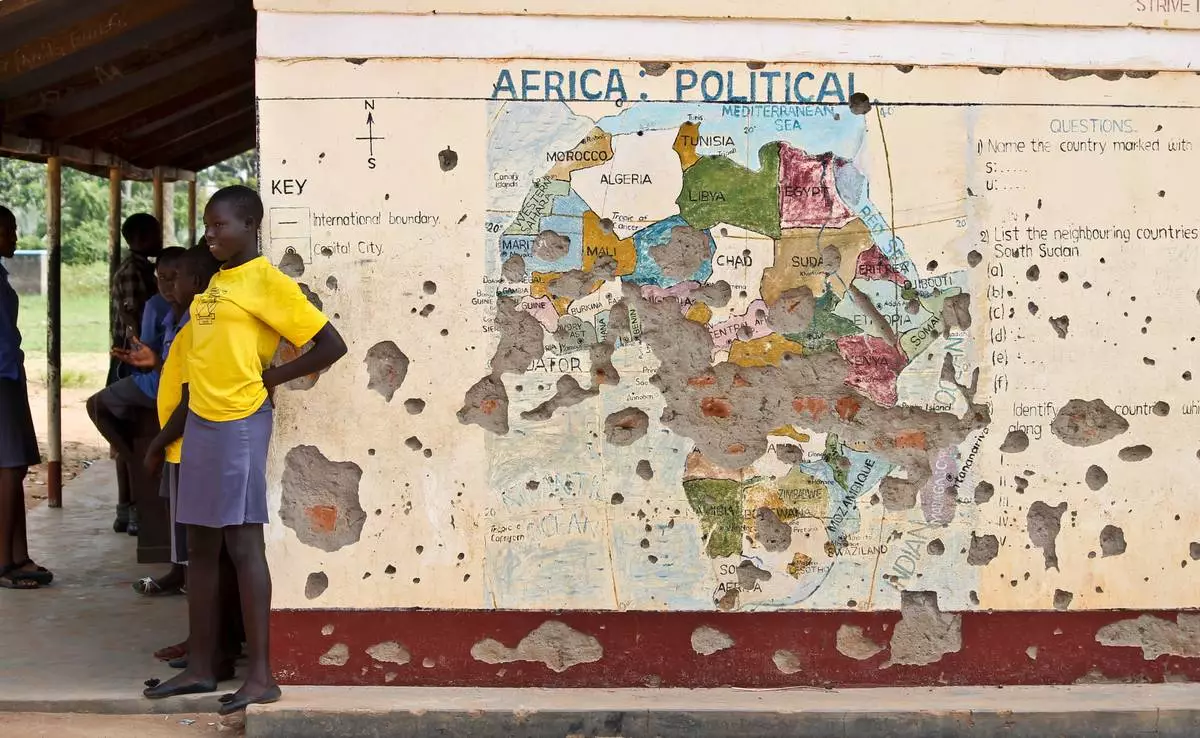
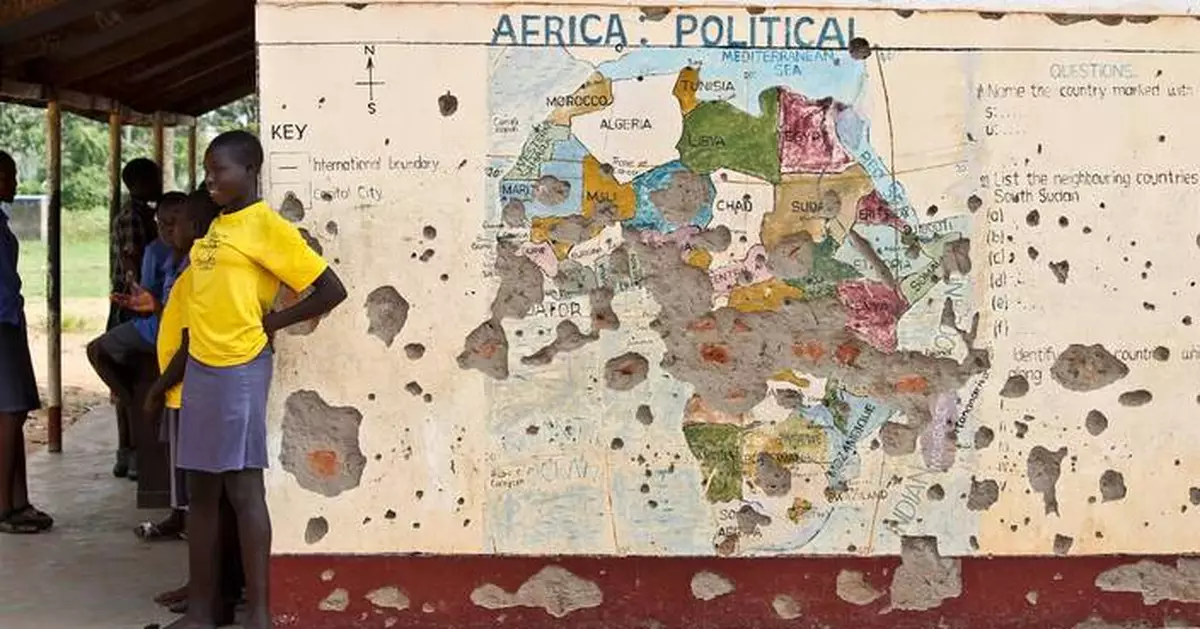
File - In this photo, taken Nov. 15, 2016, students line up outside a classroom with a map of Africa on its wall, in Yei, in southern South Sudan. (AP Photo/Justin Lynch, File)
PHNOM PENH, Cambodia (AP) — Emmanuel Macron is set to attend a biennial meeting of French-speaking territories beginning on Saturday in Cambodia, where the French president contending with public unrest at home will face international political challenges as a conflict in Africa hangs over the proceedings.
The Organisation internationale de la Francophonie, or OIF, is holding the three-day meeting through Monday in the Cambodian capital, Phnom Penh. Macron is expected to engage in bilateral discussions and join the summit meeting of the loose confederation of 90 member states and governments comprising 53 full members, five associate members and 32 observers — all French-speaking places.
Cambodia will take over the summit's chairmanship from Macron, who served as chair in 2024 when France was the host nation.
Before departing for Malaysia on Monday, Macron is to visit the famed Angkor World Heritage Site near the city of Siem Reap, where he and King Norodom Sihamoni will mark the completion of a French-supported restoration of the West Mebon temple.
Macron's trip comes at a time of widespread domestic protests, with more than 600,000 people taking to the streets earlier this month to demand higher wages and support the country’s student protest movement. The protests have seen thousands of arrests, hundreds of injuries and schools set on fire.
The summit's sticky diplomacy will be on display on Monday when Macron and other leaders will decide who will serve for the next four years as secretary-general — the group’s leader and chief executive.
The choices initially included candidates from two bitterly feuding African members, Rwanda's Louise Mushikiwabo, who is seeking reelection to a third four-year term, and the Democratic Republic of Congo's Juliana Lumumba, the 71-year-old daughter of the country’s martyred independence hero, Patrice Lumumba.
On Saturday, Congo announced it was withdrawing Lumumba's candidacy and throwing its weight behind that of Romanian former Prime Minister Dacian Ciolos, to allow “consensus around a unifying candidacy.”
There was no immediate response to a request for comment from the team of Mushikiwabo, OIF's incumbent secretary general.
Congo, the United States and U.N. experts accuse Rwanda of backing the M23, one of about 100 armed groups vying for a foothold in mineral-rich eastern Congo, along the border with Rwanda. Rwanda’s government consistently denies backing armed groups in Congo.
Congo has threatened to leave the OIF if Mushikiwabo is reelected. With a population exceeding 110 million people — over 40 million more than France — Congo is the most populous nation where French is the official language, and its withdrawal would mark a significant blow to the organization.
France is influential in the decision as the largest contributor to the OIF 2026 budget of €71.7 million ($79 million).
The challenge comes on the heels of the withdrawals of Mali, Niger and Burkina Faso from the OIF announced in March 2025, following their membership suspensions over military coups.
Mali said the suspensions infringed on sovereignty, but the withdrawals also came in the context of Francophone African countries shedding French political, military and cultural influence that they regarded as overbearing.
The summit's slogan, “Reinvest in Peace for Shared Prosperity and Lasting Stability,” is seen as a reflection of Cambodia’s recovery from years of war and unrest in the last quarter of the 20th century.
About 20 government leaders, including Canada’s Mark Carney, Vietnam’s To Lam, Rwanda’s Paul Kagame and the Democratic Republic of the Congo’s Félix Tshisekedi, are expected to attend the summit and likely will meet with Cambodia's king, as well as Prime Minister Hun Manet.
Most of the summit’s agenda is not disputed — documents will be approved on the political commitment to peaceful coexistence, social, cultural and economic cooperation, crisis resolution and peace-building, as well as the protection of cultural heritage and the promotion of cultural diversity.
Host Cambodia, which has an opportunity to showcase tourism potential and business opportunities, is holding side events highlighting commercial partnerships, cultural exchanges, science and technology.
Local political activists see the meeting as an occasion to press for more democratic freedoms in a de facto one-party state. U.N. Special Rapporteur Tom Andrews issued a statement pleading with summit delegates to uphold OIF values and pressure the Cambodian government for the release of detained rights activists.
“No one should be detained for defending human rights, reporting on matters of public concern, or voicing critical opinions,” he said.
Cambodia has a claim to helping the birth of the OIF, as its late king and mercurial independence leader, Norodom Sihanouk, was one of four founders in 1970 of the Agency for Cultural and Technical Cooperation. Sihanouk was overthrown and his immediate successors did not join, as Cambodia subsequently endured civil war and the brutal rule of the communist Khmer Rouge from 1975 to 1979. Cambodia joined OIF as an observer in 1991 and became a full member in 1993.
Peck reported from Bangkok.
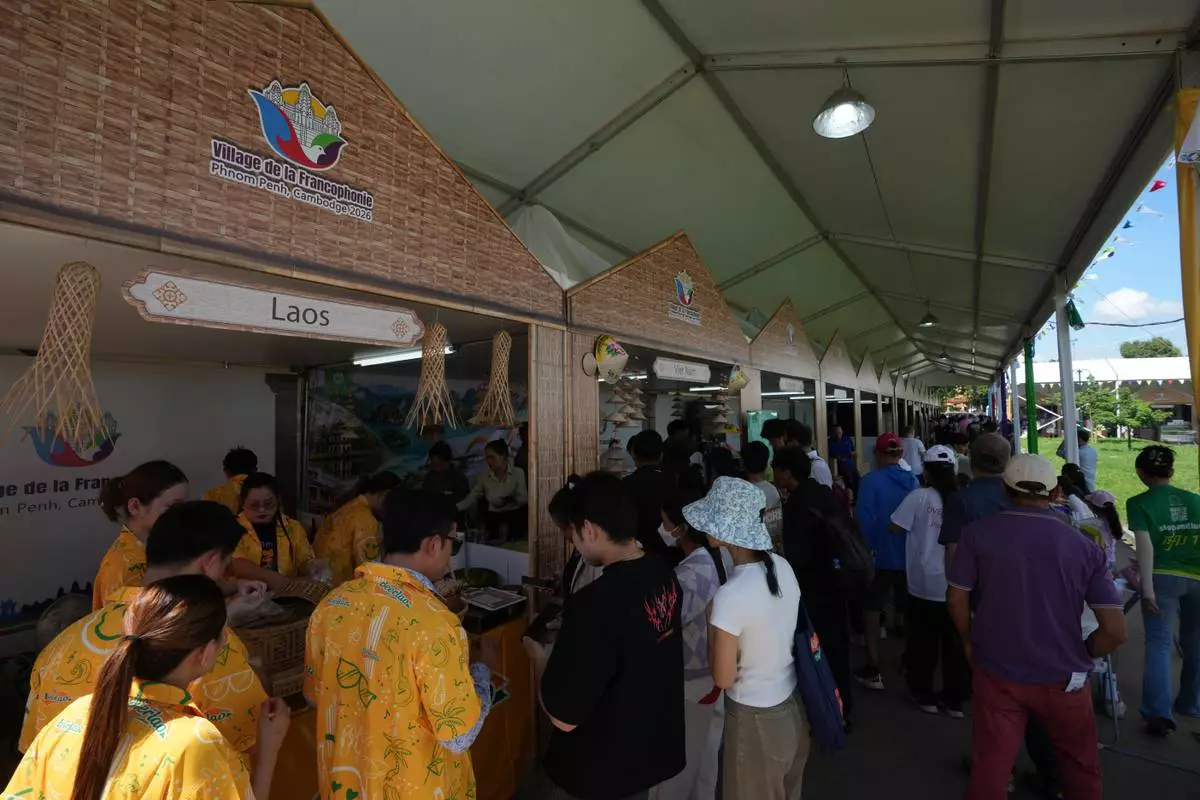
Tourists visit Village de la Francophonie, or Francophonie Village, set up to mark the 20th Francophonie Summit in Phnom Penh, Cambodia, Saturday, Nov. 14, 2026. (AP Photo/Heng Sinith)
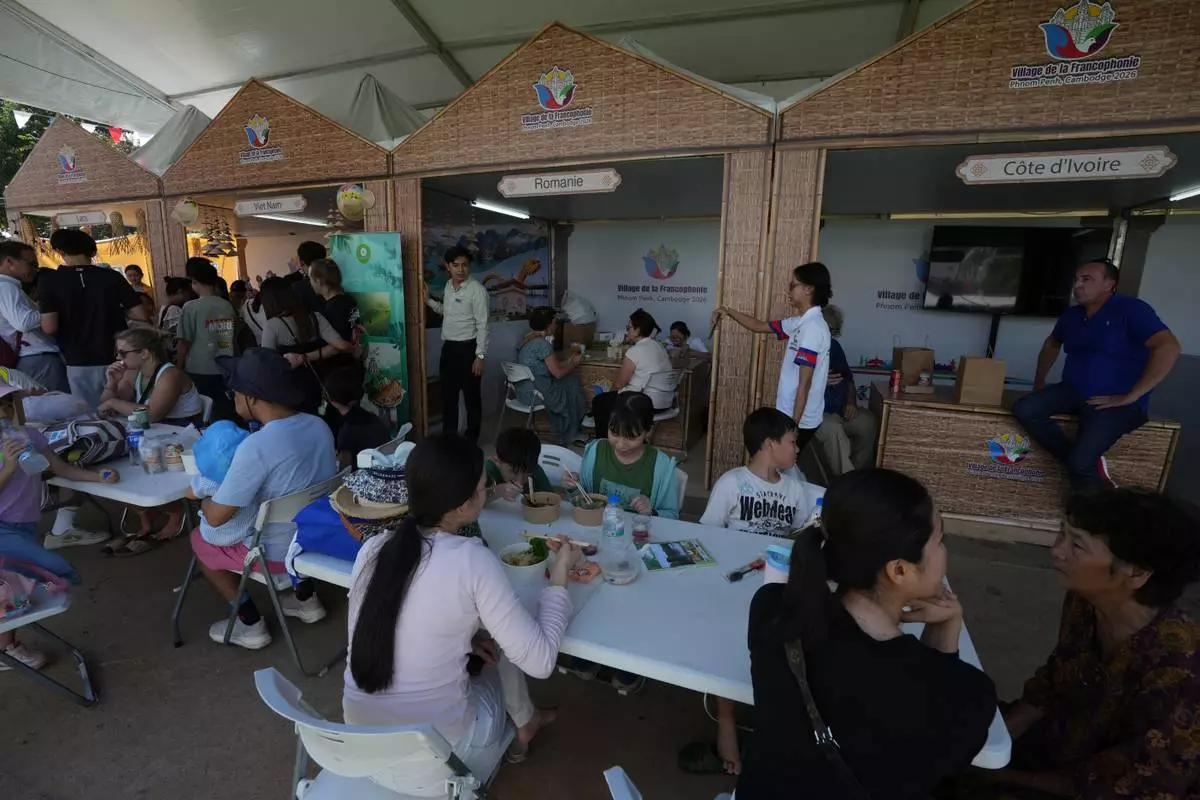
People eat at Village de la Francophonie, or Francophonie Village, set up to mark the 20th Francophonie Summit in Phnom Penh, Cambodia, Saturday, Nov. 14, 2026. (AP Photo/Heng Sinith)
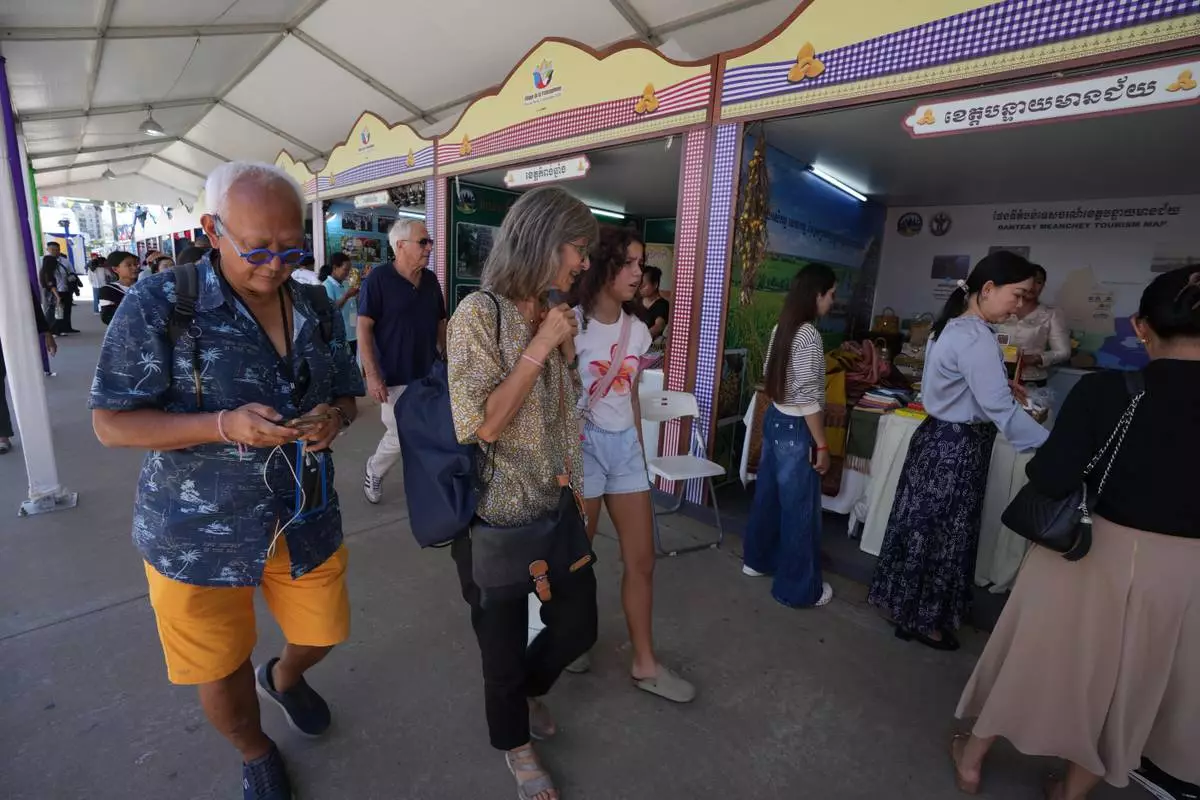
Tourists visit Village de la Francophonie, or Francophonie Village, set yp to mark the 20th Francophonie Summit in Phnom Penh, Cambodia, Saturday, Nov. 14, 2026. (AP Photo/Heng Sinith)
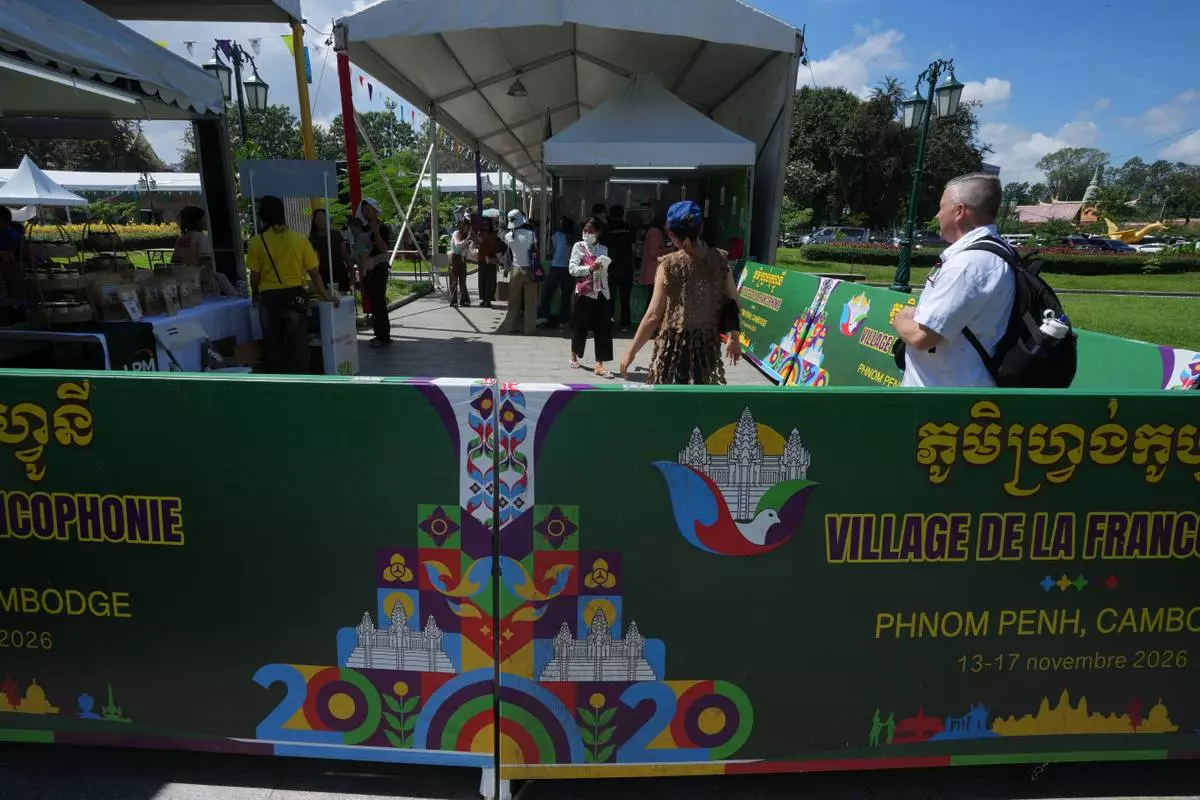
Tourists visit Village de la Francophonie, or Francophonie Village, set up to mark the 20th Francophonie Summit in Phnom Penh, Cambodia, Saturday, Nov. 14, 2026. (AP Photo/Heng Sinith)
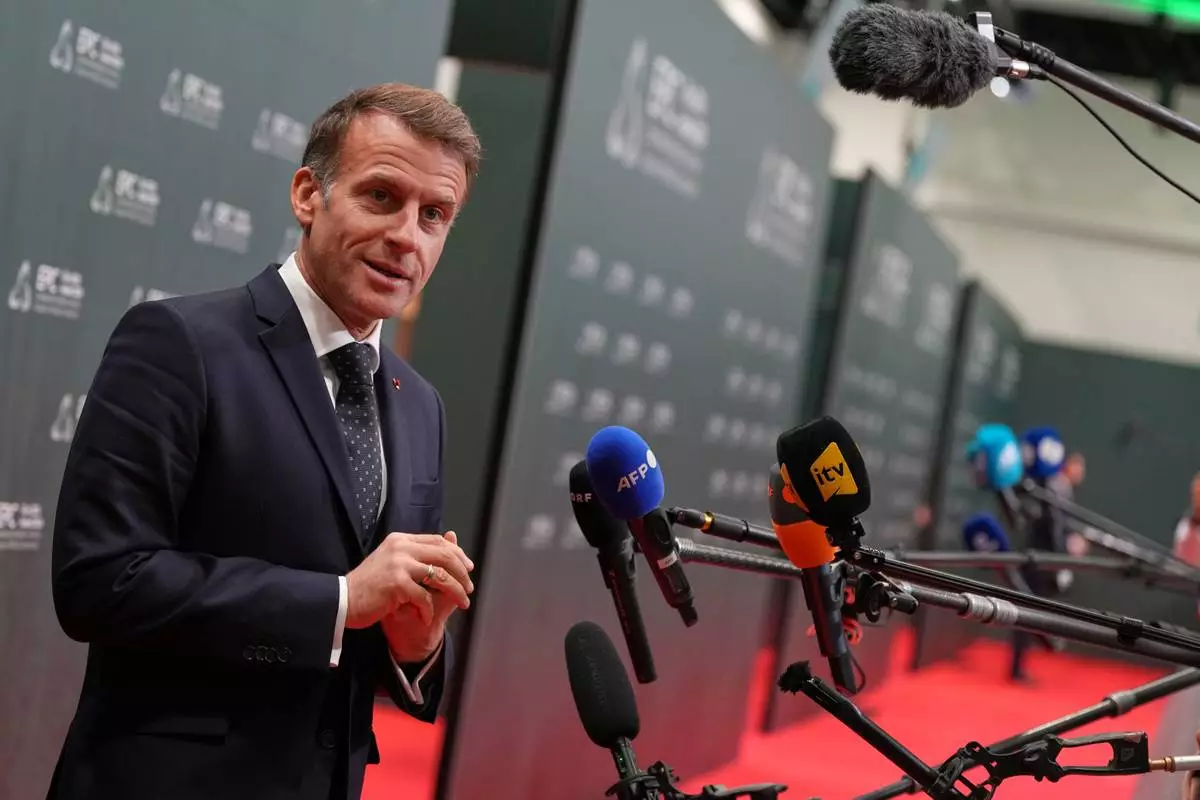
French President Emmanuel Macron speaks to the media during the European Political Community (EPC) Summit in Dublin, Thursday, Nov. 12, 2026.(AP Photo/Virginia Mayo)