As artificial intelligence shifts from model training to inference and agentic applications, Chinese semiconductor and computing firms say the industry's competitive yardstick is undergoing a fundamental transformation.
At the 23rd China International Semiconductor Expo (IC China 2026), which took place from Thursday to Saturday at the China National Convention Center in Beijing, industry executives noted that the focus is shifting away from raw peak specifications toward memory bandwidth, energy efficiency, cost per token, and total cost of ownership (TCO) as demand diversifies across scenarios.
Held alongside the World Integrated Circuit Conference, the three-day event showcased advanced memory chips, computing hardware, and automated logistics technologies. With global spending on AI inference projected to overtake training spending in 2026, the industry is entering what some executives describe as an "energy-efficiency competition," driven by surging inference token volumes and shifting market dynamics.
At ChangXin Memory Technologies (CXMT), Luo Xiaodong, vice president and head of the marketing center, said that the DRAM "super cycle" is entering a stratified era where growth logic diverges across sectors: servers absorbing high-value demand from large-scale computing centers; automotive memory projected to grow rapidly through 2030 due to intelligent driving; and PCs and smartphones remaining tied to consumer replacement cycles.
"Facing intense competition in the memory industry, we have shifted from a pure focus on individual specifications to system-level, full-stack optimization. Driven by a deep understanding of application demands, differentiated storage solutions tailored to different tiers and use cases are becoming the key variable in this market, opening a window for industry players to leapfrog rivals," Luo said.
Luo noted that as demand becomes increasingly stratified, AI-driven innovative applications continue to surge. For instance, during the token-by-token decoding stage in large-model chat applications, the bottleneck lies in memory bandwidth, whereas the prefill stage, which handles input context, plays a vastly different role, requiring an optimal balance between performance and cost.
"With the advent of inference, token cost has become a decisive competitive factor. Amid persistently high memory prices, memory efficiency has also become a key driver of competitiveness," Luo said, adding that it helps improve hardware resource utilization and lower the overall system's total cost of ownership (TCO).
According to industry data from Omdia, servers accounted for about 50 percent of the global DRAM application market in 2025 and are projected to reach roughly 60 percent in 2026 and 71 percent by 2030, underscoring how AI infrastructure is shaping the agenda for memory makers.
This architectural evolution is equally visible on the computing hardware side. Chen Xinjie, head of brand communications at domestic AI chipmaker Tecorigin, said that intelligent computing centers built with the company's assistance are operating at full capacity to meet surging domestic demand.
"We have taken part in building a large number of supercomputing and intelligent computing centers. From an industry perspective, given China's AI development and computing power demand, these centers are running at full capacity. Demand used to be concentrated on training; it has now gradually shifted toward inference, and we are exploring a range of new approaches to better serve inference workloads. The computing centers we have helped build are also supplying computing power to, and empowering, government services, energy, water management and many other sectors," Chen said, adding that short-form video dramas are also generating substantial demand for AI generation capabilities.
Addressing power and cooling constraints, Chen highlighted innovations in green energy and thermal management.
"As one of the initial enterprises in China's computing-power and electricity-coordination alliance, we have been exploring future green electricity utilization with upstream and downstream partners. Furthermore, our chips feature a high-density liquid cooling technology, which effectively resolves heat dissipation issues during AI chip operation through liquid cooling," Chen said.
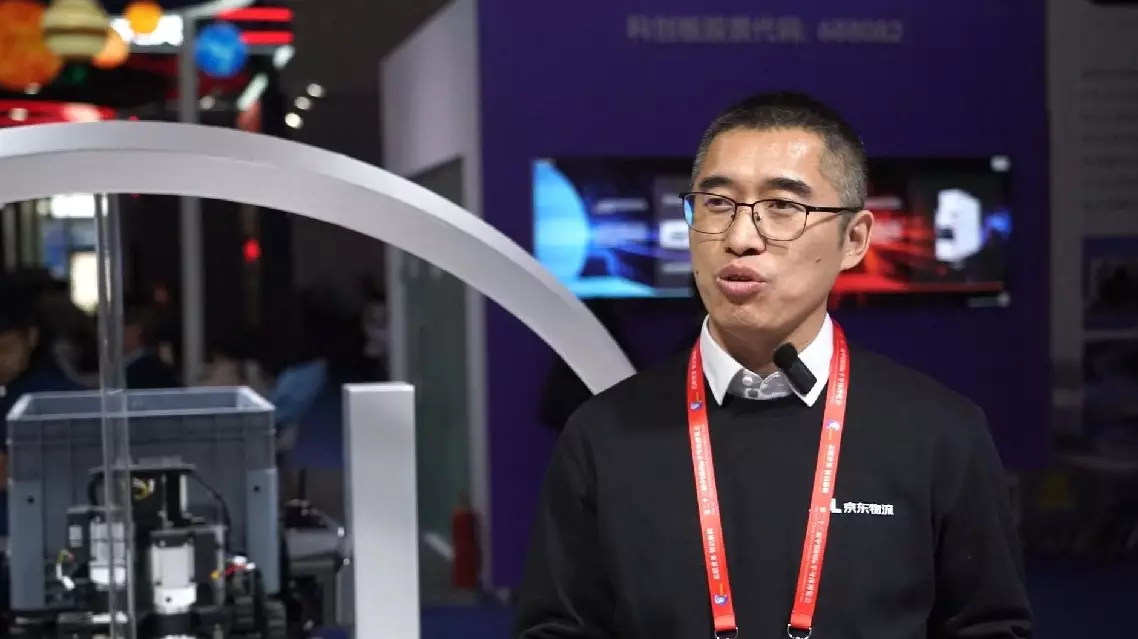
Downstream, supply chain and logistics providers are adapting their operations to fit the stringent constraints of high-value semiconductor manufacturing. Chen Jia, industry general manager at JD Logistics, noted that while semiconductor production is highly automated, warehousing and logistics have traditionally remained relatively manual.
"We found that while the semiconductor industry is already highly advanced in production automation, its warehousing and logistics remain relatively primitive. Due to extremely high cargo values, strict requirements for stability and safety, and fragile product properties, high demands are placed on safety, anti-collision, and shock-absorption treatments. Consequently, upgrading logistics intelligently involves a tension between innovation and conservatism -- there is a strong willingness and demand to innovate, yet hesitation to undertake completely unproven trials," Chen said.
To bridge this gap, JD Logistics is integrating artificial intelligence and large models into fulfillment workflows and autonomous robotics.
"We have integrated AI and large models into the entire supply chain fulfillment process. For instance, using AI large models based on fulfillment timelines and material status, orders are autonomously assigned to the appropriate warehouse and product, choosing the optimal route to maximize fulfillment efficiency. Additionally, we have conducted extensive research and application in embodied physical AI, empowering our 'Langzu' robot products with embodied models so they possess autonomous perception, decision-making, and execution capabilities. They are no longer mere automated devices, but can independently recognize site environments and combine upstream tasks to complete operations with optimal paths and strategies," Chen said.
The expo offered a glimpse into how Chinese semiconductor and tech firms are moving beyond import substitution to pursue broader technological breakthroughs and innovation across the industry ecosystem in the AI era.
Chinese chipmakers say AI inference shift reshapes memory, computing design