Maybe the trouble started with the AI billionaire and the Silicon Valley chaos that followed talk of his infidelity, including with an alleged Chinese spy. Or maybe it was the Microsoft outage that, depending on how you looked at it, either cast millions of frustrated workers adrift or spared them from a daily, unrelenting electronic avalanche.
But by Friday afternoon, when U.S. authorities suddenly ordered every plane across the country to land immediately, it felt to many that something was up. Something was broken.
Just ask Chuck Amasio, a 68-year-old from Rahway, New Jersey, trying to fly out of Newark Liberty International Airport when his canceled flight led to a few beers with his brother in an airport bar and eventually a night in a hotel. Saturday morning, he was back at the airport to try again.
“There’s a lot of weird stuff going on,” Amasio said. “It makes one think.”
His first thought was dark: “We talk about how wars aren’t done with bombs anymore. They shut down airspace or a power grid. They can cripple an economy.”
Throw in a few more examples just from Friday – a cruise ship that overturned in New Orleans when a tanker slammed into it, suspicious drones over a U.S. air base in Britain, a bomb found near an ethanol plant in Ohio — and perhaps things seem even weirder, opening the door for a writer who has been picking at America’s fears for generations to offer his own explanation.
“The aliens have landed,” Stephen King wrote in a Friday afternoon tweet. “That’s the REAL reason for the ground stop. They don’t want to start a worldwide panic.”
The official explanations for the thousands of downed jetliners and hours of email and other computer troubles were far more prosaic.
A technology upgrade on the nation’s air traffic control system had overloaded antiquated equipment and caused “intermittent” communications and radar gaps, leading to the ground stop that lasted more than four hours, administration officials said.
By Saturday morning, air travel was already smoother and Bryan Bedford, administrator of the Federal Aviation Administration, said airline schedules should be back to normal by late Sunday.
Microsoft, for its part, said Saturday that its services had been fully restored, saying the problem “was introduced by an issue during an earlier network capacity upgrade that surfaced” following a recent network change.
The outage is believed to have affected many millions of people around the world.
Maxine Gustafson, a 34-year-old physician assistant from Minneapolis, was in line to pick up a hastily booked rental car at Chicago’s O’Hare airport on Friday afternoon so she and colleagues could get home from a work training.
Gustafson said the week's mishaps made her feel afraid and helpless.
“It makes you think, like, is this a cyberattack?” she said. “We don’t have control over a lot of this stuff.”
Both the FAA and Microsoft said there were no signs that malicious activity had been behind the troubles.
Tori Perkins, 34, was hoping for a Saturday flight at Terminal 2 at San Diego International Airport, where 11 of the 62 flights already were listed as canceled that morning and the same number were delayed. Crowds were normal.
“It’s one of those things where I don’t necessarily believe what the government says,” said Perkins, who seemed to take the setback in stride. “I don’t know what’s true because there are so many people saying different things.”
Perkins, who lives in Hawaii, was in San Diego on a layover on her way to see family in Florida. She spent Friday night at the airport.
She was not surprised that Secretary of Transportation Sean Duffy had made a plea Friday for tens of billions in more funding to upgrade the country’s notoriously outdated air traffic system.
“It sounds like more of the same,” she said.
The FAA has already replaced thousands of copper wire connections with fiber optic lines and upgraded hundreds of radio systems as part of the overhaul that began last year after Congress approved $12.5 billion in funding. The White House has been pushing for $30 billion more to complete the work.
Sometimes chaos brings out the best in people.
Corbyn Wascher was stuck on the tarmac at Charlotte Douglas International Airport for four hours while heading back to Moline, Illinois, from Miami, where he had been at an education conference.
He said everyone was cordial on the plane, talking to one another and stretching their legs. He was impressed with the American Airlines staff, who handed out water, pretzels and biscotti snacks, though they were clearly under stress.
“The stewardesses were amazing,” said the 37-year-old high school teacher.
Back at the Newark airport, Caroline Ruiz had caught a few hours of sleep by a heating vent. She wasn’t sure what time it was as she waited for someone to bring her a meal she was promised after the cancellation of the first leg of her 24-hour trip to Australia. She hoped to get started later Saturday.
It was two days in a row, she noted, where she had been betrayed by technology.
Though maybe one of those days didn’t count as a betrayal.
“I kind of got a free day yesterday” because the Microsoft systems were down.
Associated Press journalists Elliot Spagat in San Diego, Ali Swenson in Chicago, Jessica Hill in Las Vegas and Aron Ranen in Newark contributed to this report.

The sign of Microsoft is photographed at an office building of the company, in Berlin, Germany, Friday, Nov. 13, 2026. (AP Photo/Markus Schreiber)
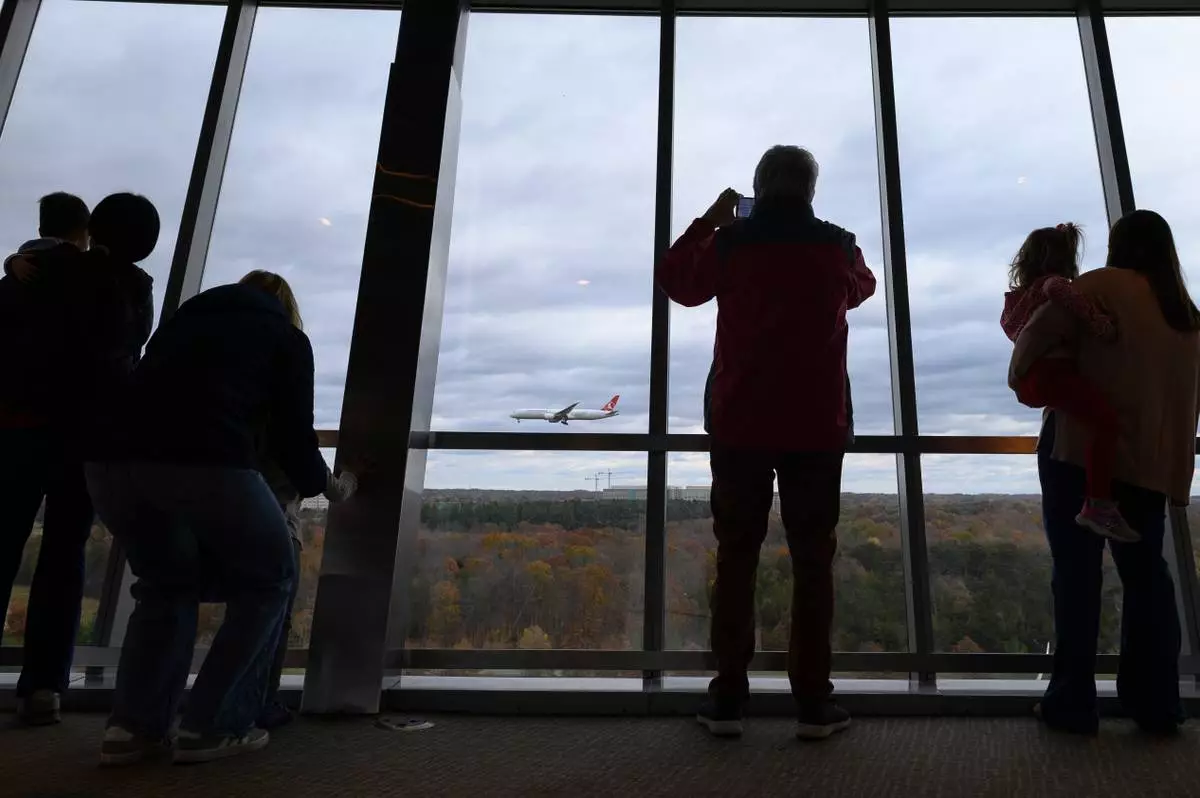
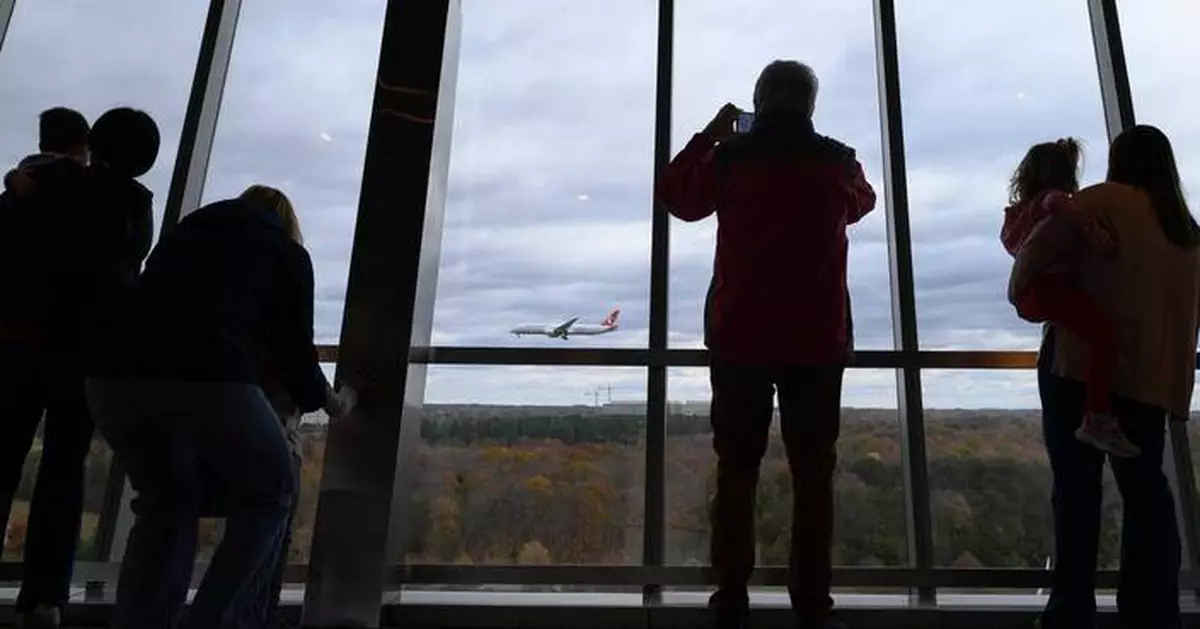
Visitors to the Steven F. Udvar-Hazy Center observation tower watch an airplane as it prepares to land at Washington Dulles International Airport after the Federal Aviation Administration lifted nationwide ground stops in Chantilly, Va., Saturday, Nov. 14, 2026. (AP Photo/Cliff Owen)
ZAÑA, Peru (AP) — Pope Leo XIV on Saturday denounced the “suffering and humiliation” endured by African enslaved people as he made a tangible show of remorse in Peru following his historic apology for the Holy See’s own role in legitimizing the African slave trade in the Americas.
The U.S.-born Leo, whose own family tree includes enslaved people and slave owners, delivered the remarks in the northern Peruvian city of Zaña, a UNESCO-recognized memorial site for slavery and a center of the Afro-Peruvian community today.
Zaña is part of Leo’s former diocese of Chiclayo, and the former Robert Prevost came here often to pray before the relics of a 16th century saint, including the night before his ordination as a bishop. He knows the city and the history of African-descended Peruvians well, and the continued discrimination that Afro-Peruvians face today.
In remarks to the community Saturday, Leo said Zaña “preserves the memory of generations of Africans who were torn from their homes and subjected to slavery.”
“Many endured great suffering and humiliation. Dear brothers and sisters of African descent, today I want to express my affection and closeness to you,” he said.
Zaña, a historic town in Chiclayo province, was recognized by UNESCO in 2017 as a “site of memory of slavery and African cultural heritage.” The recognition was the first of its kind granted to a Peruvian Afro-descendant community or any comparable community along South America’s Pacific coast, the government says.
Zaña is also home to the sanctuary of St. Turibius of Mogrovejo, the first archbishop of Lima. Mogrovejo is revered here for having denounced abuses against Indigenous and enslaved people by Spanish colonizers, and Leo has made clear on this trip that he modeled his ministry on Mogrovejo’s example.
In addition to having crisscrossed his vast archdiocese on foot and horseback, Mogrovejo learned Indigenous languages and was known for having confirmed St. Martin de Porres, the first Black saint of the Americas and the patron saint of racial harmony, social justice and people of multiracial backgrounds.
“I know that many families in this region suffer because of crime, extortion and insecurity,” Leo said Saturday in the shadow of the Mogrovejo sanctuary. “I am pained at the thought of those who live in fear, of people whose honest labor is under threat and of those who continue to experience discrimination. I hold you in my prayers and ask the Lord to grant you the peace you so deeply need.”
In his first encyclical, “Magnificent Humanity,” Leo made a sweeping apology for the role of past popes in legitimizing slavery in the Americas and failing to condemn it for centuries. It was a reference to the series of 15th-century directives from the Vatican that authorized European sovereigns to conquer Africa and the Americas and enslave non-Christians.
“It is impossible not to feel deep sorrow when contemplating the immense suffering and humiliation endured by so many in stark contrast to their immeasurable dignity as persons infinitely loved by the Lord,” Leo wrote in the encyclical. “For this, in the name of the church, I sincerely ask for pardon.”
The estimated 100,000 African slaves brought to Peru after the arrival of Spanish conquistadores toiled in sugar plantations and silver mines, with some becoming urban artisans. At one point, they and their descendants were more than 40% of Lima’s population.
Blacks now are a small fraction of Peru’s 35 million people. But they have struggled to advance in the more than 170 years since emancipation.
“Historically, the Afro-Peruvian community — much like other Afro-Latin American communities — has faced a twofold form of invisibility: the denial of its demographic and cultural weight in the nation’s formation, and the reduction of its contributions to mere folklore,” said Alejandro Frigerio, researcher at the National Council for Scientific Research of Argentina who focuses on Afro-American religions.
Omar Ali, Peruvian professor of history at the University of North Carolina at Greensboro and an expert on Afro-Latin America, said Leo’s words were “deeply touching.” “As with Black people across the Americas, Afro-Peruvians have faced social and economic marginalization rooted in the horrors of enslavement.”
The 2017 national census recorded 1,311 Zaña residents who identified as Afro-Peruvian, compared with 78,639 across the entire Lambayeque region.
On Saturday, Leo addressed them, saying he was aware that many families in the region are suffering because of crime and extortion.
“I am pained at the thought of those who live in fear, of people whose honest labor is under threat and of those who continue to experience discrimination,” he said. “I hold you in my prayers and ask the Lord to grant you the peace you so deeply need.”
There was a hint on the day Leo arrived in Peru that he would address the legacy of African-descended Peruvians when Susana Baca, the Latin Grammy-winning Afro-Peruvian singer, serenaded him on Lima’s Plaza Mayor.
Baca, arguably the best-known Afro-Peruvian musician, was also Peru’s first Black Cabinet minister and became a leading figure in the campaign to end the discrimination that has long made second-class citizens of Black Peruvians and Peru’s Indigenous peoples.
Known for her velvet voice and barefoot dancing, Baca told The Associated Press that she felt a special connection to Leo because of the importance he has placed on asking forgiveness for past injustices.
“I believe that one of the most important things in the history of Afro-Peruvians is that we did not remain submerged despite our history of suffering,” she said after her barefoot performance on Wednesday. “We are an Afro-Peruvian people who have learned to forgive.”
“And perhaps this is what connects me, in my conscience, to the pope,” she said in an email. “I feel that in all his homilies and teachings, the pope emphasizes the importance of asking for forgiveness and forgiving — that the injustices of many moments in history are less painful if we have the capacity to forgive and to be forgiven.”
Members of Zaña’s Afro-descendant community celebrated the return of Leo, their former bishop, and were particularly proud of Baca’s performance before an American pope with Black ancestors.
“I’m so proud to see an Afro-Peruvian person singing to the pope, and to know that Black blood courses through his veins,” said Felipe Gutierrez, a local chef and poet known as Frontado.
All four of Leo’s maternal great-grandparents were “free people of color” in 19th-century Louisiana census records. As part of the melting pot of French, Spanish, African and Native American cultures in Louisiana, the pope’s maternal ancestors would be considered Creole.
Zaña is home to an Afro-Peruvian museum, which features a rich collection of historical photographs, plantation carts and percussion musical instruments of African origin from Peru, Cuba and Brazil. It also holds records relating to enslaved people and some of the shackles used to restrain them.
One of its walls has photos of the Chicago-born Leo during visits to the town when he was bishop. There are also large framed photographs of Barack Obama, the first Black U.S. president, and South African anti-apartheid leader Nelson Mandela.
“They show us how someone who is Black as we are in Zaña became a president and we’re proud because we all deserve the same rights,” said Gutierrez, wearing a Chicago Bulls shirt with Michael Jordan’s iconic No. 23 on the back.
Associated Press religion coverage receives support through the AP’s collaboration with The Conversation US, with funding from Lilly Endowment Inc. The AP is solely responsible for this content.
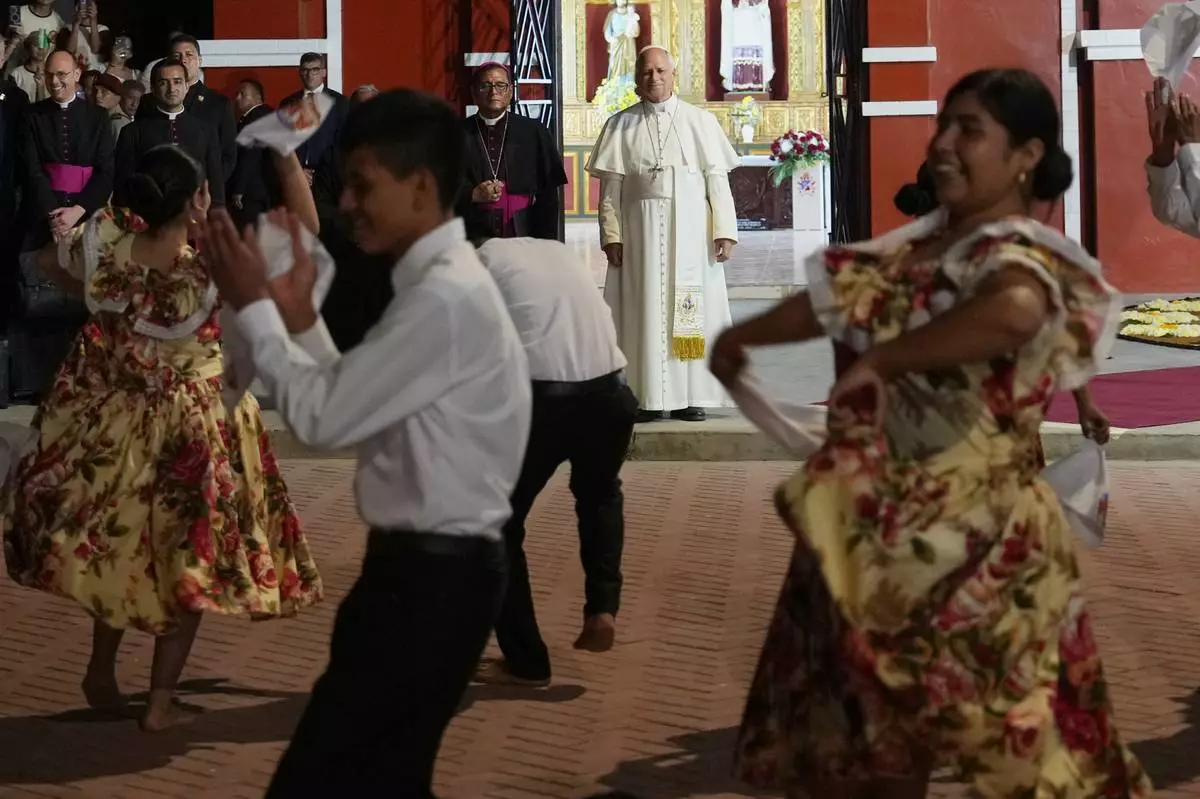
Pope Leo XIV watches dancers at the end of a meeting with the Catholic community on the occasion of the closing of the Jubilee Year of Santo Toribio de Mogrovejo at the Shrine of Santo Toribio de Mogrovejo in Zana, Peru, on the ninth day of his twelve-day apostolic journey to South America, Saturday, Nov. 14, 2026. (AP Photo/Andrew Medichini)
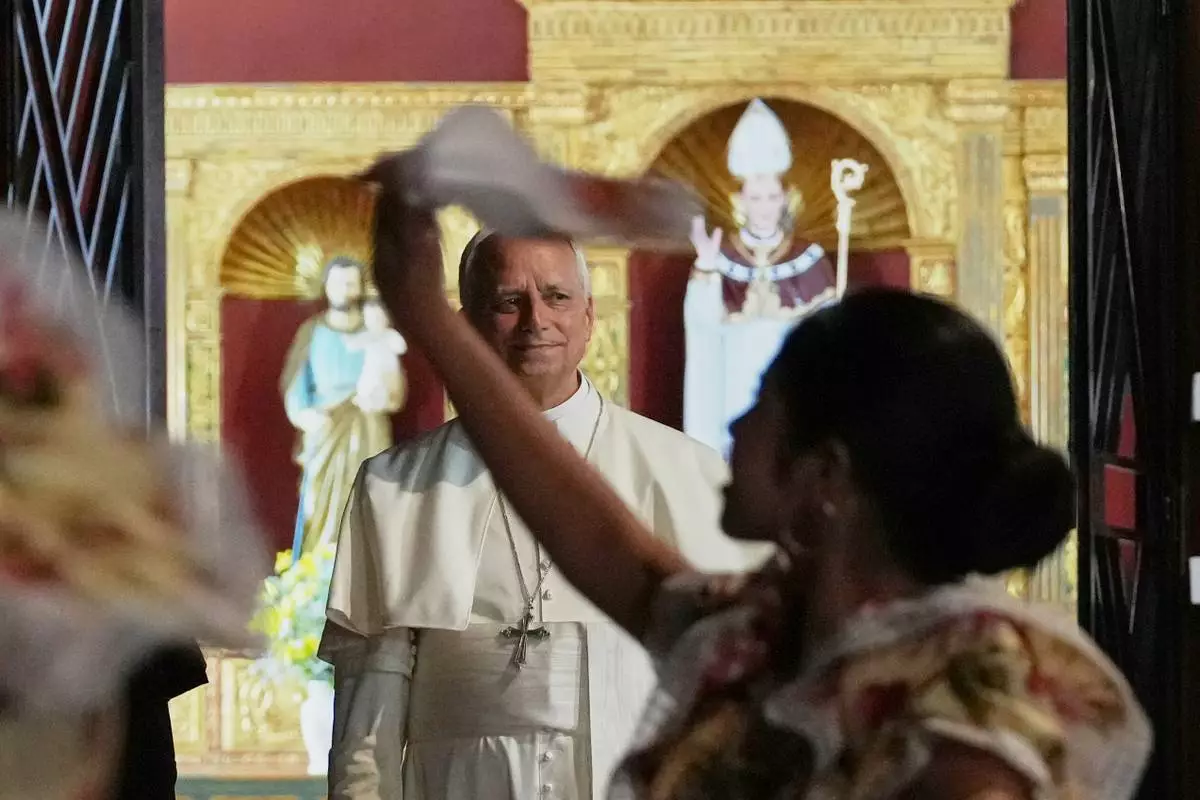
Pope Leo XIV watches dancers at the end of a meeting with the Catholic community on the occasion of the closing of the Jubilee Year of Santo Toribio de Mogrovejo at the Shrine of Santo Toribio de Mogrovejo in Zana, Peru, on the ninth day of his twelve-day apostolic journey to South America, Saturday, Nov. 14, 2026. (AP Photo/Andrew Medichini)
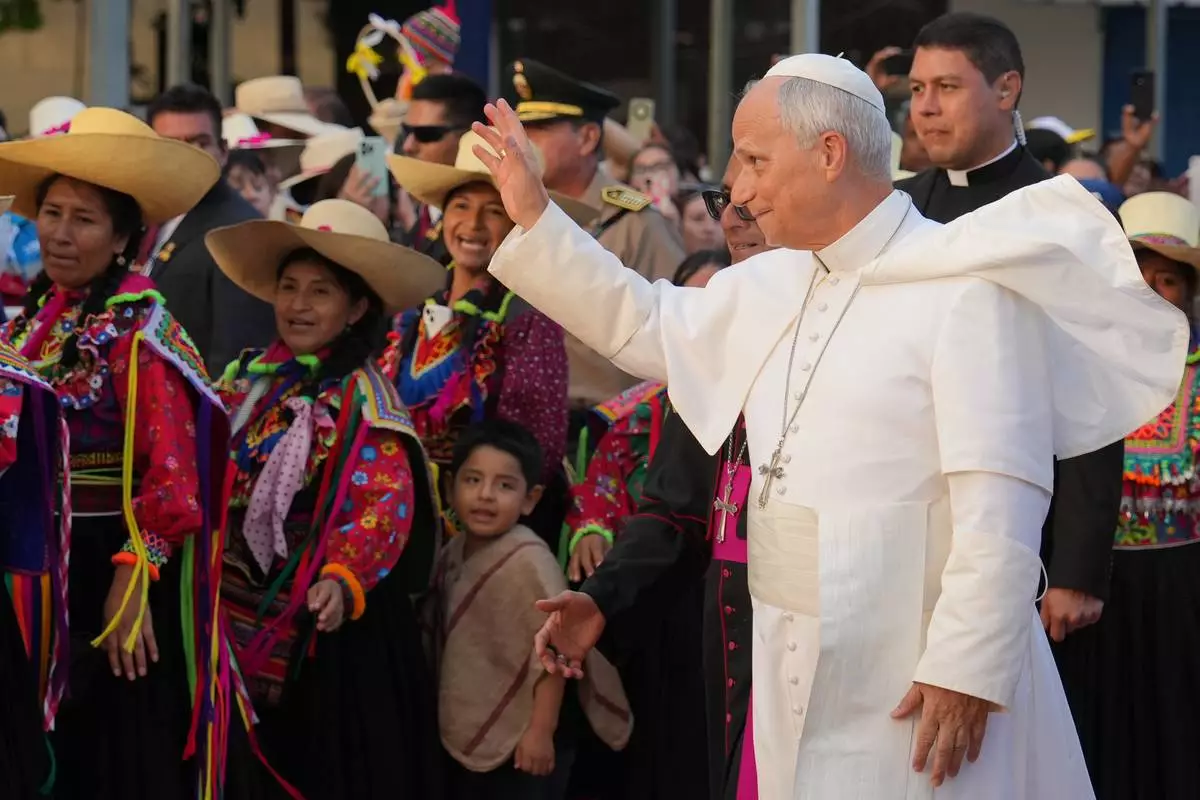
Pope Leo XIV arrives for a meeting with the Catholic community on the occasion of the closing of the Jubilee Year of Santo Toribio de Mogrovejo at the Shrine of Santo Toribio de Mogrovejo in Zana, Peru, on the ninth day of his twelve-day apostolic journey to South America, Saturday, Nov. 14, 2026. (AP Photo/Andrew Medichini)
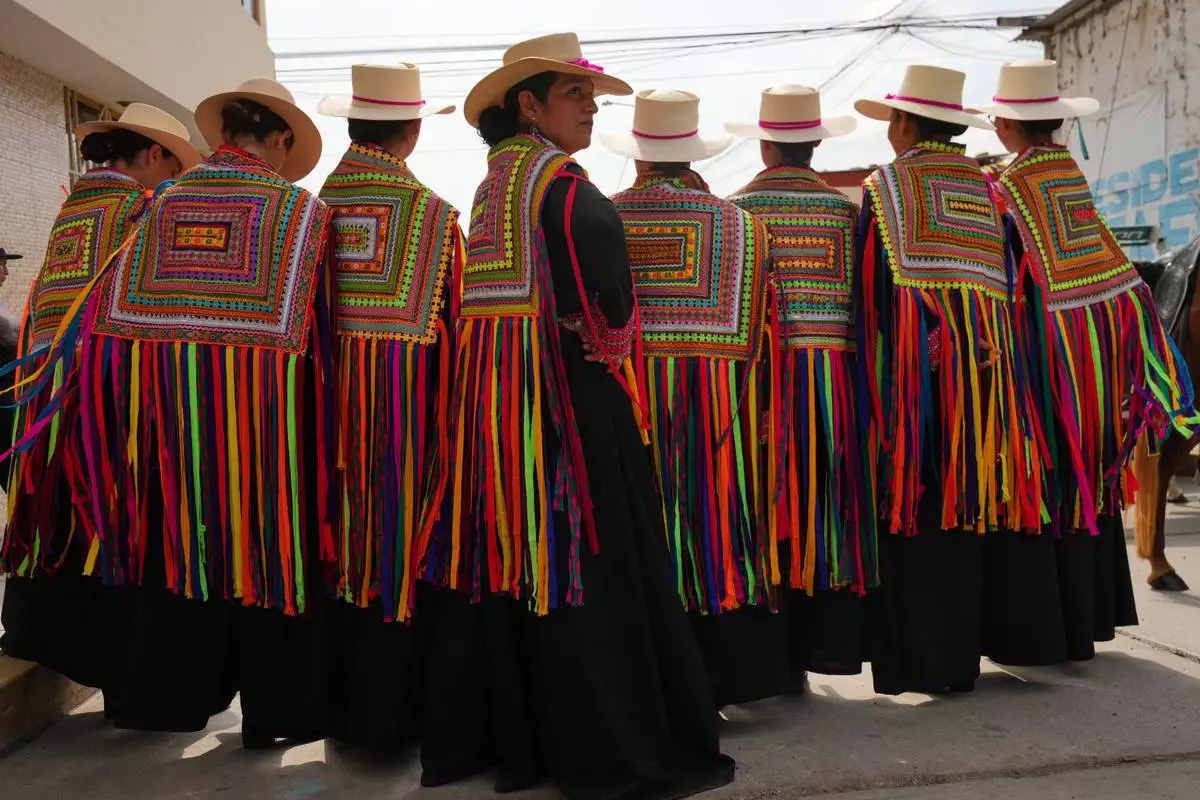
Women wait to welcome Pope Leo XIV ahead of his meeting with the Catholic community in Zaña, Peru, Saturday, Nov. 14, 2026. (AP Photo/Rodrigo Abd)
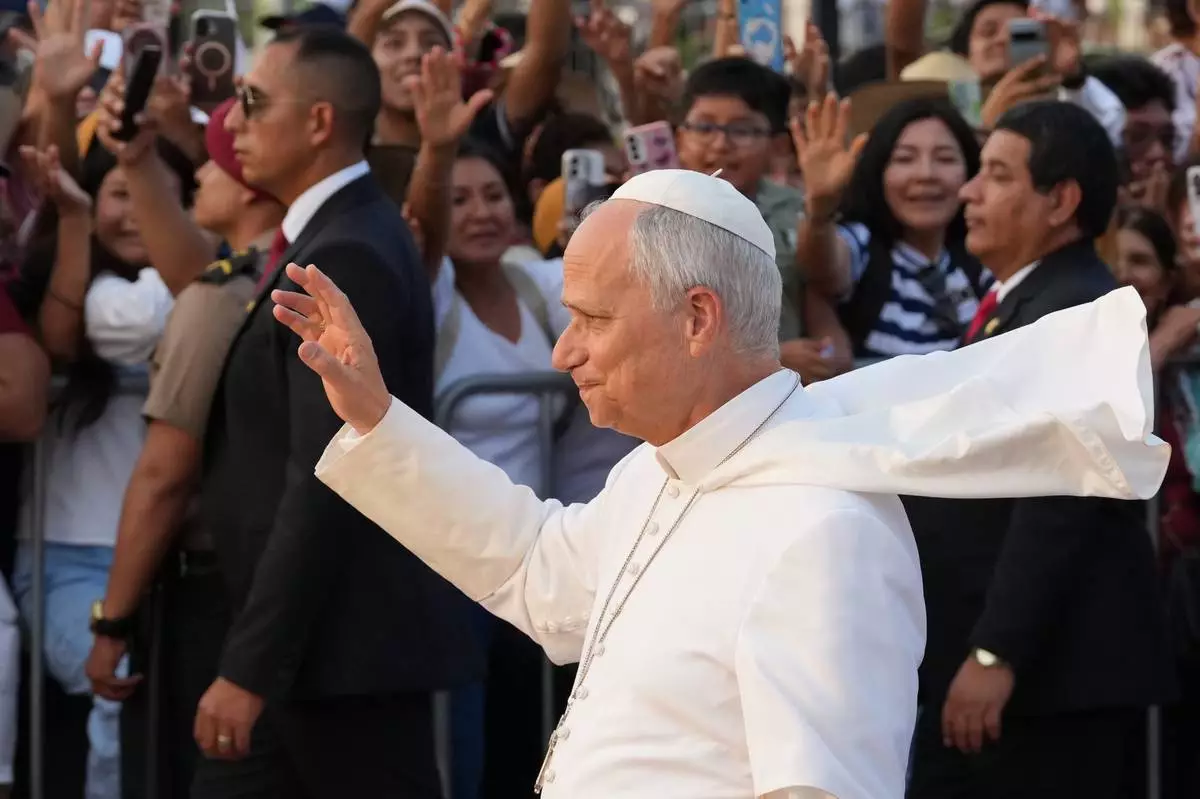
Pope Leo XIV arrives for a meeting with the Catholic community on the occasion of the closing of the Jubilee Year of Santo Toribio de Mogrovejo at the Shrine of Santo Toribio de Mogrovejo in Zana, Peru, on the ninth day of his twelve-day apostolic journey to South America, Saturday, Nov. 14, 2026. (AP Photo/Andrew Medichini)
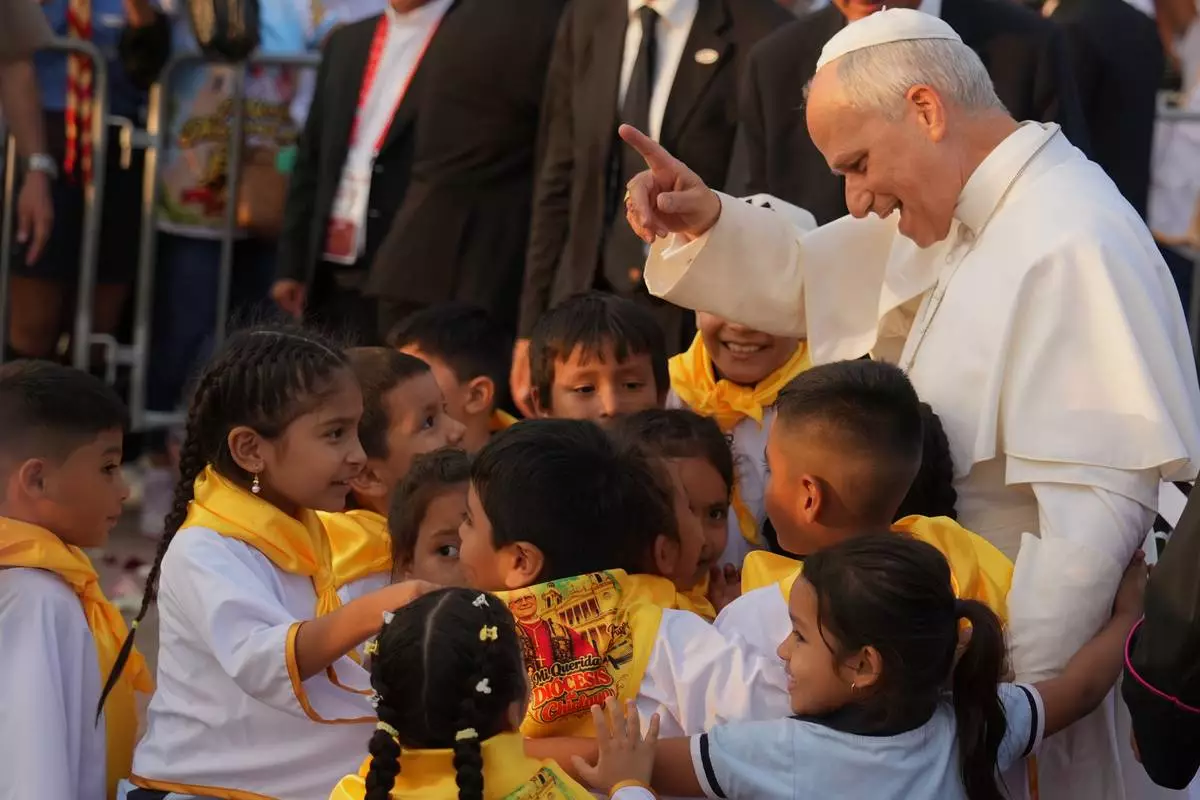
Pope Leo XIV arrives for a meeting with the Catholic community on the occasion of the closing of the Jubilee Year of Santo Toribio de Mogrovejo at the Shrine of Santo Toribio de Mogrovejo in Zana, Peru, on the ninth day of his twelve-day apostolic journey to South America, Saturday, Nov. 14, 2026. (AP Photo/Andrew Medichini)
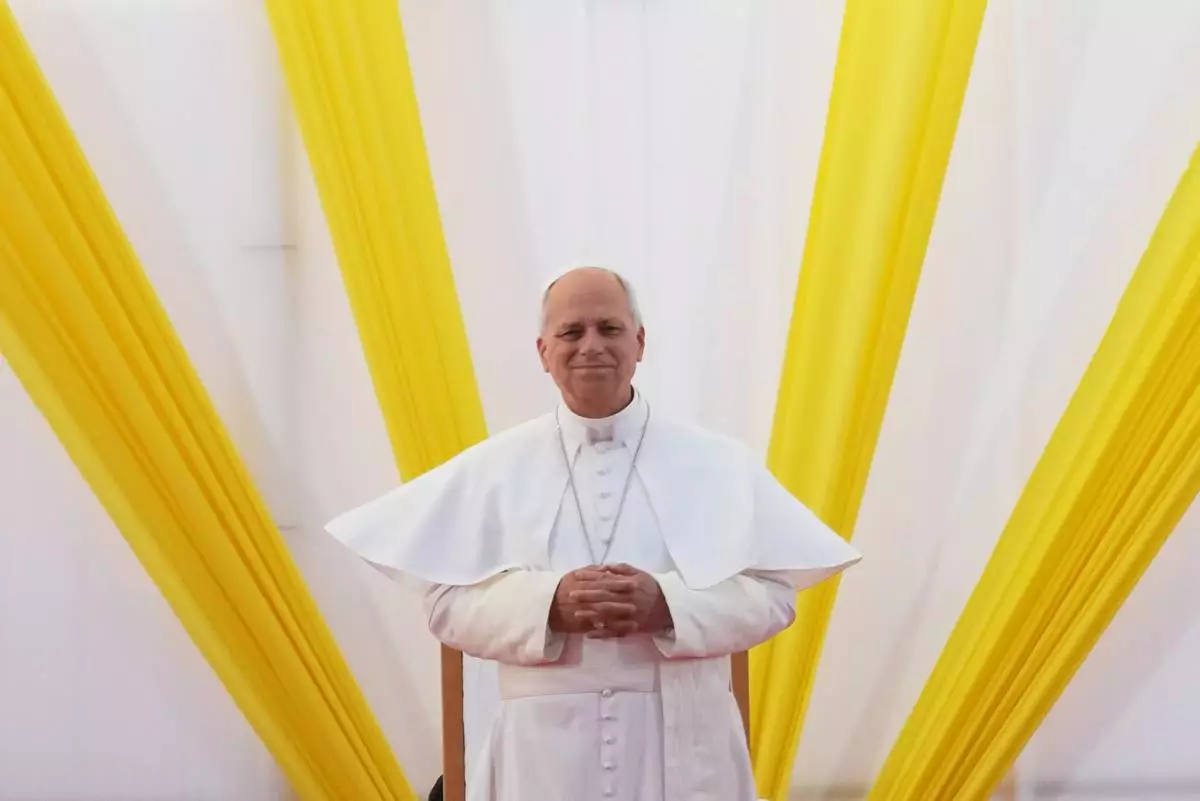
Pope Leo XIV attends a meeting with the Catholic community on the occasion of the closing of the Jubilee Year of Santo Toribio de Mogrovejo at the Shrine of Santo Toribio de Mogrovejo in Zana, Peru, on the ninth day of his twelve-day apostolic journey to South America, Saturday, Nov. 14, 2026. (AP Photo/Andrew Medichini)
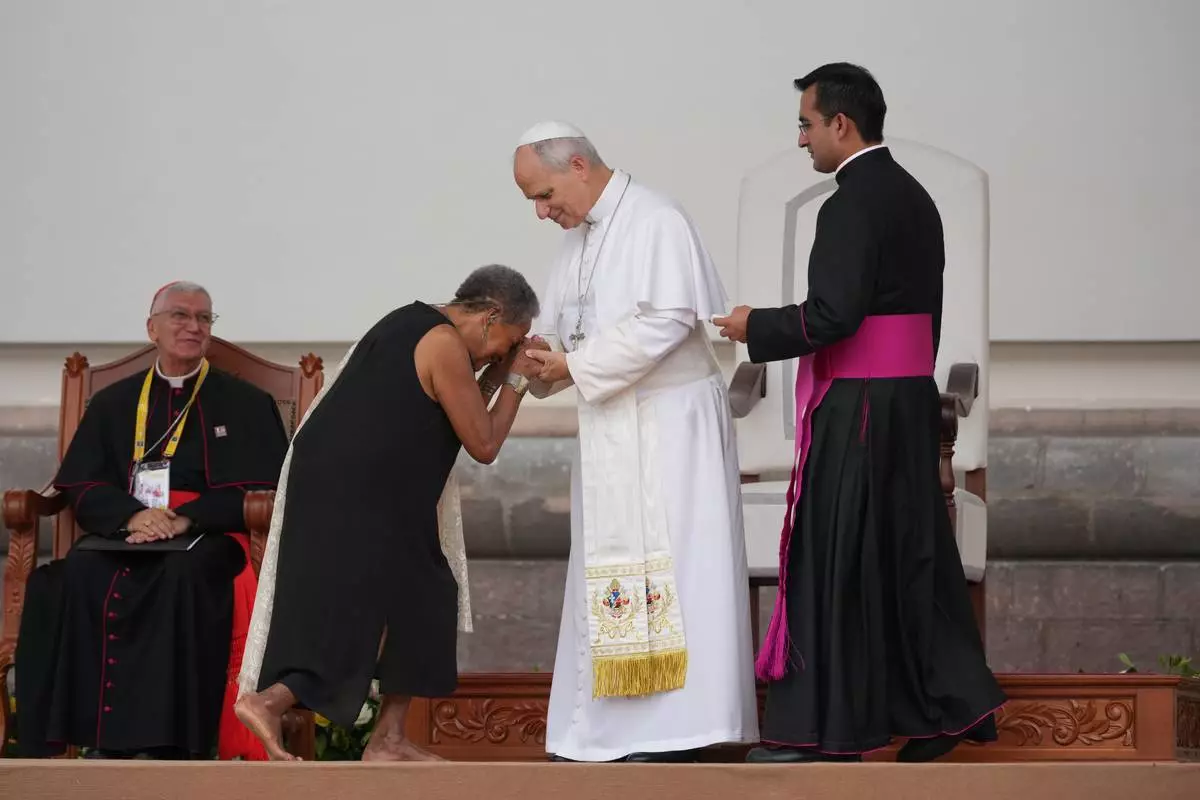
Pope Leo XIV is greeted by Peruvian singer Susana Baca during a meeting on the challenges and hopes for the future of the Peruvian people in the square outside Lima's cathedral, on the seventh day of his twelve-day apostolic journey to South America, Thursday, Nov. 12, 2026. (AP Photo/Andrew Medichini)
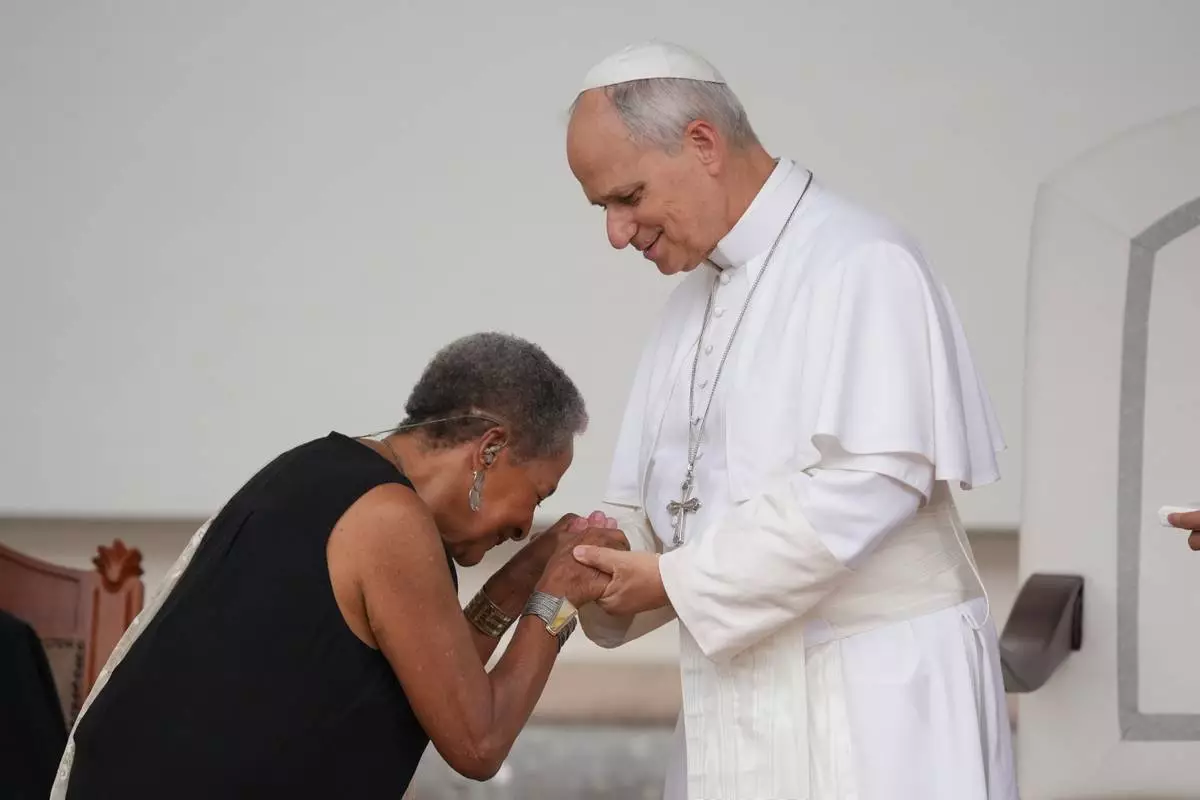
Pope Leo XIV is greeted by Peruvian singer Susana Baca during a meeting on the challenges and hopes for the future of the Peruvian people in the square outside Lima's cathedral, on the seventh day of his twelve-day apostolic journey to South America, Thursday, Nov. 12, 2026. (AP Photo/Andrew Medichini)
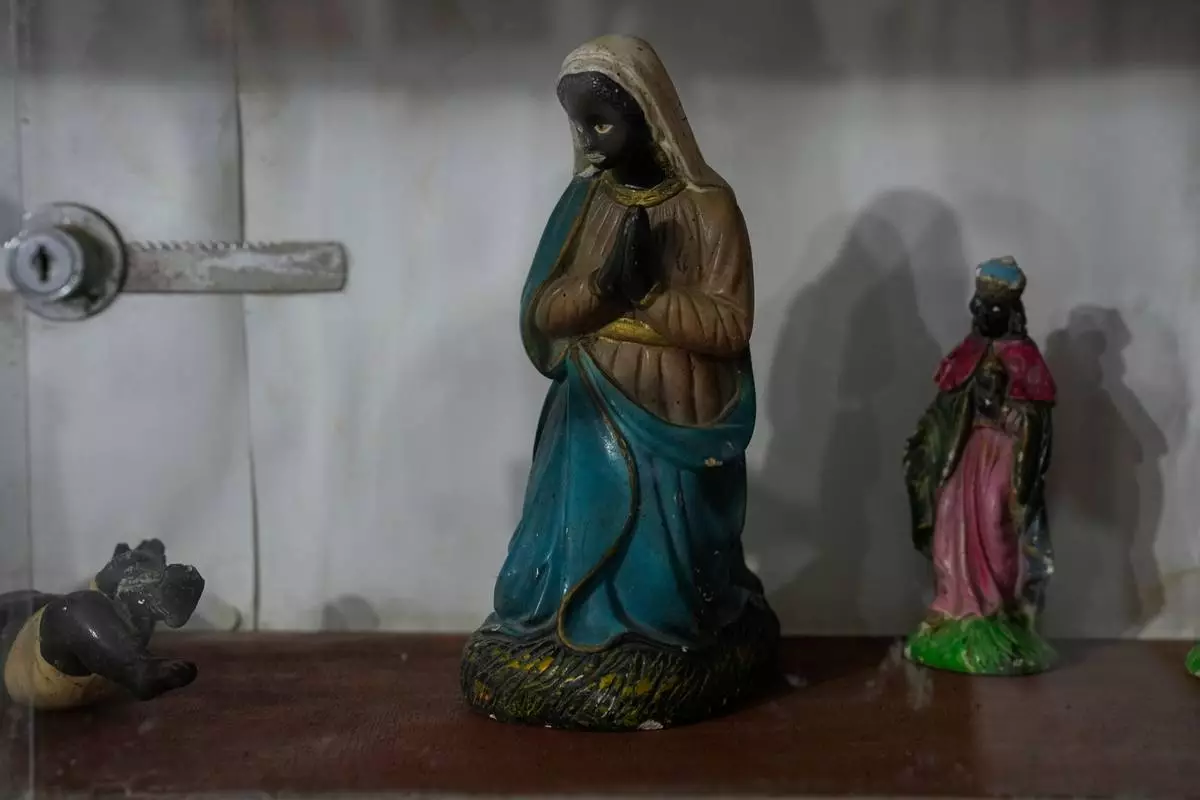
A figurine of a Black Virgin Mary is part of a Nativity scene displayed at the Afro-Peruvian Museum in Zaña, Peru, ahead of Pope Leo XIV's visit to the town to lead a prayer service at the Sanctuary of St. Turibius of Mogrovejo, Friday, Nov. 6, 2026. (AP Photo/Martin Mejia)
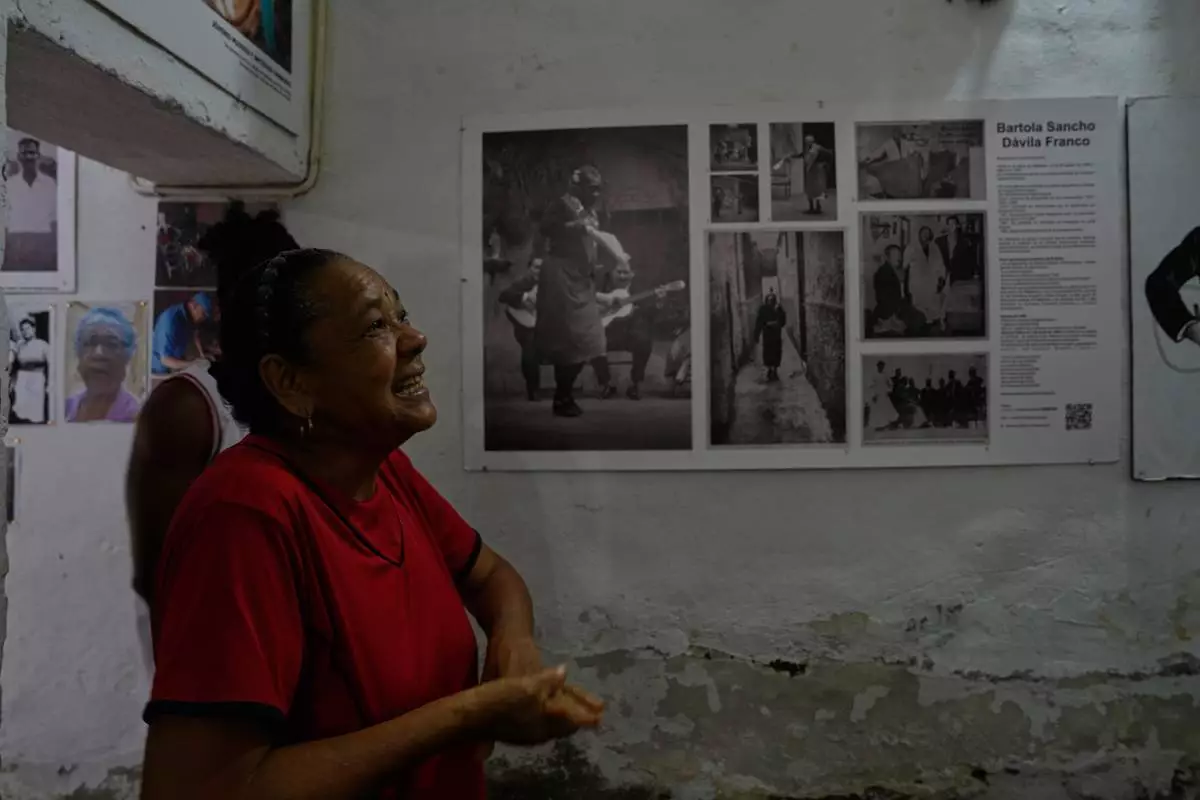
Carmen Cossio Aguilar smiles during a tour of the Afro-Peruvian Museum in Zaña, Peru, a hub of Afro-Peruvian culture, ahead of Pope Leo XIV's visit to lead a prayer service at the Sanctuary of St. Turibius of Mogrovejo, Friday, Nov. 6, 2026. (AP Photo/Martin Mejia)
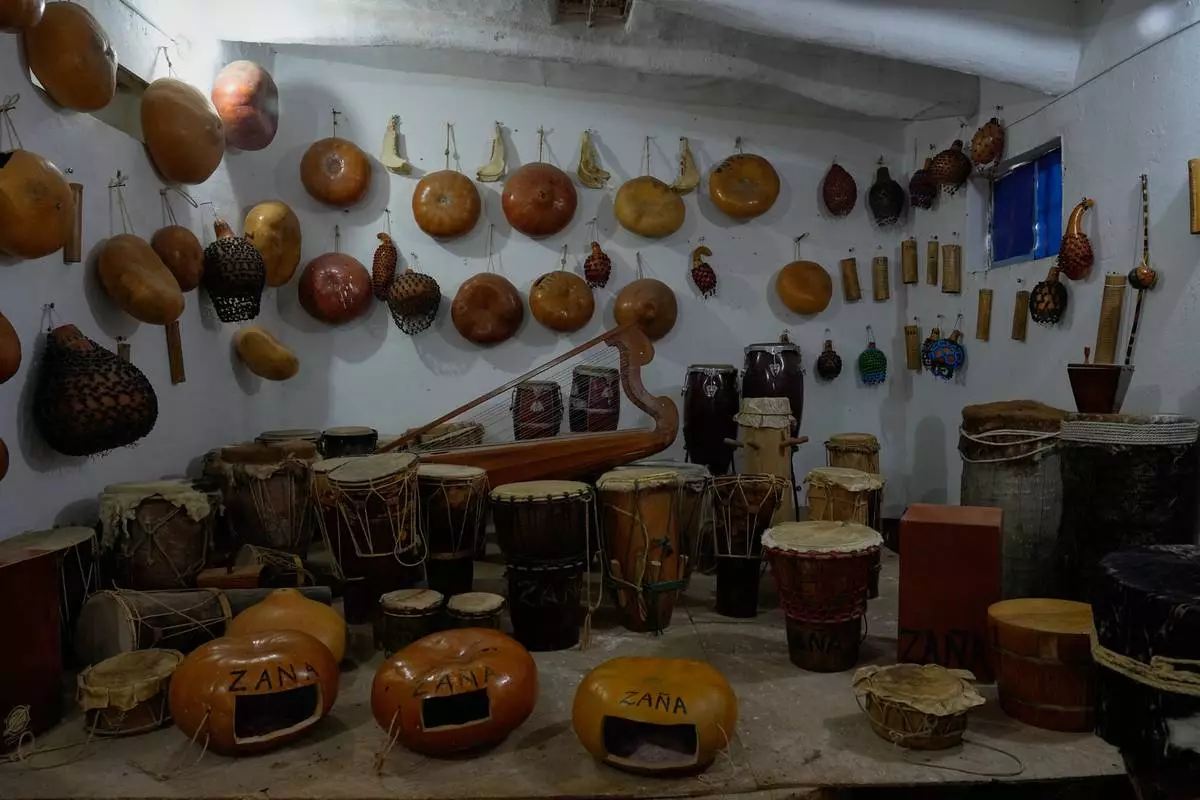
Percussion and other musical instruments are displayed at the Afro-Peruvian Museum in Zaña, Peru, ahead of Pope Leo XIV's visit to the town to lead a prayer service at the Sanctuary of St. Turibius of Mogrovejo, Friday, Nov. 6, 2026. (AP Photo/Martin Mejia)
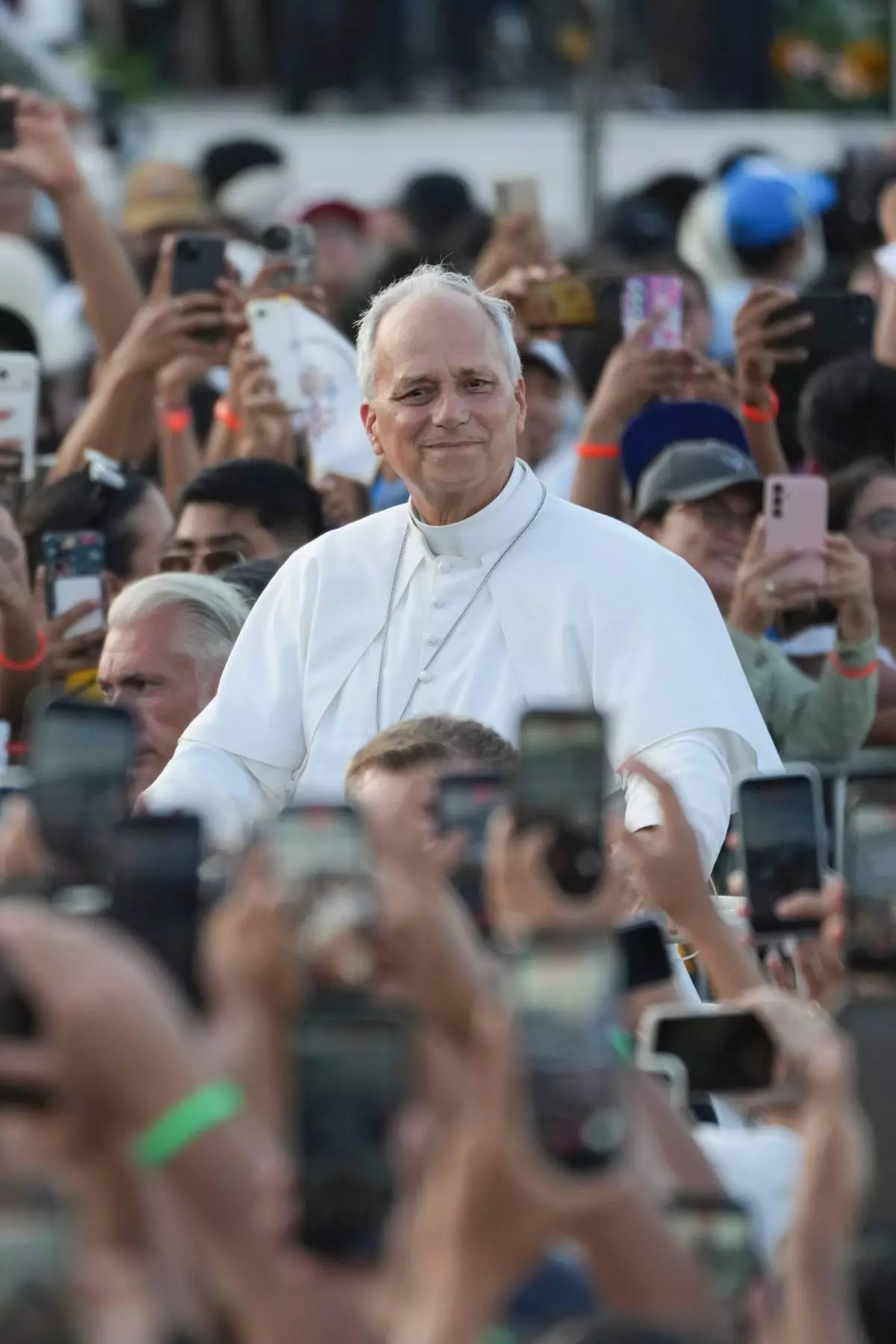
Pope Leo XIV arrives for a meeting with the university community at Santo Toribio de Mogrovejo Catholic University in Chiclayo, Peru, Friday, Nov. 13, 2026. (AP Photo/Rodrigo Abd)
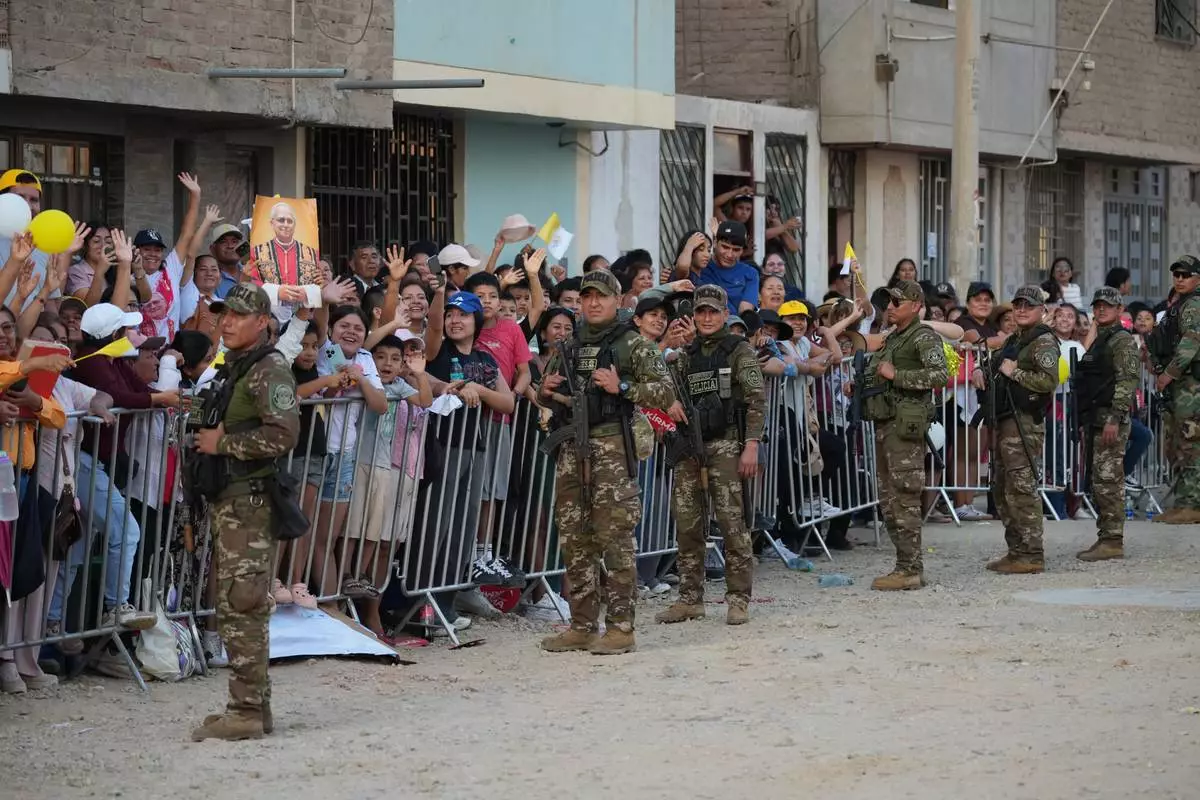
Faithful wait for the arrival of Pope Leo XIV on the occasion of his meeting the university community at Santo Toribio de Mogrovejo Catholic University in Chiclayo, Peru', Friday, Nov. 13, 2026. (AP Photo/Andrew Medichini)
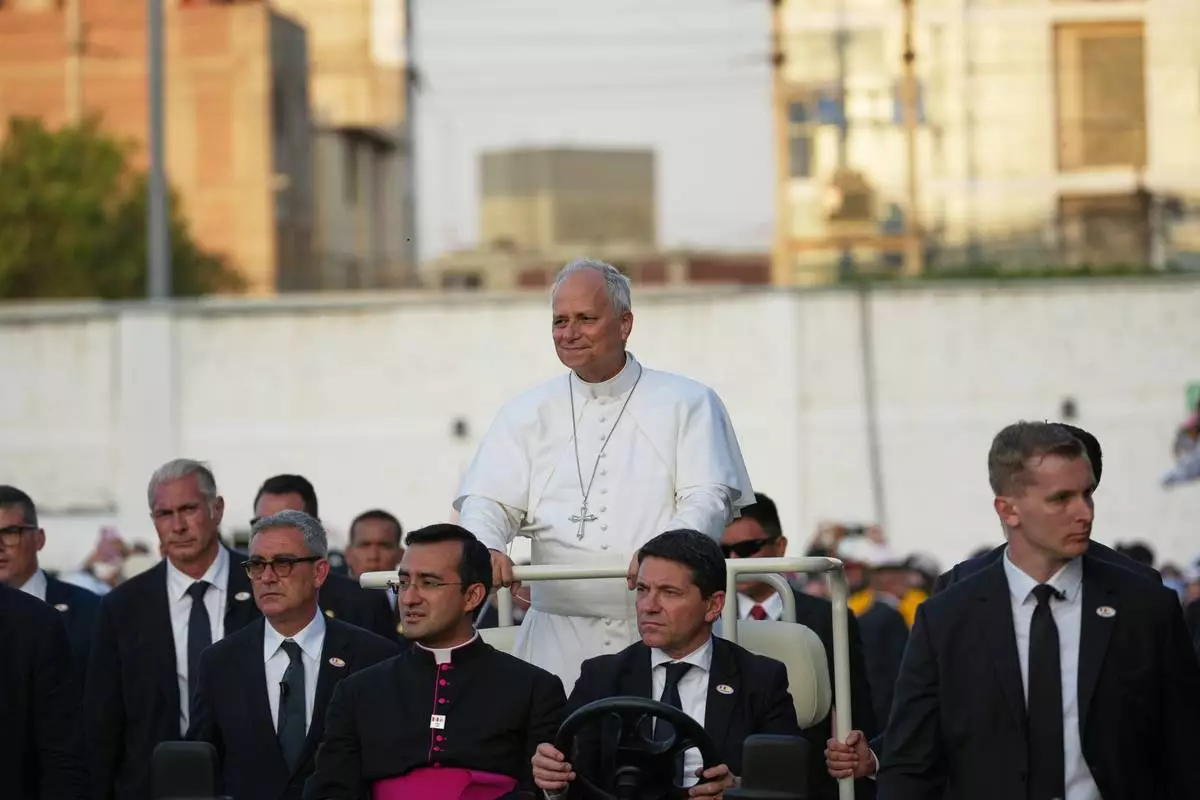
Pope Leo XIV meets the university community at Santo Toribio de Mogrovejo Catholic University in Chiclayo, Peru', on the eighth day of his twelve-day apostolic journey to South America, Friday, Nov. 13, 2026. (AP Photo/Andrew Medichini)
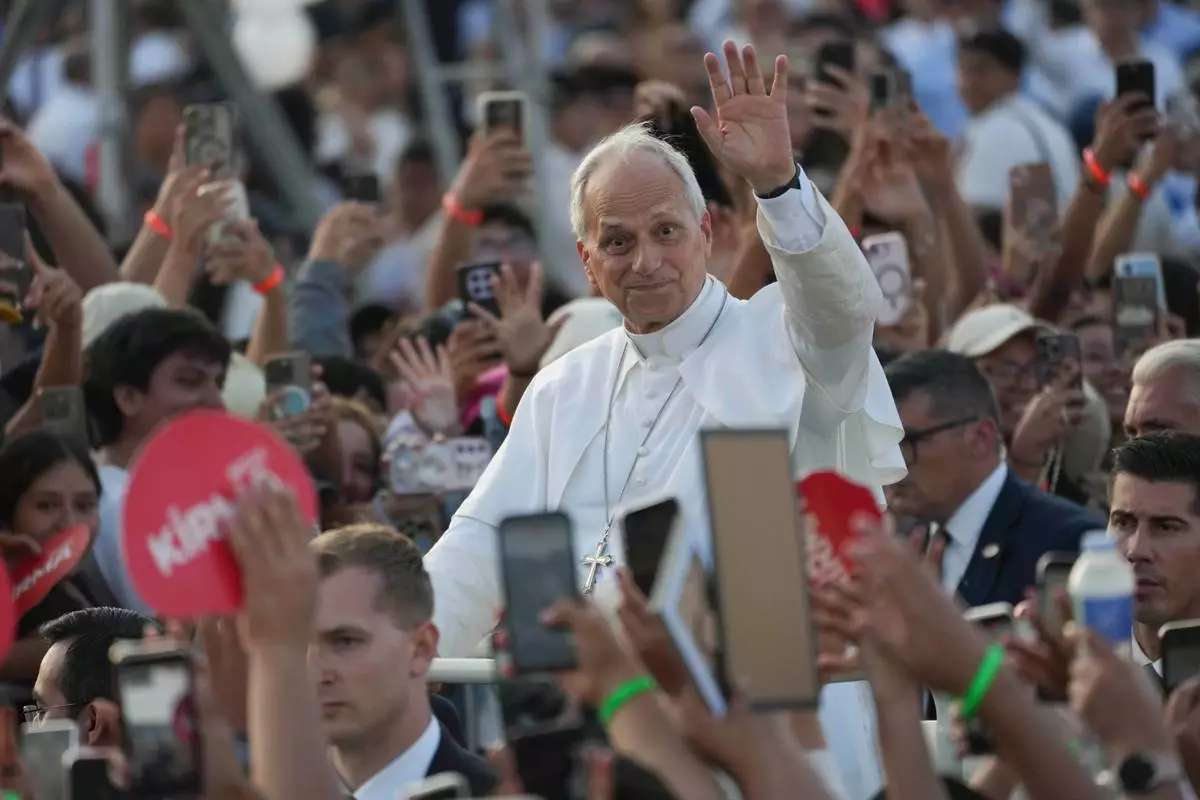
Pope Leo XIV waves to the faithful as he arrives for a meeting with the university community at Santo Toribio de Mogrovejo Catholic University in Chiclayo, Peru, Friday, Nov. 13, 2026. (AP Photo/Rodrigo Abd)
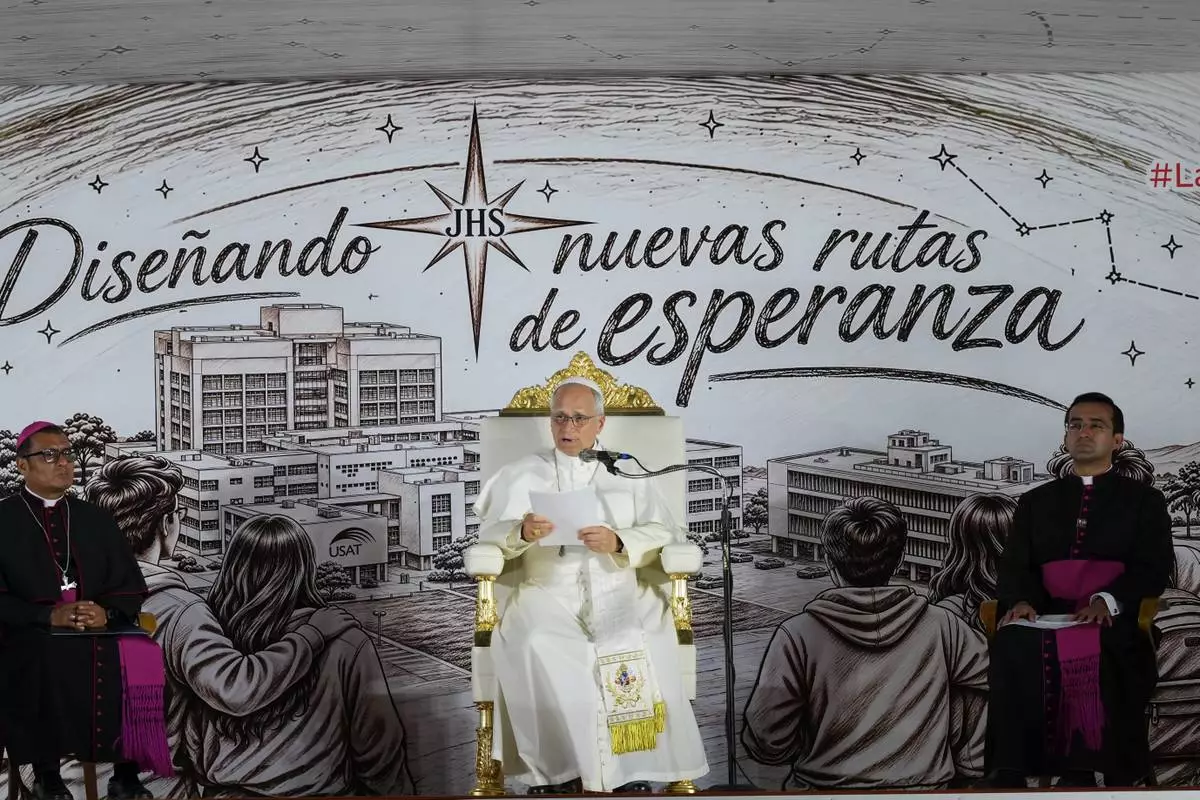
Pope Leo XIV delivers his message during his meeting with the university community at Santo Toribio de Mogrovejo Catholic University in Chiclayo, Peru', Friday, Nov. 13, 2026. (AP Photo/Andrew Medichini)