Over 200 companies in Shenzhen's Robotics Valley are enabling faster development and applications of crucial technologies including 3D sensing.
Robotics is a major frontier in the global technology industry, creating new opportunities for innovation and cooperation across the Asia-Pacific region.
The dynamic industrial ecosystem in Shenzhen City of south China's Guangdong Province has been helping realize 3D sensing and other key technologies of the robotics sector in components and real-world applications.
Unlike conventional cameras, which primarily capture visual information such as color and texture, 3D sensors can also measure spatial information, including the distance to objects, their relative positions and their depth. They're a key component in a wide range of technologies, from established applications such as facial recognition systems to the increasingly sophisticated perception systems used in humanoid robots.
More than 200 companies across the robotics supply chain are based in the area nicknamed Shenzhen's Robotics Valley, all within a 30-minute drive of one another.
Among them is Orbbec, one of China's leading producers of 3D-sensing components.
"Our vision technology can capture human operational data. That data is then fed into the robot's AI brain for training. Once trained, the model can be deployed onto the physical robot, allowing it to perform those tasks. That's how the cycle works," said Zheng Yafei (Felix Zheng), managing director for APAC region with Orbbec.
Orbbec is working closely with manufacturer Dobot Robotics, which helps robots move towards more intelligent and autonomous operation.
"For example, objects at a workstation may have been moved, or new obstacles may appear along the way. Robots can't rely entirely on pre-programmed movements. They need to adapt to their surroundings and make adjustments. So one of our advantages is in integrating visual perception with task understanding, decision-making and implementation," said Jiang Yu, deputy general manager of Dobot Robotics.
Both companies said Shenzhen's industrial ecosystem gives them a significant advantage, with key suppliers and manufacturers all within easy reach.
"Some technical issues are difficult to resolve over phone calls or emails. With suppliers nearby, our engineers can work directly with them, test equipment together and quickly adjust solutions," said Jiang.
"This allows us to quickly incorporate feedback into the next product iteration, significantly shortening the process from research and development and product validation to real-world deployment," said Zheng.
Orbbec's 3D sensors are already being deployed in robotics firms in countries like Singapore, the Republic of Korea and Japan, supporting the adoption of intelligent solutions in commercial cleaning, logistics, elderly care, healthcare and retail.
"In the first three quarters of this year, our revenue from APEC economies outside China grew by 94 percent. This reflects the strong momentum of the robotics industry across the Asia-Pacific region," said Zheng.
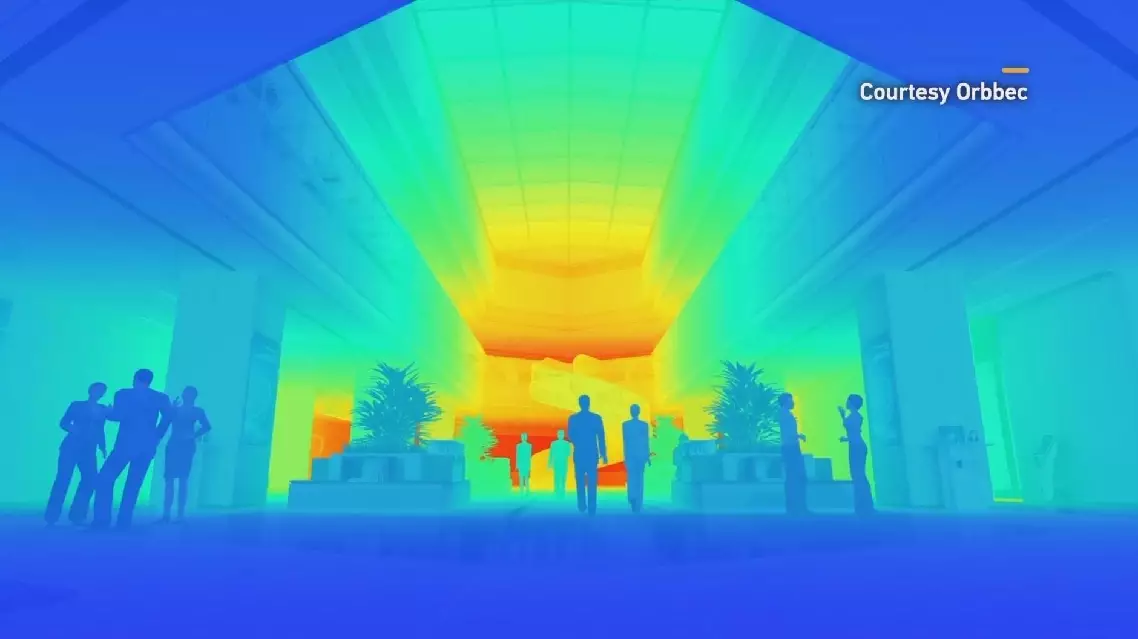
Shenzhen's Robotics Valley enables faster tech development, applications