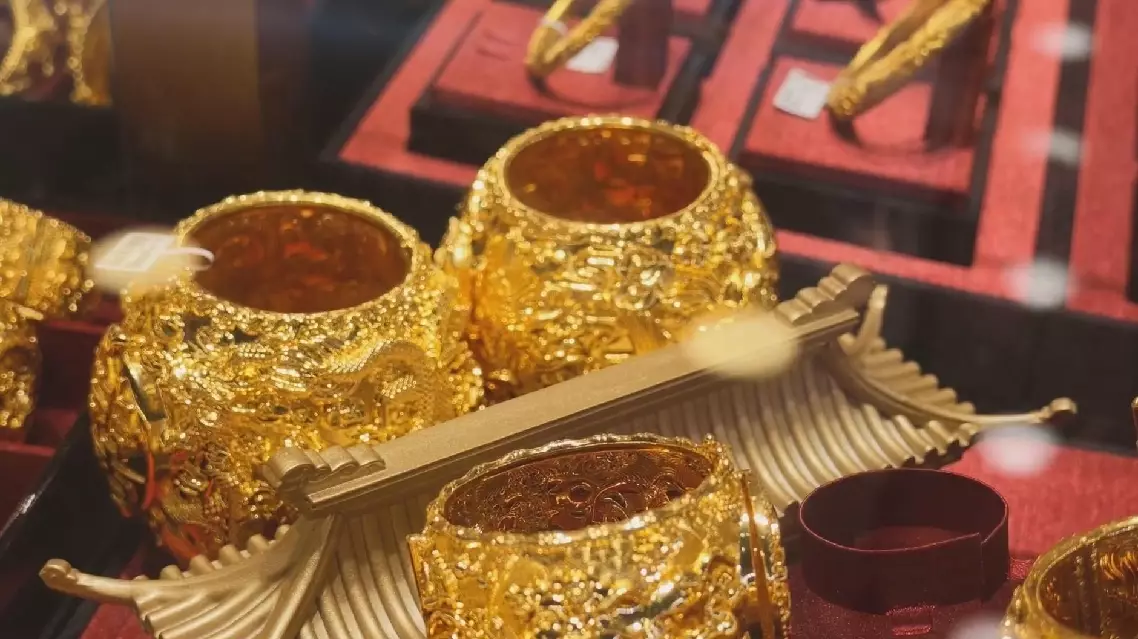
A manufacturing breakthrough in the Shuibei jewelry hub in south China's Shenzhen is challenging traditional notions of precious metals, turning pure gold into lightweight, durable, and intricately designed pieces that are captivating international buyers.
Home to one of China's largest gold and jewelry trading hubs, the Shuibei market draws buyers, wholesalers and shoppers daily. Yet beyond the sheer variety lining its shops, one product in particular is turning heads: hard-pure gold.
"At an international jewelry show in September, many buyers were interested in our hard-pure gold jewelry. Many buyers couldn't believe these pieces were made of pure gold. They thought the designs looked more like K-gold jewelry. But when we tested them on the spot, the results showed over 99.9 percent gold purity. They were amazed," said Wen Lei, general manager of the overseas business department at the Shenzhen Baitai Jewelry.
Hard-pure gold is unlocking new creative boundaries for designers and buyers alike, shifting priorities toward modern styling. For buyers like Ge Mengqian, keeping pace with contemporary trends is essential.
"What matters most to me is the design. The rings and necklaces I picked today are mostly designer pieces," said Ge.
The secret behind these intricate shapes lies in advanced manufacturing techniques. Lu Baichang, product R and D director at Jinyi Technology, explains that the process begins with a custom mold. The mold is dipped into a gold solution, where an electric current coats it with gold. The mold is then heated and removed, leaving behind a lightweight, hollow gold structure.
"Hard-pure gold can reach a hardness level of around 130. It's more resistant to wear and scratches, while also being lighter," said Lu Baichang, product R and D director at the Jinyi Tehcnology.
A bracelet that once required 30 to 40 grams of gold can now achieve the same visual volume using just 10 grams. This reduction in weight translates to lower production costs and a more accessible price tag for consumers. This transformation coincides with a fundamental shift in why consumers buy gold as Wen explains.
"The World Gold Council has also tracked this shift. In the past, wedding purchases accounted for 40 percent of gold jewelry consumption. Today, buying gold for oneself accounts for 44 percent. So, designers need to look beyond traditional styles and think about what younger consumers want," said Wen.
He further emphasized that success in Shenzhen's modern jewelry sector extends far beyond manufacturing.
"It's no longer just about manufacturing the product. From design and craftsmanship to mass production and consistent quality. The entire industry ecosystem is improving," said Wen.
As Shenzhen's artisans continue to push the boundaries of an ancient precious metal, the local hub is proving that even a centuries-old favorite can be continuously reinvented for a new generation.
China's 'hard gold' innovation reshapes jewelry market in Shenzhen's Shuibei