LONDON--(BUSINESS WIRE)--Nov 16, 2026--
According to the latest research from Omdia, Southeast Asia's smartphone market declined 36% year-on-year (YoY) in 3Q26, with shipments falling to 16.5 million units. This contraction continues a trend seen in the first half of 2026, as memory supply shortages and rising component costs constrained vendor shipments.
This press release features multimedia. View the full release here: https://www.businesswire.com/news/home/20261115993607/en/
Despite the sharp decline in volumes, market value fell by just 1% YoY while average selling prices (ASPs) increased 53%. This divergence highlights how vendors are responding to supply pressures by raising prices.
Key vendor highlights from 3Q26 include:
Shipment declines reflect supply constraints rather than weaker demand
“Shipment declines this quarter should not automatically be interpreted as weakening demand,” said Sheng Win Chow, Senior Analyst at Omdia. “Vendors can still supply devices across almost every price segment above $100, but they can no longer offer the same memory and storage specifications at previous price points. The impact on consumer demand will depend on how buyers respond to these changes and whether they consider the trade-offs acceptable. As a result, vendors are focusing their marketing on the practical benefits of new devices rather than headline RAM and storage specifications.”
“With tighter memory supplies and higher costs, vendors are facing difficult decisions about product positioning and profitability,” added Chow. “vivo, for example, had already been working to increase its ASP and reduce its dependence on devices priced below $100. Memory supply pressures have accelerated its exit from this segment.
“Omdia estimates that vivo’s 2026 year-to-date (YTD) shipments fell 33% while its ASP jumped 37%. The ultra-low-end segment typically operates on narrow margins and relies heavily on subsidies and discounting. Reducing exposure to this segment can therefore help vendors improve profitability, even as shipment volumes decline.”
Regional dynamics
“Vietnam was the only Southeast Asian market to record growth in 3Q26, with shipments increasing 1% YoY. All other Southeast Asian markets recorded double-digit declines, with shipments in Indonesia, the Philippines, Malaysia and Thailand falling by more than 30%,” said Le Xuan Chiew, Research Manager at Omdia.
“Vietnam’s relative resilience reflects its stronger macroeconomic performance. Growth was supported by foreign direct investment, manufacturing activity and exports linked to global demand for AI hardware. This economic momentum has helped sustain domestic demand, providing greater resilience in Vietnam’s smartphone market.”
“HONOR also strengthened its position in the region’s more developed markets, reaching second place in Malaysia and third in Singapore by shipments for the first time,” added Chiew. “Its established focus on premium mid-range devices rather than the sub-$200 tier most affected by memory supply constraints has helped limit its exposure to declining entry-level volumes.
“HONOR has also expanded its presence in the telco operator channel, where operator-led sales account for a significant proportion of smartphone purchases. This stronger distribution presence has been an important driver of its growth.”
ABOUT OMDIA
Omdia, part of TechTarget, Inc. d/b/a Informa TechTarget (Nasdaq: TTGT), is a technology research and advisory group. Our deep knowledge of tech markets grounded in real conversations with industry leaders and hundreds of thousands of data points, makes our market intelligence our clients’ strategic advantage. From R&D to ROI, we identify the greatest opportunities and move the industry forward.

Southeast Asia smartphone shipment market share, 3Q 2026

Southeast Asia smartphone shipment market share, top vendors, 2Q24 to 3Q26

Southeast Asia smartphone market shipment, 1Q23 to 3Q26
Fewer international students are studying at U.S. universities as the Trump administration cracks down on immigration and reshapes higher education, data released Monday shows.
Overall, U.S. campuses saw a 9% decrease in international enrollment this fall compared with last year, according to a survey from the Institute of International Education. And the number of new students entering the United States for the first time fell by 15%.
“No one aspires to send their kids to get educated in the U.S.,” said Veena Dubal, general counsel for the American Association of University Professors, whose father traveled from India to attend Tuskegee University, then the Tuskegee Institute, in the late 1960s on a student visa.
"It feels like an unsafe place. That’s the message that the Trump administration has been sending to families all over the world and they’re listening.”
Last year, the enrollment decreases were partially offset by large numbers of students who stayed in the U.S. for temporary work after graduating. But after months of speculation, the Department of Homeland Security proposed requiring schools to pay a $70,000 fee for every student who participates in the optional practice training program.
Although the rule hasn't been finalized, participation in the program, known as OPT for short, dropped 6% this fall, according the survey.
The proposed rule, which is expected to face legal challenges, is part of wider DHS efforts that include terminating the legal status of thousands of international students, along with detaining and deporting many of them.
And this summer, the administration finalized a rule that will prevent international students from staying in the U.S. for more than four years without approval from the federal government, although a judge has temporarily blocked it.
DHS Secretary Markwayne Mullin has said the changes were intended to crack down on loopholes that international students were exploiting by extending their studies.
Although the U.S. remains the top destination for international students globally, the changes are having an effect, college leaders told the IIE.
Among more than 800 U.S. colleges and universities surveyed this fall, 88% blamed the visa application process and 70% blamed travel restrictions for the enrollment drops. And if OPT options are limited, 95% of schools predicted that international students would likely look to another country, according to the survey, which offers an early look at trends before full data is released next year.
Politics aren't the only reason students are looking elsewhere, said Mirka Martel, head of research, evaluation and learning for the institute. Its survey found more global competition for international students and the rising cost of a U.S. degree also contributed.
Fanta Aw, the executive director and CEO of NAFSA, an association that represents international education, said students also are worried about research funding. Last year, the Trump administration began dismantling the federal grant-giving process and attempting to exert more political influence over what projects get funded.
“They’re saying to themselves, ‘Too much uncertainty in the United States. It’s too difficult, and you know, more importantly, we have many more choices today than we did 10 years ago. Why subject ourselves to this?’” Aw said, noting that students are going to places like China.
NAFSA, in partnership with the international education technology company JB International, found that amid the enrollment decline, international students’ contributions to the U.S. economy dropped by $2.4 billion this fall.
American colleges and universities heavily recruit students from overseas as a source of tuition revenue. So the drops have punched big holes in tuition revenue at some schools.
At Cleveland State University, international enrollment has dropped by 46% in two years, from 1,542 in fall 2025 to 828 this fall. And fewer than 50 new international students started this fall, said Provost Nigamanth Sridhar, who estimated that the budgetary impact ranges from $2 million to $4 million.
Decades ago, he arrived in the U.S. on an F1 student visa and participated in OPT. Eventually, he went through the process to became a naturalized citizen.
“I am here in this position, in this job, because I had the opportunity to come to the United States as an international graduate student and then decided to stay here and build a career," said Sridhar, who is from India. "So international education is personal to me."
The biggest drops were at the graduate level. This fall's data shows a 15% drop in international graduate enrollment, compared to a 3% decrease at the undergraduate level. The report also found declines in international students from India, which sends more students to the U.S. to study than any other country.
Sarah Spreitzer, vice president at the American Council on Education, which represents college and university presidents, said substantial immigration bills are unlikely while Trump remains president. But she said congressional oversight might halt new policies targeted at international students.
“Those types of things could provide more certainty for our international students that there’s not just going to be these sudden or unexplainable changes," Spreitzer said.
——-
The Associated Press’ education coverage receives financial support from multiple private foundations. AP is solely responsible for all content. Find AP’s standards for working with philanthropies, a list of supporters and funded coverage areas at AP.org.
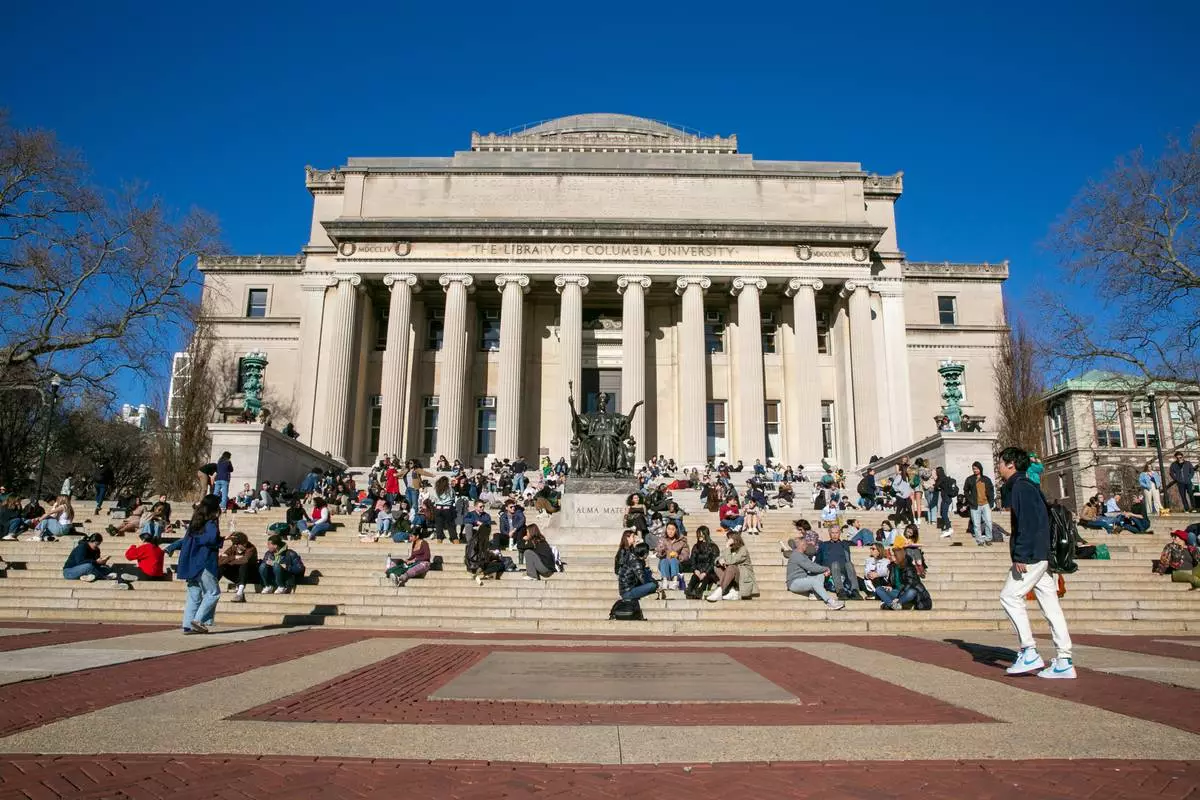
FILE - Students sit on the front steps of Low Memorial Library on the Columbia University campus in New York City, Feb. 10, 2023. (AP Photo/Ted Shaffrey, File)