Yuanchu No. 1, the world's first 300-megawatt artificial cavern compressed air energy storage (CAES) station, has been connected to the grid in northwest China's Gansu Province, China Energy Engineering Corporation announced on Monday.
At the project site in Jiuquan, high-pressure air is released from an underground artificial cavern complex with a total volume of approximately 200,000 cubic meters to drive turbines to generate electricity, realizing the station's first grid-connected power generation. A single full charge can store 1.8 million kilowatt-hours of electricity, enough to charge 30,000 new energy vehicles.
The Yuanchu No. 1 power station features a complex of four underground gas-storage caverns excavated within rock strata 110 meters deep underground. The facility is equipped with a 300-megawatt generation unit boasting an energy storage scale of 1,800 megawatt-hours. It achieves an electricity-to-electricity conversion efficiency of 72 percent, supports a six-hour discharge duration per cycle, and has an annual power generation capacity of 600 million kilowatt-hours.
"The CAES project can be coupled with surrounding wind and photovoltaic power plants to create a 'generation-plus-storage green power station' model, which can be adapted to scenarios of transmitting green power from large-scale bases in desert, Gobi and wasteland regions and even broader regions across the country, zero-carbon industrial parks, and integrated coordination of computing power and energy supply. China has become the only country in the world to master the full set of technical routes for artificial cavern compressed air energy storage," said Wan Mingzhong, chief expert of China Energy Engineering Corporation.
Compressed air energy storage is a technology that converts electrical energy into the potential energy of compressed air and reconverts it into electricity when needed.
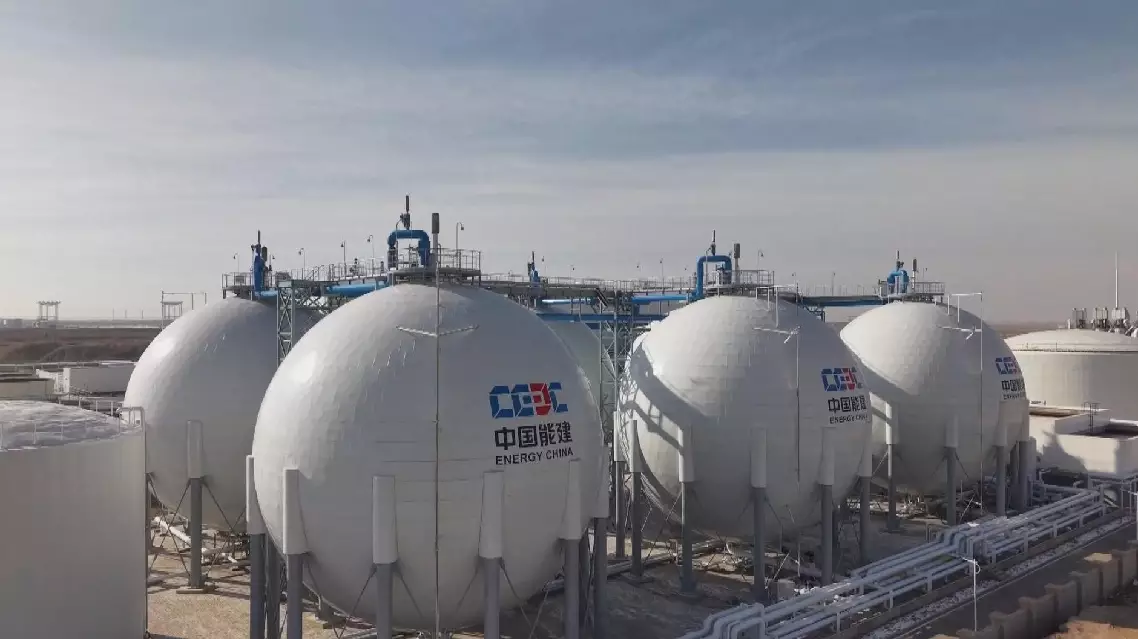
First 300-MW artificial cavern compressed air energy storage station operational