Combining autonomous mobility and collaborative robotics to support more flexible manufacturing operations worldwide
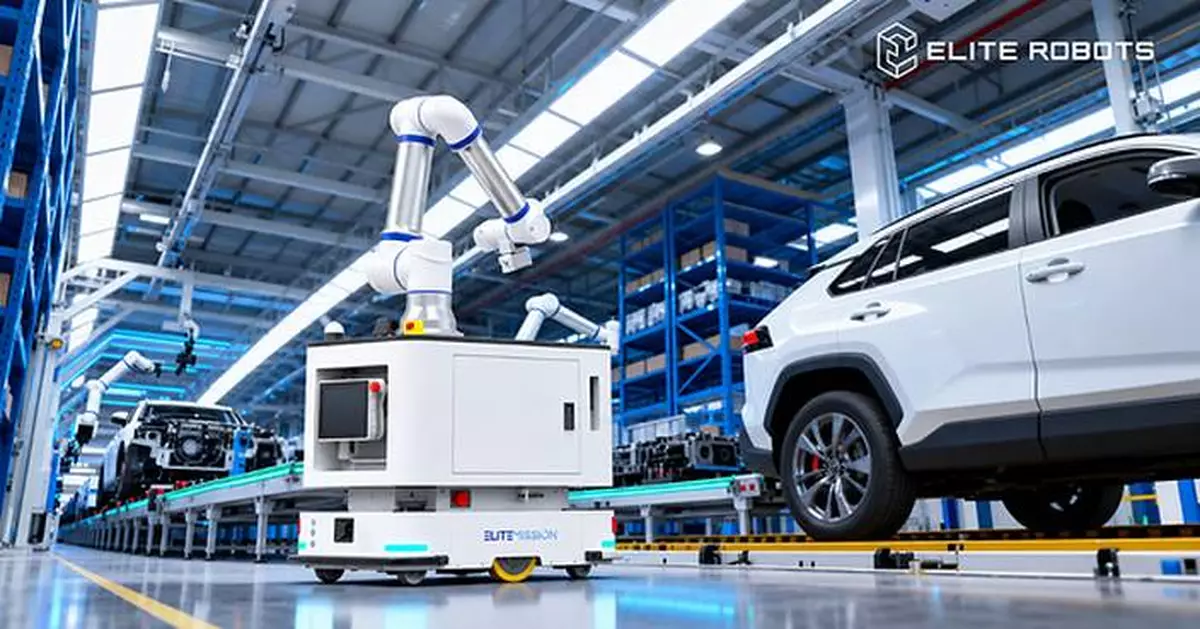
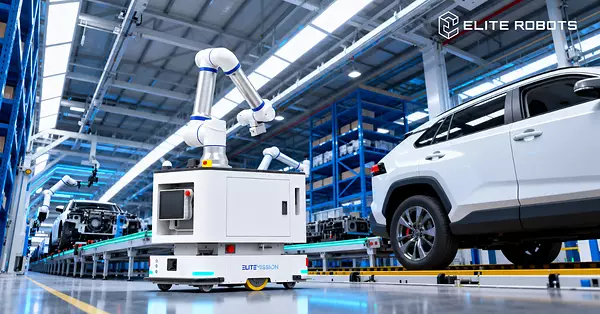
SHANGHAI, Nov. 16, 2026 /PRNewswire/ -- Elite Robots is expanding its global automation portfolio with CE-compliant ELITEMISSION mobile manipulators, bringing together autonomous mobility and collaborative robotic technology to help manufacturers build more flexible and adaptable production environments.
Unlike traditional industrial robots operating at fixed workstations, mobile manipulators combine a robotic arm with an autonomous mobile platform, enabling a single robotic system to move between different workstations and perform handling tasks where needed.
Bringing Greater Flexibility to Factory Automation
As manufacturers seek to improve production efficiency and respond to changing operational demands, flexible automation is becoming increasingly important.
ELITEMISSION mobile manipulators are designed to support applications such as machine loading and unloading, component handling, and material transfer between production stages.
By combining autonomous movement with robotic manipulation, these solutions offer manufacturers new possibilities for deploying automation across multiple workstations without relying exclusively on fixed robotic installations.
The solutions can support a variety of industrial environments, including automotive manufacturing, electronics, semiconductors, and new energy production.
ELITEMISSION also incorporates integrated vision, unified control interfaces, and supporting navigation and coordination technologies to facilitate integration with existing manufacturing systems.
Supporting International Market Expansion
The introduction of CE-compliant mobile manipulators marks an important milestone in Elite Robots' international expansion, providing manufacturers and system integrators with additional options when evaluating flexible automation solutions.
"Achieving CE compliance for our mobile robot lineup is a major milestone in our global journey," said Charles Xie, Overseas Sales Director at Elite Robots. "By combining autonomous mobility and collaborative robotic manipulation, we are empowering international manufacturers and system integrators to build more flexible, scalable production environments."
Through its expanding robotics portfolio, Elite Robots aims to help manufacturers explore new approaches to automation, improve operational flexibility, and adapt production processes to evolving industry needs.
About Elite Robots
ELITEMISSION is an industrial mobile robotics portfolio developed by Mission Robots Co., Ltd., a subsidiary of Shanghai-based Elite Robots.
Founded in 2016, Elite Robots develops collaborative robots and industrial automation solutions, serving customers in more than 50 countries and regions through a global network of distributors, system integrators, and ecosystem partners.
For more information, visit www.eliterobots.com.
** This press release is distributed by PR Newswire through automated distribution system, for which the client assumes full responsibility. **
Elite Robots Expands Global Mobile Automation Offering with CE-Compliant Mobile Manipulators
The Human-Centric Approach Helps Enterprises Build Sustainable, Scalable and Verifiable Productivity
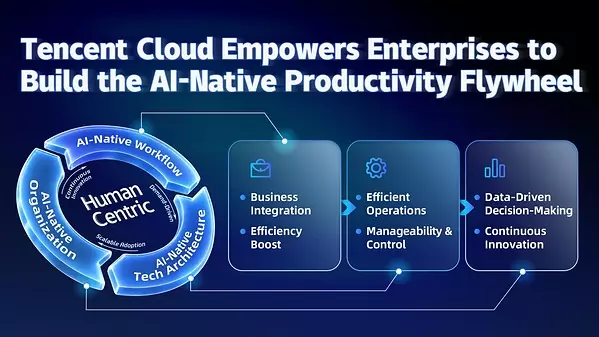
HONG KONG, Nov. 16, 2026 /PRNewswire/ -- As artificial intelligence (AI) becomes increasingly embedded in business operations, more organizations are leveraging AI to boost individual productivity. However, transforming individual capabilities into organizational capabilities and turning productivity gains into sustainable and scalable competitive advantages remains a key challenge in enterprise AI transformation. To address this, Tencent Cloud has introduced its AI-Native Productivity Flywheel framework, built around three core elements: AI-Native Workflow, AI-Native Tech Architecture, and AI-Native Organization. By fostering human-AI collaboration through a continuously reinforcing flywheel and placing human needs at the center of AI transformation, the framework helps enterprises build sustainable organizational capabilities while enabling people to focus on creativity, empathy and higher-value work.
Freda Xu, Vice President of Tencent Cloud, Head of Marketing, Head of International Marketing and Public Relations, recently delivered a keynote speech titled "Women's Leadership in the AI Era: How to Lead a Human-AI Co-Working Team" at the Women x Innovation x A Brighter Tomorrow Forum in Hong Kong. She noted that AI is reshaping the way individuals work, teams collaborate, and organizations innovate. For business leaders, the key question is no longer simply how to adopt AI tools, but how to build a new type of organization powered by human-AI collaboration, enabling employees to continuously expand their capabilities, evolve professionally, and unlock innovation and growth in the AI era.
From Super Individuals to Super Organizations
The rapid advancement of generative AI has given rise to a growing number of "super individuals" who leverage AI to significantly improve workplace productivity. However, in Tencent Cloud's view, super individuals do not automatically create super organizations. The real challenge is not achieving one-off productivity gains, but transforming individual expertise, successful experiences, and best practices into organizational assets that can be shared, replicated, and continuously amplified across the enterprise.
Xu pointed out that AI agents are evolving from workplace tools into "AI colleagues," participating in knowledge management, collaboration, and decision support. Tencent's all-in-one AI workspace, WorkBuddy, serves as a prime example. Its goal is not only to improve individual efficiency, but also to take over repetitive and process-driven tasks, allowing employees to focus on work that requires empathy, creativity, and judgment. At the same time, it helps enterprises transform institutional knowledge and best practices into sustainable organizational capabilities.
Xu said: "The greatest competitive advantage in the AI era lies in enabling employees to build on the collective knowledge and capabilities accumulated by the organization, empowering them to create greater value. Human-AI collaboration can unlock new business models and create new forms of value. Centered on human needs, the AI-native transformation of workflows, technology architecture, and organizations to unleash human potential and build AI-native productivity is at the heart of Tencent Cloud's AI-Native Productivity Flywheel framework."
AI-Native Productivity Flywheel: Enabling the Co-Evolution of People and Organizations
To help enterprises systematically advance AI transformation, Tencent Cloud introduced the AI-Native Productivity Flywheel framework. Built on the principles of human-centric design and continuous reinforcement, the flywheel consists of three interconnected components: AI-Native Workflow, AI-Native Tech Architecture, and AI-Native Organization. Through a continuous reinforcement mechanism, it enables AI to become deeply integrated into enterprise operations and decision-making processes.
At the workflow level, AI-Native Workflow focuses on reimagining how work gets done by elevating AI from a tool to a workplace partner. By connecting workplace applications, knowledge assets, and business systems, information previously scattered across documents, meetings, cloud storage, and enterprise systems becomes actionable context for AI, enabling it to better understand business needs and execute tasks. This allows AI to be deeply embedded in both personal productivity and enterprise business scenarios. AI-Native Tech Architecture provides a secure, reliable, and scalable foundation for enterprise AI adoption, while AI-Native Organization drives cultural, management, and talent innovation to embed human-AI collaboration into everyday organizational operations.
Tencent Cloud believes these three elements form a continuously reinforcing flywheel. Workflows capture organizational knowledge and best practices, technology architectures standardize and scale capabilities, while organizations encourage knowledge sharing and innovation. As the flywheel gains momentum, enterprises can transform the knowledge and expertise embedded across individuals and teams into organizational assets that are shareable, scalable, and continuously evolving. In doing so, AI evolves from a productivity tool into a strategic capability that drives the co-evolution of people and organizations, with every turn of the flywheel ultimately contributing to human growth and creativity.
Demonstrating the Value of AI Productivity Through Real Business Scenarios
During the keynote, Xu shared a number of real-world examples from leading enterprises including C&S Paper and Suning.com, illustrating how AI is evolving from an individual productivity tool into an organization-wide capability.
For example, C&S Paper, a leading tissue and personal care products company, uses WorkBuddy for business analytics and retail operations. Complex business analyses that previously required two to three employees working collaboratively for a week can now be completed within half a day. Team members are able to shift their focus from time-consuming data processing to higher-value work such as strategic interpretation and creative planning. The company also uses AI to identify high-potential stores from a network of more than four million retail outlets, developing differentiated assortment strategies based on factors such as consumer traffic, purchasing power, competitive presence, and historical sales performance. These initiatives have significantly improved resource allocation efficiency, while the company recorded a 78% year-on-year increase in net profit during the third quarter. According to Xu, the true value of AI is not the technology itself, but its ability to solve real business challenges, enable people to focus on more creative work, and transform successful experiences into scalable organizational capabilities.
As a key practice of Tencent's AI-Native Workflow strategy, WorkBuddy is helping enterprises deeply integrate AI into knowledge management, content creation, collaboration, and task execution workflows. By capturing, sharing, and amplifying employee expertise and judgment, it enables organizational knowledge and expertise to be continuously accumulated and reused across teams. To date, WorkBuddy has handled more than 9 billion task requests, serves over 50% of Fortune China 500 companies and more than 60% of China's Top 100 enterprises, and ranks among the industry leaders in third-party AI product rankings and IDC enterprise agent evaluations.
Looking ahead, enterprise competition will increasingly depend not only on technology capabilities, but also on an organization's ability to develop talent, accelerate knowledge flows, and continuously generate innovation. Tencent Cloud believes AI will become more deeply integrated into workflows, decision-making processes, and organizational collaboration, helping enterprises move from digitalization to intelligence. Guided by a people-centric philosophy, Tencent Cloud will continue to advance WorkBuddy and related AI capabilities, foster human-AI collaboration and innovation, and enable organizational intelligence to empower every individual, helping enterprises and talent unlock new opportunities in the era of human-AI collaboration.
About Tencent Cloud
Tencent Cloud, one of the world's leading cloud companies, is committed to creating innovative solutions to resolve real-world issues and enabling digital transformation for smart industries. Through our extensive global infrastructure, Tencent Cloud provides businesses across the globe with stable and secure industry-leading cloud products and services, leveraging technological advancements such as cloud computing, Big Data analytics, AI, IoT, and network security. It is our constant mission to meet the needs of industries across the board, including the fields of gaming, media and entertainment, finance, healthcare, property, retail, travel, and transportation.
** This press release is distributed by PR Newswire through automated distribution system, for which the client assumes full responsibility. **
Tencent Cloud Introduces AI-Native Productivity Flywheel Framework