BRUSSELS (AP) — European Union countries on Monday accused Russia of trying to drag out talks on ending the war in Ukraine while it bombs power plants and other infrastructure to make life even harder for civilians as winter closes in.
At talks in Brussels, EU foreign ministers said the priority should be to secure a ceasefire and then a real peace agreement. They said that Russia started the nearly five-year war and must back down rather than make fresh demands of Ukraine and its Western backers.
Click to Gallery
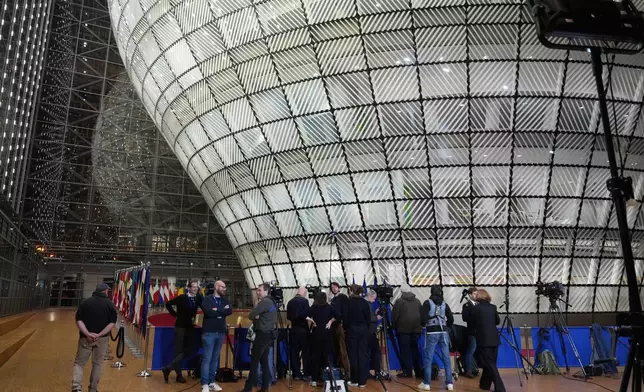
Journalists take positions as they prepare for the arrival of ministers ahead of a meeting of EU foreign ministers at the European Council building in Brussels, Monday, Nov. 16, 2026. (AP Photo/Virginia Mayo)
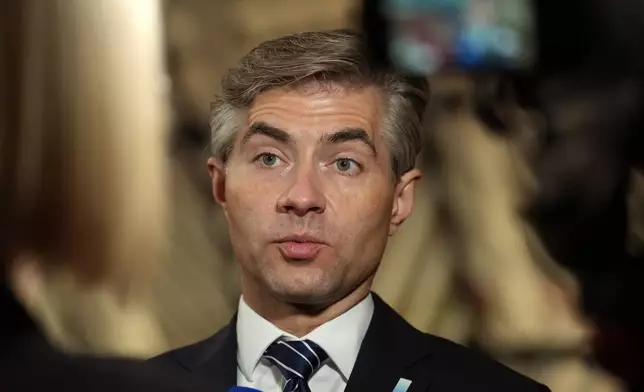
Lithuania's Foreign Minister Kestutis Budrys speaks with the media as he arrives for a meeting of EU foreign ministers at the European Council building in Brussels, Monday, Nov. 16, 2026. (AP Photo/Virginia Mayo)
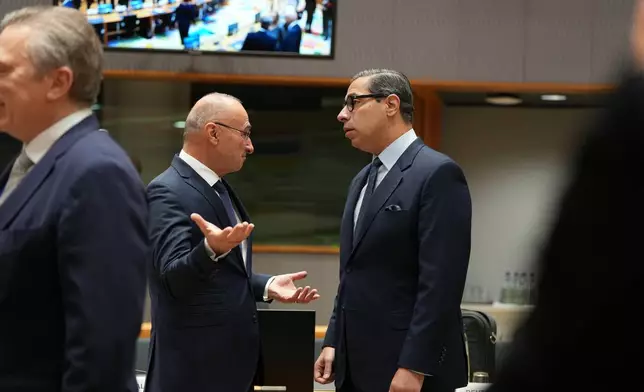
Croatia's Foreign Minister Gordan Grlic Radman, left, speaks with Cypriot Foreign Minister Constantinos Kombos during a round table meeting of EU foreign ministers at the European Council building in Brussels, Monday, Nov. 16, 2026. (AP Photo/Virginia Mayo)
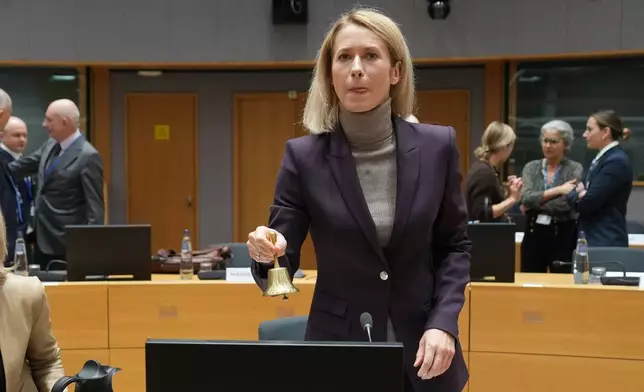
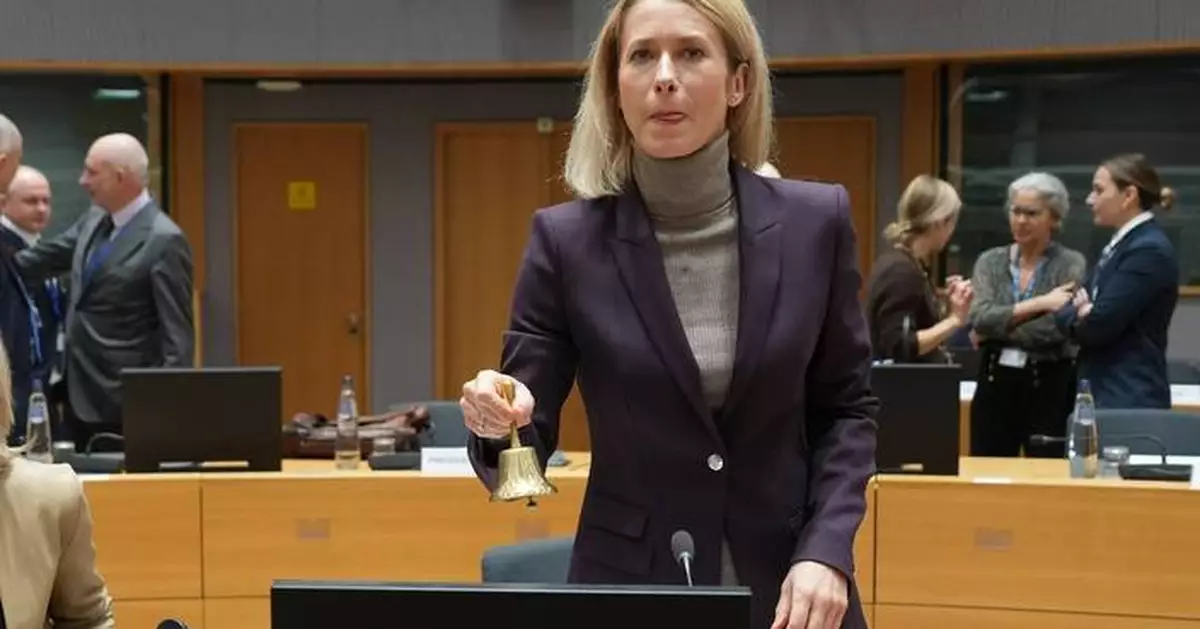
European Union foreign policy chief Kaja Kallas rings a bell to signify the start of a meeting of EU foreign ministers at the European Council building in Brussels, Monday, Nov. 16, 2026. (AP Photo/Virginia Mayo)
“Let’s not blur the picture right now. What we need to see is a ceasefire,” EU foreign policy chief Kaja Kallas said before chairing the meeting. “We don’t see it at the moment. We see that Russia is really escalating.”
After negotiations in Abu Dhabi last week, the United States encouraged Ukraine and its backers to agree to a Russian demand for a new security framework for Europe, suggesting that it might help bring peace.
But the Europeans see that as a Russian attempt to weaken NATO by obliging the military alliance to pull troops and equipment back westward, similar to the way they were deployed before the Czech Republic, Hungary and Poland joined in 1999.
That demand is “really absurd,” Kallas said. “If we look at the history, none of these countries has ever attacked Russia.” She said Russia’s tactic is always to demand more even though “they started the war. They are the aggressor. And there’s one victim.”
Irish Foreign Minister Helen McEntee, whose country currently holds the EU’s rotating presidency, said that despite the talks, “Russia has clearly not changed its position. It is continuing its attacks on civilians and civilian infrastructure.”
McEntee said the EU will agree on more sanctions later Monday “trying to in particular attack the financial mechanism by which Russia is waging this war.” The ministers will also look at ways to help Ukraine endure the coming winter.
German Foreign Minister Johann Wadephul said: “Europe has a security architecture – we don’t need a new one, we just need respect from everyone for the existing security architecture.” He said that is "the foundation for any conceivable agreement, from the European point of view.”
Lithuanian Foreign Minister Kęstutis Budrys also insisted that Europe does not need another security framework, saying that Russia cannot be trusted and has already broken past agreements anyway.
“It’s very clear that we don’t need another one. We already have one. Secure Ukraine, strong Europe, strong trans-Atlantic bond,” he told reporters. “It’s not about the rules. Rules are working. The problem is that Russia is breaking them.”
U.S. negotiators Jared Kushner and Steve Witkoff have positioned themselves as mediators and have been talking to Russia and Ukraine for just over a year. In that time, no lasting ceasefire has been agreed, and little obvious progress has been made toward peace.
Major differences remain over the control of territory and future security arrangements.
European leaders and officials, including Kallas, have expressed skepticism about the talks. The only tangible progress has been exchanges of prisoners, which are often used by warring parties as a trust-building measure during peace talks.
At a summit in Dublin last week, EU leaders agreed that Europe should be represented in future talks by a team of security advisers from France, Germany, the U.K., Italy and Poland as well as senior officials from the EU’s main institutions.
The Europeans concede that as Ukraine’s biggest backers they cannot also act as mediators. Their role will focus on security arrangements, reconstruction and Ukraine’s future. Only Ukraine itself can decide on matters involving its sovereignty, they said.
Associated Press writer Geir Moulson in Berlin contributed to this report.
Follow the AP’s coverage of the war in Ukraine at https://apnews.com/hub/russia-ukraine
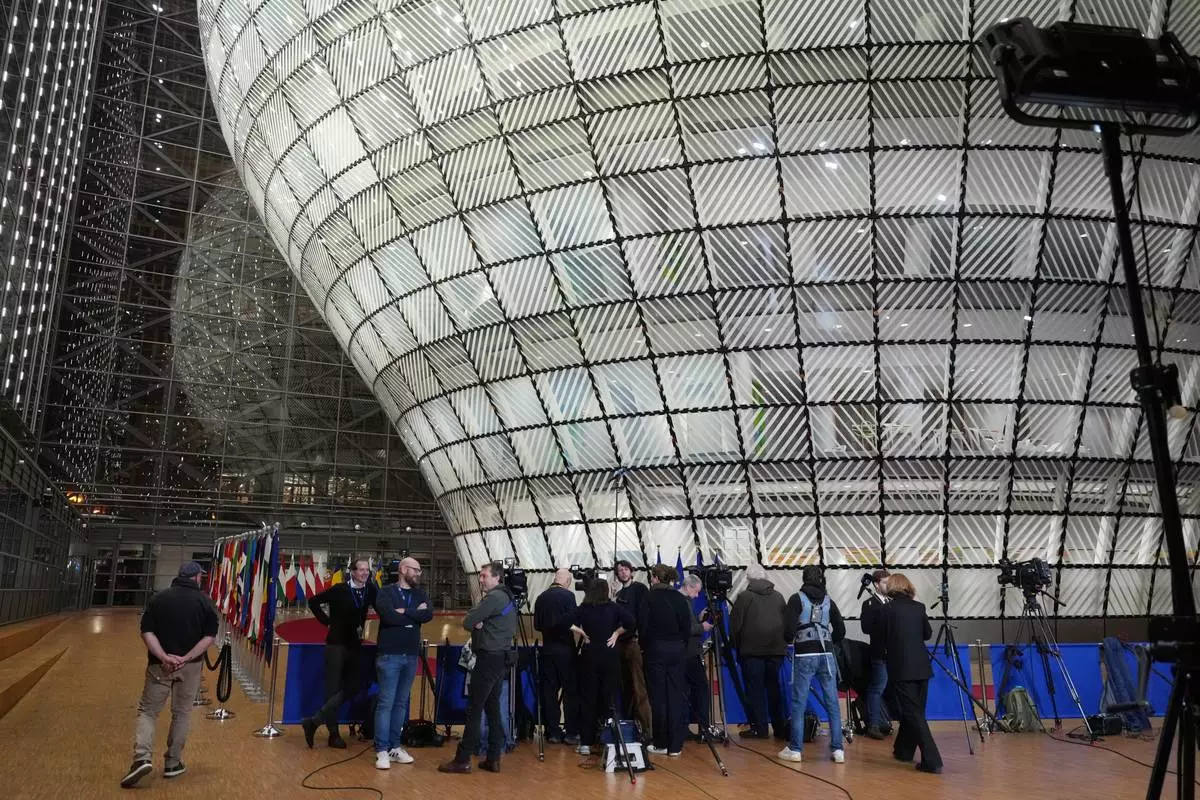
Journalists take positions as they prepare for the arrival of ministers ahead of a meeting of EU foreign ministers at the European Council building in Brussels, Monday, Nov. 16, 2026. (AP Photo/Virginia Mayo)
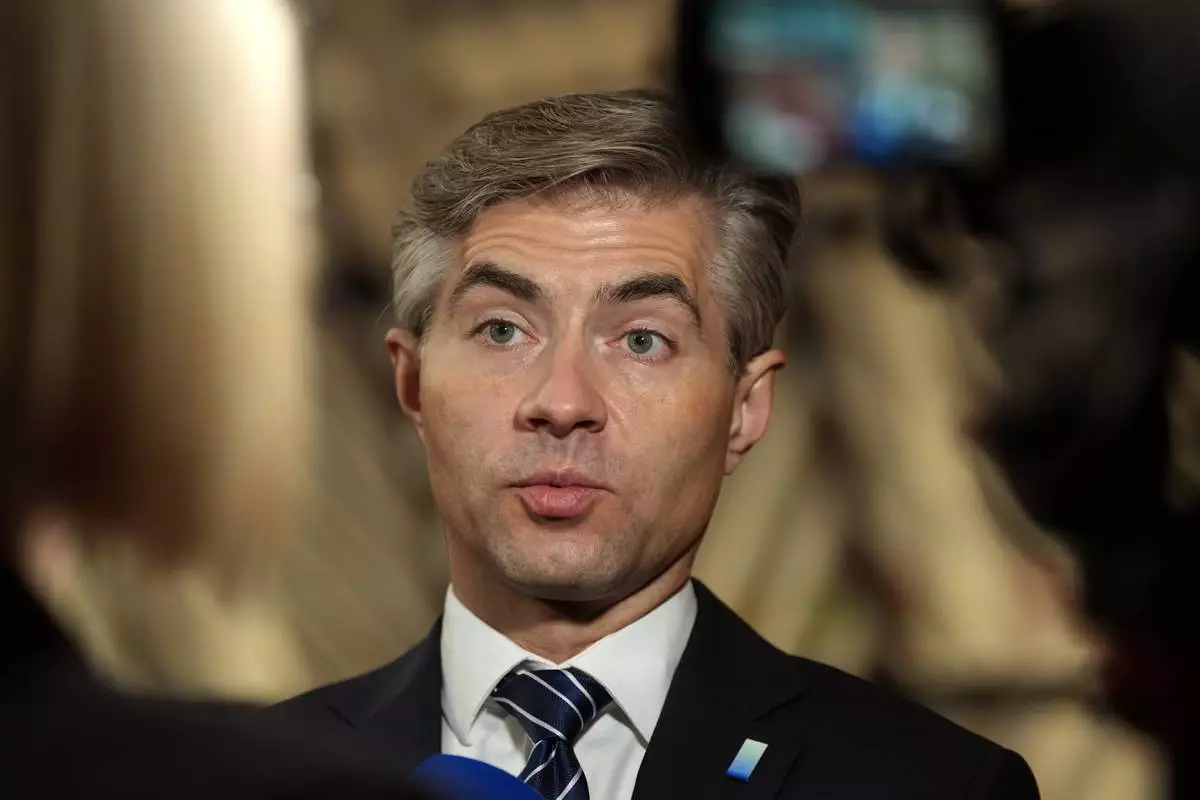
Lithuania's Foreign Minister Kestutis Budrys speaks with the media as he arrives for a meeting of EU foreign ministers at the European Council building in Brussels, Monday, Nov. 16, 2026. (AP Photo/Virginia Mayo)
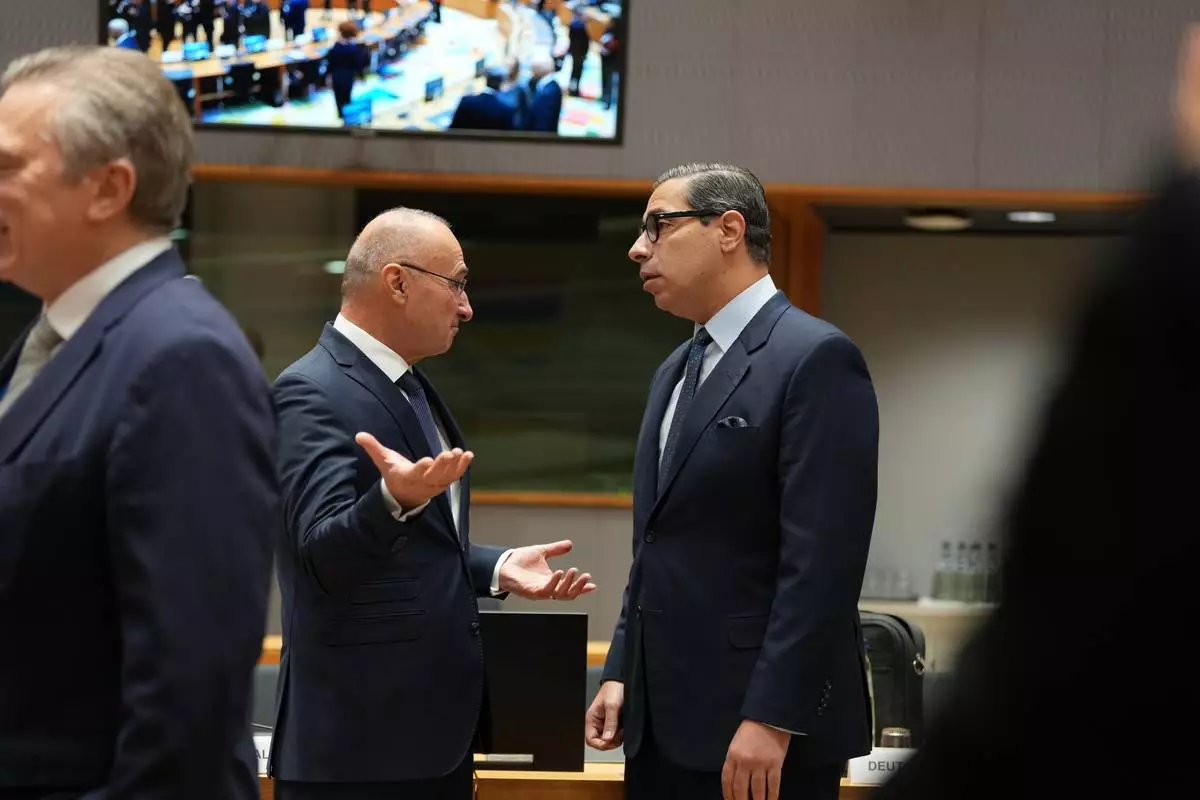
Croatia's Foreign Minister Gordan Grlic Radman, left, speaks with Cypriot Foreign Minister Constantinos Kombos during a round table meeting of EU foreign ministers at the European Council building in Brussels, Monday, Nov. 16, 2026. (AP Photo/Virginia Mayo)
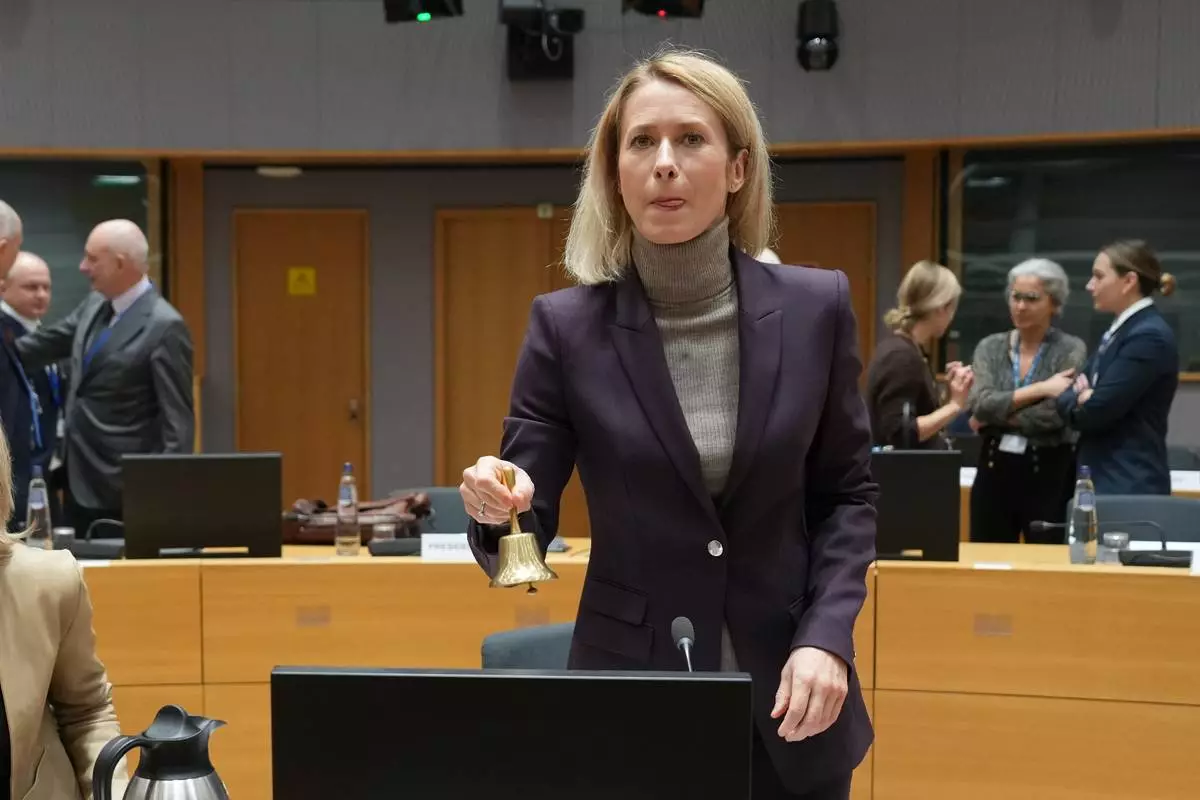
European Union foreign policy chief Kaja Kallas rings a bell to signify the start of a meeting of EU foreign ministers at the European Council building in Brussels, Monday, Nov. 16, 2026. (AP Photo/Virginia Mayo)

SIEM REAP, Cambodia (AP) — French President Emmanuel Macron left the Francophonie summit in Phnom Penh, the capital of Cambodia, on Monday with uncertainty still hanging over the leadership of the Francophone organization after a dispute between Rwanda and Congo roiled the proceedings.
After intense negotiations over the weekend and into Monday, member states decided that the incumbent secretary-general, Rwanda’s Louise Mushikiwabo, will stay on to lead the Organisation internationale de la Francophonie for another year before making way for a new leader.
Mushikiwabo was seeking a third term at the summit, which Congo had opposed, going as far as threatening to leave the OIF if she was reelected.
Congo has more than 110 million people — far exceeding France’s population of 70 million — and its withdrawal would be a significant blow to the organization.
Congo, the United States and U.N. experts accuse Rwanda of backing the M23, one of about 100 armed groups vying for a foothold in mineral-rich eastern Congo, along the border with Rwanda. Rwanda’s government consistently denies backing armed groups in Congo.
The French president’s office welcomed the one-year postponement and said it would allow the organization "to overcome divisions and preserve the consensus in the francophone family.”
Congo’s Foreign Minister Thérèse Kayikwamba Wagner said on X that “a wise compromise” would preserve unity in the Francophonie.
The OIF wrapped up three days of meetings Monday. Macron held bilateral talks, including with Cambodian Prime Minister Hun Manet and Vietnamese leader To Lam, and attended the summit of the loose confederation of 90 member states and governments comprising 53 full members, five associate members and 32 observers — all French-speaking places.
On Sunday, the French president’s office said Macron met with Rwandan President Paul Kagame and called for the three African countries presenting candidates for the OIF leadership role — Mauritania is the third — to hold talks and agree on a “consensus solution.” France is influential in the decision as the largest contributor to the OIF 2026 budget of 71.7 million euros ($79 million).
The leadership dispute comes on the heels of the withdrawals of Mali, Niger and Burkina Faso from the OIF announced in March 2025, following their membership suspensions over military coups.
Rights groups and U.N. Special Rapporteur Tom Andrews also called on world leaders attending the meetings to press Cambodia to release of rights activists and allow greater democratic freedoms in the de facto one-party state.
Hun Manet, who chaired the summit, criticized Thailand in his opening remarks Sunday and reiterated that Cambodia had not started the fighting that erupted between the Southeast Asian neighbors in 2025 over competing claims to border territory. Several dozen civilians and soldiers on both sides were killed and hundreds of thousands of people displaced.
Macron praised the Cambodian leader for choosing peace as the theme for the summit, and said that France encouraged a return to dialogue to find a peaceful, negotiated solution to border disputes.
In a Facebook post Sunday, Thai Prime Minister Anutin Charnvirakul wrote that Thailand has “always respected all agreements with Cambodia and will always adhere to international law." He also restated Thailand’s position that bilateral disputes should be resolved without third-party involvement. Thailand’s aversion to outside involvement is partly rooted in two rulings by the International Court of Justice awarding Cambodia ownership of a centuries-old temple on disputed land along the border.
Macron on Monday headed to Siem Reap, home to Cambodia's Angkor Wat complex and UNESCO World Heritage site, to join King Norodom Sihamoni in marking the completion of a French-supported restoration of the West Mebon temple.
Cambodia's Apsara National Authority told The Associated Press that restoring the West Mebon temple, built in the 11th century during the Angkor era, cost $12 million over 14 years. The joint France-Cambodia project involved transporting replacement stones and heavy machinery by boat to the island temple while managing water levels to prevent flooding during seasonal rains.
The site had been damaged by natural elements, human activity and war.
After the inauguration ceremony, Macron will head to Malaysia to meet Prime Minister Anwar Ibrahim for talks expected to focus on defense partnership and the supply of critical minerals.
Macron's trip to Southeast Asia comes at a time of widespread protests in France, with more than 600,000 people taking to the streets earlier this month to demand higher wages and support the country’s student protest movement. The protests have seen thousands of arrests, hundreds of injuries and schools set on fire.
Sopheng Cheang reported from Phnom Penh and Peck from Bangkok.
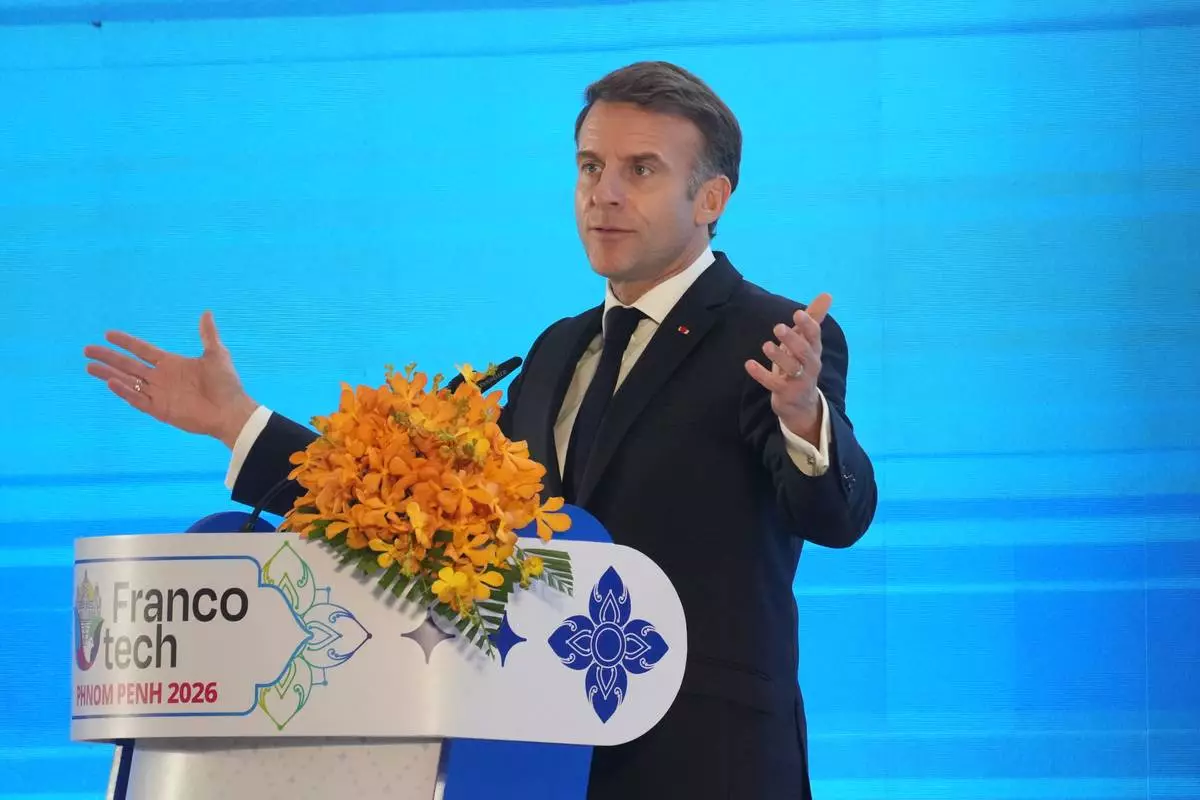
French President Emmanuel Macron gestures while delivering a speech during the opening ceremony of the Francotech Summit in Phnom Penh, Cambodia, Sunday, Nov. 15, 2026. (AP Photo/Heng Sinith)
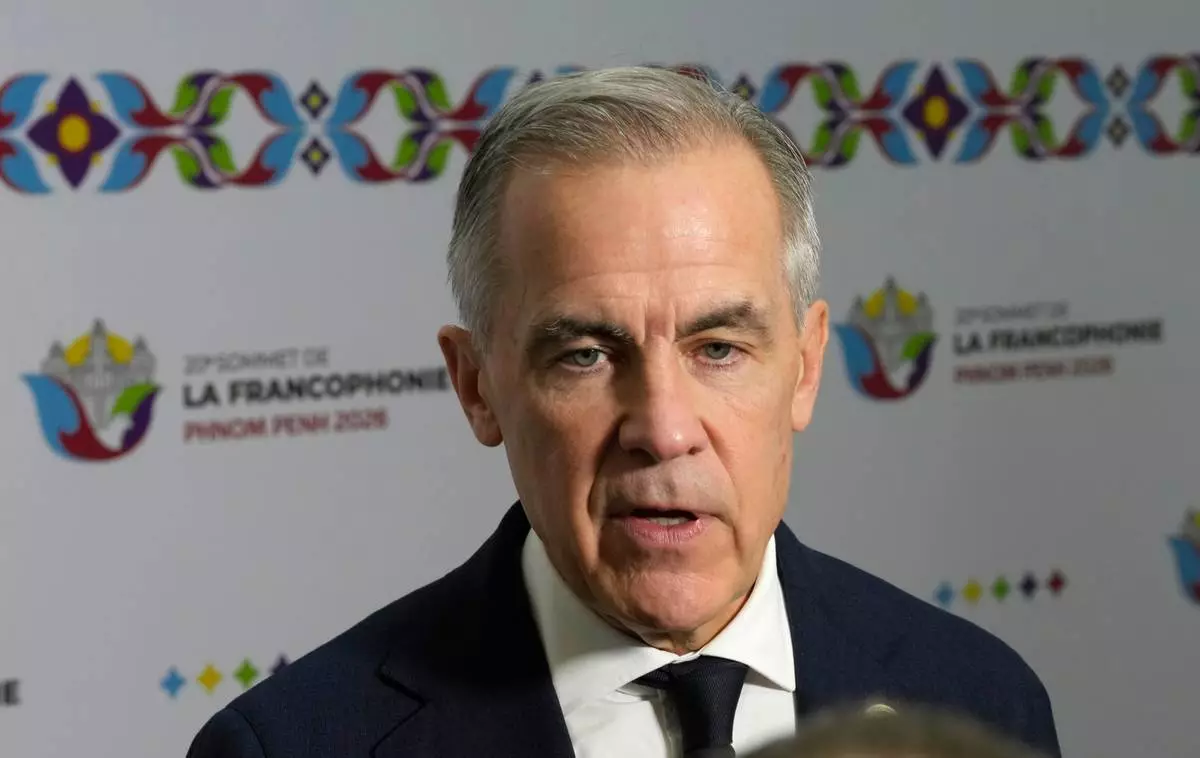
Canada's Prime Minister Mark Carney speaks with reporters at the Francophonie Summit in Phnom Penh, Cambodia, Monday, Nov. 16, 2026. (Adrian Wyld/The Canadian Press via AP)
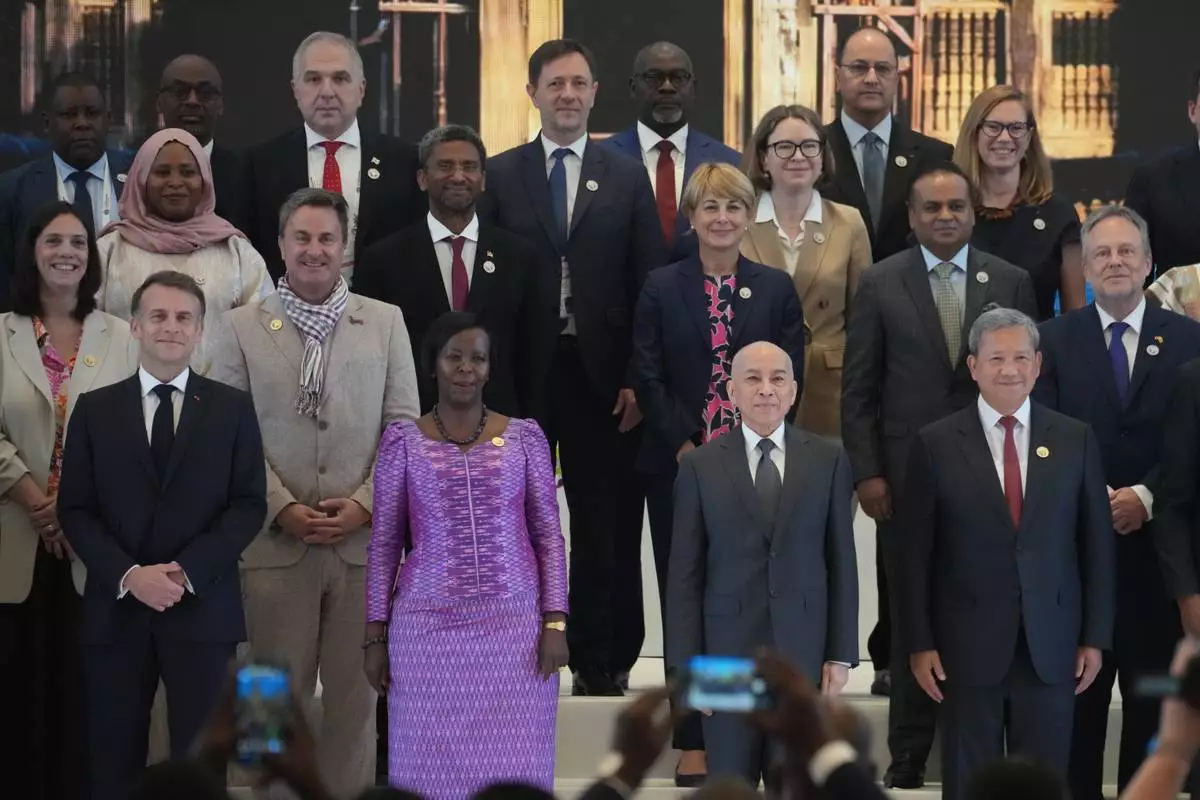
Front row, from left, French President Emmanuel Macron, Francophonie Secretary-General Louise Mushikiwabo, Cambodia's King Norodom Sihamoni and Cambodian Prime Minister Hun Manet pose for group photos during the opening ceremony of the Francophonie Summit in Phnom Penh, Cambodia, Sunday, Nov. 15, 2026. (AP Photo/Heng Sinith)
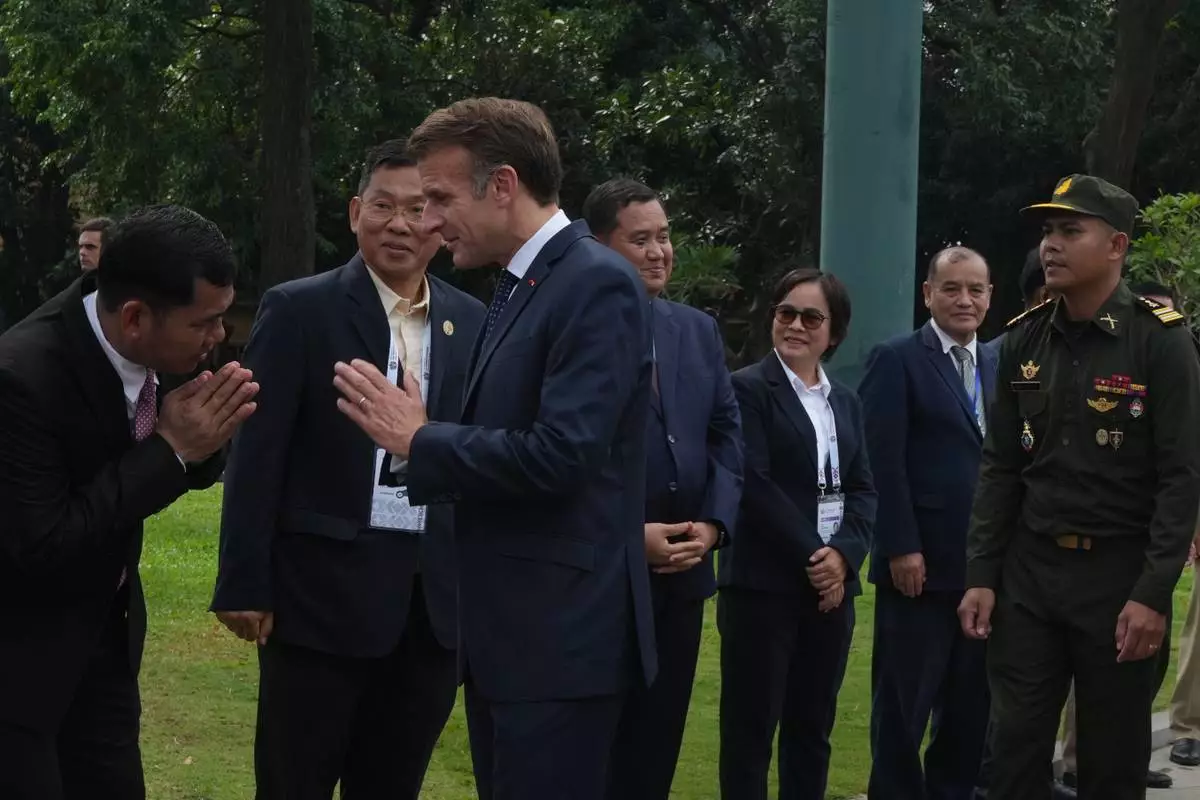
French President Emmanuel Macron, center, greets a Cambodian officer, left, as he arrives to lay a wreath at the First World War Memorial near the French Embassy in Phnom Penh, Cambodia, Monday, Nov. 16, 2026. (AP Photo/Heng Sinith)