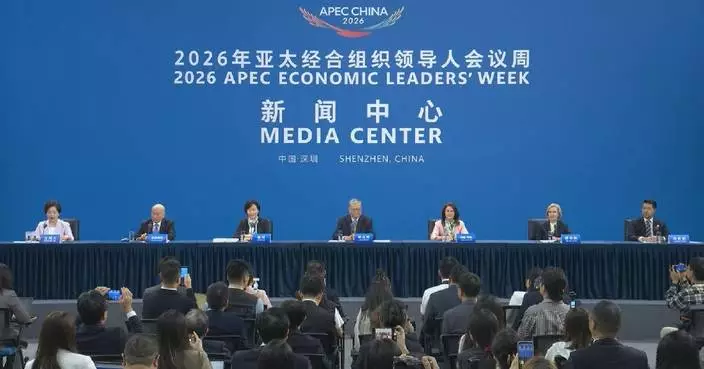
Shenzhen's Yantian Port has launched 11 new international shipping routes linking Asia-Pacific Economic Cooperation (APEC) economies this year, expanding its regional maritime network and smart logistics capacity ahead of this week's APEC meetings in the southern Chinese tech hub.
Handling over one-third of Guangdong province's foreign trade freight, the major shipping hub now operates 53 direct weekly routes connecting major Asia-Pacific markets, further strengthening regional maritime connectivity.
The port, with a natural deep-water shipping channel of nearly 18 meters deep and 475 meters wide, has 20 berths capable of accommodating the world's largest 24,000-TEU container vessels around the clock. On average, it sees over 40,000 standard containers leave its docks every day for markets worldwide.
To support rising trade volumes, Yantian has accelerated its digital and smart infrastructure upgrades, setting up remote-control centers where operators can manage giant quay and gantry cranes safely from indoors.
"Our port has already added five remote-controlled quay cranes this year, and two more will be added later this year, to save time and boost efficiency for our clients," said Pang Ning, general manager of commercial department of Yantian International Container Terminals.
In addition to automation, the port also achieved full shore power coverage for docked vessels. It has a battery swapping station for heavy trucks -- capable of batter swaps within five minutes that can serve over 300 electric container trucks.
The port also has 4,000 specialized plug-in points for refrigerated containers, offering services for cross-border e-commerce and fresh cold-chain logistics.
Backed by 39 sea-rail intermodal shipping routes and over ten exclusive cross-border e-commerce sea express lines, Yantian Port has expanded its shipping networks to cover major global trading zones, including North America, Latin America, Europe, Australia, New Zealand, and Southeast Asia.
"The port is currently upgrading its shipping network to offer exporters more berthing schedules," said Pang.
The port has also expanded and upgraded its infrastructure to better perform its role.
The Phase I project of the port's East wharf is nearing completion. Once fully integrated with the central and western zones, the expansion is expected to further enhance Yantian Port's capacity as a premier hub connecting China's manufacturing centers to the global economy.
"Ahead us is the eastern operation area, which we are advancing the construction at full steam. The investment into it has exceeded 10 billion yuan. And 15 China-made, nation-leading largest automated dual-trolley quay cranes have all been put in place," said Yang Jingxiang, duty team manager of Yantian International Container Terminals.
As shipping networks expand and smart-port facilities improve, Yantian Port is cementing its status as a world-class hub and reinforcing its role as a vital maritime corridor through which China shares development opportunities with the world.
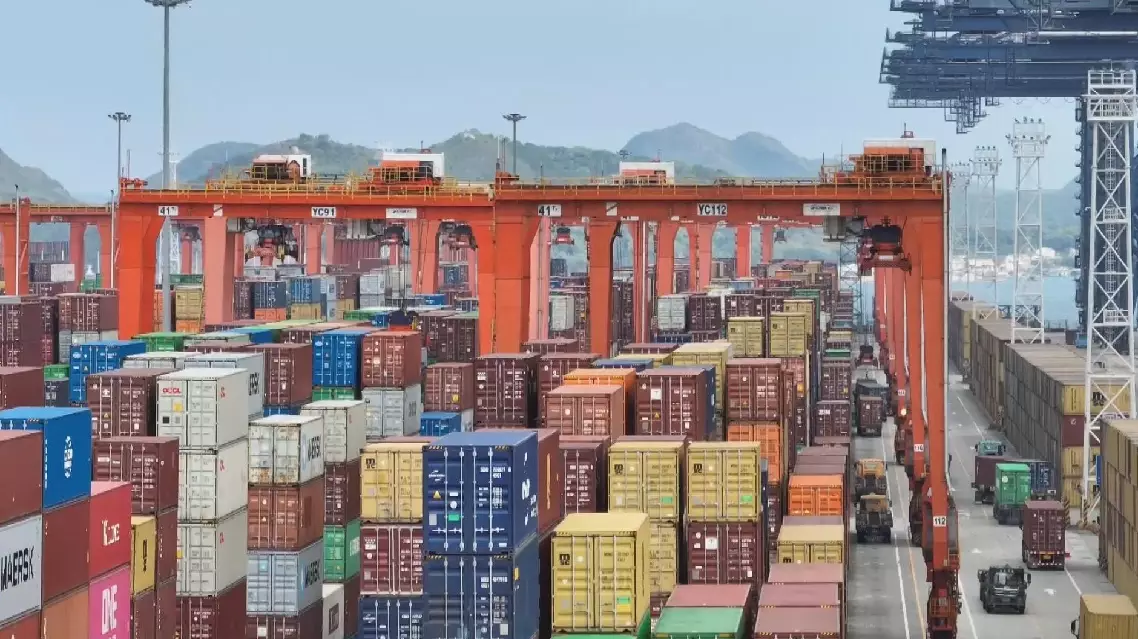
Yantian Port in south China enhances regional trade with more routes, smart logistics