Skip to Content Facebook Feature Image

Three Paths of Service Lead to National Recognition Through Navy Federal's ROTC Scholarship Program

Business

Three Paths of Service Lead to National Recognition Through Navy Federal's ROTC Scholarship Program
Business

Business

Three Paths of Service Lead to National Recognition Through Navy Federal's ROTC Scholarship Program

2026-11-18 02:40 Last Updated At:02:50

VIENNA, Va.--(BUSINESS WIRE)--Nov 17, 2026--

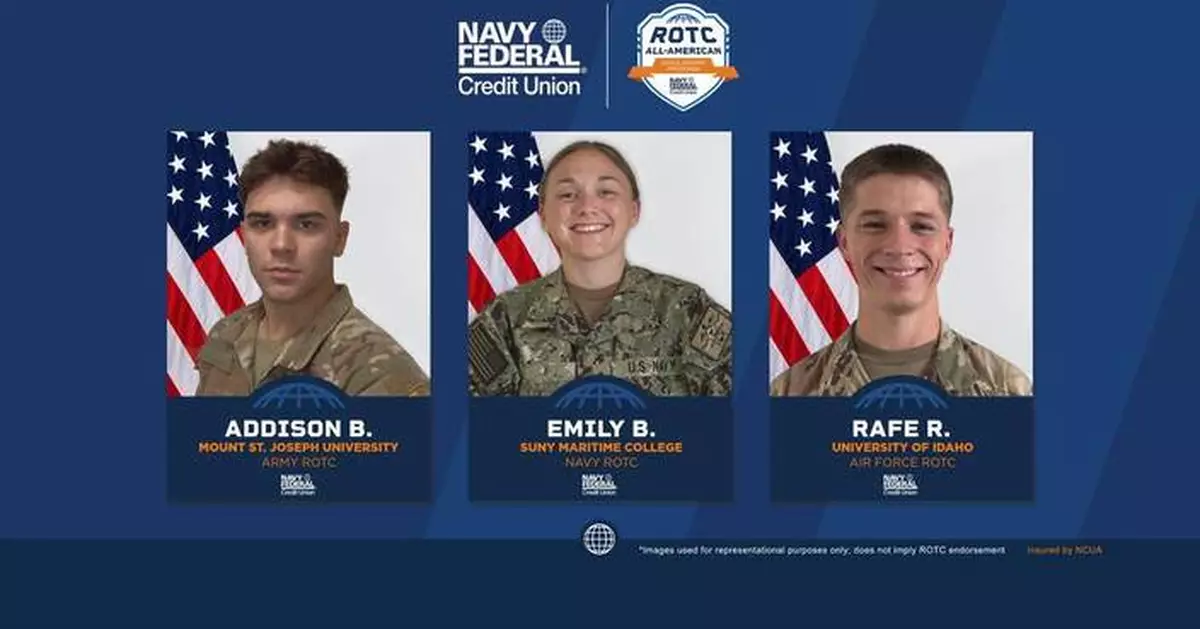
Great leaders are defined by the difference they make in the lives of others, a quality embodied by the three seniors selected as the 2026 Navy Federal Credit UnionROTC All-American Scholarship Program Students of the Year.

This press release features multimedia. View the full release here: https://www.businesswire.com/news/home/20261117484271/en/

Selected from more than 200 nominations nationwide, this year’s Students of the Year distinguished themselves among an accomplished pool of future military leaders. A panel of Navy Federal employees, who are also Veterans, evaluated the nominations, considering each student’s demonstration of the scholarship program’s four pillars: Leadership, Military Excellence, Scholarship and Service.

Each Student of the Year receives a $6,500 scholarship, along with a $5,000 donation to their Booster Club or Student Fund.

For University of Idaho Air Force ROTC cadet Rafe Richardson, military service runs in the family. After his father retired from the Air Force and passed down some of his gear, Richardson was surprised to discover he was wearing his father's nametape on his uniform — a small reminder of the family legacy that continues to shape his path of service.

He’s also the third generation in his family to earn Air Force jump wings, following in the footsteps of both his father and grandfather through Air Force Jump School. “That hits me close to home,” he said.

Richardson's commitment to service extends beyond ROTC. As an EMT with the Moscow Volunteer Fire Department, he has provided care to hundreds of people and led dozens of cadets across Idaho and Washington as a former cadet wing commander.

“I always knew I wanted to serve in some capacity,” Richardson said. “Seeing the amount of selflessness that goes into military service, I aspired to be like the people who were willing to serve and protect our country.”

Following commissioning, Richardson plans to attend medical school and serve as an Air Force flight surgeon and emergency physician. The biological engineering major currently conducts research focused on reducing injury risk among ROTC cadets.

Service takes many forms among this year's Students of the Year. For Addison Breeding, that commitment spans athletics, emergency response and advocacy for Veterans.

A nationally competitive wrestler, EMS volunteer and Veteran advocate, the Mount St. Joseph University student and Army ROTC cadet trains through Xavier University’s Army ROTC program and has built a record of leadership and service that extends well beyond the military profession.

Military service has been a part of Breeding's life from an early age. Inspired by his father's service and the values instilled at home, he learned the importance of putting others first, standing up for what's right and maintaining integrity.

“To me, the military means putting yourself on the line for other people,” Breeding said. “Service was never just a word. Watching my dad and the values he lived by taught me the importance of doing the right thing, even when it's difficult and no one is looking.”

Following commissioning, Breeding plans to attend medical school and ultimately serve as an Army physician.

Rounding out this year's Students of the Year is MIDN Emily Bryant, whose leadership has been shaped both at sea and as a three-sport NCAA athlete at SUNY Maritime College.

A Marine engineering student at SUNY Maritime College, Bryant serves as battalion executive officer of the NYC Navy ROTC Battalion, overseeing 157 midshipmen. She has gained extensive maritime experience aboard the T.S. Empire State VII, including serving as chief welder and leading the training of more than 40 freshmen during her senior cruise.

Bryant credits her leadership roles with teaching her that effective leadership begins with understanding and supporting others.

“That job does a really good job of shaping someone as a leader,” Bryant said of her role as battalion executive officer. “It's taught me to anticipate people's needs and remember that what may not seem like a big deal to me could be someone's worst day. Leading is about caring for people, treating them kindly and helping them through challenges.”

The ROTC All-American Scholarship Students of the Year will be honored guests of the AutoZone Liberty Bowl on Jan.2, 2027 and featured on ABC’s broadcast of the game. All the scholarship recipients will also be featured across Navy Federal’s social media channels.

To learn more about the scholarship program and the Students of the Year, visit rotcaa.navyfederal.org.

Navy Federal Credit Union: Established in 1933 with only seven members, Navy Federal now has the distinct honor of serving more than 15 million members globally and is the world’s largest credit union. As a member-owned and not-for-profit organization, Navy Federal always puts the financial needs of its members first. Membership is open to all Department of Defense and Coast Guard Active Duty, Veterans, civilian and contractor personnel, and their families. Navy Federal employs a workforce of over 25,000 and has a global network of more than 390 branches. Navy Federal is contracted to operate the Department of Defense Community Bank program, which provides Active Duty military deployed overseas to access 60 branches spread across 11 countries. For more information about Navy Federal Credit Union, visit navyfederal.org.
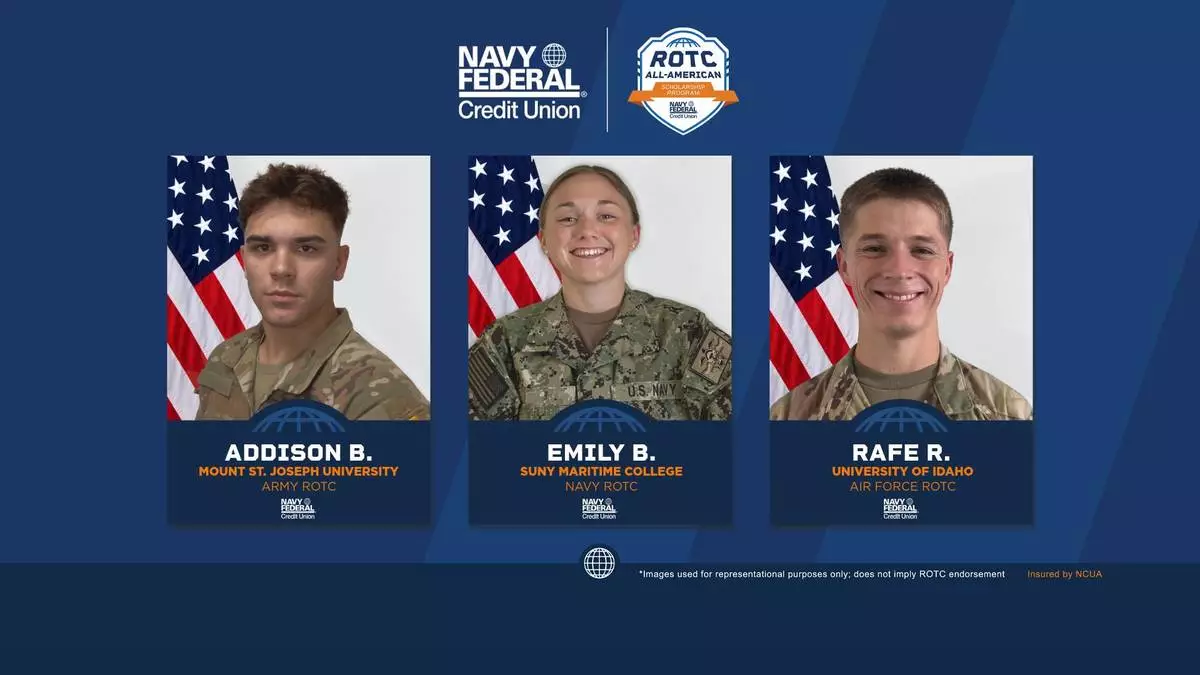
Navy Federal Credit Union ROTC All-American Students of the Year


Navy Federal Credit Union ROTC All-American Students of the Year

WASHINGTON (AP) —

The Federal Aviation Administration has paused the installation of the routers that were linked to last week’s national ground stop, and turned off any Juniper routers that were already installed.

The decision was made after technicians linked Friday’s disruption of key air traffic control systems to one of these routers that had just been installed in El Dorado, Arkansas.

For now, the FAA is relying on older Cisco routers that have been in place for 25 years to continue operating the network while they investigate the cause of Friday’s problems at 17 of the nation’s 22 regional air traffic control centers.

The routers that malfunctioned last week are being tested in a lab at the headquarters of the company that installed them named L3Harris.

THIS IS A BREAKING NEWS UPDATE. Check back for updates. AP’s earlier story follows below.

Democrats in the Senate on Tuesday called for pausing the replacement of thousands of routers across the nation’s air traffic control system after the work was blamed for setting off last week’s air traffic snarls.

They also demanded that the Trump administration provide clear answers about what went wrong.

“Identifying the device that failed does not establish why it failed. FAA must investigate further to determine the root cause and report to Congress on how it intends to prevent future issues,” said the letter sent to Transportation Secretary Sean Duffy.

President Donald Trump has blamed old technology and Democrats for the nationwide grounding of all planes and upheaval at the nation’s airports. But the FAA has been struggling to modernize the air traffic control system for decades — going back well before the first Trump administration.

The system became overloaded when a federal contractor that maintains the FAA’s telecommunications network was replacing outdated copper wires with fiber optic lines across the nation.

The closure of U.S. airspace was needed, Duffy said, after a new router that L3Harris installed in El Dorado, Arkansas, resulted in a cascade of intermittent communications and radar signals at 17 of the 22 regional air traffic control centers. The centers direct planes cruising at high altitudes.

The Federal Aviation Administration said that “excessive data” was flooding the system “at a rate of 1,000 connection attempts every 4 to 5 seconds.” That deluge created instability with “aircraft communications and radar feeds” when those connection attempts overwhelmed the 25-year-old routers throughout the network, the agency said.

Democrats on the Senate Commerce Committee said they believe that only 400 out of more than 3,600 routers have been installed. Work on installing the new devices should be stopped until “the root cause of the failure has been identified,” the letter stated.

Upgrading the nation’s air transportation system is an effort that Congress has dedicated significant sums to in recent years. The problems with aging equipment at the FAA date back decades and past efforts to modernize the system have come up short.

Duffy has pushed Congress for billions more dollars to upgrade a system he said had been neglected for decades, saying on Friday that $50 billion is needed.

The Trump administration on Tuesday sent a letter to key lawmakers updating its request for $50.1 billion to modernize the system and make other improvements at airports.

The request calls for $10.1 billion for updating the nation’s air traffic control system. Similar amounts would go toward boosting airport infrastructure, replacing or refurbishing terminals at high-impact hubs, constructing five new traffic control centers and improving or replacing up to 140 FAA-owned air traffic control towers.

“Congressional approval of these funds will equip the FAA to deliver to the American people a brand-new air traffic control system that is safer, smarter, faster, and more efficient,” states the letter, which was obtained by The Associated Press.

Congress approved $12.5 billion last year to modernize much of the key infrastructure that more than 45,000 flights a day rely on to reach their destinations safely. The funds were earmarked for replacing outdated technologies such as copper wires, floppy discs and radars built in the 1980s, but much of that money will also go toward runway upgrades and other construction projects.

A traveler with a smartphone walks across a pedestrian bridge at Philadelphia International Airport in Philadelphia, Monday, Nov. 16, 2026. (AP Photo/Matt Rourke)

A traveler with a smartphone walks across a pedestrian bridge at Philadelphia International Airport in Philadelphia, Monday, Nov. 16, 2026. (AP Photo/Matt Rourke)

Luggage is set out for travelers to pick up at a baggage claim at Philadelphia International Airport in Philadelphia, Monday, Nov. 16, 2026. (AP Photo/Matt Rourke)

Luggage is set out for travelers to pick up at a baggage claim at Philadelphia International Airport in Philadelphia, Monday, Nov. 16, 2026. (AP Photo/Matt Rourke)

A building that housed a router blamed for a technical issue that caused a nationwide ground stop is seen Monday, Nov. 16, 2026, at South Arkansas Regional Airport in El Dorado, Ark. (Penny Chanler/The El Dorado News-Times via AP)

A building that housed a router blamed for a technical issue that caused a nationwide ground stop is seen Monday, Nov. 16, 2026, at South Arkansas Regional Airport in El Dorado, Ark. (Penny Chanler/The El Dorado News-Times via AP)

Recommended Articles