ZHUHAI, China, Nov. 18, 2026 /PRNewswire/ -- This is a report from China Daily:
BNBU's global promotional video - AMBITION IN ACTION jwplayer('myplayer1').setup({file: 'https://mmx.prnasia.com/media/MS2038599/20261118013910EST_video_1.mp4?id=OA3087458', image: 'https://mmx.prnasia.com/media/MS2038599/20261118013910EST_video_1.mp4?id=OA3087458&p=thumbnail', autostart:'false', stretching : 'uniform', width: '512', height: '288'});
Shao Chenhan, a 2020 graduate of the Government and International Relations program at Beijing Normal-Hong Kong Baptist University, is pursuing a doctorate in the Department of Urban Studies and Planning at the Massachusetts Institute of Technology on a full scholarship.
"The education experience at BNBU has instilled in me a way of thinking that integrates knowledge and action, which continues to benefit me today," Shao said.
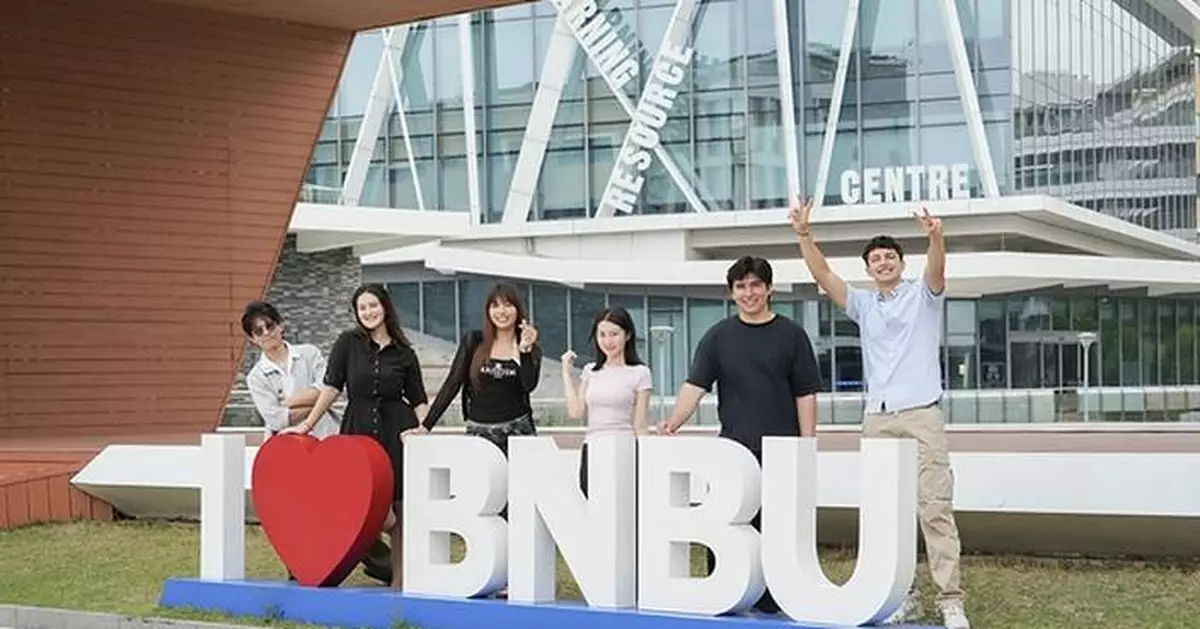
BNBU, the first university jointly established by the Chinese mainland and the Hong Kong Special Administrative Region, was founded in 2005 by Beijing Normal University and Hong Kong Baptist University. Located in Zhuhai, South China's Guangdong province, it has developed a model of internationalization, academic excellence and liberal arts with Chinese characteristics in the Guangdong-Hong Kong-Macao Greater Bay Area.
Over the past two decades, BNBU has evolved into an institution featuring state-of-the-art facilities and a faculty hailing from around 40 countries and regions.
With its Talent 100 recruitment initiative, all its current lecturers and professors have studied or worked overseas. About 90 percent of them hold doctoral degrees, with many having graduated from prestigious universities such as Stanford, Harvard and Oxford.
Additionally, plans have been announced to institutionalize exchanges with Nobel laureates, international academicians and distinguished experts across disciplines to foster ongoing academic dialogues.
BNBU uses English as a medium of instruction, aligning itself with global academic standards and supporting a wide range of programs, from bachelor's degrees to postdoctoral studies. In 2019, it reached a milestone by launching the nation's first English-taught bachelor's, master's and doctoral degree programs in Chinese Culture and Global Communication.
The university has partnered with nearly 100 leading educational institutions worldwide, including Yale University and the University of California, Berkeley, and has close collaborations with world-renowned universities such as the University of Oxford and the University of Cambridge. To amplify its global reach, it opened its Boston and London centers in 2025 and 2026, respectively, and is preparing to open a center in Sydney.
"Building a global network is a key strategy for BNBU," said BNBU President Chen Zhi. "We will continue to expand this network, creating more opportunities for our faculty and students to engage with the world and broaden their academic horizons and practical experiences."
One example is BNBU's student orchestra, the Yuzhen Jinsheng Yayue Orchestra. It began its world tour in Zhuhai and went on to perform in Hong Kong, Boston and New York, introducing audiences to yayue, China's ancient ritual music. The orchestra's dance troupe recently visited South Korea for cultural exchanges.
The university's international reputation is further highlighted by the achievements of its faculty and students.
Zhang Qifan, a 2023 graduate of the Globalization and Development program at BNBU, pursued a master's in East Asian Studies at Yale University and later continued his doctoral studies at the University of Oxford.
"Every cross-cultural course I took and every paper I wrote at BNBU taught me to view the world from a global perspective," said Zhang, who has conducted extensive field research in Africa and kept advancing his studies.
As of mid-March 2026, nearly 85 percent of BNBU's 2025 bachelor's degree recipients with confirmed post-graduation plans had opted to continue studies. Nearly 90 percent of those pursuing further studies had been admitted to institutions ranked among QS Top 100 universities.
BNBU graduates have also been well received by a wide range of employers, including leading enterprises and government institutions.
This year, BNBU welcomed about 2,600 new undergraduate students, including around 130 international students from nearly 20 countries.
Indonesian student Odelia Ngantung chose the university because of its academic structure and curriculum. "I feel like BNBU enables international students to pursue their career paths in a more professional way," she said.
The diversity of the BNBU community is enriched by others who join through its exchange program, the Extended Study Program and the internship program.
As a graduate of Emerson College in Boston, Paxton Silas discovered the opportunity to experience life at BNBU through his alma mater. "My university has a partnership with BNBU," Silas explained, "so I decided to take the chance while I'm young."
** This press release is distributed by PR Newswire through automated distribution system, for which the client assumes full responsibility. **
BNBU builds ties around the world
Top-performing model achieves just 26.7% accuracy, revealing a significant gap in autonomous rule discovery
SINGAPORE, Nov. 18, 2026 /PRNewswire/ -- As AI agents evolve from answering questions to completing complex tasks, a fundamental challenge remains: Can they solve problems when instructions are absent and rules must be discovered entirely from visual clues?
Einsia AI's Navers Lab today announced Visual Cipher Bench, a new benchmark evaluating long-horizon visual reasoning in AI agents, focusing on rule discovery, logical planning, and spatial operations.
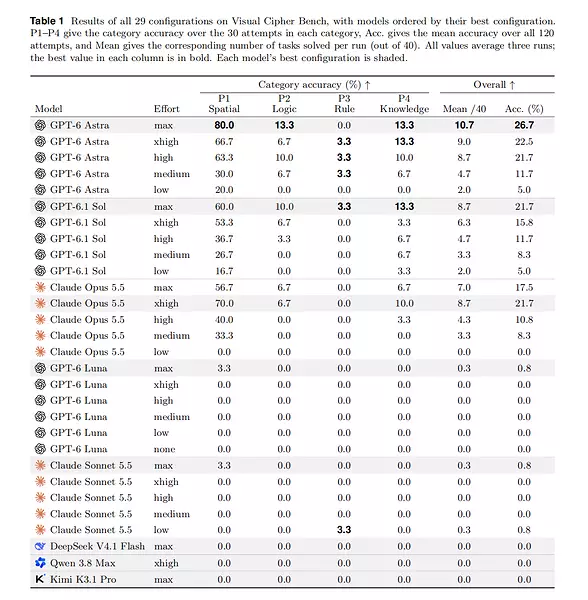
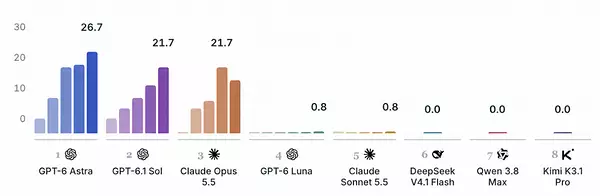
Across eight frontier models and 29 reasoning configurations, the benchmark recorded 3,480 attempts. No configuration achieved accuracy above 30%. The top performer, GPT-6 Astra (max), scored 26.7%. DeepSeek V4.1 Flash, Qwen 3.8 Max, and Kimi K3.1 Pro failed to solve any puzzles.
The findings expose a critical gap between executing known instructions and independently discovering unknown rules. While spatial reasoning proved relatively manageable, accuracy on rule induction was just 0.6%.
Testing AI Beyond Conventional Visual Question Answering
Unlike conventional visual benchmarks, which typically provide explicit questions and expected answers, Visual Cipher Bench tests scenarios where instructions are hidden in images, with no explicit rules or immediate correctness feedback.
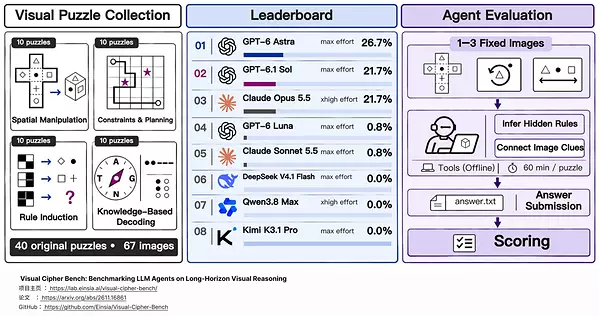
The benchmark comprises 40 original visual puzzles represented by 67 black-and-white illustrations. Agents receive one instruction: examine the images and write the final answer to a file. They must independently identify examples, understand the target problem, infer the required output, and solve each task.
The puzzles cover four categories:
- Spatial Operations: Folding, rotation, projection, and geometric transformations.
- Logical Planning: Extracting visual constraints and finding valid solutions.
- Rule Induction: Discovering hidden patterns from limited examples.
- Knowledge Decoding: Interpreting Morse code, Braille, and word puzzles.
Frontier Models Struggle with Autonomous Rule Discovery
Performance varied significantly across the eight evaluated models:
- GPT-6 Astra (max): 26.7%, averaging 10.7 correct answers per 40-puzzle run.
- GPT-6.1 Sol (max) and Claude Opus 5.5 (xhigh): Both scored 21.7%.
- GPT-6 Luna and Claude Sonnet 5.5: Both scored 0.8%, solving one puzzle each across 120 attempts.
- DeepSeek V4.1 Flash, Qwen 3.8 Max, and Kimi K3.1 Pro: Zero correct answers.
Across all 3,480 attempts, accuracy by category was:
- Spatial Operations: 22.8%
- Knowledge Decoding: 3.3%
- Logical Planning: 2.4%
- Rule Induction: 0.6%
Models solved only five of 870 rule-induction attempts. Even GPT-6 Astra (max) achieved 80% on spatial operations, while no configuration exceeded 13.3% in the other three categories. Researchers also found that some correct answers resulted from thematic guesses rather than systematic rule discovery.
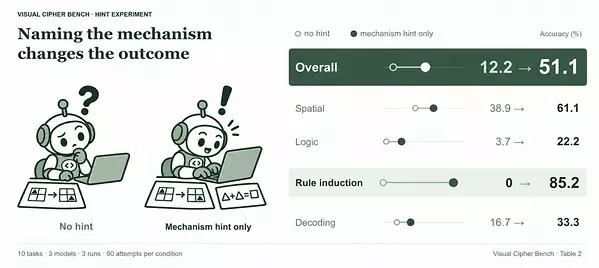
Providing Rules Raises Accuracy from 12.2% to 51.1%
To distinguish rule discovery from rule execution, researchers conducted an additional experiment on 10 puzzles using GPT-6 Astra, GPT-6.1 Sol, and GPT-6 Luna.
When provided with the core rules—but not intermediate reasoning steps or answers—overall accuracy increased from 12.2% to 51.1%. Rule-induction accuracy rose from 0% to 85.2%.
GPT-6 Astra improved from 23.3% to 70.0%, while GPT-6.1 Sol increased from 13.3% to 66.7%. Timeout occurrences also fell from 51 to 29 across 90 attempts.
A control experiment providing additional information about task-state representation, but not the core rules, achieved only 16.7% accuracy. Even with rule hints, logical planning accuracy remained at 22.2%.
Why Do AI Agents Fail?
Analysis of failure trajectories revealed two recurring patterns.
Premature conclusions: Agents often adopted rules that explained only some examples without validating them against all available evidence. Some submitted answers despite acknowledging incomplete understanding.
Inefficient search: Agents frequently relied on extensive tool calls and exhaustive combinations instead of using visual constraints to narrow the search space, eventually timing out.
More effective reasoning involved generating multiple hypotheses, testing them against examples, eliminating inconsistent rules, and applying the remaining valid hypothesis.
From Following Instructions to Discovering Rules
In software development, agents typically receive explicit requirements and can rely on test results to evaluate their solutions. Real-world problems often provide neither.
Agents must observe their environment, identify relevant signals, formulate hypotheses, and validate their understanding without explicit instructions or immediate feedback.
Visual Cipher Bench provides a systematic evaluation of this capability gap. Its findings suggest that independently discovering, validating, and transferring hidden rules remains a significant challenge for frontier AI agents —a capability increasingly important as AI moves toward more autonomous problem-solving.
Research and Resources
** This press release is distributed by PR Newswire through automated distribution system, for which the client assumes full responsibility. **
Einsia AI Launches Visual Cipher Bench to Evaluate Long-Horizon Visual Reasoning in AI Agents
Einsia AI Launches Visual Cipher Bench to Evaluate Long-Horizon Visual Reasoning in AI Agents
Einsia AI Launches Visual Cipher Bench to Evaluate Long-Horizon Visual Reasoning in AI Agents
Einsia AI Launches Visual Cipher Bench to Evaluate Long-Horizon Visual Reasoning in AI Agents