Collaboration combines industry expertise, practical solutions and financing support to help Singapore businesses turn sustainability into growth and resilience.
SINGAPORE, Nov. 18, 2026 /PRNewswire/ -- CIMB Singapore and the Singapore Manufacturing Federation (SMF) are strengthening their collaboration to help small and medium-sized enterprises (SMEs) turn sustainability ambitions into practical business action.
By combining CIMB Singapore's banking and sustainable finance expertise with SMF's manufacturing network and enterprise transformation experience, the collaboration aims to help businesses improve operational efficiency, meet evolving customer expectations and build long-term competitiveness.
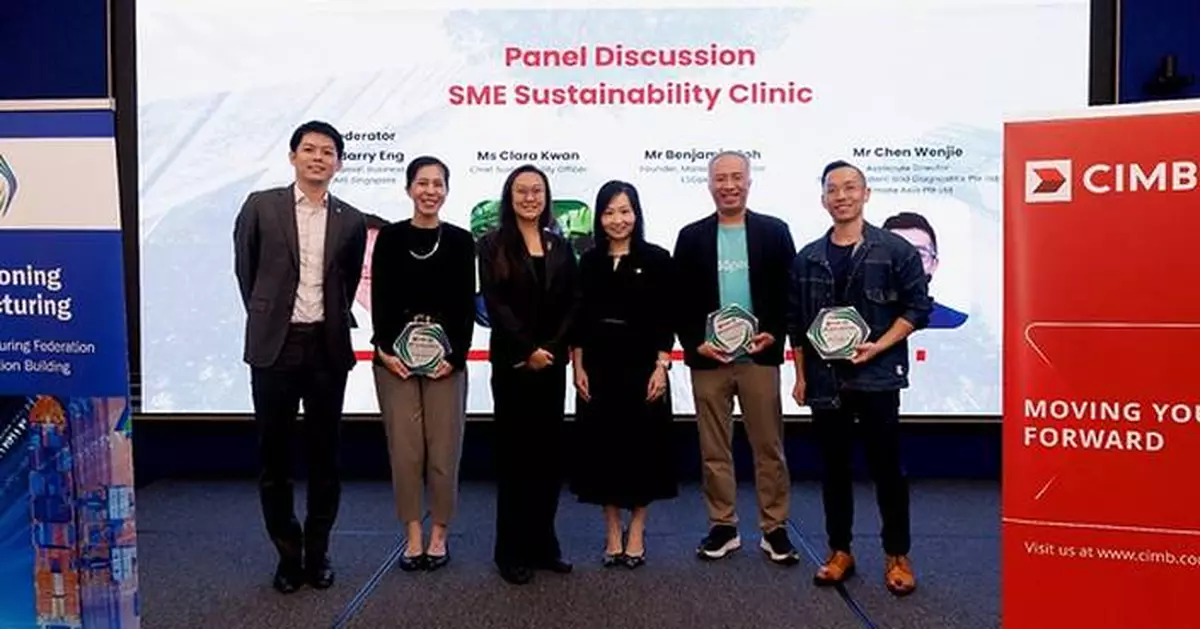
The partnership was showcased at the SME Growth Exchange, jointly organised by CIMB Singapore and SMF on 17 November 2026 at SMF's Advanced Manufacturing Innovation Centre, with support from Enterprise Singapore.
Held under the theme Beyond Compliance for Sustainable Business Growth, the event brought together SME owners, business leaders and sustainability specialists to explore how companies can respond to rising operating costs, changing supply-chain expectations and emerging sustainability requirements.
The programme featured perspectives from Enterprise Singapore, CIMB Singapore and SMF, alongside ecosystem participants ESGpedia, Building System & Diagnostics and Climate Asia. Through presentations, industry dialogue and the SME Sustainability Clinic, participants gained insights into how sustainability expertise, practical solutions and financing can work together to support business growth.
Sustainability Becomes a Business Competitiveness Priority
Sustainability is increasingly influencing procurement, supply-chain relationships and investment decisions, making credible environmental practices commercially important for SMEs.
Singapore's introduction of Technical Reference TR 149:2026 in May 2026 further supports this direction. The framework provides a progressive approach for organisations to assess and improve their environmental sustainability maturity.
SMF convened the working group that developed TR 149, contributing manufacturing industry perspectives to the national sustainability standards landscape.
For SMEs, particularly those supplying larger corporations and participating in regional supply chains, the ability to demonstrate credible sustainability practices can help strengthen customer readiness and business competitiveness.
Turning Ambition into Action with Financing
Since 2024, CIMB Singapore has supported local SMEs through its Sustainability-Linked Loan/Financing Programme. To date, the programme has enabled more than 300 companies to establish greenhouse-gas emissions-reduction targets and access preferential financing terms. One such company is Springleaf Prata Place.
"The programme provides a meaningful incentive for us to reduce our carbon emissions while continuing to grow our business. The interest rebates we have received over the past two years reinforce the value of integrating sustainability into our business decisions," said Gunalan S/O Subramaniam, Director, Fex Springleaf Prata Place Pte Ltd.
Expertise for Every Stage of the Sustainability Journey
Recognising that sustainability challenges go beyond financing, CIMB Singapore's Sustainability Beyond Banking ecosystem also connects businesses with complementary capabilities at different stages of their sustainability journey.
The ecosystem includes ESGpedia, Building System & Diagnostics, Climate Asia and SMF, with expertise spanning sustainability data management and reporting, operational efficiency and enterprise sustainability development. Together, these capabilities complement CIMB Singapore's financial solutions and help SMEs identify practical pathways to action.
"SMEs need more than financing to make progress on sustainability. They need the right expertise at the right stage of their journey. Together with SMF and our ecosystem partners, we are connecting businesses with practical know-how and financing solutions so they can act with confidence," said Benjamin Tan, Head of Commercial & Transaction Banking, CIMB Singapore.
"Many of our members are already feeling pressure from customers and supply chains to show credible sustainability practices. This collaboration with CIMB brings practical expertise and financing perspectives together, so SMEs can move beyond compliance and turn sustainability into operational efficiency and growth," said Clara Kwan, Chief Sustainability Officer, Singapore Manufacturing Federation.
Through this collaboration, CIMB Singapore and SMF aim to help SMEs see sustainability not merely as a compliance requirement, but as an opportunity to build resilience, improve performance and compete more effectively.
– END –
About CIMB
CIMB is one of ASEAN's leading banking groups and Malaysia's second largest financial services provider, by assets. Listed on Bursa Malaysia via CIMB Group Holdings Berhad, it had a market capitalisation of approximately RM80.1 billion as at 30 June 2026. It offers consumer banking, commercial banking, wholesale banking, transaction banking, Islamic banking and asset management products and services. Headquartered in Kuala Lumpur, the Group is present across ASEAN in Malaysia, Indonesia, Singapore, Thailand, Cambodia, Vietnam and the Philippines. Singapore is one of its key markets with approximately 1,000 employees serving clients across consumer, commercial, wholesale and transaction banking products and services.
Beyond ASEAN, the Group has market presence in China, Hong Kong and UK. CIMB has one of the most extensive retail branch networks in ASEAN with 524 branches and over 33,000 employees as at 30 June 2026. CIMB's investment banking arm is one of the largest Asia Pacific-based investment banks, which together with its award-winning treasury & markets and corporate banking units comprise the Group's leading wholesale banking franchise. CIMB is also the 92.46% shareholder of Bank CIMB Niaga in Indonesia, and 94.83% shareholder of CIMB Thai in Thailand.
Sustainability is a core pillar of CIMB's Forward30 strategy and 2030 roadmap. The Group is guided by its Green, Social, Sustainable Impact Products and Services ("GSSIPS") framework, an internal taxonomy designed to deliver impactful sustainable finance. Since launching its sustainable finance framework in 2021, CIMB has progressively raised its ambitions, increasing its initial RM30 billion target to RM100 billion for 2021–2024. The Group now targets RM300 billion in sustainable finance by 2030, reinforcing its commitment to enabling a lower-carbon and more inclusive economy across the region.
About Singapore Manufacturing Federation
Founded in 1932, the Singapore Manufacturing Federation (SMF) champions the nation's manufacturing sector by driving innovation and sustainable growth. Organised into 10 Industry Groups and supported by Associated Services, SMF addresses distinct industry needs. Focusing on sustainability, human capital, internationalization, and productivity, SMF enhances sector resilience. As a collaboration catalyst, it fosters strategic alliances and market expansion locally and globally.
** This press release is distributed by PR Newswire through automated distribution system, for which the client assumes full responsibility. **
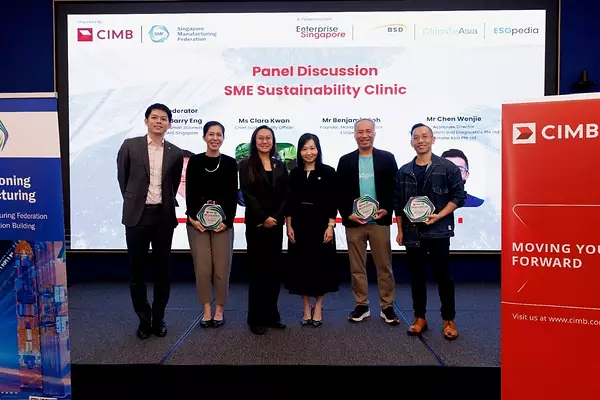
CIMB Singapore and SMF Unite Sustainability Ecosystem to Strengthen SME Competitiveness