
Skip to Content Facebook Feature Image

World Bank official says Lebanon slow to act on reconstruction

News

World Bank official says Lebanon slow to act on reconstruction
News

News

World Bank official says Lebanon slow to act on reconstruction

2026-11-18 19:15 Last Updated At:19:30

BEIRUT (AP) — Lebanon has been slow to use international assistance to rebuild areas battered by two recent wars, a top World Bank official told The Associated Press.

The international financial institution approved $250 million in June 2025 to help Lebanon clear rubble and repair “damaged critical public infrastructure” after a bruising 2024 war between Israel and the Iran-backed Lebanese militant group Hezbollah.

The World Bank initially projected that $100 million would be disbursed by July 2026, but a September progress report showed that only $4.2 million had been paid out.

“I think we have to be honest and say it’s slower than where we want it to be,” World Bank Managing Director of Operations Anna Bjerde said Tuesday during a trip to Lebanon, including visits to war-damaged areas in the south.

She said security issues had contributed to the delays but that the World Bank wants to see the work go more quickly.

Even the full $250 million would cover only a fraction of Lebanon’s reconstruction needs.

The World Bank estimated that rebuilding after the 2024 war would cost about $11 billion. Another Israel-Hezbollah war, which broke out in March, caused further destruction, and the Israeli military now occupies a large swath of southern Lebanon. A ceasefire has held in other parts of the country since late June.

Bjerde said that “institutions in Lebanon are very thinly stretched” after years of crises and the security situation has required “very careful planning around where you can start and where you don’t start” to remove rubble and repair infrastructure.

The World Bank needs to be “insistent” and “very close to monitoring on a daily basis” to make sure the work gets done, she said, “because you cannot let the people down.”

The office of Lebanese Prime Minister Nawaf Salam said in a statement, “Parliament ratification of the said loan experienced considerable delays and the worsening security situation due to the conflict with Israel delayed the timely launch of project activities.”

It said Lebanon's Council for Development and Reconstruction has taken measures to speed up implementation and that $70 million worth of projects are expected to be launched by the end of the year.

At the height of the latest war, more than 1 million people were displaced in Lebanon. About 300,000 remain unable to return home.

Hezbollah has accused Lebanon of failing to carry out its duties to help the displaced. Last month, the group announced it will pay up to $14,000 to families whose homes were destroyed or made uninhabitable during the war with Israel.

U.S. officials have said that large-scale reconstruction aid is contingent on the militant group’s disarmament, but that is not a condition for the World Bank assistance.

Bjerde also visited Syria on Wednesday, where hopes that Gulf money would help fund reconstruction after nearly 14 years of civil conflict have been dashed by the regional war that began when the U.S. and Israel attacked Iran on Feb. 28.

The war has disrupted energy exports through the Strait of Hormuz, and Iran has fired missiles and drones at Gulf countries hosting U.S. bases. In normal times, 20% of the world’s oil supply passes through the strait.

The conflict has driven up prices, with 80% of countries worldwide seeing inflation rise this year, Bjerde said. The effects have been felt acutely in the Middle East.

“Lebanon and Syria and the broader region are affected by this conflict, and it’s affected by what happens in the Gulf countries,” Bjerde said. “Those are a big, big part of the economy in this region.”

Since the war began, countries in the region have pushed ahead with plans for transportation and energy networks that would provide alternatives to routes through the strait. These include a rail line connecting Iraq’s Basra port to Turkey and an oil pipeline linking Kirkuk in northern Iraq to the ports of Baniyas in Syria and Tripoli in northern Lebanon.

Bjerde said the World Bank had received more requests for help building such “economic corridors” and was conducting “a lot of due diligence” on potential projects.

“This is a new, emerging, large transformative opportunity,” she said.

The projects are costly and will require a mix of public and private funding, Bjerde said, “but these are worthwhile investments that can really change a country’s opportunity and make a region, a sub-region, an economic unit.”

Anna Bjerde, the World Bank's managing director of operations, speaks during an interview with The Associated Press in Beirut, Tuesday, Nov. 17, 2026. (AP Photo/Bilal Hussein)

Anna Bjerde, the World Bank's managing director of operations, speaks during an interview with The Associated Press in Beirut, Tuesday, Nov. 17, 2026. (AP Photo/Bilal Hussein)

Anna Bjerde, the World Bank's managing director of operations, speaks during an interview with The Associated Press in Beirut, Tuesday, Nov. 17, 2026. (AP Photo/Bilal Hussein)

Anna Bjerde, the World Bank's managing director of operations, speaks during an interview with The Associated Press in Beirut, Tuesday, Nov. 17, 2026. (AP Photo/Bilal Hussein)

Anna Bjerde, the World Bank's managing director of operations, speaks during an interview with The Associated Press in Beirut, Tuesday, Nov. 17, 2026. (AP Photo/Bilal Hussein)

Anna Bjerde, the World Bank's managing director of operations, speaks during an interview with The Associated Press in Beirut, Tuesday, Nov. 17, 2026. (AP Photo/Bilal Hussein)

Iran’s targeting of its Gulf neighbors picked up Wednesday with attacks on Bahrain and on a Kuwaiti base used by U.S. forces, in an apparent retaliation for American fire a day earlier.

Iran-backed Houthis also fired two cruise missiles at Riyadh, following a major attack by the Saudi-backed coalition on the rebel group’s missile and drone capabilities.

Meanwhile, a state-run oil giant in the United Arab Emirates said one of its vessels was attacked while transiting the Strait of Hormuz.

Here is the latest news from the Middle East on Wednesday. Read our full coverage here.

The Saudi-led coalition fighting the Iranian-backed Houthis said Wednesday it launched a major air attack across the rebel-held territories in Yemen, which the Houthis said killed at least 17 people.

Maj. Gen. Turki al-Malki, the coalition spokesman, said the strikes launched Tuesday targeted Houthi tunnels to mountain warehouses that store ballistic missiles, and workshops to assemble and store drones. He said “60 legitimate military targets” were destroyed in the capital, Sanaa, and the provinces of Amran, Saada and Hodeida.

A spokesman for the Houthi-run health ministry, Anees al-Asbahi, said one strike hit a sponge factory in Hodeida, killing at least 15 people and wounding 15 others. Another strike on Saada killed at least two people and wounded four. In Sanaa, at least nine people were wounded in a strike on a shoe factory, al-Asbahi said.

Al-Malki said Saudi air defenses intercepted and destroyed two cruise missiles fired by the Houthis on Wednesday toward the capital, Riyadh. Saudi Arabia also sounded alerts in three cities in the kingdom's south, near the border with Yemen, but officials later said the potential danger had passed, without providing more details. The alerts have become a usual occurrence in recent months.

Wednesday's fighting came after Saudi-backed forces pulled out from areas around the Bab el-Mandeb Strait in a setback to the anti-Houthi camp. The withdrawal consolidated the Iran-backed rebels’ grip on the waterway that serves as a key route for global oil and commercial goods shipments.

The Iranian army claimed early Wednesday it targeted Ali Al Salem Air Base with drones, triggering air defense alerts in the oil-rich Gulf country for the first time in weeks.

The army claimed it attacked air defense systems, as well as drone and missile launch platforms, Iran’s state broadcaster reported.

U.S. Central Command, which oversees U.S. forces in the Middle East, did not immediately comment.

Kuwait’s army said Wednesday its air defenses intercepted drone attacks but did not immediately report damage. And Bahrain’s army reported its defense systems repelled a number of Iranian attacks.

The Abu Dhabi National Oil Company said one crew member was unaccounted for and 11 others were injured in the attack Tuesday. It did not identify the vessel or say who was behind the attack in a statement Wednesday.

Maritime incidents in and around the Strait of Hormuz have increased in recent weeks. Iran claimed attacks on vessels it said transited “unauthorized” routes, and said others hit navy mines.

A Panama-flagged gas tanker was also attacked earlier this week while transiting the strait, the Indian embassy in Oman said. One Indian crew member was unaccounted for and two more were injured.

Hundreds of people protested after 13 workers died in a weekend bus crash, demanding that the bus company's leaders resign, Iranian state media reported. Videos shared on social media showed people chanting anti-theocracy slogans, including “death to the dictator," in the town of Abdanan, a hot spot for anti-government protests in January.

The protest was among the first in Iran since thousands of people were killed earlier this year in a major government crackdown on dissent.

On Tuesday, Iranian authorities arrested protesters, including seven Kurdish people, among them a 15-year-old boy, according to the Hengaw Organization for Human Rights. The group said two detainees, including the boy, were later released, while the whereabouts of the others remained unknown.

Strikes early Wednesday killed a Palestinian in Gaza City and another in Deir al-Balah, in central Gaza, according to Shifa Hospital and Al-Aqsa Martyrs Hospital, where the bodies were taken.

Israel’s military said it targeted a Hamas militant in Gaza City but did not immediately comment on the other strike. At least 1,650 Palestinians have been killed in Gaza since Israel and Hamas reached a ceasefire deal last year, according to the Health Ministry, which is part of the Hamas-run government. Its figures are generally considered reliable by the international community.

This report will be updated throughout the day as new developments emerge.

Ezzidin and Magdy reported from Cairo, Egypt.

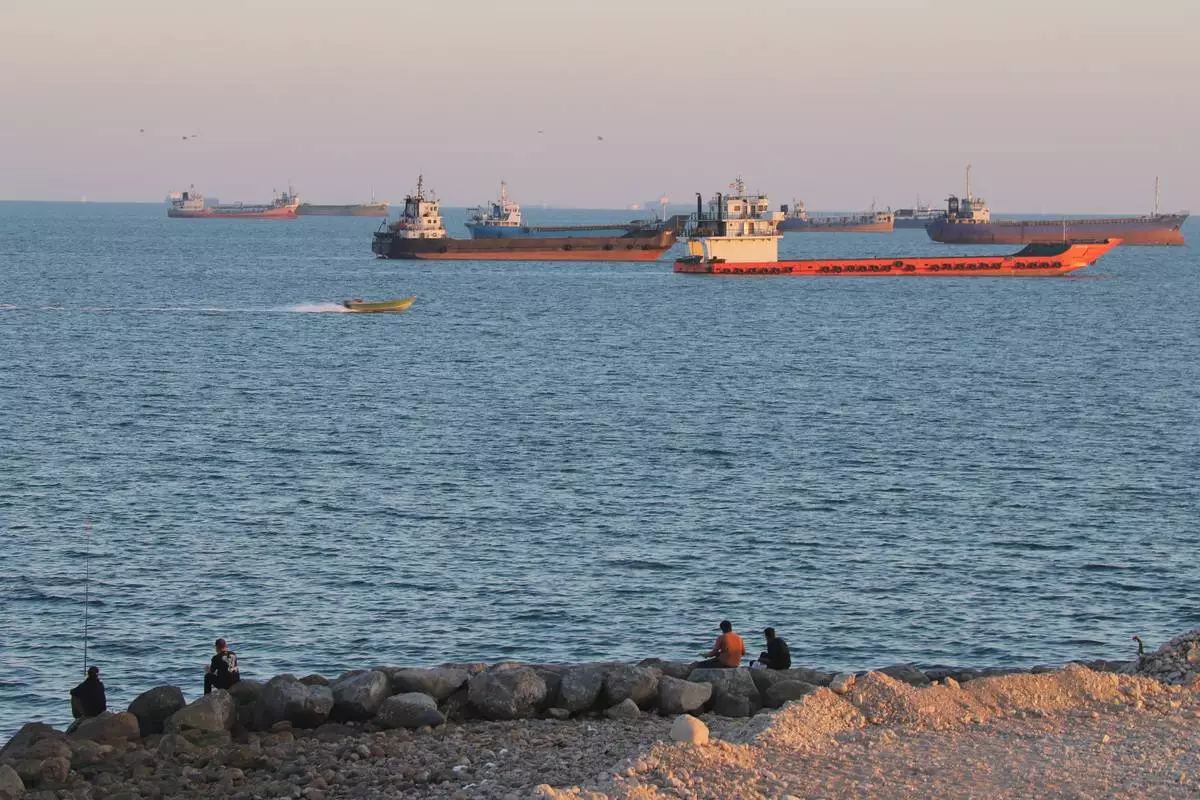
People sit on rocks along the shore as cargo ships lie at anchor in the Strait of Hormuz off Bandar Abbas, Iran, early Friday, Nov. 13, 2026. (Amirhosein Khorgooi/ISNA via AP)

People sit on rocks along the shore as cargo ships lie at anchor in the Strait of Hormuz off Bandar Abbas, Iran, early Friday, Nov. 13, 2026. (Amirhosein Khorgooi/ISNA via AP)

Recommended Articles