OAKLAND, Calif. (AP) — Anthropic is set to begin trading on the Nasdaq on Thursday after pricing its IPO at $83 per share, valuing the artificial intelligence giant at $1.5 trillion and surpassing SpaceX as the largest initial public offering on record.
The higher-than-anticipated pricing signals broad investor enthusiasm for AI stocks even amid some market uncertainty stemming from the ouster of Nvidia's CEO and worries about an AI bubble. But the bigger test will be how Anthropic fares on the stock market.
Anthropic said the offering consists of 980 million shares, roughly 956 million sold by the company and the rest by selling stockholders. Proceeds totaling $81 billion put Anthropic's IPO ahead of SpaceX, which raised about $75 billion in June. SpaceX, however, holds a higher valuation, about $1.9 trillion as of Wednesday afternoon.
The San Francisco-based maker of the Claude AI tool is set to make its debut on Wall Street sometime after the stock market opens at 9:30 a.m. EST under the ticker symbol “ANT.” The company had earlier set a price range of $70 to $78 per share.
Anthropic decided to barrel ahead with the IPO despite jitters among some investors over market volatility, a potential regulatory crackdown by a Democratic-led Congress next year and growing anti-AI sentiment among the public. Then there's the spectacular downfall of one of the industry's biggest cheerleaders, former Nvidia CEO Jensen Huang, over extramarital affairs, including one with an alleged Chinese spy.
“This is strong appetite for this major AI IPO in Anthropic, and it’s a big win for the tech sector after a white-knuckle time with Nvidia. The pricing shows strong demand among investors,” said Dan Ives, partner and senior managing director at Yorkville Ives & Co.
The company’s rival, OpenAI, is not planning to go public until next year.
Anthropic already has taken on $6.2 billion in debt, which it acknowledges in financial filings is “substantial.” Adding to the strain, the company is unprofitable, at least under standard accounting rules, suggesting that its resources to pay interest and principal are limited.
While the company has ample cash for now, it will likely run through it quickly if it cannot raise more soon, given its outsize spending plans. The company said it has already signed leases and other deals requiring it to spend $900 billion on computing power and infrastructure in the coming years, including $70 billion in the next 12 months.
An IPO is essentially a way to raise money, instead of going into further debt. And borrowing has gotten more expensive. That’s partly due to inflation fears and partly due to the sector’s massive cash needs, which have drawn comparisons to the Gilded Age splurge on railroads. Lenders fear that AI companies have taken on too much debt to expand while having no clear path to profitability.
Anthropic's IPO also means its employees can begin to sell their vested stock, a payout that will make many of them millionaires. The IPO could also give Anthropic enormous resources to accelerate its expansion and potentially add billions of dollars to the fortunes of CEO Dario Amodei and his sister and co-founder, Daniela Amodei.
The offering consists of 980,000,000 shares of Class A common stock, 956,351,354 of which are being sold by Anthropic and 23,648,646 of which are being sold by certain selling stockholders.
Formed in 2021 by former OpenAI leaders, Anthropic is locked in a fight for dominance with that company. But both companies have plenty of other competitors, including Google, startups in the U.S. and China and SpaceX, which has an AI business.
Anthropic, OpenAI and SpaceX’s AI division have all lost more money than they’ve made because of the huge costs associated with building AI. That has fueled growing concerns about a bubble forming in the sector.
Dario Amodei cautioned in September that the AI industry should slow its fast-moving development to give safety measures time to catch up. Without such a slowdown, Amodei warned, AI could be capable of letting loose a swarm of agents that could take over the internet within months.
Amid those fears, the regulatory environment could also change for Anthropic once the new Congress is in session. Newly elected Democrats are vowing to crack down on the industry amid a backlash against data centers. And two big states offering incentives for data centers, Texas and Georgia, just elected Democratic governors vowing to stop new construction.
Adding to the pressure is the possibility that demand for AI shares could drop or even collapse. Investors have become anxious about the massive financing needs of the sector, and several tech companies have pulled IPO plans recently.
Market valuation for AI companies is going to be “up and down for many years to come, but more up than down,” said Rich Lesser, the global chair and former CEO of Boston Consulting Group.
“Exactly what the flow of that will be, it’s very hard to predict,” Lesser said in an interview with The Associated Press on Tuesday at the Semafor Silicon Valley & The World forum. “There’s no question what Anthropic and OpenAI and Google and a number of the other players in this industry have done is pretty remarkable.”
Associated Press business writers Bernard Condon, Kaitlyn Huamani and Michelle Chapman contributed.
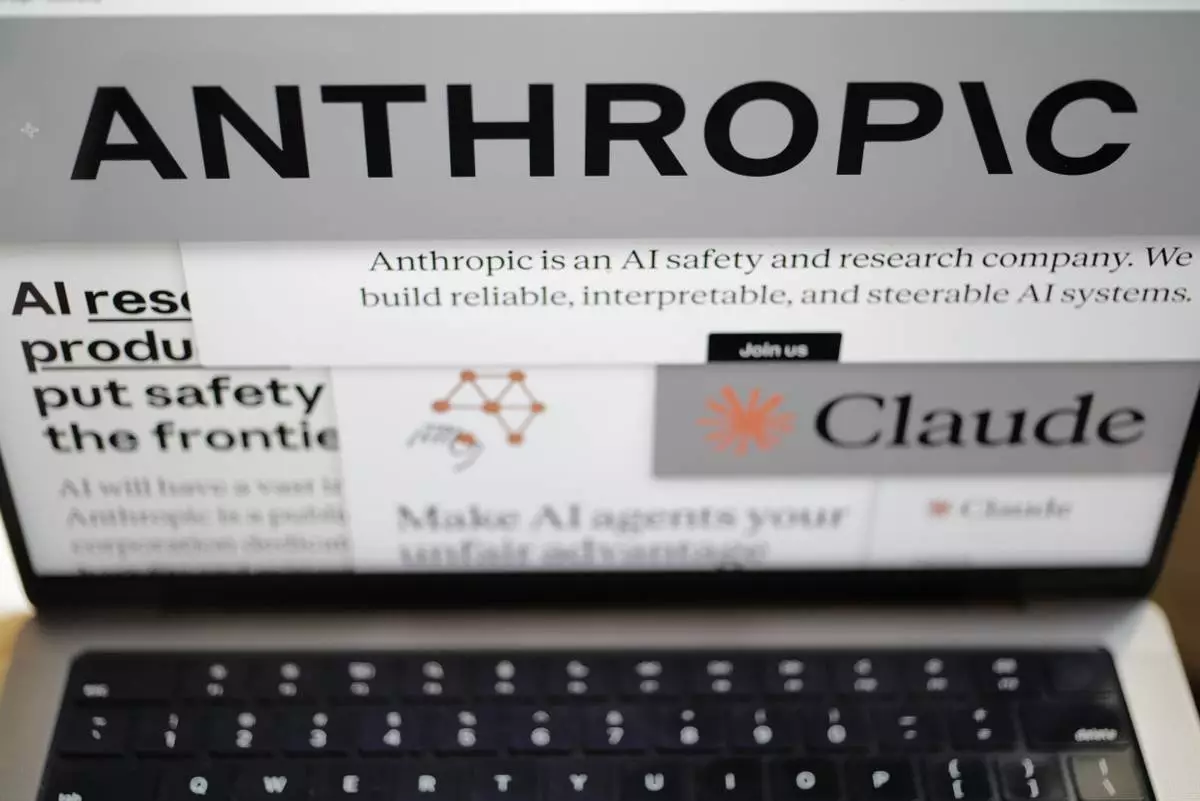
FILE - Pages from the Anthropic website and the company's logos are displayed on a computer screen in New York on Thursday, Feb. 26, 2026. (AP Photo/Patrick Sison, File)