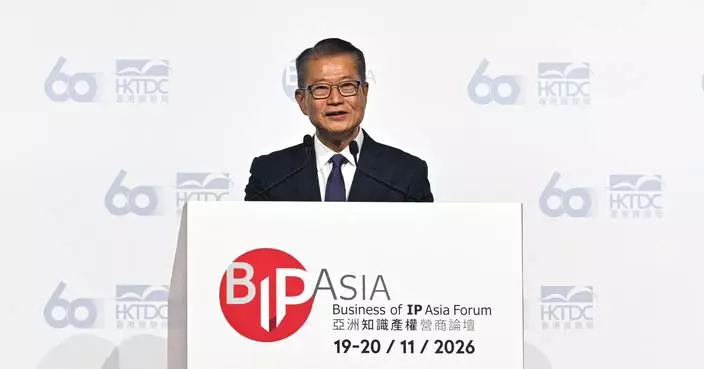
Speech by Acting SCED at APEC Workshop on Leveraging IP Financing for Innovative Enterprises: Current Landscape, Key Challenges and Way Forward
Following is the speech by the Acting Secretary for Commerce and Economic Development, Dr Bernard Chan, at the APEC (Asia-Pacific Economic Cooperation) Workshop on Leveraging IP (Intellectual Property) Financing for Innovative Enterprises: Current Landscape, Key Challenges and Way Forward today (November 19):
Distinguished guests, speakers, delegates, ladies and gentlemen,
Good afternoon. Welcome to Hong Kong, China, and to this APEC workshop on leveraging IP financing for innovative enterprises.
Let me begin by thanking the APEC IP Rights Experts Group and our co-sponsoring economies, Chile, China, Korea and Singapore, for their support in making this workshop possible. As China hosts APEC this year, we are delighted to contribute to regional co-operation through this workshop, which is being held alongside the Business of IP Asia Forum.
Innovation creates value. But turning that value into finance is not always straightforward. For many innovative enterprises, particularly small and medium-sized enterprises (SMEs) and start-ups, patents, trade marks and other IP assets are important sources of competitive advantages underpinning their companies' worth. Yet these businesses may struggle to secure financing when they lack traditional tangible collateral.
There are several challenges to overcome, including complex valuation, limited market reference data and difficulties in realising IP value. Addressing them can help enterprises access capital to develop new products, to enter new markets and to commercialise their research and creative outcomes.
For Hong Kong, our strengths as an international financial centre, supported by our professional services, provide a strong foundation for developing IP financing and advancing our role as a regional IP trading centre.
Last December, our bureau, the Commerce and Economic Development Bureau, together with the Hong Kong Monetary Authority and the Intellectual Property Department, launched the IP Financing Sandbox. It brings together banks, enterprises and professional services organisations to test IP-based financing arrangements in a collaborative, risk-controlled environment.
In September this year, we announced the first seven pilot cases that had successfully completed credit approval. They cover the electronics, construction, toy manufacturing and medical device sectors, involving IP assets comprising patents and trademarks, with loan amounts ranging from $1 million to $39 million.
These are encouraging first steps. By taking account of IP asset value, participating banks have offered greater flexibility regarding loan amounts and financing terms, while gaining valuable experiences in valuation, credit assessment and risk management.
Practical testing must go hand in hand with stronger support. In September, we also launched the two-year Pilot Patent Valuation Support Scheme through the Hong Kong Technology and Innovation Support Centre. It helps eligible SMEs meet the cost of professional valuation of their patents and other IP assets, with qualitative patent evaluation provided as a complementary tool where appropriate.
Better information helps enterprises demonstrate the economic value of their assets and enables financiers to assess opportunities and risks. It supports, rather than replaces, commercial judgement and prudent risk assessment.
People are equally important. Later today, we will launch the Hong Kong IP Academy to provide more systematic, practical IP training across industries. We need enterprises that understand and manage their IP strategically, alongside professionals who can assess its commercial potential. By equipping both groups with the necessary knowledge and skills, training helps build these complementary capabilities.
Looking ahead, the value of a pilot lies not only in the transactions it facilitates, but also in the knowledge, confidence and working relationships it builds.
Government can facilitate testing and strengthen support measures. Banks and professional services providers bring commercial expertise and risk assessment. Enterprises must prepare and manage their IP assets to support their business objectives. Progress depends on effective collaboration among all parties.
We will consolidate our experiences from the Sandbox and market feedback to explore wider participation, facilitate more pilot cases and enhance valuation processes.
This is also where APEC co-operation can make a difference. Our economies have different legal frameworks and market conditions; no single model fits all. By exchanging practical lessons, sharing experiences and learning from one another, we can each develop approaches suited to our circumstances.
Ladies and gentlemen, let us build on today's exchanges to turn shared knowledge into practical financing opportunities. Together, we can help more enterprises bring their innovations to market, creating new sources of growth and contributing to a more dynamic and innovative Asia-Pacific economy.
I wish you all a productive workshop. Thank you so much.

Source: AI-found images
Remarks by CE at media session in Shenzhen
The Chief Executive, Mr John Lee, met the media in Shenzhen this afternoon (November 19) during his attendance at the Asia-Pacific Economic Cooperation (APEC) Economic Leaders' Meeting and other related activities. Following are Mr Lee's remarks:
Reporter: My first question is, what do you see, or expect to be, Hong Kong's biggest achievement and takeaway at this year's event? Hong Kong is serving its dual role as a "super connector" and a "super value-adder". How would you explain this important concept to our global audience, especially in terms of the SAR's integration into the overall national development of China and the Greater Bay Area?
Chief Executive: We have been actively participating. I think we have achieved five results.
First, contributing Hong Kong's strength by actively participating in and supporting our country's successful hosting of the APEC meetings. The Hong Kong SAR (Special Administrative Region) has a dual role on this occasion. Hong Kong, China is an APEC member, and I am, at the same time, an official of China, our country. Therefore, we should take an active role in assisting our country's successful hosting of this year's APEC meetings. Therefore, Hong Kong, China actively attended and organised meetings and workshops, and launched a series of capacity-building projects. For this week's APEC Economic Leaders' Week, Hong Kong has sent its largest-ever delegation of over 50 members.
Second, deepening exchanges with APEC member economies. APEC member economies are Hong Kong's important trading partners, accounting for 87 per cent of Hong Kong's external trade. Through APEC meetings and events, I exchanged views with leaders of various economies. Through bilateral meetings and engagements, I met with the leaders of seven economies: Malaysia, Vietnam, Brunei, Thailand, Chile, Peru and Singapore to strengthen ties and discuss issues of mutual concern.
Third, consolidating relations with ASEAN (Association of Southeast Asian Nations) member states. Seven ASEAN member states are APEC members. ASEAN is Hong Kong's second-largest trading partner. The APEC meetings provided me with the opportunity to meet with five ASEAN leaders at bilateral meetings and engagements to further consolidate our relations.
Fourth, further exploring emerging markets. The Hong Kong SAR Government is actively expanding Hong Kong's economic and trade network, and expanding and exploring different markets, especially on strengthening ties with emerging markets and economies with growth potential. Yesterday, the President of Chile and I jointly witnessed the signing of the Working Holiday Scheme agreement between Hong Kong and Chile.
Fifth, telling good stories of the Greater Bay Area (GBA) and Hong Kong. The successful hosting of APEC meetings in Shenzhen, a core city of the Greater Bay Area, fully demonstrated the GBA's strength and charm as a window for the country's high-standard opening up. At the APEC CEO Summit on Tuesday, I seized the opportunity to promote the development opportunities of the GBA and Hong Kong's unique advantages, and I also discussed GBA opportunities with participating leaders.
My takeaway is that Hong Kong's development resonates with our country's development. As an international city and international financial centre, we can serve the country's needs with our unique advantages and what Hong Kong does best. We are pressing ahead with four centres development and one hub development, contributing to our country's high-quality development. Therefore, we shall actively integrate with and serve our national development, and at the same time, we will strengthen our connectivity with the international world.
On connectivity, Hong Kong can continue to leverage our unique advantages under the "one country, two systems" principle to play an active role as a "super connector" and "super value-adder". We can make full use of APEC and other international platforms to showcase the HKSAR as an international hub. The 2026 APEC Finance Ministers' Meeting in the HKSAR actually demonstrated our unique advantage in this regard. We can also expand the global trade and investment network. Through our 15 overseas ETOs (Economic and Trade Offices), together with Hong Kong Trade Development Council and Invest Hong Kong offices, our network covers 68 cities and 129 countries. We will deepen engagement with emerging economies in ASEAN (Association of Southeast Asian Nations), the Middle East, Central Asia and South America, pursue early RCEP (Regional Comprehensive Economic Partnership) accession, and aim at reaching more free trade agreements and investment promotion and protection agreements. I think we can also leverage Hong Kong's status as an international centre to contribute to the country's high-quality development. We will press ahead with the development of the "four centres and one hub" to serve the country's high-level opening up.
As regards deepening our integration into national development, first of all, I think we can deepen Greater Bay Area development through hard and soft connectivity and connectivity of hearts, and take forward the Northern Metropolis development for integrating into national development. Second, we can contribute to Belt and Road co-operation. Third, we can, through the GoGlobal Task Force (Task Force on Supporting Mainland Enterprises in Going Global), support Mainland enterprises in leveraging Hong Kong's world-class professional services and extensive global network, and using Hong Kong as a springboard to expand into global markets. Thank you.
(Please also refer to the Chinese portion of the remarks.)
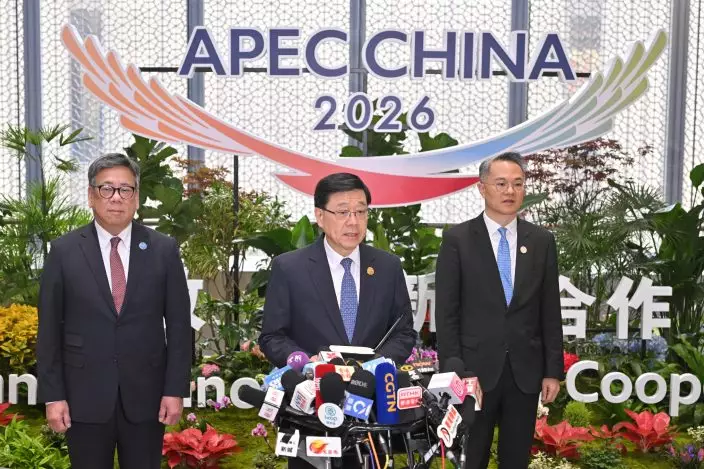
The Chief Executive, Mr John Lee (centre), accompanied by the Secretary for Commerce and Economic Development, Mr Algernon Yau (left), and the Director-General of Trade and Industry, Mr Aaron Liu (right), meets the media in Shenzhen today (November 19). Source: HKSAR Government Press Releases