Boeing looks forward to deeper cooperation with China in sustainability and decarbonizing the aviation sector, said Brendan Nelson, president of Boeing Global.
Nelson was in China to attend the Asia-Pacific Economic Cooperation (APEC) CEO Summit in Shenzhen, south China's Guangdong Province on Tuesday and Wednesday. In an interview on Thursday in Beijing, he said he was thoroughly impressed by the event and was happy to witness the results of Shenzhen's modernization.
"It was extremely impressive, and what Shenzhen has been able to achieve with the APEC meeting presents the best not just of Shenzhen, but of China itself, an extraordinary achievement," Nelson said.
If he had to choose one word to describe China's economic development, Nelson said he would choose "stunning."
"China's economic growth obviously has a critically important role on global economic growth, and our industry, aviation, is arguably the most interconnected industry in the world. And our industry is 4 percent of global GDP. It's extremely important. We're also making sure that as the commercial fleet of Boeing aircraft increases in China that we have the parts that are available here to safely support the continued operation of those aircraft, and we also expect to be doing more in sustainability and de-carbonizing the aviation sector in China," he said.
Boeing has a long-standing partnership with the Commercial Aircraft Corporation of China (COMAC), especially in the areas of sustainable aviation fuel (SAF) and green aviation technologies.
Nelson said the co-investments the companies have made will be crucial to meeting China's and the world's sustainability goals.
"One of the obvious ones is the work that we do with COMAC on technology for de-carbonizing our industry. So looking at technologies for the production of sustainable aviation fuels, for example, one of the things that's critically important. In fact in the 15th fifth year plan, the Chinese government has identified de-carbonizing the Chinese economy to the extent that it can, 3.8 percent per unit of GDP, but also in air transport, 4 percent reduction per tonne of CO2 emissions for kilometer travel and 15 percent for passengers and in order like, pretty much all of the challenges that humankind faces, technology is critically important to that. So we have been co-investing in technologies that will help us produce sustainable aviation fuels in China, for China. The target is 2.4 million tonnes of sustainable aviation fuel by 2030," he said.
During the course of the partnership, Nelson has become deeply familiar with COMAC's self-developed C919 aircraft. The executive said he looks forward to welcoming the narrow-body aircraft into the global market.
"It's stunningly impressive and China of course you expect is going to design and build its own commercial aircraft. And Boeing has been in two joint ventures with COMAC, the Completion Center, sustainability, and increasingly COMAC will come into the market, but it's going to be a much bigger market at this stage. The manufacturing process at COMAC is extremely impressive. And we will expect to see more COMAC deliveries, but that's something, again, that will give a sense of pride to China," Nelson said.
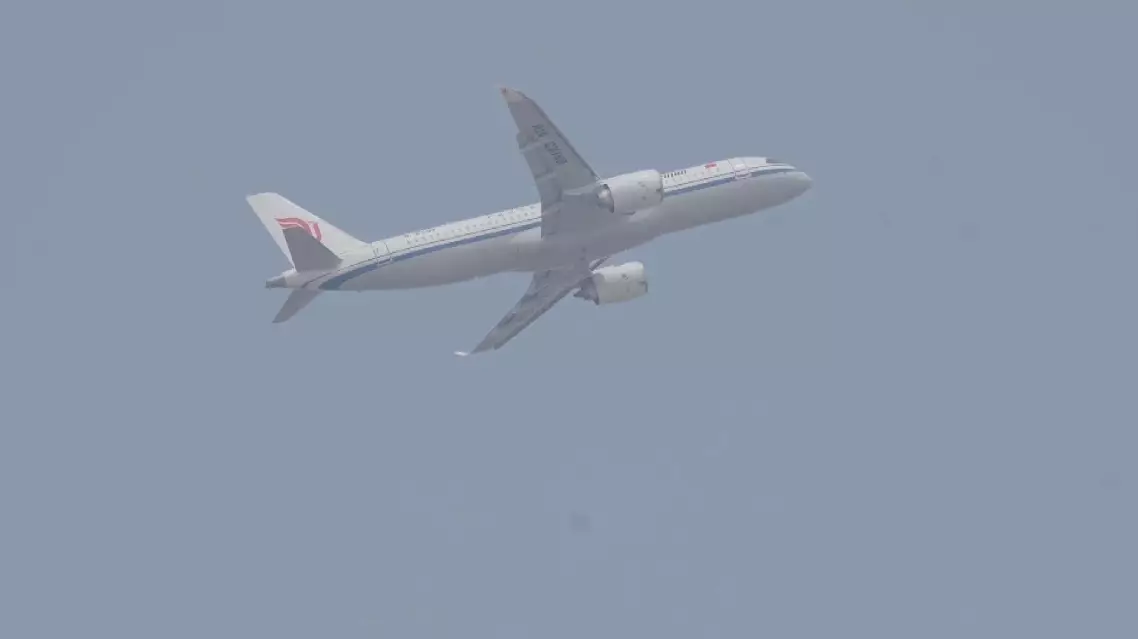
Boeing Global president eyes deeper China cooperation on aviation sustainability