Tsinghua University convened its third Business Journalism Forum at the National Press Club in Washington, D.C. on Friday to discuss the outlook for China-U.S. relations and the evolving media landscape.
Taking place weeks after the historic U.S. midterm elections, the panel brought together media professionals and scholars to share insights on bilateral relations and the media's responsibility in explaining the changes to global audiences.
Hailed as a timely intercultural conversation among media practitioners, the event highlighted the power of dialogue in advancing bilateral ties.
Min Hang, director of the Tsinghua Research Center for Economic Communication and Development, emphasized the value of direct people-to-people exchange.
"The people-to-people conversation, especially face-to-face conversation, is so important nowadays, [as] China and the U.S. are two giants," she said.
The 2026 gathering marks the third edition of the Tsinghua Business Journalism Forum hosted at the National Press Club in Washington, D.C.
This year, experts addressed a wide range of media and public policy issues, including challenges of AI, evolving storytelling methods, and climate change.
Many of the public concerns have been integrated with the national strategies of the two countries, with AI as the most significant example, Mark Hamrick, former president of the National Press Club noted at the event.
"Both countries are competing for leadership in AI, and I think that is going to be a theme to watch," he said.
Panelists also discussed the media's responsibility to foster mutual understanding while delivering credible, fact-based economic reporting.
"By talking about policy, by having a frank discussion of the big policy issues, the economic issues, the better the coverage will be in both countries -- to improve coverage of China in America, to improve coverage of America in China," said Rick Dunham, co-director of the Tsinghua Global Business Forum.
Calling the roundtable discussion fruitful, organizers expressed their intention to host the forum annually on the third Friday of November.
"I think it's very important to set up a bridge to connect people from two sides, especially media practitioners from China and from the U.S. I think this is a very important platform for them to get to know each other," said Min.
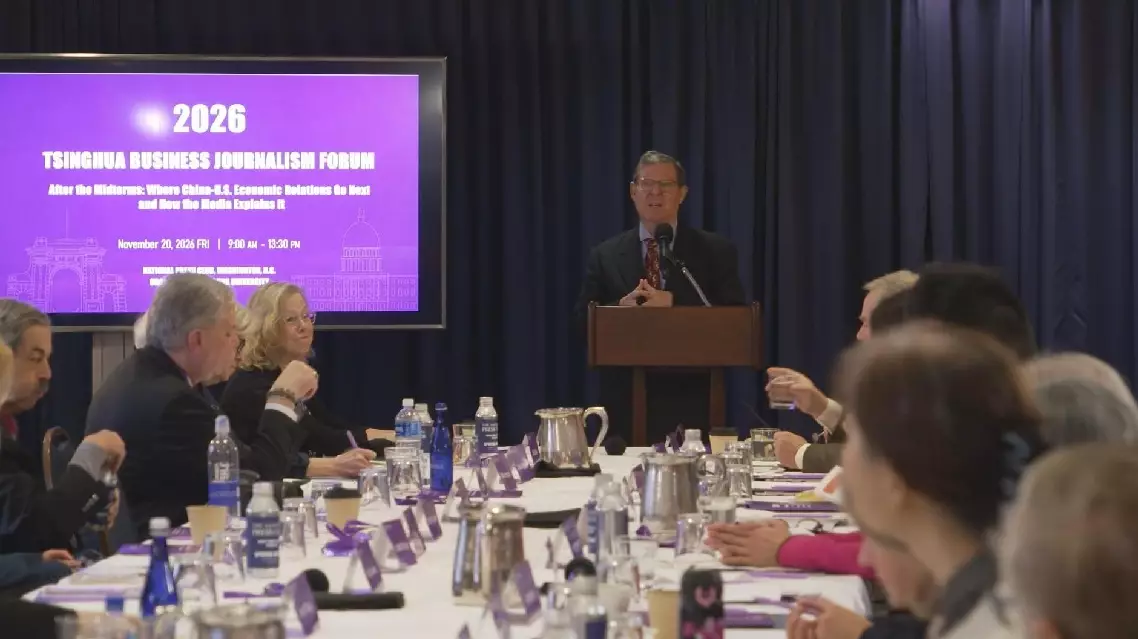
Tsinghua holds Business Journalism Forum in D.C. to discuss bilateral relations outlook
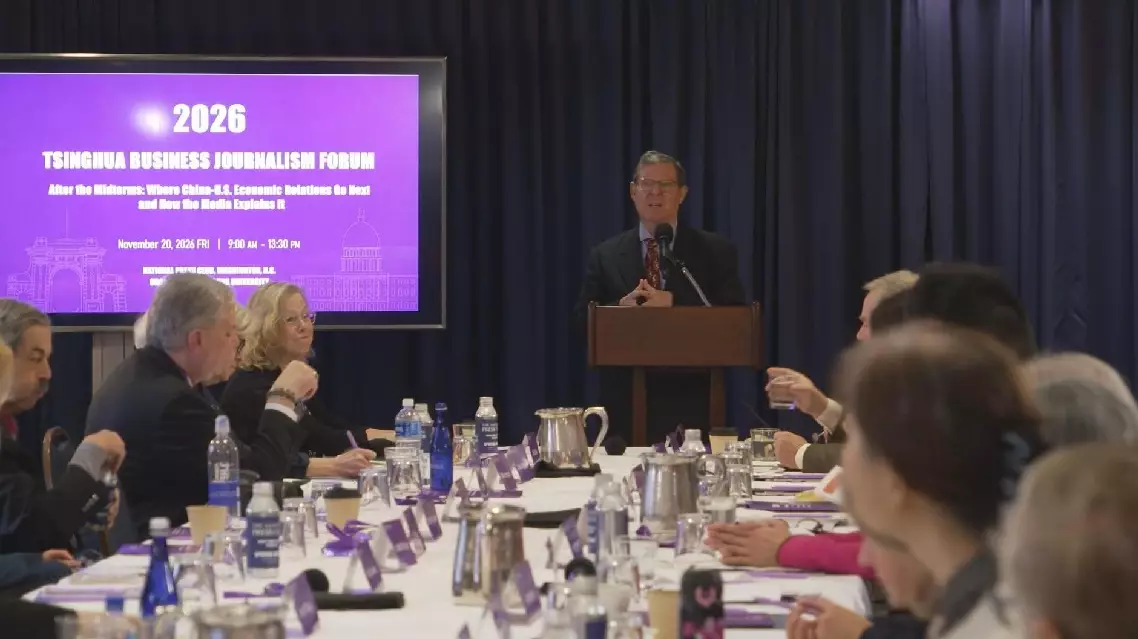
Tsinghua holds Business Journalism Forum in D.C. to discuss bilateral relations outlook
UNICEF Deputy Executive Director Ted Chaiban marked World Children's Day in Beijing on Friday by reaffirming a principle at the heart of the agency's work, "nothing about children without children", as he weighed the enormous progress made for children worldwide over eight decades against the serious challenges that remain.
Chaiban was speaking in an interview with the China Global Television Network (CGTN) in Beijing, where a flagship event was held to mark both the global observance dedicated for children and UNICEF's 80th anniversary.
Co-hosted by UNICEF and the China National Children's Center, the Beijing event featured an art exhibition in which children from around the world expressed their hopes through artworks.
The event also took place as China and the UN agency gear up to co-host the Global Children's Environmental Health Conference in Beijing on Nov 23.
Speaking to CGTN, Chaiban stressed that children's participation is not merely symbolic but a core principle of UNICEF's work.
"The Convention on the Rights of the Child emphasizes the importance of a child being able to participate and weigh in, have opinions on decisions that have an impact on their future. And for UNICEF, we take this very seriously. It's not just something we do symbolically. We feel that it's very important for children to be consulted when policies or programs are developed that are about them. So, nothing about children without children. And this year at this World Children's Day - this is one of the things we've done in China - where we've asked children from around China to basically say what are their dreams through essays, through art expression, what are they looking for in terms of the future? And we have an exhibition at this very center here, which is showing some of those aspirations and some of those dreams," he said.
Reflecting on UNICEF's 80th anniversary, Chaiban described the progress in promoting children's rights over the past decades as "enormous."
"UNICEF started in 1946, right after World War II when the world was in turmoil - millions displaced, economies devastated. And we tend to think of the world as still being in turmoil, and it certainly is. But enormous progress has been made. There's been a child survival revolution in the last 80 years and specifically in the last 20 years. In 2002, we had almost 10 million under-5 deaths, children's death per year, and that was cut to 4.8 million in 2024, so more than a 50-percent reduction. More children today are learning, which is so essential for their future than ever before in history. And their diseases that used to kill millions that have either been very much curtailed or eliminated. So, a lot of progress has been made," he said.
Despite these gains, Chaiban cautioned that significant challenges remain, highlighting conflict, climate change and mental health, as well as the opportunities and risks that emerging technologies such as AI present for children's rights.
"But we also have knowledge that more remains to be done. One in five children around the world still lives in a conflict zone. Children are facing new challenges, whether it's climate, mental health issues. Artificial intelligence is both an opportunity, but also represents challenges and risks, so we have to deal with these emerging issues around war, poverty and both the opportunities and risks of new technologies. And UNICEF is there for children, will work with governments and other partners to continue on that journey," he told CGTN.
UNICEF official pushes for youth voice in decisions on World Children's Day