Home defeats to big rivals. Injuries to key players. One of the worst defenses in the Premier League.
Another crisis might be unfolding at Chelsea, just a few months into Xabi Alonso's tenure.
“We’re in a fragile moment,” Alonso said Saturday after seeing his team overrun in a 4-1 home loss to Leeds, which hadn't won at Stamford Bridge this century.
Already without major players in striker Joao Pedro and defender Maxence Lacroix because of injuries, Chelsea fell apart against Leeds following the enforced withdrawal of Moises Caicedo in the 22nd minute after the Ecuador midfielder landed awkwardly on his back while making a challenge.
Despite going ahead within three minutes through Emmanuel Emegha on his first start, Leeds equalized almost immediately through Noah Okafor and dominated the second half, scoring through Dominic Calvert-Lewin — via the penalty spot — Okafor again and then U.S. midfielder Brenden Aaronson.
Leeds — whose rivalry with Chelsea dates back to the 1960s and early '70s — last beat the London club away in 1999. Less than a month ago, Tottenham won at Stamford Bridge for the first time since 2018. Before the international break, Chelsea lost 1-0 at Sunderland, which started that match in last place.
Chelsea, one of the biggest spenders in Europe in recent seasons, has tumbled toward mid-table and is putting in lethargic performances even though the team doesn't have the hindrance of European competition this season.
“After we lost Moises, we lost completely the momentum,” Alonso said. “Until then we were doing OK, but from that moment they started believing and we started not believing. After that, we never got the good feeling and were not able to come from the pressure. It completely changed.
“I’m not feeling (let down). We do it as a team, as (a) collective. We need to support each other. We need to find solutions to do better because this will happen. There were moments that we were not competing at the level required. But the physicality, the duels, it’s not the only explanation. The mentality part we can do better.”
Chelsea has now conceded 20 goals in 11 games, with only last-place Crystal Palace and promoted teams Ipswich and Coventry letting in more.
See AP’s full soccer coverage here

Chelsea's manager Xabi Alonso waits for the start of the English Premier League soccer match between Sunderland and Chelsea in Sunderland, England, Sunday, Nov. 8, 2026. (Owen Humphreys/PA via AP)
CAPE CANAVERAL, Fla. (AP) — A pair of spacecraft slipped into orbit around Mercury on Saturday after an eight-year cruise through the inner solar system to unravel our littlest planet's mountain of mysteries.
The linked robotic explorers — one European, the other Japanese — will separate from one another next month in order to map and study the scorching little planet from different altitudes. The $2 billion (1.7 billion euros) mission is known collectively as BepiColombo.
The European Space Agency announced BepiColombo's arrival via social media. A series of thruster firings slowed the spacecraft enough to be captured by the planet's weak gravity. But it took several anxious hours before flight controllers in Germany — 94 million miles (152 million kilometers) away — could confirm that BepiColombo had achieved orbit. Teams pored over the data streaming back; additional information was not immediately available.
BepiColombo is only the third spacecraft to visit Mercury — the sun's closest planet and barely bigger than our moon — and the first in more than a decade.
NASA's Mariner 10 flew past Mercury three times in the mid-1970s. The team included the late Italian mathematician Giuseppe “Bepi” Colombo, for whom this latest mission is named. NASA's Messenger spacecraft entered orbit around Mercury in 2011 and, after running out of fuel, crashed into the planet in 2015.
Launched in 2018, BepiColombo took a slower, more roundabout route to get to Mercury, flying once past Earth, twice past Venus and six times past Mercury for gravity-guiding assists. All those loop-de-loops put more than 6 billion miles (10 billion kilometers) on the odometer. The conjoined spacecraft shed their mother ship in September for the final leg of the journey.
Lead project scientist Geraint Jones said he and others can’t wait for all the new data to start streaming down in the spring. The mission will provide the ability to compare “unprecedented measurements taken by two spacecraft at the planet at the same time,” he noted.
Once orbiting separately, the European Space Agency's satellite and the Japan Aerospace Exploration Agency’s smaller craft will study Mercury’s dense interior and exterior magnetic field, as well as everything in between: impact craters, volcanic plains, mountain ridges and peaks jutting as high as 3 miles (4 1/2 kilometers).
The mercury at Mercury can hit more than 800 degrees (427 degrees Celsius), adding strain to electronic and engineering systems. Space agency officials want to keep the mission going for at least one Earth year — or the equivalent of four Mercury years.
“The spacecraft and its instruments need to be kept as cool as possible, which is a huge technical challenge in itself,” Jones said in an email.
Despite its relative proximity to Earth, Mercury is one of the solar system’s least explored planets. Only outer planets Uranus and Neptune have had fewer visitors — a lone Voyager 2 back in the 1980s.
The Associated Press’ health and science coverage receives financial support from the AP Fund for Journalism and private foundations. AP is solely responsible for all content. Find AP’s standards for working with philanthropies, a list of supporters and funded coverage areas at AP.org.
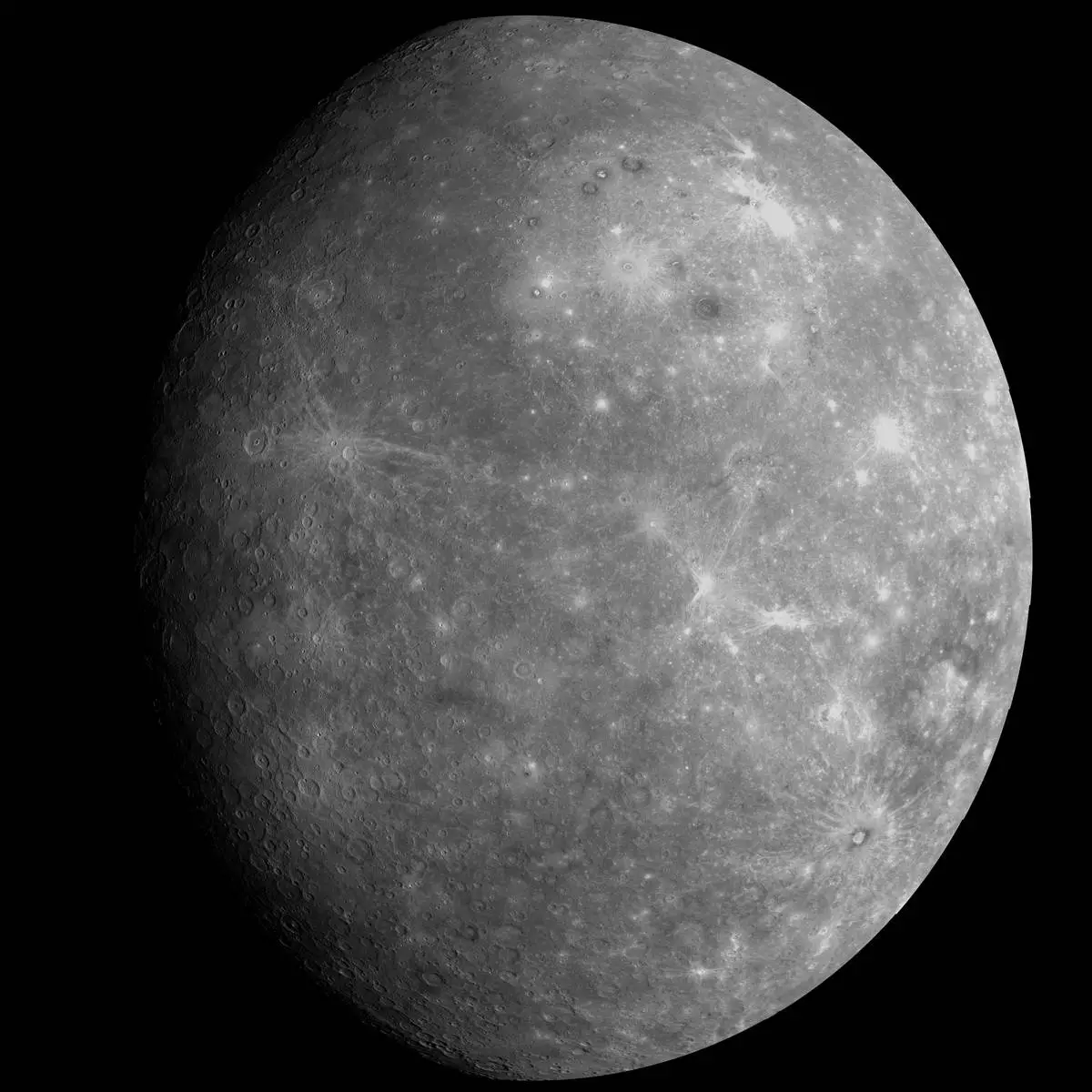
FILE - This composite image provided by NASA/Johns Hopkins University Applied Physics Laboratory/Carnegie Institution of Washington on Oct. 22, 2013, shows Mercury as it appeared to the Messenger spacecraft following a flyby of the planet. (NASA/Johns Hopkins University Applied Physics Laboratory/Carnegie Institution of Washington via AP, File)
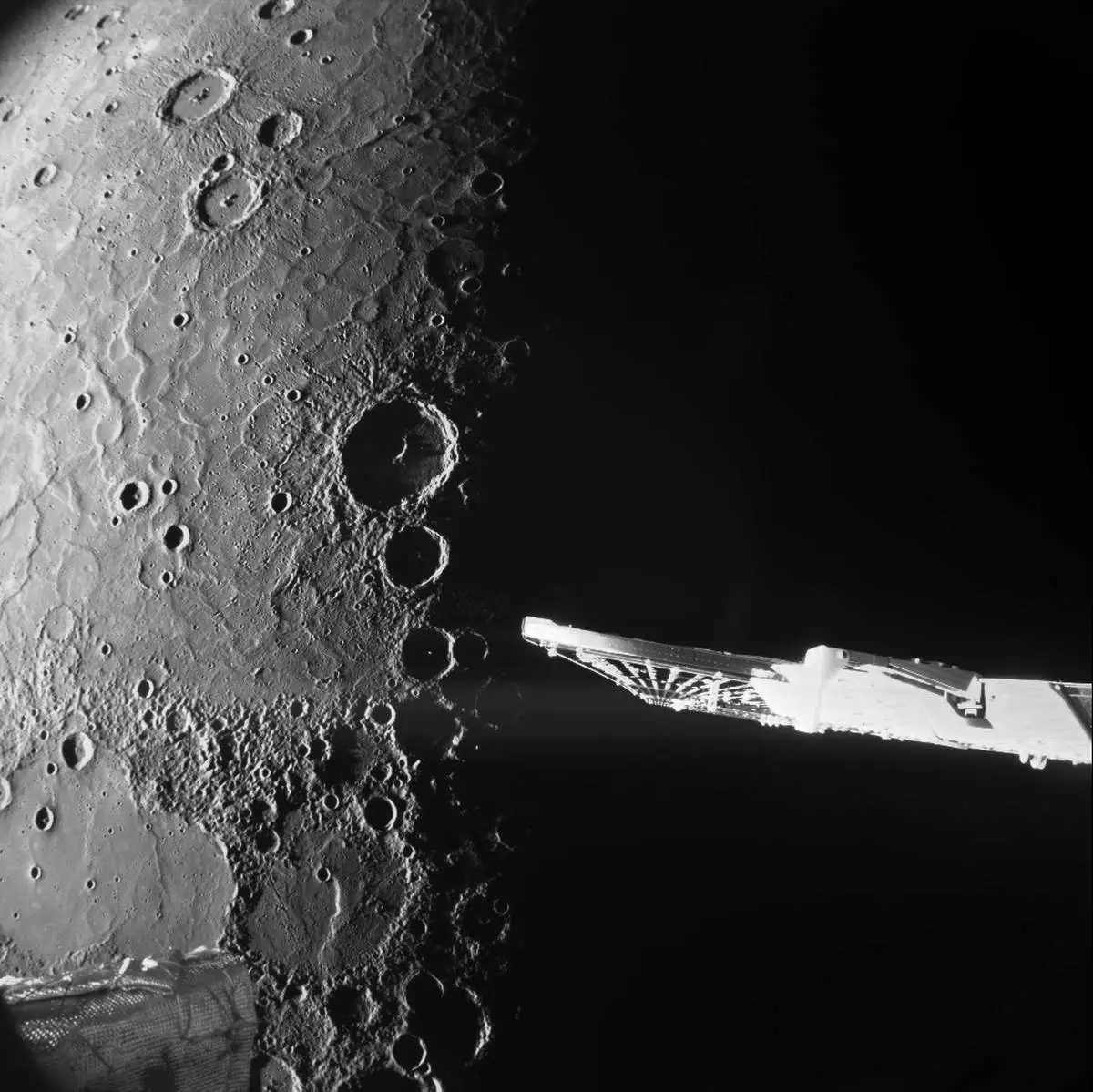
FILE - This image taken on Jan. 8, 2025 and provided by the European Space Agency shows close-up photos of Mercury's north pole captured by the European-Japanese spacecraft BepiColombo. (ESA via AP, File)