All eyes were on US President Donald Trump as he entered the APEC (Asia-Pacific Economic Cooperation) state banquet hall.
The hall struck up "America the Beautiful" especially for the occasion. Trump stopped and listened for a long moment, then applauded the orchestra and raised his fist in salute.
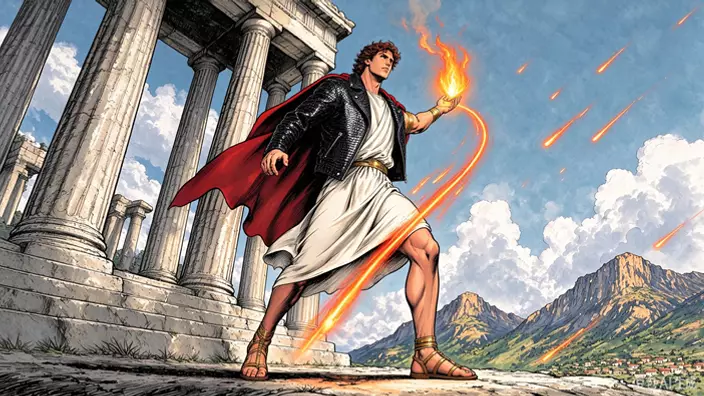
Courtesy to all. AI current-affairs cartoon.
Echoes of 1972
The moment carried everyone back to February 21, 1972. That night, at the state banquet welcoming Richard Nixon at the Great Hall of the People, the PLA Military Band played the same piece. Zhou Enlai had personally conceived and arranged the musical gesture.
In 2018, the Zhou Enlai Memorial Website revisited that historic scene. After the state banquet ended, Nixon made a point of going with Zhou Enlai to congratulate and thank the military band.
In memoirs written in his later years, Nixon recalled that hearing the familiar American folk song sent a wave of warmth through his heart because it was the piece he had chosen for his inauguration.
Reading the Message
Let me put it plainly. China is a nation of ritual propriety, and it has always carried itself with the bearing of a great power. Its diplomatic language runs deep but rarely shows its hand. For years, Chinese and foreign observers alike have missed that deeper meaning. They assumed China had to dance to the tango of the US and the West before it could claim great-power dignity.
Rest easy. Today's APEC state banquet just taught the world a lesson. Call it "China Studies": from now on, we read China's essence through the conduct of a great power. That is the reliable way.
Before Donald Trump walked into the banquet, he surely had no inkling of the details China had arranged. Only once inside the hall did he realize that the American patriotic music ringing out before him was in fact a wall of force, charged with the positive energy of multilateral metaphor.
Stop and think about it. Trump seemed to get the message. Why clench a fist after applauding? Forgive the speculation, but this was the president's psychological tell. He may well have answered the Chinese side in metaphor too, as if to say, all right, let's do it this way. The attitude was resolute: I understand.
Protocol Is the Thermometer
Zhou Enlai once laid down the rule for his diplomats: protocol must serve politics, and protocol must serve foreign policy. Protocol officers need political minds, he said, because every arrangement should reflect politics, reflect policy and reflect the state of bilateral relations. The warmth or chill between two countries shows up first in the protocol. Who goes to receive the visitor? Who sees him off? Who sits across the table? Even the ceremony in between can change. Protocol, Zhou concluded, is the thermometer of diplomatic work: when relations are good, receive guests more warmly; when relations are bad, trim the scale of the welcome.
The account comes from an article reposted by People's Daily Online, built on the oral history of Lu Peixin, former acting director-general of the Protocol Department of the Ministry of Foreign Affairs. Lu recalled that before Richard Nixon's visit to China, Premier Zhou handed down sixteen words of guidance: neither hot nor cold, neither humble nor arrogant, receive guest with courtesy without imposing on him.
This, Lu stressed, was a matter of diplomatic principle. Nixon came mainly to discuss bilateral relations, and that was politics. But the reception had to make China's position clear: not hot, because the two countries had not established diplomatic relations; not cold, because this time Nixon was coming on his own initiative, and his journey, like Henry Kissinger's earlier secret visit to China, had been hard to pull off. A certain warmth was required, and the protocol had to show it accordingly.
This time, when Donald Trump came to Shenzhen, the message began the moment Air Force One touched down. China's reception lineup was already doing the talking. According to foreign media reports, Xi Jinping personally walked to the foot of the aircraft stairs to welcome Trump, shaking his hand and embracing him.
At the same time, China sent five J-10C fighter jets of the August 1st Aerobatic Team roaring low over the airport, trailing colored smoke in salute. It was a special arrangement no other leader received during the APEC summit.
The BBC reported that Xi's presence at the airport marked the first time in 46 years that a Chinese head of state had received a visiting counterpart there. Wen Wei Po framed it as reciprocity: when Xi made a state visit to the United States in September this year, Trump went to the airport in person and sent fighter jets flying overhead in welcome.
Handshake, Not Embrace
One episode in Lu Peixin's oral account of his diplomatic career should be noted: a Deng Xiaoping story.
When Mikhail Gorbachev visited China in May 1989, Deng set the line with care. The visit was a major event watched by the world, but Sino-Soviet relations had not returned to an alliance, so Deng said he would shake hands with Gorbachev but not embrace him. The Protocol Department of the Ministry of Foreign Affairs then made that clear to the other side when discussing protocol arrangements.
Overall, China-US relations are moving in a positive direction. Whether Donald Trump adds more hardline measures after returning home, or turns toward win-win outcomes, will become clear only once his follow-on policies appear.
Postscript: I believe diplomacy's sharpest messages are not spoken. They are played and clasped, and that shows its greatness. Do you agree?
Deep Blue
** 博客文章文責自負,不代表本公司立場 **