NEW YORK (AP) — Fourteen years and six movies in, “The Hunger Games” movie franchise rediscovered its box-office might, as “Sunrise on the Reaping” debuted with $120 million in North American theaters over the weekend, according to studio estimates Sunday.
The sun had seemed to be setting on “The Hunger Games” as a cultural force. After the original blockbuster run of four movies led by Jennifer Lawrence, Lionsgate’s 2023 prequel, “The Ballad of Songbirds and Snakes,” topped off at $361.8 million worldwide — a decent sum but about half what each of the first four movies grossed.
Yet “The Hunger Games: Sunrise on the Reaping” has restored the Suzanne Collins adaptations to blockbuster status. The film, a sequel to “Songbirds and Snakes” and set 25 years before the original series, launched with $225 million worldwide on its opening weekend. Lionsgate produced and distributed the movie, budgeted at about $150 million.
“It’s obviously not common for a film in its sixth installment to completely reverse the trajectory, but it’s awfully satisfying to be a part of it,” said Adam Fogelson, chairman of the Lionsgate Motion Picture Group.
At a time when movie series longevity is far from assured, “Sunrise on the Reaping” managed to notch the year’s fifth $100 million-plus domestic launch — something only accomplished in 2026 by some of the most bankable franchises: Spider-Man (“Spider-Man: Brand New Day”), Toy Story (“Toy Story 5”), Super Mario (“The Super Mario Galaxy Movie”) and whatever Christopher Nolan makes (“The Odyssey”).
And it did it while a significant portion of potential moviegoers were locked at home playing “Grand Theft Auto VI.”
Yet Gen Z again powered a big weekend in theaters. Some 74% of the audience for the “Hunger Games” prequel-sequel were aged 18-34. Several of 2026’s box-office hits — including “Obsession,” “Backrooms” and “You Can See Everything” — have likewise succeeded by packing theaters with the most potent demographic in moviegoing.
While “Sunrise on the Reaping” includes a supporting cast of well-known veteran stars (Ralph Fiennes, Kieran Culkin, Elle Fanning, Jesse Plemons), the movie largely belongs to a new generation of young actors: Jo Zada, Mckenna Grace, Ben Wang and Whitney Peak. The film, directed by Francis Lawrence, is centered around teenage Haymitch Abernathy (Zada), the role originally played by Woody Harrelson.
Fogelson credits several things to the “Hunger Games” turnaround. “Songbirds and Snakes” was an origin story of a villain, and thus a darker tale. “Sunrise on the Reaping” has the Hunger Games themselves more front and center. It focuses on the backstory of a beloved character in Haymitch. And the cast, a mix of newcomers and veterans, elevated the film.
“It’s consistent with how ‘The Hunger Games’ has always operated. Jennifer Lawrence wasn’t the mega movie star when this franchise started with her,” Fogelson says. “There is no question that part of the incredible resurgence we’ve seen at the box office has been Gen Z and Gen Alpha demonstrating how much they love going to movie theaters.”
Reviews were OK (67% fresh on Rotten Tomatoes), but audience scores were better. “Sunrise on the Reaping” earned an “A-” CinemaScore from moviegoers, a tick up from the “B+” received by “Songbirds and Snakes.”
In its first weekend of wide release, Amazon MGM Studios’ “I Play Rocky” came in second with $9.3 million from 2,477 locations. Peter Farrelly’s comic drama about the making of “Rocky” stars Anthony Ippolito as a young Sylvester Stallone. It has previously played in limited release for two weeks.
The biggest win for “I Play Rocky” — a potential Oscar contender — wasn’t its bottom-line gross, but its CinemaScore: an A+. Such a high mark is rare. (Even “The Odyssey” didn’t score so well.) But Farrelly has managed it before. His best picture-winning 2018 film “Green Book” got the same score.
Ticket sales were down about 10% from the same weekend last year, when “Wicked For Good” came out, according to data firm Rentrak. But they were up 84.9% from last weekend.
From the earliest stage of dating “Sunrise on the Reaping,” Lionsgate analyzed the benefits and risks of going up against “Grand Theft Auto.” Ultimately, the studio believed both could coexist. Some 67% of the audience for the “Hunger Games” film was female.
“Many have speculated as to whether the release of ‘Grand Theft Auto VI’ would hurt ‘The Hunger Games’ at the box office this weekend, and I think the marketplace has already spoken,” said Paul Dergarabedian, head of marketplace trends for Rentrak. “Both can do just fine.”
Last week's No. 1 film, “Ebenezer,” starring Johnny Depp, dipped 60% in its second weekend with $7.7 million. The Paramount release has grossed $32.5 million domestically and $45.9 million internationally.
Hollywood will now turn its attention to a Thanksgiving holiday weekend full of intrigue. “Sunrise on the Reaping” will be competing with a variety of new releases: Universal’s “Focker in Law,” the Disney animated film “Hexed,” Netflix’s IMAX release of “The Further Mis-Adventures of Cliff Booth” and Neon’s wide release of James Gray’s crime drama “Paper Tiger.”
With final domestic figures being released Monday, this list factors in the estimated ticket sales for Friday through Sunday at U.S. and Canadian theaters, according to Rentrak:
1. “The Hunger Games: Sunrise on the Reaping,” $120 million.
2. “I Play Rocky,” $9.3 million.
3. “Ebenezer,” $7.7 million.
4. “The Cat in the Hat,” $6.9 million.
5. “Godzilla Minus Zero,” $2.7 million.
6. “You Can See Everything,” $2.5 million.
7. “Wild Horse Nine,” $2.5 million.
8. “Ghost Soldier,” $2.4 million.
9. “Wildwood,” $2.3 million.
10. “Ramayana,” $2.1 million.

Jo Zada, from left, Mckenna Grace, Ben Wang and Whitney Peak pose for a portrait to promote "The Hunger Games: Sunrise on the Reaping" on Saturday, Oct. 24, 2026, in New York. (Photo by Andy Kropa/Invision/AP)
ANTALYA, Turkey (AP) — United Nations climate talks fizzled out Sunday without reaching an overarching agreement because of disputes over whether to mention the fossil fuels that cause global warming.
Expectations had already been low heading into the two-week negotiations in Turkey, but impasses over explicitly including fossil fuels and other issues, including money, proved irreconcilable. Nations' negotiators, activists and even organizers used the word “disappointing” to characterize the discussions.
Though the talks, called COP31, failed to reach a main agreement, known as a cover decision, the meeting had already made progress on smaller issues. The two-week session ended Sunday night, after running more than 50 hours overtime at the resort town of Antalya.
This all happened as global warming accelerates with ever-worsening heat waves, floods, storms and droughts. The U.N. said it is now inevitable that the world will soon blow past the warming threshold established by the 2015 Paris climate agreement. And there is also a global energy shock due to the war in Iran. On top of that, a strong El Niño amplifies human-caused warming and causes more weather disasters.
“I am deeply disappointed that COP31 has ended without consensus on an overarching outcome,” United Nations Secretary-General Antonio Guterres said. “Temperatures keep shattering records. Climate extremes keep intensifying. Emissions remain far too high. And every delay makes our task harder and more costly.”
Upset youth representative Oumnia Anfer told the negotiators “you have let us down.”
Any pact approved at the talks requires near-unanimous consensus. Several countries and the 27-nation European Union said they could not accept the final proposal from the joint Turkish-Australian leadership, which didn’t mention fossil fuels. A considerably larger number of nations accepted the decision, often reluctantly, saying consensus on something was more important, though it ultimately failed. Russia and Saudi Arabia sought to keep fossil fuels out of the document.
“It’s unconscionable that we would have a climate act that makes no reference to fossil fuels,” Darragh O’Brien, Ireland’s climate minister, said on behalf of the EU at the climate talks.
Previously, fossil fuels went unmentioned in COP final decisions for more than 25 years, said Alden Meyer, with the think tank E3G. Then, three years ago in the oil-rich United Arab Emirates, a groundbreaking agreement called for “transitioning away from fossil fuels” but since then there’s been no explicit mention of fossil fuels. The Turkish-Australian proposal recalled the Dubai agreement in its entirety, but that wasn’t enough for many nations and environmental groups.
“Fossil fuels are driving the climate crisis,” said Guterres. “The continued addiction to coal, oil and gas is fueling climate chaos, exposing economies to price shocks and undermining energy security. We can’t put out the fire while pouring fuel on it.”
Adding to the disagreement was the fact that the draft included explicit language and a goal for carbon capture and storage for industrial polluters, which many nations and activists said would undermine efforts to reduce overall emissions.
“The failure of COP31 is an outrage — it is outrageous that a handful of petrostates have veto power over any mention of fossil fuels," said former U.S. Vice President Al Gore.
As the proposed deal fell apart in the plenary session, Turkish Environment Minister Murat Kurum, the president of COP31, was absent, leaving it to Elchin Allahverdiyev of Azerbaijan to announce the failure.
“Unfortunately, we were unable to reach agreement on a cover decision. And that’s disappointing, very disappointing,” said Australia’s Chris Bowen, COP31's president of negotiations.
Bowen said the Dubai agreement's explicit call to wean away from coal, oil and natural gas that cause climate change is still in force: “Transition away from fossil fuels in the real world is happening. It’s happening. It’s happening at speed and it’s irreversible.”
Other climate issues weren’t settled, and many were deferred to next year’s negotiations in Ethiopia. They include details on transitioning away from fossil fuels, financial help for poorer nations to adapt to the warming world and action on gender and climate.
For this year's negotiations, Turkey made global electrification its signature issue. A proposal introduced separately from the main agreement calls for countries to increase the share of electricity in total final energy consumption from about 21% today to 35% by 2035. This would require nations to commit to measures such as switching transportation — including cars, trucks and planes — from fossil fuels to electricity and using electricity instead of coal to make industrial products. Nearly 100 nations signed up for this goal as part of the separate pledge.
Meyer, with E3G, also hailed progress on global adaptation goals and on a program that helps countries achieve their emissions-cutting goals fairly.
In negotiations over the main agreement, the final proposal was distributed after 3 a.m. and negotiators had little time to register their objections. Many observers and countries blamed the two-headed leadership of Turkey and Australia for the failure to reach an overarching agreement.
Speaking at the meeting, Antwi-Boasiako Amoah, chair of the African Group of Negotiators, said, “With all due respect, Mr. President, you have not shown respect to a group of 54 countries (from Africa) and my country (Ghana) for that matter.” Kurum later publicly apologized.
Confusion ensued at the meeting. Kurum was caught on a hot mic telling U.N. climate chief Simon Stiell “to sit down,” as Stiell tried to advise him on proceedings onstage.
Earlier this week, Panamanian Environment Minister Juan Carlos Navarro said the talks were being held hostage by a “petroleum mafia” and needed to be reformed.
Manuel Pulgar-Vidal, president of COP20 and now climate energy lead at the World Wildlife Fund, said “COP31 left too much undone.”
“Too many once again shied away from the toughest decisions, including how to turn their commitment to transition away from fossil fuels into real action," he said. "The climate will not wait for governments to find their courage.”
Earlier this year, the United Nations Environment Program announced that the world will blow past the Paris Agreement temperature threshold of limiting long-term warming to 1.5 degrees Celsius (2.7 degrees Fahrenheit) above preindustrial times. The goal should now be to limit how much the world exceeds that threshold and then somehow come back down using systems to suck carbon out of the air, U.N. officials said.
The world is heading for between 2.7 C and 3 C (between 4.9 F and 5.4 F) of warming by the end of the century, scientists estimate. October 2026 had the largest temperature increase above preindustrial temperatures of any month on record at 1.8 C (3.2 F), according to Berkeley Earth, which said there’s a 97% chance that 2026 will end up as the warmest year on record. Friday saw the most above normal temperature on record, according to the European climate monitor Copernicus.
“Mother Nature decided to comment on the collapse of #COP31 climate negotiations in failure by setting a new record,” University of Pennsylvania climate scientist Michael Mann said on X.
Borenstein reported from Kensington, Maryland; Delgado from Bangkok and Arasu from Bengaluru, India.
The Associated Press’ climate and environmental coverage receives financial support from multiple private foundations. AP is solely responsible for all content. Find AP’s standards for working with philanthropies, a list of supporters and funded coverage areas at AP.org.
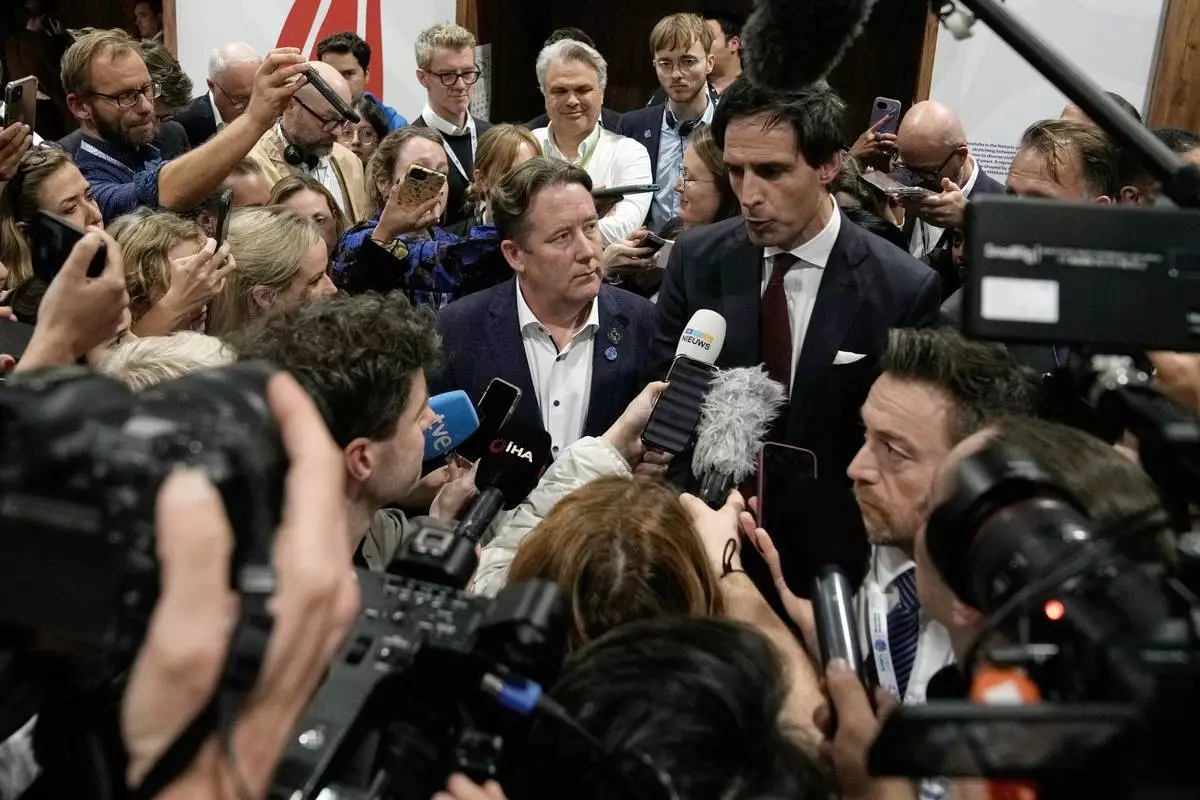
Darragh O'Brien, minister of climate, energy and the environment of Ireland, left, and Wopke Hoekstra, EU climate commissioner, speak outside a plenary session at the COP31 U.N. Climate Summit, Sunday, Nov. 22, 2026, in Antalya, Turkey. (AP Photo/Khalil Hamra)
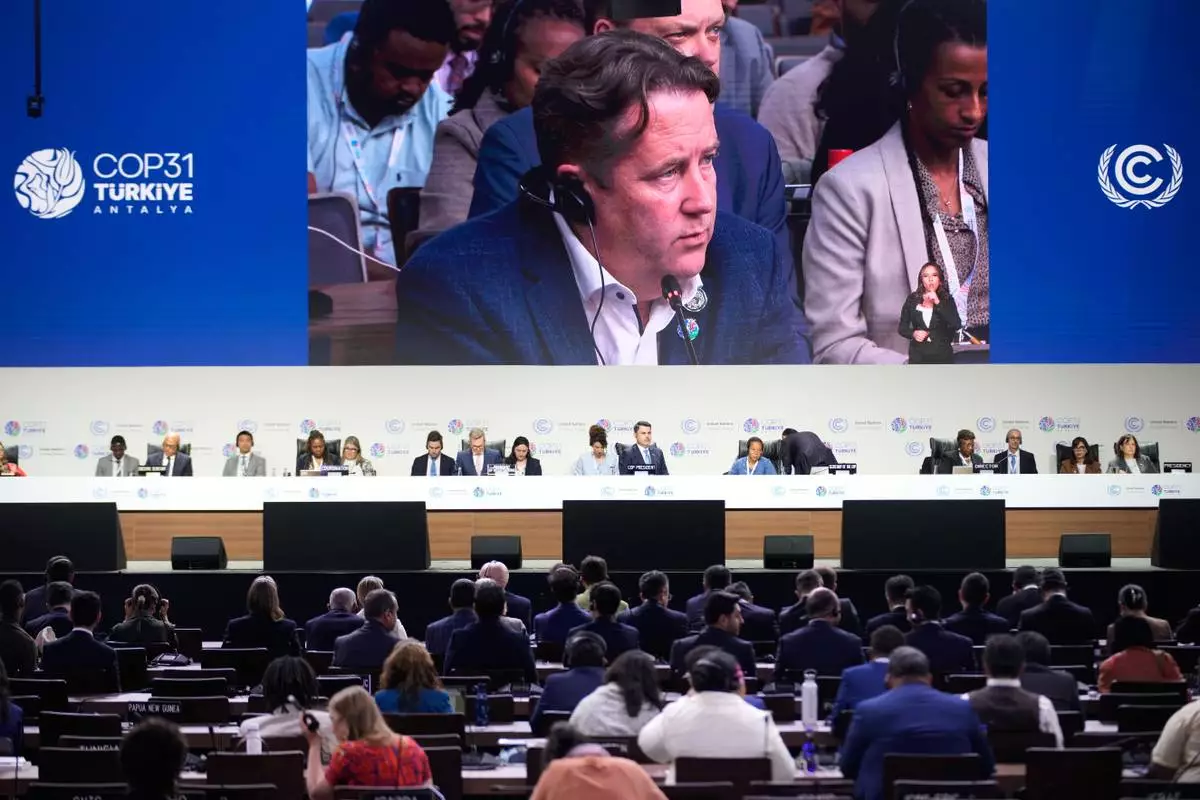
Darragh O'Brien, minister of climate, energy and the environment of Ireland, onscreen, speaks during a closing plenary session as COP31 President Murat Kurum, sits center, at the COP31 U.N. Climate Summit, Sunday, Nov. 22, 2026, in Antalya, Turkey. (AP Photo/Khalil Hamra)

COP31 President Murat Kurum, center, leaves a closing plenary session at the COP31 U.N. Climate Summit, Sunday, Nov. 22, 2026, in Antalya, Turkey. (AP Photo/Khalil Hamra)
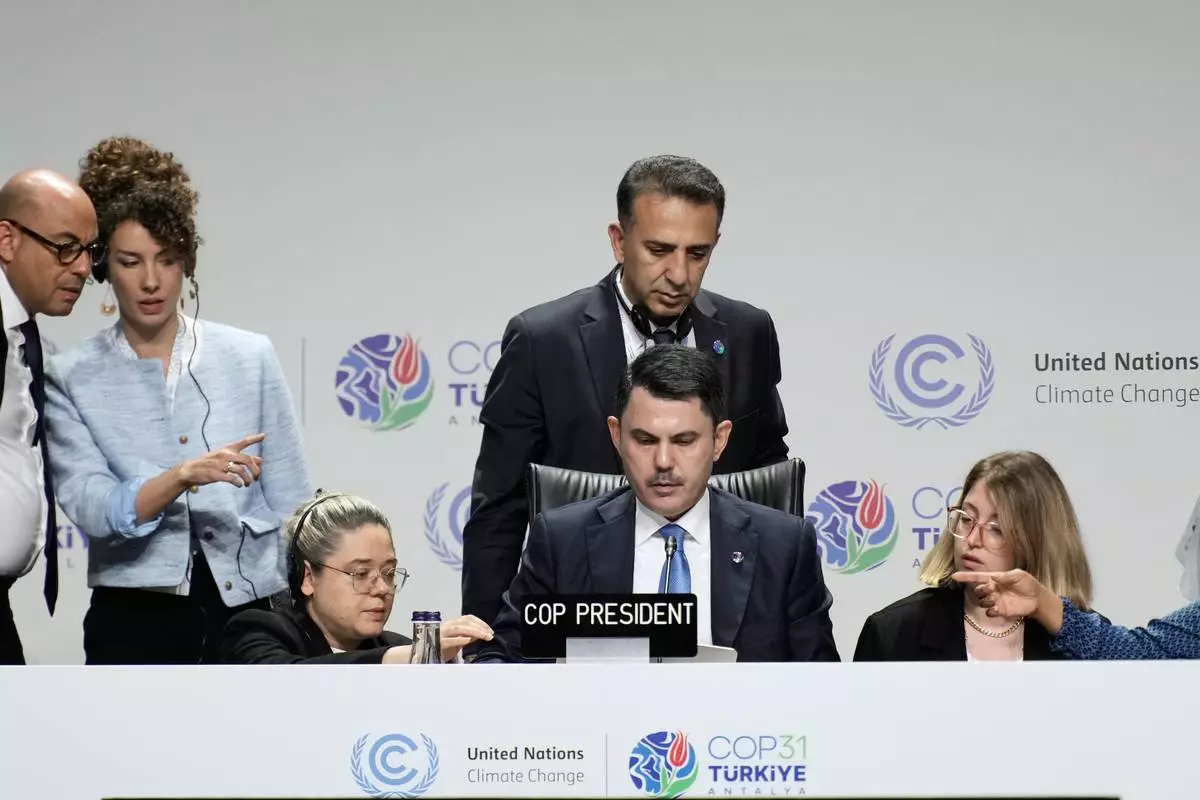
COP31 President Murat Kurum center, attends a closing plenary session at the COP31 U.N. Climate Summit, Sunday, Nov. 22, 2026, in Antalya, Turkey. (AP Photo/Khalil Hamra)
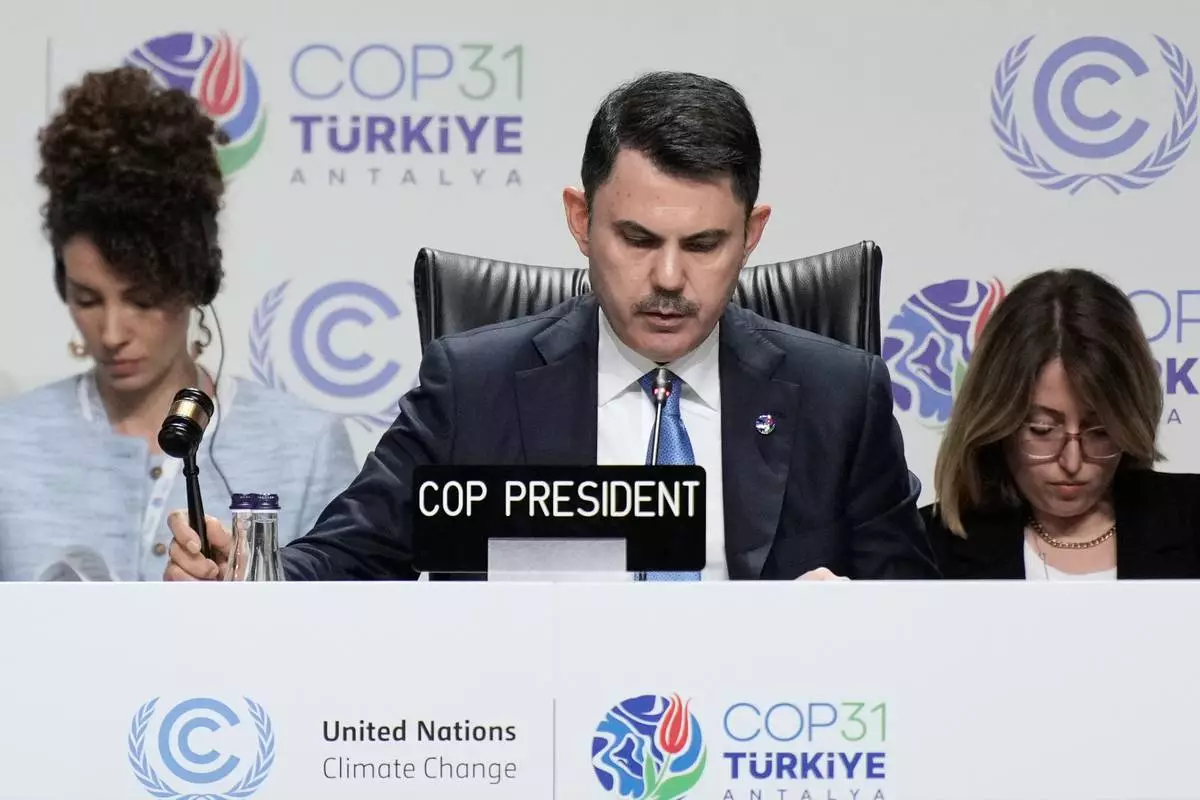
COP31 President Murat Kurum, center, bangs the gavel during a closing plenary session at the COP31 U.N. Climate Summit, Sunday, Nov. 22, 2026, in Antalya, Turkey. (AP Photo/Khalil Hamra)
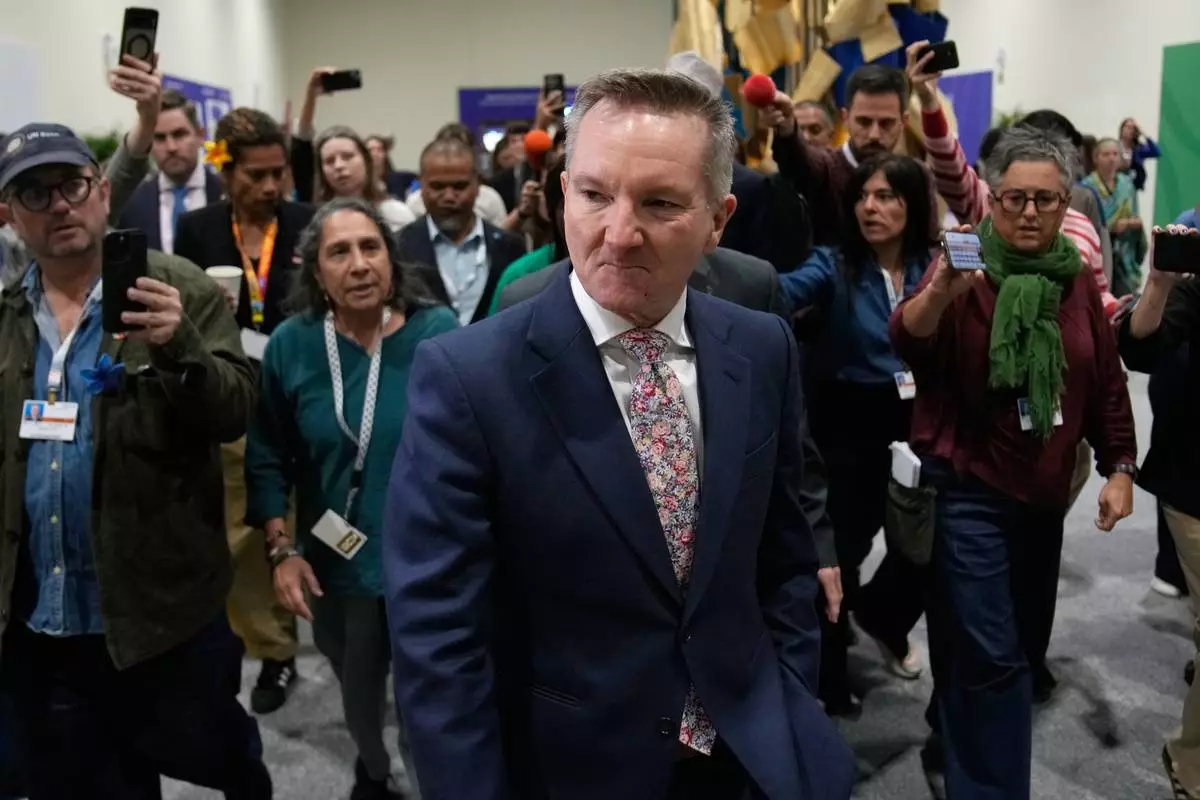
Chris Bowen, president of COP31 negotiations and minister for climate change and energy of Australia, walks through the venue for the COP31 U.N. Climate Summit, Sunday, Nov. 22, 2026, in Antalya, Turkey. (AP Photo/Khalil Hamra)

Wopke Hoekstra, EU climate commissioner, left, speaks with Darragh O'Brien, minister of climate, energy and the environment of Ireland, during a closing plenary session at the COP31 U.N. Climate Summit, Sunday, Nov. 22, 2026, in Antalya, Turkey. (AP Photo/Khalil Hamra)

Carsten Schneider, Germany's minister of the environment, speaks to members of the media at the COP31 U.N. Climate Summit, Sunday, Nov. 22, 2026, in Antalya, Turkey. (AP Photo/Khalil Hamra)
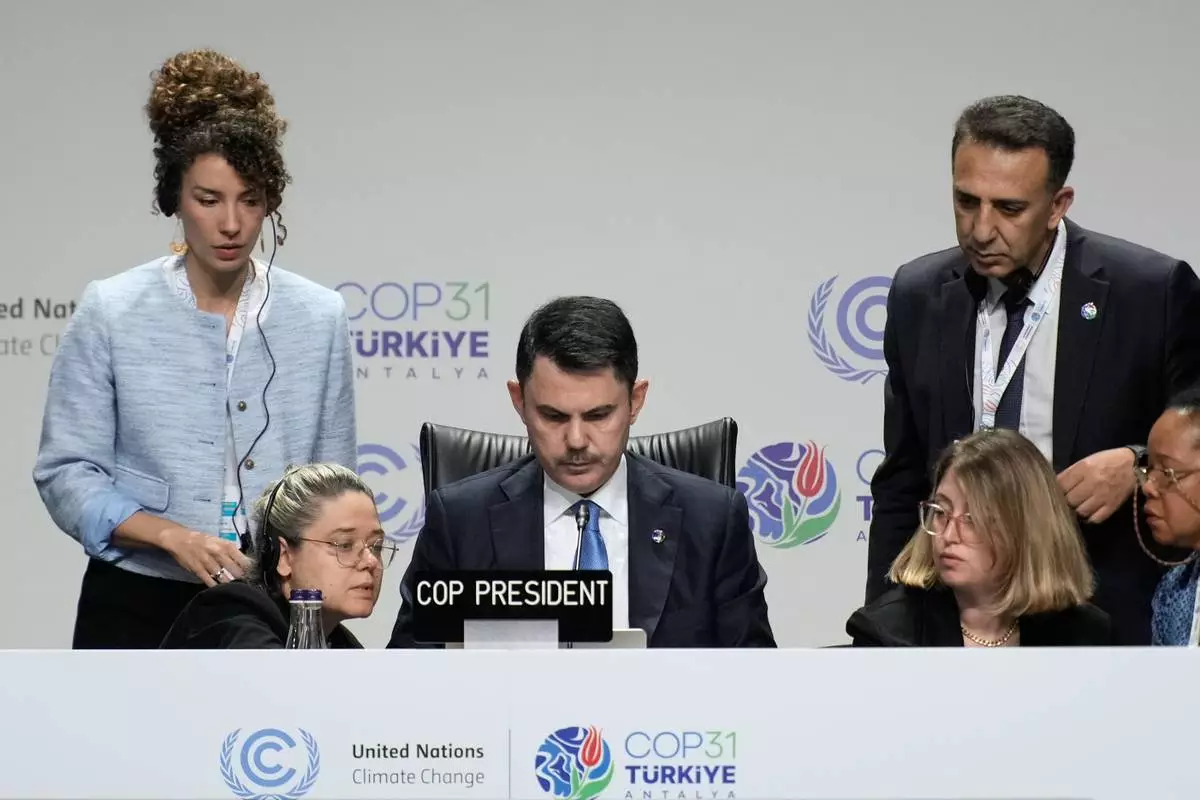
COP31 President Murat Kurum, sits at center, during a closing plenary session at the COP31 U.N. Climate Summit, Sunday, Nov. 22, 2026, in Antalya, Turkey. (AP Photo/Khalil Hamra)
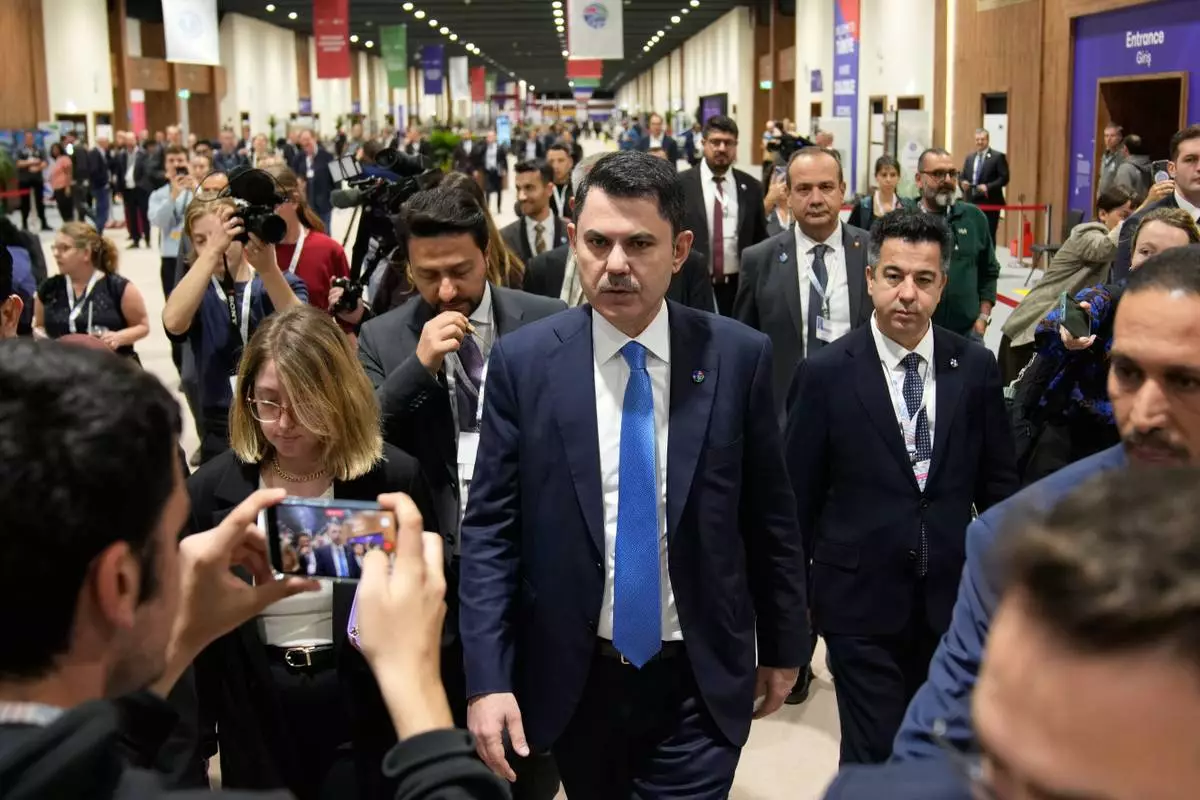
COP31 President Murat Kurum walks through the venue for the COP31 U.N. Climate Summit, Sunday, Nov. 22, 2026, in Antalya, Turkey. (AP Photo/Khalil Hamra)
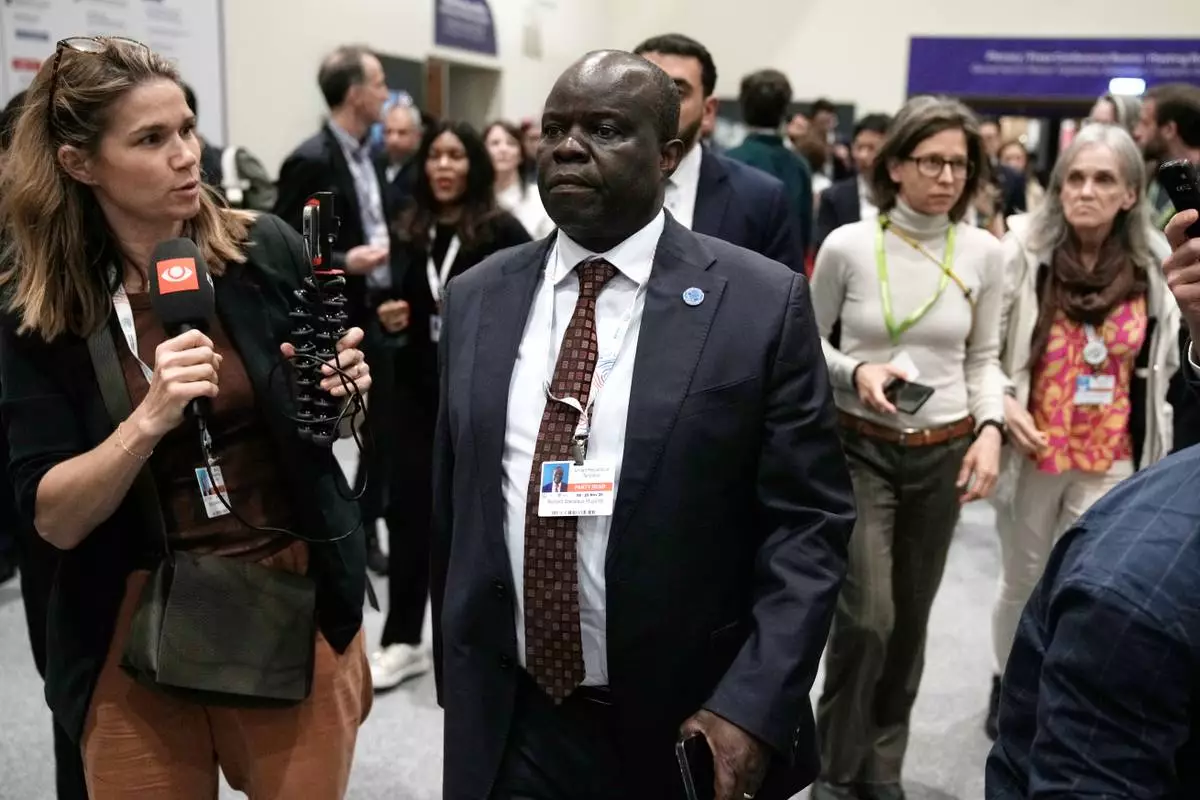
Richard Muyungi, Tanzania climate envoy, center, walks through the venue for the COP31 U.N. Climate Summit, Saturday, Nov. 21, 2026, in Antalya, Turkey. (AP Photo/Khalil Hamra)
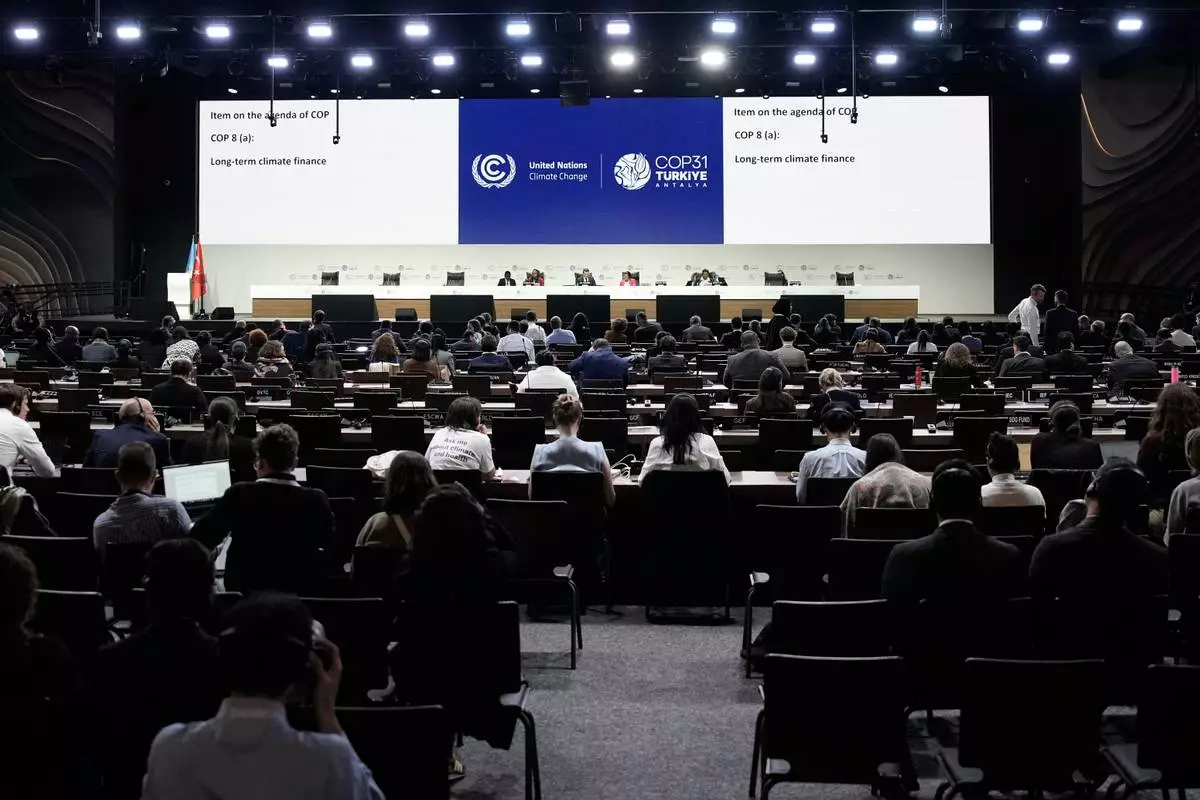
A closing plenary session takes place at the COP31 U.N. Climate Summit, Sunday, Nov. 22, 2026, in Antalya, Turkey. (AP Photo/Khalil Hamra)

People gather around COP31 President Murat Kurum at a closing plenary during the COP31 U.N. Climate Summit, Sunday, Nov. 22, 2026, in Antalya, Turkey. (AP Photo/Khalil Hamra)