China's manned deep-sea submersible, Jiaolong, has recently carried out a challenging dive to explore a seamount, providing key support for research on deep-sea habitats.
The 476th dive of the submersible was aimed at the seamount on the Ontong Java Plateau in the southwestern Pacific Ocean.
The maximum depth of the dive was about 5,000 meters beneath the sea surface, and the descent took about two and a half hours. The submersible descended to the sea floor before traveling up along the slope of the seamount.
"The place we're heading to today is on the flank of a seamount. And what we're going to do today is actually climbing a seamount. The difference is that we are climbing it in a submersible," said Fu Wentao, a Jiaolong pilot. "The survey will begin at a depth of about 5,000 meters, and the submersible will then head for the summit of the seamount. Jiaolong climbs nearly 800 meters, which is a considerable challenge," said Xu Weikun, assistant to chief scientist for the second leg of China's 100th ocean expedition.
This dive has conducted a detailed survey of seamount habitats employing high-definition camera system. The records will provide data support for subsequent digital research on typical habitats in this area.
Since its initial sea trial in 2009, Jiaolong has completed nearly 500 dives. The high-definition seabed footage and deep-sea samples it retrieved have provided crucial first-hand data for China's oceanographic research, continually expanding humanity's understanding of the deep ocean.

China's Jiaolong submersible explores Pacific seamount, supporting deep-sea habitat research
A national Brain-Computer Interface (BCI) competition took place in Beijing from Thursday to Sunday, bringing together teams from universities, research institutions, and enterprises across China to showcase advances in brain signal decoding and human-machine interaction.
Running concurrently with the 2026 Brain-Computer Interface Conference, the competition was hosted by China Academy of Information and Communications Technology, featuring eight competition events into three categories of control systems, algorithm development, and innovative roadshow.
Among the most followed areas, the brain-controlled robotic hand final saw eight teams compete with electroencephalogram (EEG) acquisition headsets.
By decoding participants' motor imagery signals, BCI systems in competition can direct robotic hands to carry out precise finger movements. Steady mental focus and accurate EEG signal recognition were critical to ensuring the robotic hands completed tasks smoothly.
Zhou Fangyujia, a student from the University of Science and Technology of China's School of Information Science and Technology, detailed her team's breakthrough in EEG signal classification.
"Our subject imagines six distinct movements: five separate finger motions plus a thumb-index pinch. This is a core innovation, as most industry solutions currently only support binary, ternary or four-movements classification. We have reached six," she said.
In the brain-controlled car event, competitors navigate a vehicle through obstacle courses and designated paths with EEG signals, reaching four task points in sequence by translating mental intent directly into physical motion.
One participant said as BCI technology matures, brain-controlled systems are projected to expand into industrial operations, accessibility support, and other practical fields.
"Today we are controlling a small car with brain signals, but this framework can be adapted for drones, unmanned vehicles, or to help people with paralysis operate wheelchairs," said Wang Junyang, a member of Tianjin University's BCI team.
The emotion perception event focused on decoding brain states. Leveraging real-time EEG analysis, participating teams track subjects' emotional fluctuations and convert intangible emotional and cognitive states into measurable data, a practical technology which can facilitate mental health screening and attention level assessment.
Judges noted that the event's broad coverage of medical, industrial and consumer health applications reflects the growing commercial and practical viability of BCI technology.
"The competition is designed around application scenarios where BCI products and applications can be rolled out quickly, and we have seen many innovative concepts with strong practical potential," said competition judge Wang Yijun, also a researcher with the Chinese Academy of Sciences' Institute of Semiconductors.
"Beyond showcasing technological progress, the competition helps researchers identify priorities for further advancement. From improving the convenience and reliability of interaction, to developing next-generation hardware such as user-friendly ear electrodes and optimizing algorithms to boost the signal-to-noise ratio of captured data, all these areas need further improvement," said fellow judge Xu Guanghua, a professor at Xi'an Jiaotong University.
Listed as a key future industry in China's 15th Five-Year Plan (2026-2030), BCI technology was written into the annual Government Work Report for the first time in 2026.
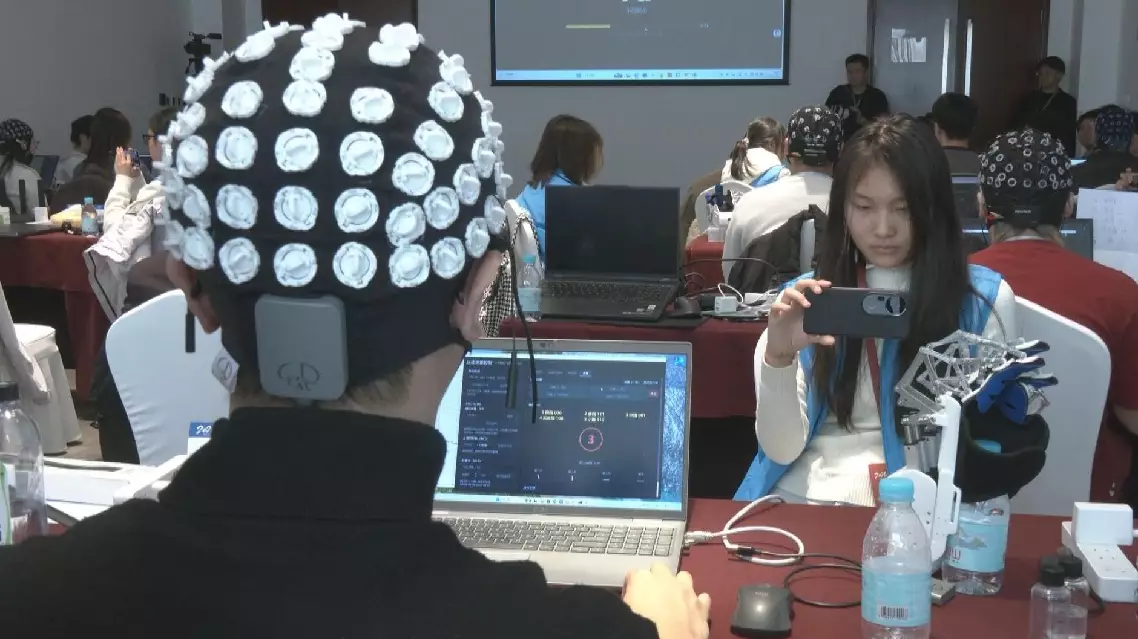
Brain-Computer Interface Competition in Beijing showcases application potential