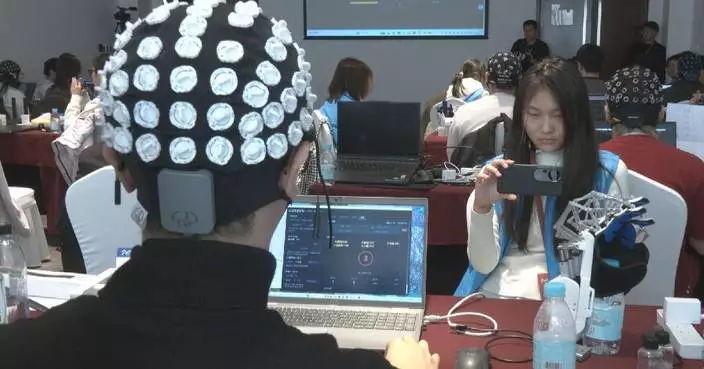
The 2026 Brain-Computer Interface Conference, hosted by the China Academy of Information and Communications Technology (CAICT), was held in Beijing from Thursday to Sunday, showcasing various application scenarios for brain-computer interface (BCI) technology.
BCI technology establishes a direct communication route between the brains of humans or animals and external devices. By capturing and decoding neural signals, BCI enables seamless interaction between brain and machine, ultimately allowing control over assistive devices to execute intended actions.
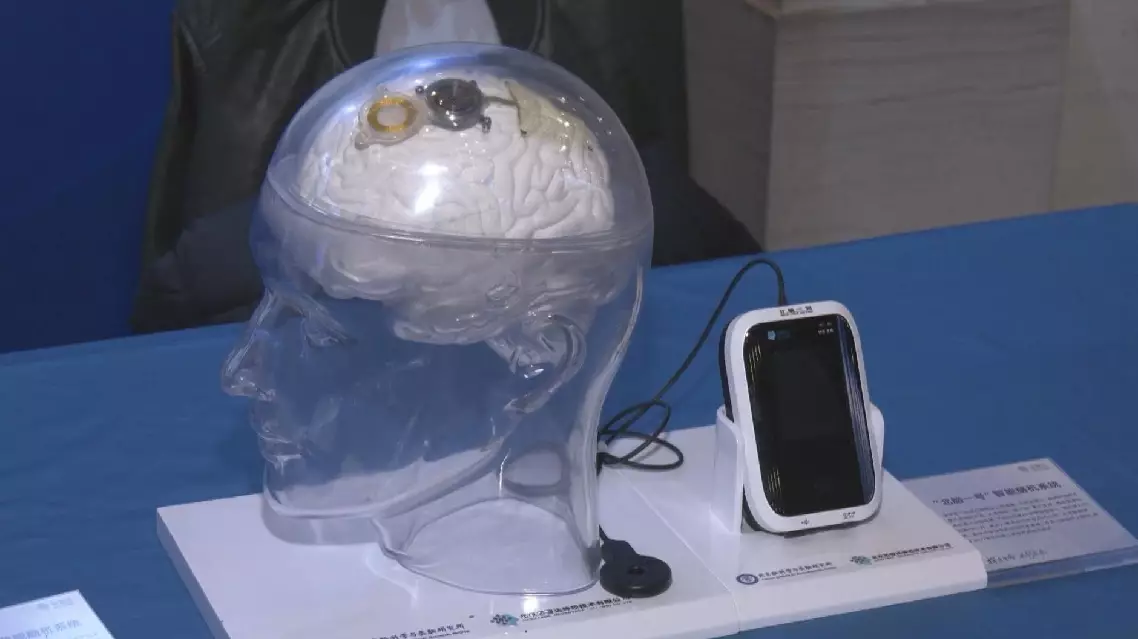
An invasive BCI system drew significant attention at the achievement exhibition area at the conference. Implanted on the surface of the cerebral cortex, the system decodes precise motor commands generated by the brain, helping patients -- such as those with spinal cord injuries or those who have suffered a stroke -- to restore motor function and undergo limb rehabilitation training.
"Our flexible intracranial cortical electrodes are less than six microns thick -- about one-fifteenth the thickness of a human hair. They must be highly flexible to achieve conformal contact with the brain, which allows for the acquisition of more precise neural signals. To date, we have completed a total of 44 human implantations," said Hua Yi, business development manager of NeuCyber Neurotech, developer of the product. Beyond medical settings, BCI products are also making their way into industrial environments. A smart hard hat brought by NeuroHua, anther Beijing-based neurotechnology company, features an embedded EEG (electroencephalography) acquisition module that monitors workers' fatigue levels and attention in real time.
"We have already deployed thousands of units across various application scenarios -- such as infrastructure, mining, power, and metallurgy -- and we expect the scale to reach tens of thousands of units by 2027," said Tang Zaixi, founder of the company.
To make BCI products better suited for everyday use, methods for collecting EEG data are constantly being refined; some companies have even shifted the data-collection point from the head to the wrist.
"This wristband captures the signals sent from the brain to the hand at the wrist. Using a large-scale model of neural intent, it decodes these signals into specific micro-gestures, which can then serve as an interface for human-machine interaction," said Wang Yi, founder of Agiphant, an AI-native intelligent hardware company based in Shanghai.
Key components have also seen breakthroughs. A non-invasive, integrated BCI system newly unveiled at the event weighs only three grams and has a volume of two cubic centimeters. By highly integrating signal acquisition, signal transmission, and power supply units, it lays a hardware foundation for the miniaturization and wearability of BCI devices.
"This is an extremely compact, integrated EEG data acquisition device. It is designed to be more accessible and better suited for everyday use. Its small form factor and low power consumption enable a wider range of applications -- such as monitoring EEG during sleep, while at work, during physical exercise, or in educational settings," said Han Lingling, a staff member of Shengong Diting, a Tianjin-based tech company.
Brain-Computer Interface Conference in Beijing highlights application scenarios