NEW YORK (AP) — Ellen Nimmons, a longtime international editor at The Associated Press known for a steadfast commitment to high standards and disarming dedication to her colleagues’ development and well-being, has died.
Nimmons died Monday after a brief illness, her daughter Bridget Fitzgerald said. She was 78.
Nimmons, who retired four years ago, began working for AP in 1977 as a reporter, first in Minneapolis and then in Boston. She went on to work as a New York-based editor for national and international news, lending her expert touch to coverage of big global stories including the deaths of popes, kings and queens; a massacre in Bosnia; the aftermath of 9/11; and the falls of Saddam Hussein and Moammar Gadhafi.
Nimmons spent more than 15 years overseeing the daily report on the International Desk, then served from 2017 until her retirement in 2022 as a global news manager on the Nerve Center, a hub for news coordination, client engagement and audience development.
By the time she retired, she had earned the respect and affection of countless international journalists whose training she oversaw.
“As a young journalist, I lived in a mixture of awe and fear of Ellen. She had such high standards. But once you learned to adopt those standards for yourself, she’d welcome you to the team and let her guard down,” said Ravi Nessman, AP's global director of text, who spent years as a foreign correspondent being edited by Nimmons. “It was an honor we didn’t take lightly.”
She was remembered Tuesday as a demanding editor who earned her colleagues’ respect and gave it in return, along with an endless supply of her personal brand of warmth.
“She was intimidatingly unflappable, incredibly smart and always had everything under complete control,” said Paul Haven, AP's vice president of news gathering, who worked under Nimmons in the 1990s.
While tough on foreign correspondents' copy, Nimmons cared deeply about their welfare. She kept up with their personal lives, reveling in their adventures and watching over them from afar.
“Ellen was a giant heart wrapped in a no-nonsense exterior,” said Ted Anthony, AP's director of new storytelling and newsroom innovation and a former international correspondent in Asia. “When I was going through some of the toughest periods of my professional life in Islamabad, Kabul and Baghdad after 9/11, she was my lifeline. She checked in on me and ordered me: ‘If you’re not OK, you’re going to call me no matter what. Got it?'”
“She taught me so much about editing but a lot more about life.”
Born in Vermont, Nimmons grew up in Greenfield, Massachusetts, and earned a bachelor's degree in journalism and political science from Syracuse University.
Before joining AP, she was city editor for the Concord Monitor in New Hampshire.
Robert H. Reid, a former AP correspondent who led coverage of the wars in Iraq and Afghanistan and covered major stories from the fall of the Shah of Iran to the Balkan conflicts, remembered Nimmons' deft coordination of fast-breaking news events from afar.
“Her sound news judgment, calm demeanor and detailed knowledge of international affairs were invaluable in helping guide coverage of the most challenging stories,” Reid said.
“She would not shy away from telling field reporters that they were missing the point or editors that their expectations were misguided,” Reid said. “Her contribution to AP’s international coverage cannot be overstated.”
Many who worked with Nimmons remembered and cherished her presence — someone whose praise and pointed remarks could be heard without amplification across the newsroom, providing a running commentary on the news and her colleagues covering it. For the casual observer, it was a patter; for those who knew her, it was a continuous burst of journalistic energy that reflected how seriously she took her job.
“She was smart, funny and outrageous while at the same time caring deeply for AP’s journalism and all of us as human beings,” said Amanda Barrett, AP's vice president for standards and inclusion.
Nimmons believed strongly in feminist causes and with a group of friends she helped fund the first free abortion clinic in New Hampshire in the 1970s, Fitzgerald, her daughter, said. “Her radical activist political days had to be bookended around professional AP neutral journalism,” she said.
It was hard to find a topic that Nimmons felt neutral about. Colleagues spoke of her wide-ranging passions — for travel, culture, journalism and, above all, her family.
Nimmons was married to Jim Fitzgerald, a longtime writer and editor in AP's New York City bureau. He died in 2017. Nimmons is also survived by a second daughter, Caitlin Fitzgerald, and her daughters' families.
In her final AP email to dozens of colleagues in 2022, Nimmons ended with a signature finish.
“I will miss most of you.”
This story has been updated to correct the amount of time Nimmons spent overseeing the daily report on the International Desk. It was more than 15 years, not 5 years.

In this undated photo, Ellen Nimmons poses for a portrait. (AP Photo)
MIDDLETOWN, Iowa (AP) — Iowa residents who could be in the path of a dangerous plume from the planned detonation of bomb-making chemicals on Wednesday morning sealed their windows and doors and prepared to stay home from work.
Boxes of painters tape and masks were scattered outside government buildings for those wanting to protect their homes and themselves. Shops and businesses planned to close after the U.S. Army announced the detonation would occur the day before Thanksgiving.
Others, though, seemed to shrug off concerns as government officials warned those closest to be ready to evacuate to avoid lead dust in the air, while also assuring residents that barriers around the blast zone should limit much of the plume.
“It concerns me,” said 62-year-old Chris Fullenkamp who has lived his whole life near the plant, “but not overly.”
“There’s a lot on edge, but I think they’re just jumping to conclusions or they want to get worked up about something,” added Fullenkamp, whose house in West Point is 15 miles (24 kilometers) from the detonation site but still in the plume's likely path.
After days of delays, the Army plans to detonate the nation’s entire stockpile of lead azide around 9 a.m. local time Wednesday, saying that waiting longer could cause the dangerously degrading chemicals to explode on their own at any time.
“Inaction is no longer an option,” said Maj. Gen. Eric Shirley, the Army’s leader of the operation.
The controlled detonation of roughly five tons of the degraded lead azide inside 68 barrels at the Iowa Army Ammunition Plant in Middletown has set off concerns about potential health and environmental effects, and frustration over lack of information.
“We don’t believe that the public should be in a panic,” said Acting Secretary of the Army Adam Telle. “Our goal is to keep as much of it as we can here on our Iowa Army Ammunition plant to prevent it from traveling.”
Officials overseeing the detonation say the wind on Wednesday is expected to blow southwest and away from nearby Burlington, a city of just under 25,000 people that sits along the Mississippi River.
The Army released new maps Tuesday showing the likely trajectory of the plume traveling southwest toward Missouri.
The U.S. Department of Agriculture projected that 350 farms could be impacted based on the expected path of the plume and said it would make sure that no heavy metals or lead enter the food chain. Farmers were encouraged to move their animals indoors and protect hay bales and water tanks.
An “imminent threat alert” sent to cellphones Tuesday morning said that some people within 5 miles (8 kilometers) southwest of the ammunition plant may be evacuated. Others farther out were told to remain indoors with their windows closed.
Randy Welding, the city administrator in West Point, said many businesses were closing Wednesday. He plans on being the only person in City Hall to monitor developments.
“We just don’t want people out,” he said. “Other than that, we’re just going to wait and see what happens.”
He said most people aren’t too worried, “but we’ve never been through it before.”
Still, the detonation and warnings of possible lead pollution were testing the resolve of rural Iowans who often pride themselves on their independence and stoicism.
Brett Moravec, a truck driver who lives about a half-mile from the plant, said the timing could have been better given it’s happening the day before Thanksgiving. But he said the stockpile needs to be dealt with now.
“Delaying is just going to endanger more people,” he said. “The government knows what it’s doing. I know a lot of people don’t think so.”
The Army rescheduled the detonation to Wednesday because of more favorable wind conditions and to allow more time for extra safety measures.
Experts have advised that the stockpile will become more volatile as temperatures cool in the coming days.
The detonation was initially planned for last Friday. The Army said they need to blow up the stockpile to prevent a possible chain-reaction explosion, which would be more dangerous.
The Army has set up additional “blast barriers” around the bunkers where the stockpile will be detonated, and will use ballistic gels and foams to absorb the lead dust.
It also plans to douse the materials with thousands of gallons of water.
“We’ve taken every viable solution and considered it,” Telle said. “In every instance, the answer is controlled detonation is safest.”
The Army got final approval to carry out the detonation in a ruling late Monday that said the U.S. Environmental Protection Agency adequately incorporated safeguards to minimize the dispersal of dust.
Environmental groups had sued to stop the detonation.
The judges said the Army evaluated “a full range” of alternatives, including using other chemicals to neutralize the lead azide and thermal treatment but determined detonation was safest.
The Army changed the detonation date three times following an outpouring of public concern.
Officials said the greatest risk of lead exposure was to children and pregnant women.
A team from the University of Iowa was deploying air monitors, collecting soil samples and positioning to measure the extent of any contamination, said David Cwiertny, director of the Center for Health Effects of Environmental Contamination .
“The things we are hearing a lot about are playground equipment, furniture, high touch areas,” he said.
Iowa Republican Gov. Kim Reynolds said Tuesday that after speaking with military leaders she supports the planned detonation.
But U.S. Sen. Joni Ernst, a Republican, said Iowans “are right to be frustrated” that more information, such as the risk of lead contamination from the blast, wasn’t shared earlier.
The Army told her the detonation will last “only seconds” and the dust will dissipate within an hour. Air, soil, surface water and lead residue were sampled before the detonation and will continue after to measure changes and guide cleanup, she said.
Telle, the acting Army secretary, said he understands that some were concerned and frustrated. The Army is reviewing all of its weapons storage facilities to ensure something like this never happens again, he said.
What matters now, he added, is “getting this operation right.”
Montoya Bryan reported from Albuquerque, New Mexico. Associated Press writers Scott Bauer in Madison, Wisconsin; Dave Collins in Hartford, Connecticut; Michael Phillis in Washington, D.C.; and John Seewer in Toledo, Ohio, contributed.
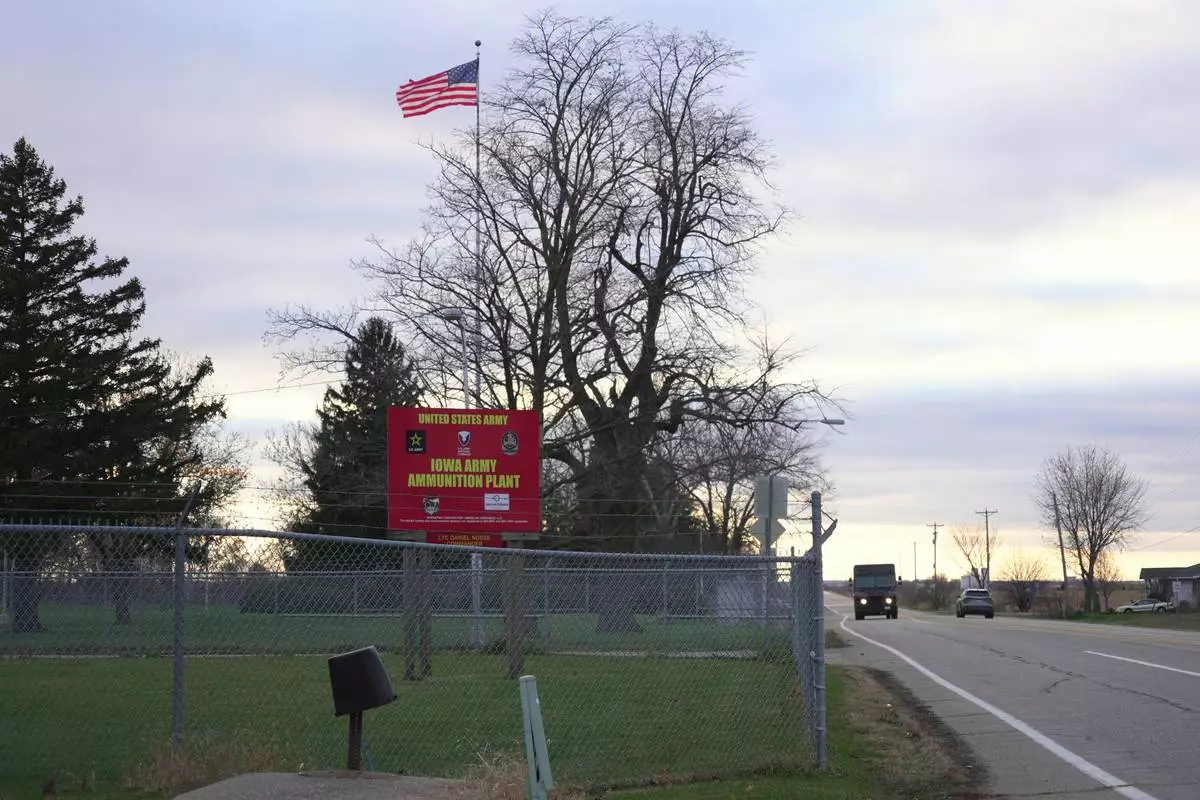
A sign is displayed for the United States Army's Iowa Army Ammunition Plant in Middletown, Iowa, Monday, Nov. 23, 2026. (AP Photo/Laura Bargfeld)
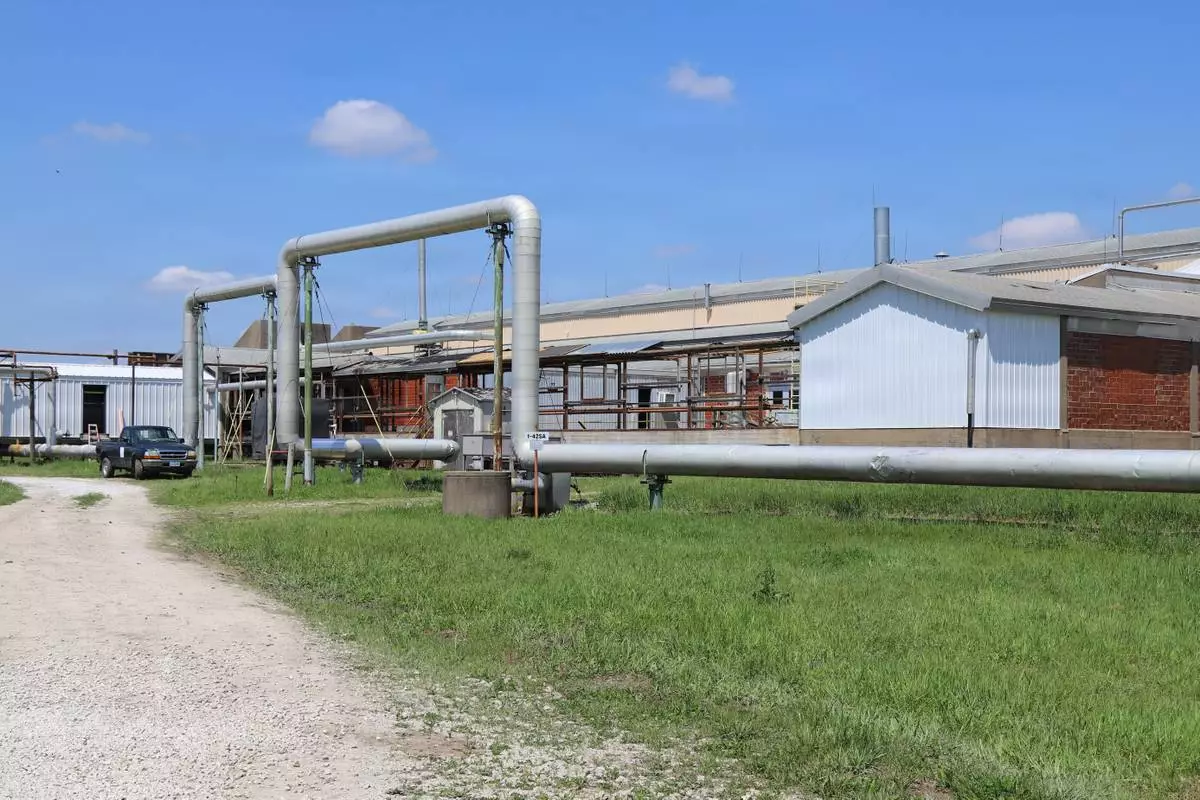
This photo provided by the U.S. Army shows the Iowa Army Ammunition Plant in Middletown, Iowa, on May 14, 2024. (Shawn Eldridge/U.S. Army via AP)