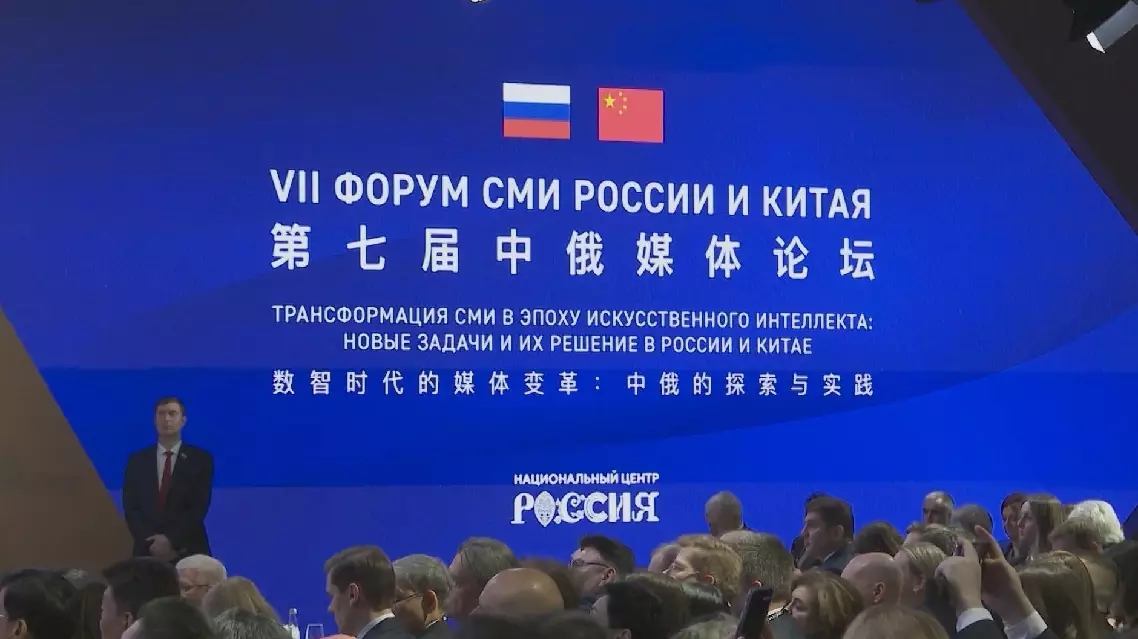
Media leaders from China and Russia met in Moscow this week for the 7th China-Russia Media Forum, where discussions centered on AI-driven disinformation, audience trust and the responsible use of artificial intelligence in news production.
The two-day forum, held on Nov. 24-25, examined how artificial intelligence (AI) is reshaping newsrooms and content production, with participants warning of a surge in fabricated material alongside new tools for reporting.
"A year ago, when I presented similar statistics, they showed that 132,000 fabricated, non-existent quotes — attributed to non-existent authors — had been identified. This year, that figure has climbed to nearly one million. This is an alarming phenomenon that we must, quite simply, combat together," said Andrey Kondrashov, director general of Russian news agency TASS.
Forum participants were generally optimistic about how AI is affecting the media industry.
"We still believe that AI cannot replace human creativity, as it is the existential human experience that sets us apart from AI. Therefore, it currently appears that AI serves more as an aid to the media," said Svetlana Balanova, CEO of Russia‘s National Media Group.
The digital transformation has brought numerous new challenges — foremost among them, the training of national neural network models. According to forum participants, media organizations from both countries have already contributed vast datasets of verified information to train AI systems, and there is a clear need to improve the relevant legal frameworks.
"What is permitted, what is prohibited, what is strictly forbidden under any circumstances, what must be verified, and how to ensure that content consumers are not misled — a serious effort is under way in this regard. In my view, China has made more progress here," said Pavel Negoitsa, director general of the Russian state newspaper Rossiyskaya Gazeta.
The business segment of the forum featured three thematic sessions. In addition to the transformation driven by neural networks, participants discussed media cooperation aimed at fostering strategic engagement between the two countries.
China Media Group (CMG) exemplifies this collaborative approach. As a co-organizer of the forum, CMG has maintained long-standing partnerships with major Russian media outlets, jointly producing content and sharing technical expertise, particularly in the application of AI in news production.
Nearly 250 people from relevant departments and heads of media organizations from the two countries attended the event. During the forum, 14 cooperation documents were signed to deepen media cooperation between China and Russia.
Media leaders at China-Russia forum weigh AI risks, press trust