The 4th Belt and Road Energy Ministerial Conference opened in Qingdao, east China's Shandong Province, on Thursday, with a call for greater cooperation in accelerating the green energy transition.
Themed "sharing innovation outcomes, advancing energy transition, building a secure future together," the two-day conference brought together ministers, other senior government officials, and representatives of international organizations, energy companies and research institutions.
During the conference, the Governing Board of Belt and Road Energy Partnership was officially established, and a joint ministerial statement on enhancing energy cooperation among Belt and Road Initiative (BRI) partners was released.
The statement calls on BRI countries to strengthen the alignment of cross-border power grid planning and the development of infrastructure, deepen cooperation in areas such as technical standards, electricity trade, operational coordination, and market opening up, and facilitate the optimized allocation of clean energy across broader areas.
The statement also encourages financial institutions and multilateral development agencies to increase financing support for energy projects in BRI countries.
"We are willing to work with all other parties on the basis of equality, mutual benefit, and consensus to strengthen the coordination of cross-border power planning, steadily advance cross-border power transmission and the interconnection of regional power grids, and facilitate mutual power support and the sharing of reserve capacity while respecting each nation's authority to manage its own power system. We aim to jointly promote connectivity that better serves energy security, the green transition, and the improvement of people's livelihoods," said Wang Hongzhi, administrator of the National Energy Administration of China.
The statement also addresses electricity access gaps in some BRI countries, setting a goal of reducing the number of people without basic electricity services by more than 50 percent by 2035 compared with the 2025 levels.
"We estimate that by 2035, renewable energy sources will account for nearly 80 percent of the total installed power capacity in developing countries. This indicates that as the energy demand in these nations will continue to grow, the share of renewables in newly installed power capacity will keep rising, further shifting the energy supply mix toward a cleaner and lower-carbon structure," said Zhou Yi, director of China Electric Power Planning and Engineering Institute.
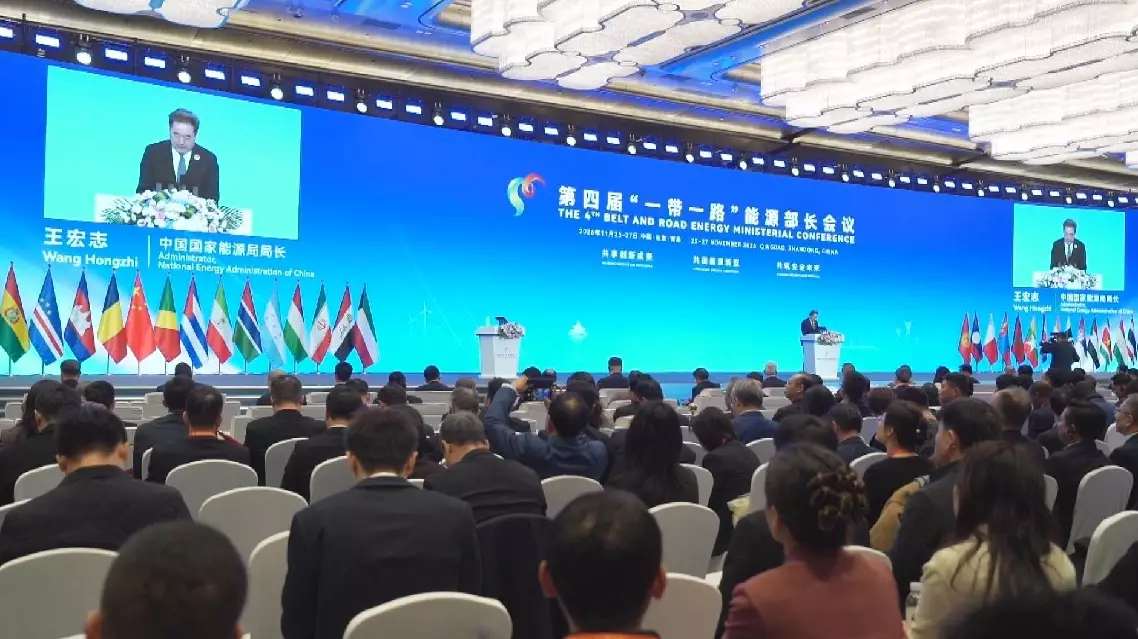
Belt-Road energy ministerial meeting held in east China city to promote energy transition