At the 28th China Hi-Tech Fair in Shenzhen, south China's Guangdong Province, the focus in the robot zone is shifting from which robots put on the best show to which ones can actually get the job done.
The three-day event opened on Thursday, drawing around 5,000 companies and institutions from more than 120 countries and regions. More than 500 companies from the global robotics supply chain are showcasing their latest products at the fair.
However, robot dancing is no longer the main attraction; for buyers at the ongoing event, the real question is whether these AI-powered machines are ready for commercial readiness and real-world deployment.
"We're in the process of setting up an import channel to Australia for different industries, looking at which industries robots would fit in," said Australian purchaser Brian Horakh.
"Definitely industrial use, this is where we start logistics and production," said Danish purchaser Ole Poulsen.
"I'm very interested in the home robots, of course. I'm very interested to understand what the robot does," said Italian purchaser Francesco Cinotti.
But putting robots to work can mean two very different things: deploying them on factory floors or bringing them into people's homes.
DEEP Robotics, a Chinese high-tech company specializing in the research and development, manufacturing, and commercialization of quadruped robots, humanoid robots, and core robotic components, is already making strides in industrial applications, but the company says that the industry is still in its early stages.
"Many tasks are still pre-programmed. To work truly autonomously requires many basic technological breakthroughs," said Li Yang, the company's branding director.
Beyond factory floors, robots are also entering complex commercial environments, with some already being deployed to refuel vehicles at gas stations.
"Every car model has a different gas cap. We have to train the robot to generalize across various scenarios," said Maggie Zhang, marketing director of Shenzhen Ruoyu Technology, a robot AI developer.
But the home remains the ultimate frontier. Some companies are developing foldable robots designed to take on household chores, with mass production expected to begin next year.
Wang Yunjie, co-founder and COO of KNOWIN, a Chinese embodied-AI startup building home robots, said the company took the top spot on RoboDojo, a unified sim-and-real benchmark for evaluating generalist robot manipulation policies, but still has further to go.
"We ranked first on the RoboDojo benchmark with a success rate of 82.3 percent. But for our robot to enter homes next year, we require a success rate of over 90 percent. To get there, we are focusing on three key areas: brain capabilities, engineering, and human-robot interaction," said Wang Yunjie, Co-founder and COO of KNOWIN.
Many are also attempting to lower the barrier by betting on a home robot priced under 1,400 U.S. dollars. However, they admit the whole industry is still waiting for a breakthrough.
"All robots are waiting for a 'DeepSeek moment.' They've evolved fast in the past six months. It won't be long before they do housework in our homes," said Ryan Yang, marketing director of Beijing Noetix Robotics Technology Group.
From factories to living rooms, the ultimate test is the same: it's about who can solve a real problem.
Going forward, it will be up to industrial capability and market forces to turn technological promise into practical solutions for production and daily life.
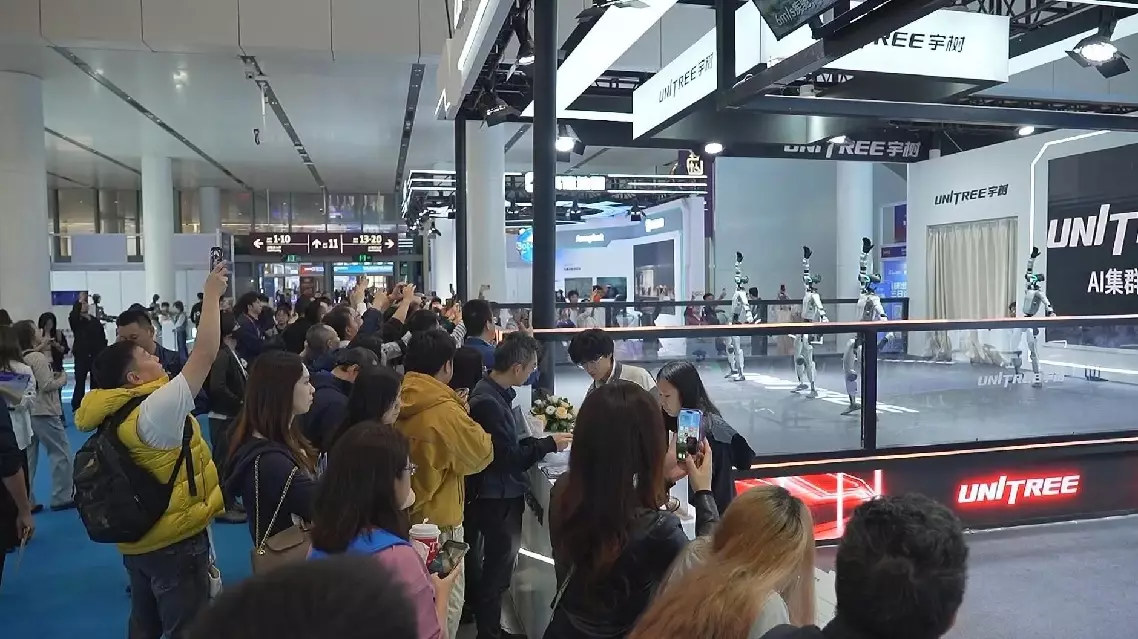
China Hi-Tech Fair attendees eye robots' readiness for real-world applications