The Shenzhou-23 crew handed over the key of China's space station to the Shenzhou-24 astronauts on Saturday and is set to return to Earth in the coming days.
Astronaut Zhu Yangzhu, who has already spent six months in orbit, will remain aboard the Tiangong space station for another six months to complete a year-long stay experiment, serving alongside mission commander Tang Hongbo and astronaut Wu Yi as part of the Shenzhou-24 crewed spaceflight mission.
Two Shenzhou-23 astronauts, Zhang Zhiyuan and Li Jiaying, together with the Shenzhou-24 mission's Pakistani astronaut Muhammad Zeeshan Ali, are scheduled to return to the Dongfeng landing site in north China aboard the Shenzhou-23 spacecraft.
Final preparations are underway across all participating systems and the landing site is ready to welcome the trio back.
The Shenzhou-24 crewed spaceship, atop a Long March-2F carrier rocket, blasted off from the Jiuquan Satellite Launch Center in northwest China on Wednesday, sending astronauts Tang Hongbo, Wu Yi and Ali to space.
This mission marks the first joint flight of Chinese and foreign astronauts in the history of China's manned space program, and the first visit by a foreign astronaut to China's space station.
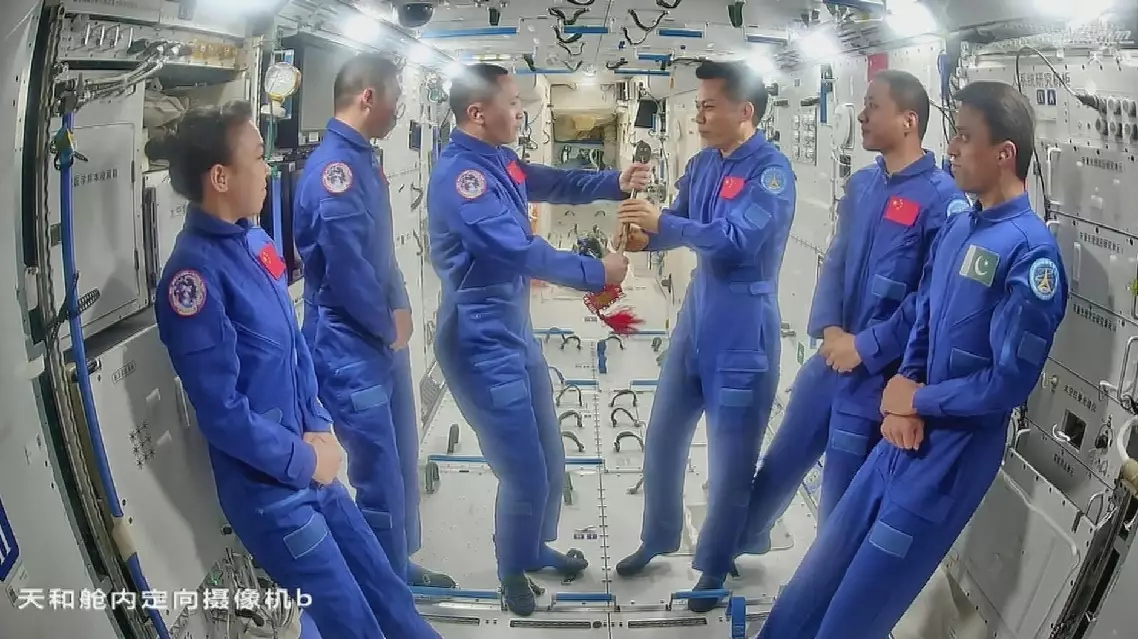
Shenzhou-23, Shenzhou-24 crews complete in-orbit handover
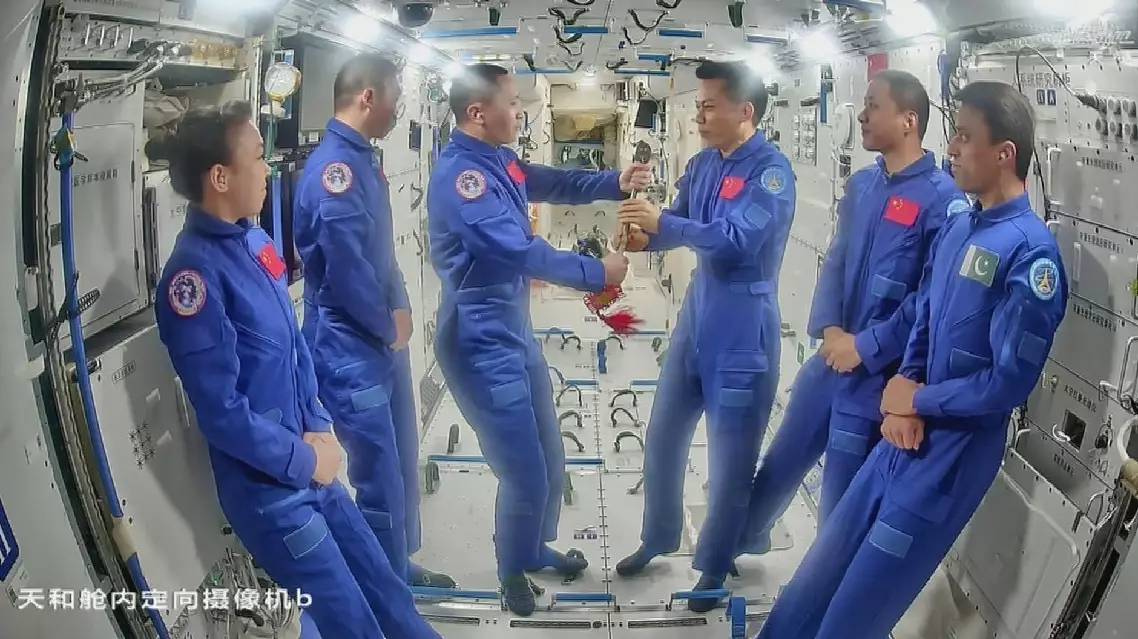
Shenzhou-23, Shenzhou-24 crews complete in-orbit handover
Workers began the first maintenance on the world's tallest power transmission towers on Saturday in east China's Jiangsu Province.
The towers belong to the 500kV Fengcheng-Meili Yangtze River Crossing Project, China's largest ultra-high voltage cross-river power transmission project and the maintenance is to safeguard stable power delivery through the upcoming winter demand peak.
The maintenance workers are to eliminate accumulated equipment defects caused by long-term exposure to harsh riverine conditions, ensuring clean power generated in northern Jiangsu can be reliably transmitted to power load centers in southern province and stabilizing regional grid performance.
Zheng Yimin, head of maintenance operations at Jiangsu Power Transmission and Transformation Co., Ltd., noted the project's demanding operating environment makes targeted upkeep critical.
"These ultra-high voltage towers operate permanently in a high-humidity, gust-prone environment over the Yangtze River. Over the time, hidden hazards like component corrosion and loosening will slowly pop up. And when winter comes, Jiangsu's power grid will enter its peak load season, incurring greater pressure on power supply. This maintenance work is an important step to secure cross-river power transmission across Jiangsu," Zheng said.
Before maintenance workers ascended the towers, engineering teams conducted a full pre-inspection with drones, with AI-powered analytics identifying equipment faults across the entire river crossing section to produce a targeted defect checklist. The document allows maintenance teams to carry out repair with greater precision and efficiency.
Even with high-tech support, the operation poses substantial challenges. Work began on the riverbank tower platform, which is 364 meters above the river surface. While wind speeds registered as mild at ground level, average wind speeds at the high-altitude platform reached around 8-10 meters per second, with gusts hitting 14-17 meters per second.
From the platform, workers descended along insulator strings connecting the tower cross-arm, which is roughly 380 meters above the water, to start the maintenance.They had to step carefully along the smooth insulator surfaces while carrying out full condition inspections.
A second core task requires technicians to traverse the river along 25-millimeter-diameter power conductors. The full crossing spans 2,550 meters with a vertical line drop of 260 meters, and the complete cable walk would take nearly four hours, posing a tremendous test of the workers' physical strength. The mid-river section is particularly challenging with strong cable swing. Workers must adjust their posture in line with the cable's swing and halt in case of gusts.
To support the linemen, workers used exoskeleton robots for the first time in power transmission maintenance. Equipped with AI that monitors workers' physical status and on-site conditions in real time, the devices provide stability assistance and weight support, significantly reducing strain on workers' legs during the long traverse.
During the operation, maintenance teams detected a safety defect on the line and requested approval for immediate on-site repair.
"Our workers just reported a loose clamp bolt on the No. 25 spacer damper of the tower-side conductors, and we dealt with it right away. The long cross-river span and persistent river winds subject the lines to constant wind load and vibration, which gradually loosens clamp bolts over time. That is the way our teams need to inspect every section along the line and shoot the trouble as soon as it is spotted," Zheng explained.
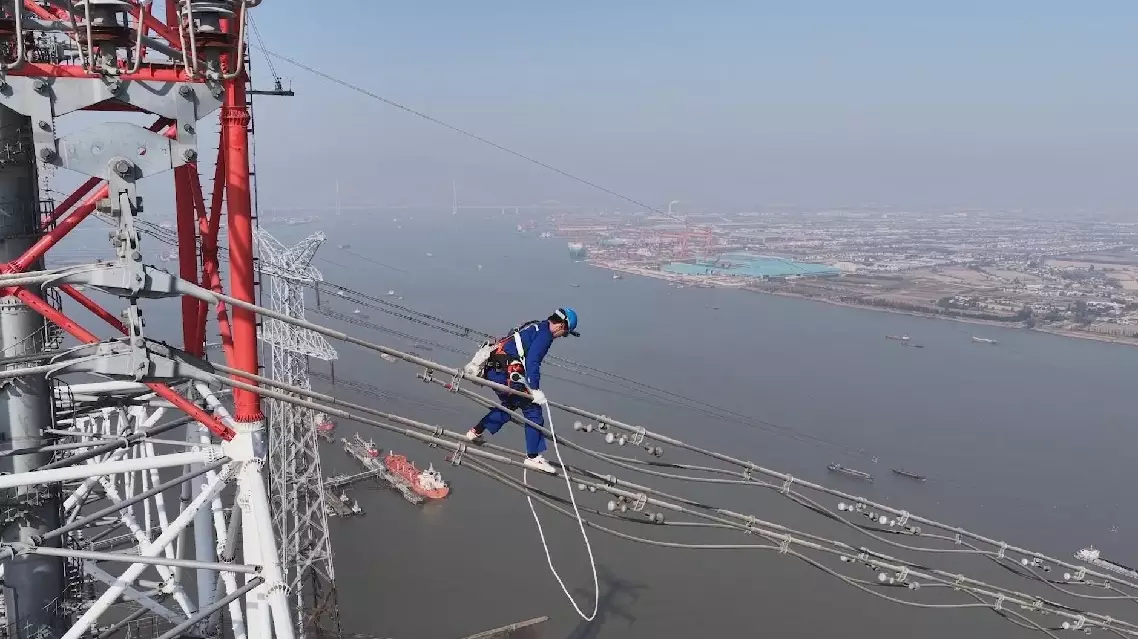
Jiangsu conducts first check on world's tallest transmission towers