Spanish voters head to the polls Sunday in a snap general election where immigration has become a flashpoint, alongside mounting frustration over housing costs and strained public services.
The campaign has exposed a sharp divide: while the political right has sought to make the election a referendum on migration, many voters, particularly the young, say their ballot will be cast over more immediate concerns.
The numbers tell part of the story. Spain's Interior Ministry recorded 28,155 irregular sea arrivals between January and October this year, up 4.3 percent from the same period in 2025. On Tuesday alone, more than 2,100 migrants reached the island of El Hierro via the Atlantic route. And on Friday, the final day of the official campaign period, Spanish news agency EFE reported that 14 people died and 90 were rescued after a migrant boat was found off El Hierro.
For the right, those figures justify a hard line. The conservative People's Party has pledged to ban mass regularizations, set annual work-visa quotas tied to labor shortages, and deploy additional police and military support to the southern border. Party leader Alberto Nunez Feijoo has promised order, security and housing in response to what he calls the incumbent government's "uncontrolled" migration management.
The far-right Vox party goes further. Its platform calls for "remigration"- the repatriation of undocumented migrants and the expulsion of foreigners living on public subsidies - alongside a "national priority" policy that would give Spaniards preferential access to public housing, social benefits, and the minimum income scheme.
Prime Minister Pedro Sanchez's governing center-left Spanish Socialist Workers' Party counters with a different vision: expanding legal and safe migration routes, a 500-million-euro integration plan for 2026-2030, and a public campaign against hate speech. The party has framed the election as a choice between integration and the "fear-mongering" it accuses the right of promoting.
On the streets of Madrid, the priorities diverge from the campaign headlines.
"Especially health and education," said one resident, describing the public services she sees deteriorating.
Another said her overriding concern was "having access to a house."
Ruth Ferrero-Turrion, a professor of Political Science and European Studies at the Universidad Complutense of Madrid, argued that migration is being used as a political tool rather than addressed as a policy challenge.
"Migration is, I would say that it's being weaponized by some political actors. it's an instrument to win elections, using the anxiety and the fear of the population in a context in which social rights are being cut off, and the public expenditure is being cut off to health and education," she said.
Sanchez announced the early general election in early October, a move that came amid widespread protests over Spain's housing crisis.

Immigration dominates Spain's snap election

Immigration dominates Spain's snap election
Workers began the first maintenance on the world's tallest power transmission towers on Saturday in east China's Jiangsu Province.
The towers belong to the 500kV Fengcheng-Meili Yangtze River Crossing Project, China's largest ultra-high voltage cross-river power transmission project and the maintenance is to safeguard stable power delivery through the upcoming winter demand peak.
The maintenance workers are to eliminate accumulated equipment defects caused by long-term exposure to harsh riverine conditions, ensuring clean power generated in northern Jiangsu can be reliably transmitted to power load centers in southern province and stabilizing regional grid performance.
Zheng Yimin, head of maintenance operations at Jiangsu Power Transmission and Transformation Co., Ltd., noted the project's demanding operating environment makes targeted upkeep critical.
"These ultra-high voltage towers operate permanently in a high-humidity, gust-prone environment over the Yangtze River. Over the time, hidden hazards like component corrosion and loosening will slowly pop up. And when winter comes, Jiangsu's power grid will enter its peak load season, incurring greater pressure on power supply. This maintenance work is an important step to secure cross-river power transmission across Jiangsu," Zheng said.
Before maintenance workers ascended the towers, engineering teams conducted a full pre-inspection with drones, with AI-powered analytics identifying equipment faults across the entire river crossing section to produce a targeted defect checklist. The document allows maintenance teams to carry out repair with greater precision and efficiency.
Even with high-tech support, the operation poses substantial challenges. Work began on the riverbank tower platform, which is 364 meters above the river surface. While wind speeds registered as mild at ground level, average wind speeds at the high-altitude platform reached around 8-10 meters per second, with gusts hitting 14-17 meters per second.
From the platform, workers descended along insulator strings connecting the tower cross-arm, which is roughly 380 meters above the water, to start the maintenance.They had to step carefully along the smooth insulator surfaces while carrying out full condition inspections.
A second core task requires technicians to traverse the river along 25-millimeter-diameter power conductors. The full crossing spans 2,550 meters with a vertical line drop of 260 meters, and the complete cable walk would take nearly four hours, posing a tremendous test of the workers' physical strength. The mid-river section is particularly challenging with strong cable swing. Workers must adjust their posture in line with the cable's swing and halt in case of gusts.
To support the linemen, workers used exoskeleton robots for the first time in power transmission maintenance. Equipped with AI that monitors workers' physical status and on-site conditions in real time, the devices provide stability assistance and weight support, significantly reducing strain on workers' legs during the long traverse.
During the operation, maintenance teams detected a safety defect on the line and requested approval for immediate on-site repair.
"Our workers just reported a loose clamp bolt on the No. 25 spacer damper of the tower-side conductors, and we dealt with it right away. The long cross-river span and persistent river winds subject the lines to constant wind load and vibration, which gradually loosens clamp bolts over time. That is the way our teams need to inspect every section along the line and shoot the trouble as soon as it is spotted," Zheng explained.
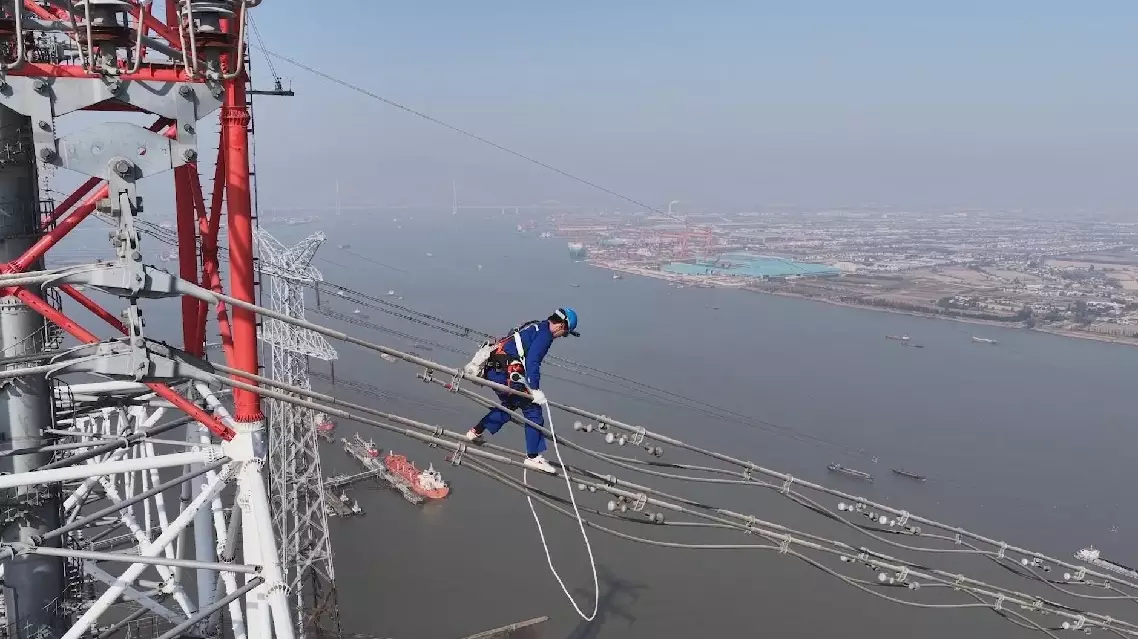
Jiangsu conducts first check on world's tallest transmission towers