
Basic Law (full text)
2024年12月20日
The Basic Law of the Hong Kong Special Administrative Region of the People's Republic of China
(Adopted at the Third Session of the Seventh National People's Congress on 4 April 1990 Promulgated by Order No. 26 of the President of the People's Republic of China on 4 April 1990 Effective as of 1 July 1997)
Preamble
Hong Kong has been part of the territory of China since ancient times; it was occupied by Britain after the Opium War in 1840. On 19 December 1984, the Chinese and British Governments signed the Joint Declaration on the Question of Hong Kong, affirming that the Government of the People's Republic of China will resume the exercise of sovereignty over Hong Kong with effect from 1 July 1997, thus fulfilling the long-cherished common aspiration of the Chinese people for the recovery of Hong Kong.
Upholding national unity and territorial integrity, maintaining the prosperity and stability of Hong Kong, and taking account of its history and realities, the People's Republic of China has decided that upon China's resumption of the exercise of sovereignty over Hong Kong, a Hong Kong Special Administrative Region will be established in accordance with the provisions of Article 31 of the Constitution of the People's Republic of China, and that under the principle of "one country, two systems", the socialist system and policies will not be practised in Hong Kong. The basic policies of the People's Republic of China regarding Hong Kong have been elaborated by the Chinese Government in the Sino-British Joint Declaration.
In accordance with the Constitution of the People's Republic of China, the National People's Congress hereby enacts the Basic Law of the Hong Kong Special Administrative Region of the People's Republic of China, prescribing the systems to be practised in the Hong Kong Special Administrative Region, in order to ensure the implementation of the basic policies of the People's Republic of China regarding Hong Kong.
Chapter I - General Principles
Article 1
The Hong Kong Special Administrative Region is an inalienable part of the People's Republic of China.
Article 2
The National People's Congress authorizes the Hong Kong Special Administrative Region to exercise a high degree of autonomy and enjoy executive, legislative and independent judicial power, including that of final adjudication, in accordance with the provisions of this Law.
Article 3
The executive authorities and legislature of the Hong Kong Special Administrative Region shall be composed of permanent residents of Hong Kong in accordance with the relevant provisions of this Law.
Article 4
The Hong Kong Special Administrative Region shall safeguard the rights and freedoms of the residents of the Hong Kong Special Administrative Region and of other persons in the Region in accordance with law.
Article 5
The socialist system and policies shall not be practised in the Hong Kong Special Administrative Region, and the previous capitalist system and way of life shall remain unchanged for 50 years.
Article 6
The Hong Kong Special Administrative Region shall protect the right of private ownership of property in accordance with law.
Article 7
The land and natural resources within the Hong Kong Special Administrative Region shall be State property. The Government of the Hong Kong Special Administrative Region shall be responsible for their management, use and development and for their lease or grant to individuals, legal persons or organizations for use or development. The revenues derived therefrom shall be exclusively at the disposal of the government of the Region.
Article 8
The laws previously in force in Hong Kong, that is, the common law, rules of equity, ordinances, subordinate legislation and customary law shall be maintained, except for any that contravene this Law, and subject to any amendment by the legislature of the Hong Kong Special Administrative Region.
Article 9
In addition to the Chinese language, English may also be used as an official language by the executive authorities, legislature and judiciary of the Hong Kong Special Administrative Region.
Article 10
Apart from displaying the national flag and national emblem of the People's Republic of China, the Hong Kong Special Administrative Region may also use a regional flag and regional emblem.
The regional flag of the Hong Kong Special Administrative Region is a red flag with a bauhinia highlighted by five star-tipped stamens.
The regional emblem of the Hong Kong Special Administrative Region is a bauhinia in the centre highlighted by five star-tipped stamens and encircled by the words "Hong Kong Special Administrative Region of the People's Republic of China" in Chinese and " HONG KONG" in English.
Article 11
In accordance with Article 31 of the Constitution of the People's Republic of China, the systems and policies practised in the Hong Kong Special Administrative Region, including the social and economic systems, the system for safeguarding the fundamental rights and freedoms of its residents, the executive, legislative and judicial systems, and the relevant policies, shall be based on the provisions of this Law.
No law enacted by the legislature of the Hong Kong Special Administrative Region shall contravene this Law.
Chapter II - Relationship between the Central Authorities and the Hong Kong Special Administrative Region
Article 12
The Hong Kong Special Administrative Region shall be a local administrative region of the People's Republic of China, which shall enjoy a high degree of autonomy and come directly under the Central People's Government.
Article 13
#The Central People's Government shall be responsible for the foreign affairs relating to the Hong Kong Special Administrative Region.
The Ministry of Foreign Affairs of the People's Republic of China shall establish an office in Hong Kong to deal with foreign affairs.
The Central People's Government authorizes the Hong Kong Special Administrative Region to conduct relevant external affairs on its own in accordance with this Law.
Article 14
The Central People's Government shall be responsible for the defence of the Hong Kong Special Administrative Region.
The Government of the Hong Kong Special Administrative Region shall be responsible for the maintenance of public order in the Region.
Military forces stationed by the Central People's Government in the Hong Kong Special Administrative Region for defence shall not interfere in the local affairs of the Region. The Government of the Hong Kong Special Administrative Region may, when necessary, ask the Central People's Government for assistance from the garrison in the maintenance of public order and in disaster relief.
In addition to abiding by national laws, members of the garrison shall abide by the laws of the Hong Kong Special Administrative Region.
Expenditure for the garrison shall be borne by the Central People's Government.
Article 15
The Central People's Government shall appoint the Chief Executive and the principal officials of the executive authorities of the Hong Kong Special Administrative Region in accordance with the provisions of Chapter IV of this Law.
Article 16
The Hong Kong Special Administrative Region shall be vested with executive power. It shall, on its own, conduct the administrative affairs of the Region in accordance with the relevant provisions of this Law.
Article 17
The Hong Kong Special Administrative Region shall be vested with legislative power.
Laws enacted by the legislature of the Hong Kong Special Administrative Region must be reported to the Standing Committee of the National People's Congress for the record. The reporting for record shall not affect the entry into force of such laws.
If the Standing Committee of the National People's Congress, after consulting the Committee for the Basic Law of the Hong Kong Special Administrative Region under it, considers that any law enacted by the legislature of the Region is not in conformity with the provisions of this Law regarding affairs within the responsibility of the Central Authorities or regarding the relationship between the Central Authorities and the Region, the Standing Committee may return the law in question but shall not amend it. Any law returned by the Standing Committee of the National People's Congress shall immediately be invalidated. This invalidation shall not have retroactive effect, unless otherwise provided for in the laws of the Region.
Article 18
The laws in force in the Hong Kong Special Administrative Region shall be this Law, the laws previously in force in Hong Kong as provided for in Article 8 of this Law, and the laws enacted by the legislature of the Region.
National laws shall not be applied in the Hong Kong Special Administrative Region except for those listed in Annex III to this Law. The laws listed therein shall be applied locally by way of promulgation or legislation by the Region.
The Standing Committee of the National People's Congress may add to or delete from the list of laws in Annex III after consulting its Committee for the Basic Law of the Hong Kong Special Administrative Region and the government of the Region. Laws listed in Annex III to this Law shall be confined to those relating to defence and foreign affairs as well as other matters outside the limits of the autonomy of the Region as specified by this Law.
In the event that the Standing Committee of the National People's Congress decides to declare a state of war or, by reason of turmoil within the Hong Kong Special Administrative Region which endangers national unity or security and is beyond the control of the government of the Region, decides that the Region is in a state of emergency, the Central People's Government may issue an order applying the relevant national laws in the Region.
Article 19
The Hong Kong Special Administrative Region shall be vested with independent judicial power, including that of final adjudication.
The courts of the Hong Kong Special Administrative Region shall have jurisdiction over all cases in the Region, except that the restrictions on their jurisdiction imposed by the legal system and principles previously in force in Hong Kong shall be maintained.
#The courts of the Hong Kong Special Administrative Region shall have no jurisdiction over acts of state such as defence and foreign affairs. The courts of the Region shall obtain a certificate from the Chief Executive on questions of fact concerning acts of state such as defence and foreign affairs whenever such questions arise in the adjudication of cases. This certificate shall be binding on the courts. Before issuing such a certificate, the Chief Executive shall obtain a certifying document from the Central People's Government.
Article 20
The Hong Kong Special Administrative Region may enjoy other powers granted to it by the National People's Congress, the Standing Committee of the National People's Congress or the Central People's Government.
Article 21
Chinese citizens who are residents of the Hong Kong Special Administrative Region shall be entitled to participate in the management of state affairs according to law.
In accordance with the assigned number of seats and the selection method specified by the National People's Congress, the Chinese citizens among the residents of the Hong Kong Special Administrative Region shall locally elect deputies of the Region to the National People's Congress to participate in the work of the highest organ of state power.
Article 22
No department of the Central People's Government and no province, autonomous region, or municipality directly under the Central Government may interfere in the affairs which the Hong Kong Special Administrative Region administers on its own in accordance with this Law.
If there is a need for departments of the Central Government, or for provinces, autonomous regions, or municipalities directly under the Central Government to set up offices in the Hong Kong Special Administrative Region, they must obtain the consent of the government of the Region and the approval of the Central People's Government.
All offices set up in the Hong Kong Special Administrative Region by departments of the Central Government, or by provinces, autonomous regions, or municipalities directly under the Central Government, and the personnel of these offices shall abide by the laws of the Region.
*For entry into the Hong Kong Special Administrative Region, people from other parts of China must apply for approval. Among them, the number of persons who enter the Region for the purpose of settlement shall be determined by the competent authorities of the Central People's Government after consulting the government of the Region.
The Hong Kong Special Administrative Region may establish an office in Beijing.
Article 23
The Hong Kong Special Administrative Region shall enact laws on its own to prohibit any act of treason, secession, sedition, subversion against the Central People's Government, or theft of state secrets, to prohibit foreign political organizations or bodies from conducting political activities in the Region, and to prohibit political organizations or bodies of the Region from establishing ties with foreign political organizations or bodies.
Chapter III - Fundamental Rights and Duties of the Residents
Article 24
Residents of the Hong Kong Special Administrative Region ("Hong Kong residents") shall include permanent residents and non-permanent residents.
The permanent residents of the Hong Kong Special Administrative Region shall be:
Chinese citizens born in Hong Kong before or after the establishment of the Hong Kong Special Administrative Region;
Chinese citizens who have ordinarily resided in Hong Kong for a continuous period of not less than seven years before or after the establishment of the Hong Kong Special Administrative Region;
* Persons of Chinese nationality born outside Hong Kong of those residents listed in categories (1) and (2);
Persons not of Chinese nationality who have entered Hong Kong with valid travel documents, have ordinarily resided in Hong Kong for a continuous period of not less than seven years and have taken Hong Kong as their place of permanent residence before or after the establishment of the Hong Kong Special Administrative Region;
Persons under 21 years of age born in Hong Kong of those residents listed in category (4) before or after the establishment of the Hong Kong Special Administrative Region; and
Persons other than those residents listed in categories (1) to (5), who, before the establishment of the Hong Kong Special Administrative Region, had the right of abode in Hong Kong only.
The above-mentioned residents shall have the right of abode in the Hong Kong Special Administrative Region and shall be qualified to obtain, in accordance with the laws of the Region, permanent identity cards which state their right of abode.
The non-permanent residents of the Hong Kong Special Administrative Region shall be persons who are qualified to obtain Hong Kong identity cards in accordance with the laws of the Region but have no right of abode.
Article 25
All Hong Kong residents shall be equal before the law.
Article 26
Permanent residents of the Hong Kong Special Administrative Region shall have the right to vote and the right to stand for election in accordance with law.
Article 27
Hong Kong residents shall have freedom of speech, of the press and of publication; freedom of association, of assembly, of procession and of demonstration; and the right and freedom to form and join trade unions, and to strike.
Article 28
The freedom of the person of Hong Kong residents shall be inviolable.
No Hong Kong resident shall be subjected to arbitrary or unlawful arrest, detention or imprisonment. Arbitrary or unlawful search of the body of any resident or deprivation or restriction of the freedom of the person shall be prohibited. Torture of any resident or arbitrary or unlawful deprivation of the life of any resident shall be prohibited.
Article 29
The homes and other premises of Hong Kong residents shall be inviolable. Arbitrary or unlawful search of, or intrusion into, a resident's home or other premises shall be prohibited.
Article 30
The freedom and privacy of communication of Hong Kong residents shall be protected by law. No department or individual may, on any grounds, infringe upon the freedom and privacy of communication of residents except that the relevant authorities may inspect communication in accordance with legal procedures to meet the needs of public security or of investigation into criminal offences.
Article 31
Hong Kong residents shall have freedom of movement within the Hong Kong Special Administrative Region and freedom of emigration to other countries and regions. They shall have freedom to travel and to enter or leave the Region. Unless restrained by law, holders of valid travel documents shall be free to leave the Region without special authorization.
Article 32
Hong Kong residents shall have freedom of conscience.
Hong Kong residents shall have freedom of religious belief and freedom to preach and to conduct and participate in religious activities in public.
Article 33
Hong Kong residents shall have freedom of choice of occupation.
Article 34
Hong Kong residents shall have freedom to engage in academic research, literary and artistic creation, and other cultural activities.
Article 35
Hong Kong residents shall have the right to confidential legal advice, access to the courts, choice of lawyers for timely protection of their lawful rights and interests or for representation in the courts, and to judicial remedies.
Hong Kong residents shall have the right to institute legal proceedings in the courts against the acts of the executive authorities and their personnel.
Article 36
Hong Kong residents shall have the right to social welfare in accordance with law. The welfare benefits and retirement security of the labour force shall be protected by law.
Article 37
The freedom of marriage of Hong Kong residents and their right to raise a family freely shall be protected by law.
Article 38
Hong Kong residents shall enjoy the other rights and freedoms safeguarded by the laws of the Hong Kong Special Administrative Region.
Article 39
The provisions of the International Covenant on Civil and Political Rights, the International Covenant on Economic, Social and Cultural Rights, and international labour conventions as applied to Hong Kong shall remain in force and shall be implemented through the laws of the Hong Kong Special Administrative Region.
The rights and freedoms enjoyed by Hong Kong residents shall not be restricted unless as prescribed by law. Such restrictions shall not contravene the provisions of the preceding paragraph of this Article.
Article 40
The lawful traditional rights and interests of the indigenous inhabitants of the "New Territories" shall be protected by the Hong Kong Special Administrative Region.
Article 41
Persons in the Hong Kong Special Administrative Region other than Hong Kong residents shall, in accordance with law, enjoy the rights and freedoms of Hong Kong residents prescribed in this Chapter.
Article 42
Hong Kong residents and other persons in Hong Kong shall have the obligation to abide by the laws in force in the Hong Kong Special Administrative Region.
Chapter IV - Political Structure
Section 1 The Chief Executive
Article 43
The Chief Executive of the Hong Kong Special Administrative Region shall be the head of the Hong Kong Special Administrative Region and shall represent the Region.
The Chief Executive of the Hong Kong Special Administrative Region shall be accountable to the Central People's Government and the Hong Kong Special Administrative Region in accordance with the provisions of this Law.
Article 44
The Chief Executive of the Hong Kong Special Administrative Region shall be a Chinese citizen of not less than 40 years of age who is a permanent resident of the Region with no right of abode in any foreign country and has ordinarily resided in Hong Kong for a continuous period of not less than 20 years.
Article 45
The Chief Executive of the Hong Kong Special Administrative Region shall be selected by election or through consultations held locally and be appointed by the Central People's Government.
The method for selecting the Chief Executive shall be specified in the light of the actual situation in the Hong Kong Special Administrative Region and in accordance with the principle of gradual and orderly progress. The ultimate aim is the selection of the Chief Executive by universal suffrage upon nomination by a broadly representative nominating committee in accordance with democratic procedures.
The specific method for selecting the Chief Executive is prescribed in Annex I: "Method for the Selection of the Chief Executive of the Hong Kong Special Administrative Region".
Article 46
The term of office of the Chief Executive of the Hong Kong Special Administrative Region shall be five years. He or she may serve for not more than two consecutive terms.
Article 47
The Chief Executive of the Hong Kong Special Administrative Region must be a person of integrity, dedicated to his or her duties.
The Chief Executive, on assuming office, shall declare his or her assets to the Chief Justice of the Court of Final Appeal of the Hong Kong Special Administrative Region. This declaration shall be put on record.
Article 48
The Chief Executive of the Hong Kong Special Administrative Region shall exercise the following powers and functions:
To lead the government of the Region;
To be responsible for the implementation of this Law and other laws which, in accordance with this Law, apply in the Hong Kong Special Administrative Region;
To sign bills passed by the Legislative Council and to promulgate laws;
To sign budgets passed by the Legislative Council and report the budgets and final accounts to the Central People's Government for the record;
To decide on government policies and to issue executive orders;
To nominate and to report to the Central People's Government for appointment the following principal officials: Secretaries and Deputy Secretaries of Departments, Directors of Bureaux, Commissioner Against Corruption, Director of Audit, Commissioner of Police, Director of Immigration and Commissioner of Customs and Excise; and to recommend to the Central People's Government the removal of the above-mentioned officials;
To appoint or remove judges of the courts at all levels in accordance with legal procedures;
To appoint or remove holders of public office in accordance with legal procedures;
To implement the directives issued by the Central People's Government in respect of the relevant matters provided for in this Law;
To conduct, on behalf of the Government of the Hong Kong Special Administrative Region, external affairs and other affairs as authorized by the Central Authorities;
To approve the introduction of motions regarding revenues or expenditure to the Legislative Council;
To decide, in the light of security and vital public interests, whether government officials or other personnel in charge of government affairs should testify or give evidence before the Legislative Council or its committees;
To pardon persons convicted of criminal offences or commute their penalties; and
To handle petitions and complaints.
Article 49
If the Chief Executive of the Hong Kong Special Administrative Region considers that a bill passed by the Legislative Council is not compatible with the overall interests of the Region, he or she may return it to the Legislative Council within three months for reconsideration. If the Legislative Council passes the original bill again by not less than a two-thirds majority of all the members, the Chief Executive must sign and promulgate it within one month, or act in accordance with the provisions of Article 50 of this Law.
Article 50
If the Chief Executive of the Hong Kong Special Administrative Region refuses to sign a bill passed the second time by the Legislative Council, or the Legislative Council refuses to pass a budget or any other important bill introduced by the government, and if consensus still cannot be reached after consultations, the Chief Executive may dissolve the Legislative Council.
The Chief Executive must consult the Executive Council before dissolving the Legislative Council. The Chief Executive may dissolve the Legislative Council only once in each term of his or her office.
Article 51
If the Legislative Council of the Hong Kong Special Administrative Region refuses to pass the budget introduced by the government, the Chief Executive may apply to the Legislative Council for provisional appropriations. If appropriation of public funds cannot be approved because the Legislative Council has already been dissolved, the Chief Executive may, prior to the election of the new Legislative Council, approve provisional short-term appropriations according to the level of expenditure of the previous fiscal year.
Article 52
The Chief Executive of the Hong Kong Special Administrative Region must resign under any of the following circumstances:
When he or she loses the ability to discharge his or her duties as a result of serious illness or other reasons;
When, after the Legislative Council is dissolved because he or she twice refuses to sign a bill passed by it, the new Legislative Council again passes by a two-thirds majority of all the members the original bill in dispute, but he or she still refuses to sign it; and
When, after the Legislative Council is dissolved because it refuses to pass a budget or any other important bill, the new Legislative Council still refuses to pass the original bill in dispute.
Article 53
If the Chief Executive of the Hong Kong Special Administrative Region is not able to discharge his or her duties for a short period, such duties shall temporarily be assumed by the Administrative Secretary, Financial Secretary or Secretary of Justice in this order of precedence.
*In the event that the office of Chief Executive becomes vacant, a new Chief Executive shall be selected within six months in accordance with the provisions of Article 45 of this Law. During the period of vacancy, his or her duties shall be assumed according to the provisions of the preceding paragraph.
Article 54
The Executive Council of the Hong Kong Special Administrative Region shall be an organ for assisting the Chief Executive in policy-making.
Article 55
Members of the Executive Council of the Hong Kong Special Administrative Region shall be appointed by the Chief Executive from among the principal officials of the executive authorities, members of the Legislative Council and public figures. Their appointment or removal shall be decided by the Chief Executive. The term of office of members of the Executive Council shall not extend beyond the expiry of the term of office of the Chief Executive who appoints them.
Members of the Executive Council of the Hong Kong Special Administrative Region shall be Chinese citizens who are permanent residents of the Region with no right of abode in any foreign country.
The Chief Executive may, as he or she deems necessary, invite other persons concerned to sit in on meetings of the Council.
Article 56
The Executive Council of the Hong Kong Special Administrative Region shall be presided over by the Chief Executive.
Except for the appointment, removal and disciplining of officials and the adoption of measures in emergencies, the Chief Executive shall consult the Executive Council before making important policy decisions, introducing bills to the Legislative Council, making subordinate legislation, or dissolving the Legislative Council.
If the Chief Executive does not accept a majority opinion of the Executive Council, he or she shall put the specific reasons on record.
Article 57
A Commission Against Corruption shall be established in the Hong Kong Special Administrative Region. It shall function independently and be accountable to the Chief Executive.
Article 58
A Commission of Audit shall be established in the Hong Kong Special Administrative Region. It shall function independently and be accountable to the Chief Executive.
Section 2 The Executive Authorities
Article 59
The Government of the Hong Kong Special Administrative Region shall be the executive authorities of the Region.
Article 60
The head of the Government of the Hong Kong Special Administrative Region shall be the Chief Executive of the Region.
A Department of Administration, a Department of Finance, a Department of Justice, and various bureaux, divisions and commissions shall be established in the Government of the Hong Kong Special Administrative Region.
Article 61
The principal officials of the Hong Kong Special Administrative Region shall be Chinese citizens who are permanent residents of the Region with no right of abode in any foreign country and have ordinarily resided in Hong Kong for a continuous period of not less than 15 years.
Article 62
The Government of the Hong Kong Special Administrative Region shall exercise the following powers and functions:
To formulate and implement policies;
To conduct administrative affairs;
To conduct external affairs as authorised by the Central People's Government under this Law;
To draw up and introduce budgets and final accounts;
To draft and introduce bills, motions and subordinate legislation; and
To designate officials to sit in on the meetings of the Legislative Council and to speak on behalf of the government.
Article 63
The Department of Justice of the Hong Kong Special Administrative Region shall control criminal prosecutions, free from any interference.
Article 64
The Government of the Hong Kong Special Administrative Region must abide by the law and be accountable to the Legislative Council of the Region: it shall implement laws passed by the Council and already in force; it shall present regular policy addresses to the Council; it shall answer questions raised by members of the Council; and it shall obtain approval from the Council for taxation and public expenditure.
Article 65
The previous system of establishing advisory bodies by the executive authorities shall be maintained.
Chapter IV - Political Structure
Expand All Collapse All
Section 1
The Chief Executive
Article 43
The Chief Executive of the Hong Kong Special Administrative Region shall be the head of the Hong Kong Special Administrative Region and shall represent the Region.
The Chief Executive of the Hong Kong Special Administrative Region shall be accountable to the Central People's Government and the Hong Kong Special Administrative Region in accordance with the provisions of this Law.
Article 44
The Chief Executive of the Hong Kong Special Administrative Region shall be a Chinese citizen of not less than 40 years of age who is a permanent resident of the Region with no right of abode in any foreign country and has ordinarily resided in Hong Kong for a continuous period of not less than 20 years.
Article 45
The Chief Executive of the Hong Kong Special Administrative Region shall be selected by election or through consultations held locally and be appointed by the Central People's Government.
The method for selecting the Chief Executive shall be specified in the light of the actual situation in the Hong Kong Special Administrative Region and in accordance with the principle of gradual and orderly progress. The ultimate aim is the selection of the Chief Executive by universal suffrage upon nomination by a broadly representative nominating committee in accordance with democratic procedures.
The specific method for selecting the Chief Executive is prescribed in Annex I: "Method for the Selection of the Chief Executive of the Hong Kong Special Administrative Region".
Article 46
The term of office of the Chief Executive of the Hong Kong Special Administrative Region shall be five years. He or she may serve for not more than two consecutive terms.
Article 47
The Chief Executive of the Hong Kong Special Administrative Region must be a person of integrity, dedicated to his or her duties.
The Chief Executive, on assuming office, shall declare his or her assets to the Chief Justice of the Court of Final Appeal of the Hong Kong Special Administrative Region. This declaration shall be put on record.
Article 48
The Chief Executive of the Hong Kong Special Administrative Region shall exercise the following powers and functions:
To lead the government of the Region;
To be responsible for the implementation of this Law and other laws which, in accordance with this Law, apply in the Hong Kong Special Administrative Region;
To sign bills passed by the Legislative Council and to promulgate laws;
To sign budgets passed by the Legislative Council and report the budgets and final accounts to the Central People's Government for the record;
To decide on government policies and to issue executive orders;
To nominate and to report to the Central People's Government for appointment the following principal officials: Secretaries and Deputy Secretaries of Departments, Directors of Bureaux, Commissioner Against Corruption, Director of Audit, Commissioner of Police, Director of Immigration and Commissioner of Customs and Excise; and to recommend to the Central People's Government the removal of the above-mentioned officials;
To appoint or remove judges of the courts at all levels in accordance with legal procedures;
To appoint or remove holders of public office in accordance with legal procedures;
To implement the directives issued by the Central People's Government in respect of the relevant matters provided for in this Law;
To conduct, on behalf of the Government of the Hong Kong Special Administrative Region, external affairs and other affairs as authorized by the Central Authorities;
To approve the introduction of motions regarding revenues or expenditure to the Legislative Council;
To decide, in the light of security and vital public interests, whether government officials or other personnel in charge of government affairs should testify or give evidence before the Legislative Council or its committees;
To pardon persons convicted of criminal offences or commute their penalties; and
To handle petitions and complaints.
Article 49
If the Chief Executive of the Hong Kong Special Administrative Region considers that a bill passed by the Legislative Council is not compatible with the overall interests of the Region, he or she may return it to the Legislative Council within three months for reconsideration. If the Legislative Council passes the original bill again by not less than a two-thirds majority of all the members, the Chief Executive must sign and promulgate it within one month, or act in accordance with the provisions of Article 50 of this Law.
Article 50
If the Chief Executive of the Hong Kong Special Administrative Region refuses to sign a bill passed the second time by the Legislative Council, or the Legislative Council refuses to pass a budget or any other important bill introduced by the government, and if consensus still cannot be reached after consultations, the Chief Executive may dissolve the Legislative Council.
The Chief Executive must consult the Executive Council before dissolving the Legislative Council. The Chief Executive may dissolve the Legislative Council only once in each term of his or her office.
Article 51
If the Legislative Council of the Hong Kong Special Administrative Region refuses to pass the budget introduced by the government, the Chief Executive may apply to the Legislative Council for provisional appropriations. If appropriation of public funds cannot be approved because the Legislative Council has already been dissolved, the Chief Executive may, prior to the election of the new Legislative Council, approve provisional short-term appropriations according to the level of expenditure of the previous fiscal year.
Article 52
The Chief Executive of the Hong Kong Special Administrative Region must resign under any of the following circumstances:
When he or she loses the ability to discharge his or her duties as a result of serious illness or other reasons;
When, after the Legislative Council is dissolved because he or she twice refuses to sign a bill passed by it, the new Legislative Council again passes by a two-thirds majority of all the members the original bill in dispute, but he or she still refuses to sign it; and
When, after the Legislative Council is dissolved because it refuses to pass a budget or any other important bill, the new Legislative Council still refuses to pass the original bill in dispute.
Article 53
If the Chief Executive of the Hong Kong Special Administrative Region is not able to discharge his or her duties for a short period, such duties shall temporarily be assumed by the Administrative Secretary, Financial Secretary or Secretary of Justice in this order of precedence.
*In the event that the office of Chief Executive becomes vacant, a new Chief Executive shall be selected within six months in accordance with the provisions of Article 45 of this Law. During the period of vacancy, his or her duties shall be assumed according to the provisions of the preceding paragraph.
Article 54
The Executive Council of the Hong Kong Special Administrative Region shall be an organ for assisting the Chief Executive in policy-making.
Article 55
Members of the Executive Council of the Hong Kong Special Administrative Region shall be appointed by the Chief Executive from among the principal officials of the executive authorities, members of the Legislative Council and public figures. Their appointment or removal shall be decided by the Chief Executive. The term of office of members of the Executive Council shall not extend beyond the expiry of the term of office of the Chief Executive who appoints them.
Members of the Executive Council of the Hong Kong Special Administrative Region shall be Chinese citizens who are permanent residents of the Region with no right of abode in any foreign country.
The Chief Executive may, as he or she deems necessary, invite other persons concerned to sit in on meetings of the Council.
Article 56
The Executive Council of the Hong Kong Special Administrative Region shall be presided over by the Chief Executive.
Except for the appointment, removal and disciplining of officials and the adoption of measures in emergencies, the Chief Executive shall consult the Executive Council before making important policy decisions, introducing bills to the Legislative Council, making subordinate legislation, or dissolving the Legislative Council.
If the Chief Executive does not accept a majority opinion of the Executive Council, he or she shall put the specific reasons on record.
Article 57
A Commission Against Corruption shall be established in the Hong Kong Special Administrative Region. It shall function independently and be accountable to the Chief Executive.
Article 58
A Commission of Audit shall be established in the Hong Kong Special Administrative Region. It shall function independently and be accountable to the Chief Executive.
Section 2
The Executive Authorities
Article 59
The Government of the Hong Kong Special Administrative Region shall be the executive authorities of the Region.
Article 60
The head of the Government of the Hong Kong Special Administrative Region shall be the Chief Executive of the Region.
A Department of Administration, a Department of Finance, a Department of Justice, and various bureaux, divisions and commissions shall be established in the Government of the Hong Kong Special Administrative Region.
Article 61
The principal officials of the Hong Kong Special Administrative Region shall be Chinese citizens who are permanent residents of the Region with no right of abode in any foreign country and have ordinarily resided in Hong Kong for a continuous period of not less than 15 years.
Article 62
The Government of the Hong Kong Special Administrative Region shall exercise the following powers and functions:
To formulate and implement policies;
To conduct administrative affairs;
To conduct external affairs as authorised by the Central People's Government under this Law;
To draw up and introduce budgets and final accounts;
To draft and introduce bills, motions and subordinate legislation; and
To designate officials to sit in on the meetings of the Legislative Council and to speak on behalf of the government.
Article 63
The Department of Justice of the Hong Kong Special Administrative Region shall control criminal prosecutions, free from any interference.
Article 64
The Government of the Hong Kong Special Administrative Region must abide by the law and be accountable to the Legislative Council of the Region: it shall implement laws passed by the Council and already in force; it shall present regular policy addresses to the Council; it shall answer questions raised by members of the Council; and it shall obtain approval from the Council for taxation and public expenditure.
Article 65
The previous system of establishing advisory bodies by the executive authorities shall be maintained.
Section 3 The Legislature
Article 66
The Legislative Council of the Hong Kong Special Administrative Region shall be the legislature of the Region.
Article 67
The Legislative Council of the Hong Kong Special Administrative Region shall be composed of Chinese citizens who are permanent residents of the Region with no right of abode in any foreign country. However, permanent residents of the Region who are not of Chinese nationality or who have the right of abode in foreign countries may also be elected members of the Legislative Council of the Region, provided that the proportion of such members does not exceed 20 percent of the total membership of the Council.
Article 68
The Legislative Council of the Hong Kong Special Administrative Region shall be constituted by election.
The method for forming the Legislative Council shall be specified in the light of the actual situation in the Hong Kong Special Administrative Region and in accordance with the principle of gradual and orderly progress. The ultimate aim is the election of all the members of the Legislative Council by universal suffrage.
The specific method for forming the Legislative Council and its procedures for voting on bills and motions are prescribed in Annex II: "Method for the Formation of the Legislative Council of the Hong Kong Special Administrative Region and Its Voting Procedures".
Article 69
The term of office of the Legislative Council of the Hong Kong Special Administrative Region shall be four years, except the first term which shall be two years.
Article 70
If the Legislative Council of the Hong Kong Special Administrative Region is dissolved by the Chief Executive in accordance with the provisions of this Law, it must, within three months, be reconstituted by election in accordance with Article 68 of this Law.
Article 71
The President of the Legislative Council of the Hong Kong Special Administrative Region shall be elected by and from among the members of the Legislative Council.
The President of the Legislative Council of the Hong Kong Special Administrative Region shall be a Chinese citizen of not less than 40 years of age, who is a permanent resident of the Region with no right of abode in any foreign country and has ordinarily resided in Hong Kong for a continuous period of not less than 20 years.
Article 72
The President of the Legislative Council of the Hong Kong Special Administrative Region shall exercise the following powers and functions:
To preside over meetings;
To decide on the agenda, giving priority to government bills for inclusion in the agenda;
To decide on the time of meetings;
To call special sessions during the recess;
To call emergency sessions on the request of the Chief Executive; and
To exercise other powers and functions as prescribed in the rules of procedure of the Legislative Council.
Article 73
The Legislative Council of the Hong Kong Special Administrative Region shall exercise the following powers and functions:
To enact, amend or repeal laws in accordance with the provisions of this Law and legal procedures;
To examine and approve budgets introduced by the government;
To approve taxation and public expenditure;
To receive and debate the policy addresses of the Chief Executive;
To raise questions on the work of the government;
To debate any issue concerning public interests;
To endorse the appointment and removal of the judges of the Court of Final Appeal and the Chief Judge of the High Court;
To receive and handle complaints from Hong Kong residents;
If a motion initiated jointly by one-fourth of all the members of the Legislative Council charges the Chief Executive with serious breach of law or dereliction of duty and if he or she refuses to resign, the Council may, after passing a motion for investigation, give a mandate to the Chief Justice of the Court of Final Appeal to form and chair an independent investigation committee. The committee shall be responsible for carrying out the investigation and reporting its findings to the Council. If the committee considers the evidence sufficient to substantiate such charges, the Council may pass a motion of impeachment by a two-thirds majority of all its members and report it to the Central People's Government for decision; and
To summon, as required when exercising the above-mentioned powers and functions, persons concerned to testify or give evidence.
Article 74
Members of the Legislative Council of the Hong Kong Special Administrative Region may introduce bills in accordance with the provisions of this Law and legal procedures. Bills which do not relate to public expenditure or political structure or the operation of the government may be introduced individually or jointly by members of the Council. The written consent of the Chief Executive shall be required before bills relating to government policies are introduced.
Article 75
The quorum for the meeting of the Legislative Council of the Hong Kong Special Administrative Region shall be not less than one half of all its members.
The rules of procedure of the Legislative Council shall be made by the Council on its own, provided that they do not contravene this Law.
Article 76
A bill passed by the Legislative council of the Hong Kong Special Administrative Region may take effect only after it is signed and promulgated by the Chief Executive.
Article 77
Members of the Legislative Council of the Hong Kong Special Administrative Region shall be immune from legal action in respect of their statements at meetings of the Council.
Article 78
Members of the Legislative Council of the Hong Kong Special Administrative Region shall not be subjected to arrest when attending or on their way to a meeting of the Council.
Article 79
The President of the Legislative Council of the Hong Kong Special Administrative Region shall declare that a member of the Council is no longer qualified for the office under any of the following circumstances:
When he or she loses the ability to discharge his or her duties as a result of serious illness or other reasons;
When he or she, with no valid reason, is absent from meetings for three consecutive months without the consent of the President of the Legislative Council;
When he or she loses or renounces his or her status as a permanent resident of the Region;
When he or she accepts a government appointment and becomes a public servant;
When he or she is bankrupt or fails to comply with a court order to repay debts;
When he or she is convicted and sentenced to imprisonment for one month or more for a criminal offence committed within or outside the Region and is relieved of his or her duties by a motion passed by two-thirds of the members of the Legislative Council present; and
When he or she is censured for misbehaviour or breach of oath by a vote of two-thirds of the members of the Legislative Council present.
Section 4 The Judiciary
Article 80
The courts of the Hong Kong Special Administrative Region at all levels shall be the judiciary of the Region, exercising the judicial power of the Region.
Article 81
The Court of Final Appeal, the High Court, district courts, magistrates' courts and other special courts shall be established in the Hong Kong Special Administrative Region. The High Court shall comprise the Court of Appeal and the Court of First Instance.
The judicial system previously practised in Hong Kong shall be maintained except for those changes consequent upon the establishment of the Court of Final Appeal of the Hong Kong Special Administrative Region.
Article 82
The power of final adjudication of the Hong Kong Special Administrative Region shall be vested in the Court of Final Appeal of the Region, which may as required invite judges from other common law jurisdictions to sit on the Court of Final Appeal.
Article 83
The structure, powers and functions of the courts of the Hong Kong Special Administrative Region at all levels shall be prescribed by law.
Article 84
The courts of the Hong Kong Special Administrative Region shall adjudicate cases in accordance with the laws applicable in the Region as prescribed in Article 18 of this Law and may refer to precedents of other common law jurisdictions.
Article 85
The courts of the Hong Kong Special Administrative Region shall exercise judicial power independently, free from any interference. Members of the judiciary shall be immune from legal action in the performance of their judicial functions.
Article 86
The principle of trial by jury previously practised in Hong Kong shall be maintained.
Article 87
In criminal or civil proceedings in the Hong Kong Special Administrative Region, the principles previously applied in Hong Kong and the rights previously enjoyed by parties to proceedings shall be maintained.
Anyone who is lawfully arrested shall have the right to a fair trial by the judicial organs without delay and shall be presumed innocent until convicted by the judicial organs.
Article 88
Judges of the courts of the Hong Kong Special Administrative Region shall be appointed by the Chief Executive on the recommendation of an independent commission composed of local judges, persons from the legal profession and eminent persons from other sectors.
Article 89
A judge of court of the Hong Kong Special Administrative Region may only be removed for inability to discharge his or her duties, or for misbehaviour, by the Chief Executive on the recommendation of a tribunal appointed by the Chief Justice of the Court of Final Appeal and consisting of not fewer than three local judges.
The Chief Justice of the Court of Final Appeal of the Hong Kong Special Administrative Region may be investigated only for inability to discharge his or her duties, or for misbehaviour, by a tribunal appointed by the Chief Executive and consisting of not fewer than five local judges and may be removed by the Chief Executive on the recommendation of the tribunal and in accordance with the procedures prescribed in this Law.
Article 90
The Chief Justice of the Court of Final Appeal and the Chief Judge of the High Court of the Hong Kong Special Administrative Region shall be Chinese citizens who are permanent residents of the Region with no right of abode in any foreign country.
In the case of the appointment or removal of judges of the Court of Final Appeal and the Chief Judge of the High Court of the Hong Kong Special Administrative Region, the Chief Executive shall, in addition to following the procedures prescribed in Articles 88 and 89 of this Law, obtain the endorsement of the Legislative Council and report such appointment or removal to the Standing Committee of the National People's Congress for the record.
Article 91
The Hong Kong Special Administrative Region shall maintain the previous system of appointment and removal of members of the judiciary other than judges.
Article 92
Judges and other members of the judiciary of the Hong Kong Special Administrative Region shall be chosen on the basis of their judicial and professional qualities and may be recruited from other common law jurisdictions.
Article 93
Judges and other members of the judiciary serving in Hong Kong before the establishment of the Hong Kong Special Administrative Region may all remain in employment and retain their seniority with pay, allowances, benefits and conditions of service no less favourable than before.
The Government of the Hong Kong Special Administrative Region shall pay to judges and other members of the judiciary who retire or leave the service in compliance with regulations, including those who have retired or left the service before the establishment of the Hong Kong Special Administrative Region, or to their dependants, all pensions, gratuities, allowances and benefits due to them on terms no less favourable than before, irrespective of their nationality or place of residence.
Article 94
On the basis of the system previously operating in Hong Kong, the Government of the Hong Kong Special Administrative Region may make provisions for local lawyers and lawyers from outside Hong Kong to work and practise in the Region.
Article 95
The Hong Kong Special Administrative Region may, through consultations and in accordance with law, maintain juridical relations with the judicial organs of other parts of the country, and they may render assistance to each other.
Article 96
With the assistance or authorization of the Central People's Government, the Government of the Hong Kong Special Administrative Region may make appropriate arrangements with foreign states for reciprocal juridical assistance.
Section 5 District Organizations
Article 97
District organizations which are not organs of political power may be established in the Hong Kong Special Administrative Region, to be consulted by the government of the Region on district administration and other affairs, or to be responsible for providing services in such fields as culture, recreation and environmental sanitation.
Article 98
The powers and functions of the district organizations and the method for their formation shall be prescribed by law.
Section 6 Public Servants
Article 99
Public servants serving in all government departments of the Hong Kong Special Administrative Region must be permanent residents of the Region, except where otherwise provided for in Article 101 of this Law regarding public servants of foreign nationalities and except for those below a certain rank as prescribed by law.
Public servants must be dedicated to their duties and be responsible to the Government of the Hong Kong Special Administrative Region.
Article 100
Public servants serving in all Hong Kong government departments, including the police department, before the establishment of the Hong Kong Special Administrative Region, may all remain in employment and retain their seniority with pay, allowances, benefits and conditions of service no less favourable than before.
Article 101
The Government of the Hong Kong Special Administrative Region may employ British and other foreign nationals previously serving in the public service in Hong Kong, or those holding permanent identity cards of the Region, to serve as public servants in government departments at all levels, but only Chinese citizens among permanent residents of the Region with no right of abode in any foreign country may fill the following posts: the Secretaries and Deputy Secretaries of Departments, Directors of Bureaux, Commissioner Against Corruption, Director of Audit, Commissioner of Police, Director of Immigration and Commissioner of Customs and Excise.
The Government of the Hong Kong Special Administrative Region may also employ British and other foreign nationals as advisers to government departments and, when required, may recruit qualified candidates from outside the Region to fill professional and technical posts in government departments. These foreign nationals shall be employed only in their individual capacities and shall be responsible to the government of the Region.
Article 102
The Government of the Hong Kong Special Administrative Region shall pay to public servants who retire or who leave the service in compliance with regulations, including those who have retired or who have left the service in compliance with regulations before the establishment of the Hong Kong Special Administrative Region, or to their dependants, all pensions, gratuities, allowances and benefits due to them on terms no less favourable than before, irrespective of their nationality or place of residence.
Article 103
The appointment and promotion of public servants shall be on the basis of their qualifications, experience and ability. Hong Kong's previous system of recruitment, employment, assessment, discipline, training and management for the public service, including special bodies for their appointment, pay and conditions of service, shall be maintained, except for any provisions for privileged treatment of foreign nationals.
Article 104
#When assuming office, the Chief Executive, principal officials, members of the Executive Council and of the Legislative Council, judges of the courts at all levels and other members of the judiciary in the Hong Kong Special Administrative Region must, in accordance with law, swear to uphold the Basic Law of the Hong Kong Special Administrative Region of the People's Republic of China and swear allegiance to the Hong Kong Special Administrative Region of the People's Republic of China.
Chapter V - Economy
Section 1 Public Finance, Monetary Affairs, Trade, Industry and Commerce
Article 105
The Hong Kong Special Administrative Region shall, in accordance with law, protect the right of individuals and legal persons to the acquisition, use, disposal and inheritance of property and their right to compensation for lawful deprivation of their property.
Such compensation shall correspond to the real value of the property concerned at the time and shall be freely convertible and paid without undue delay.
The ownership of enterprises and the investments from outside the Region shall be protected by law.
Article 106
The Hong Kong Special Administrative Region shall have independent finances.
The Hong Kong Special Administrative Region shall use its financial revenues exclusively for its own purposes, and they shall not be handed over to the Central People's Government.
The Central People's Government shall not levy taxes in the Hong Kong Special Administrative Region.
Article 107
The Hong Kong Special Administrative Region shall follow the principle of keeping the expenditure within the limits of revenues in drawing up its budget, and strive to achieve a fiscal balance, avoid deficits and keep the budget commensurate with the growth rate of its gross domestic product.
Article 108
The Hong Kong Special Administrative Region shall practise an independent taxation system.
The Hong Kong Special Administrative Region shall, taking the low tax policy previously pursued in Hong Kong as reference, enact laws on its own concerning types of taxes, tax rates, tax reductions, allowances and exemptions, and other matters of taxation.
Article 109
The Government of the Hong Kong Special Administrative Region shall provide an appropriate economic and legal environment for the maintenance of the status of Hong Kong as an international financial centre.
Article 110
The monetary and financial systems of the Hong Kong Special Administrative Region shall be prescribed by law.
The Government of the Hong Kong Special Administrative Region shall, on its own, formulate monetary and financial policies, safeguard the free operation of financial business and financial markets, and regulate and supervise them in accordance with law.
Article 111
The Hong Kong dollar, as the legal tender in the Hong Kong Special Administrative Region, shall continue to circulate.
The authority to issue Hong Kong currency shall be vested in the Government of the Hong Kong Special Administrative Region. The issue of Hong Kong currency must be backed by a 100 per cent reserve fund. The system regarding the issue of Hong Kong currency and the reserve fund system shall be prescribed by law.
The Government of the Hong Kong Special Administrative Region may authorize designated banks to issue or continue to issue Hong Kong currency under statutory authority, after satisfying itself that any issue of currency will be soundly based and that the arrangements for such issue are consistent with the object of maintaining the stability of the currency.
Article 112
No foreign exchange control policies shall be applied in the Hong Kong Special Administrative Region. The Hong Kong dollar shall be freely convertible. Markets for foreign exchange, gold, securities, futures and the like shall continue.
The Government of the Hong Kong Special Administrative Region shall safeguard the free flow of capital within, into and out of the Region.
Article 113
The Exchange Fund of the Hong Kong Special Administrative Region shall be managed and controlled by the government of the Region, primarily for regulating the exchange value of the Hong Kong dollar.
Article 114
The Hong Kong Special Administrative Region shall maintain the status of a free port and shall not impose any tariff unless otherwise prescribed by law.
Article 115
The Hong Kong Special Administrative Region shall pursue the policy of free trade and safeguard the free movement of goods, intangible assets and capital.
Article 116
The Hong Kong Special Administrative Region shall be a separate customs territory.
The Hong Kong Special Administrative Region may, using the name "Hong Kong, China", participate in relevant international organizations and international trade agreements (including preferential trade arrangements), such as the General Agreement on Tariffs and Trade and arrangements regarding international trade in textiles.
Export quotas, tariff preferences and other similar arrangements, which are obtained or made by the Hong Kong Special Administrative Region or which were obtained or made and remain valid, shall be enjoyed exclusively by the Region.
Article 117
The Hong Kong Special Administrative Region may issue its own certificates of origin for products in accordance with prevailing rules of origin.
Article 118
The Government of the Hong Kong Special Administrative Region shall provide an economic and legal environment for encouraging investments, technological progress and the development of new industries.
Article 119
The Government of the Hong Kong Special Administrative Region shall formulate appropriate policies to promote and co-ordinate the development of various trades such as manufacturing, commerce, tourism, real estate, transport, public utilities, services, agriculture and fisheries, and pay regard to the protection of the environment.
Section 2 Land Leases
Article 120
All leases of land granted, decided upon or renewed before the establishment of the Hong Kong Special Administrative Region which extend beyond 30 June 1997, and all rights in relation to such leases, shall continue to be recognized and protected under the law of the Region.
Article 121
As regards all leases of land granted or renewed where the original leases contain no right of renewal, during the period from 27 May 1985 to 30 June 1997, which extend beyond 30 June 1997 and expire not later than 30 June 2047, the lessee is not required to pay an additional premium as from 1 July 1997, but an annual rent equivalent to 3 per cent of the rateable value of the property at that date, adjusted in step with any changes in the rateable value thereafter, shall be charged.
Article 122
In the case of old schedule lots, village lots, small houses and similar rural holdings, where the property was on 30 June 1984 held by, or , in the case of small houses granted after that date, where the property is granted to, a lessee descended through the male line from a person who was in 1898 a resident of an established village in Hong Kong, the previous rent shall remain unchanged so long as the property is held by that lessee or by one of his lawful successors in the male line.
Article 123
Where leases of land without a right of renewal expire after the establishment of the Hong Kong Special Administrative Region, they shall be dealt with in accordance with laws and policies formulated by the Region on its own.
Section 3 Shipping
Article 124
The Hong Kong Special Administrative Region shall maintain Hong Kong's previous systems of shipping management and shipping regulation, including the system for regulating conditions of seamen.
The Government of the Hong Kong Special Administrative Region shall, on its own, define its specific functions and responsibilities in respect of shipping.
Article 125
The Hong Kong Special Administrative Region shall be authorized by the Central People's Government to continue to maintain a shipping register and issue related certificates under its legislation, using the name "Hong Kong, China".
Article 126
With the exception of foreign warships, access for which requires the special permission of the Central People's Government, ships shall enjoy access to the ports of the Hong Kong Special Administrative Region in accordance with the laws of the Region.
Article 127
Private shipping businesses and shipping-related businesses and private container terminals in the Hong Kong Special Administrative Region may continue to operate freely.
Section 4 Civil Aviation
Article 128
The Government of the Hong Kong Special Administrative Region shall provide conditions and take measures for the maintenance of the status of Hong Kong as a centre of international and regional aviation.
Article 129
The Hong Kong Special Administrative Region shall continue the previous system of civil aviation management in Hong Kong and keep its own aircraft register in accordance with provisions laid down by the Central People's Government concerning nationality marks and registration marks of aircraft.
Access of foreign state aircraft to the Hong Kong Special Administrative Region shall require the special permission of the Central People's Government.
Article 130
The Hong Kong Special Administrative Region shall be responsible on its own for matters of routine business and technical management of civil aviation, including the management of airports, the provision of air traffic services within the flight information region of the Hong Kong Special Administrative Region, and the discharge of other responsibilities allocated to it under the regional air navigation procedures of the International Civil Aviation Organization.
Article 131
The Central People's Government shall, in consultation with the Government of the Hong Kong Special Administrative Region, make arrangements providing air services between the Region and other parts of the People's Republic of China for airlines incorporated in the Hong Kong Special Administrative Region and having their principal place of business in Hong Kong and other airlines of the People's Republic of China.
Article 132
All air service agreements providing air services between other parts of the People's Republic of China and other states and regions with stops at the Hong Kong Special Administrative Region and air services between the Hong Kong Special Administrative Region and other states and regions with stops at other parts of the People's Republic of China shall be concluded by the Central People's Government.
In concluding the air service agreements referred to in the first paragraph of this Article, the Central People's Government shall take account of the special conditions and economic interests of the Hong Kong Special Administrative Region and consult the government of the Region.
Representatives of the Government of the Hong Kong Special Administrative Region may, as members of the delegations of the Government of the People's Republic of China, participate in air service consultations conducted by the Central People's Government with foreign governments concerning arrangements for such services referred to in the first paragraph of this Article.
Article 133
Acting under specific authorizations from the Central People's Government, the Government of the Hong Kong Special Administrative Region may:
renew or amend air service agreements and arrangements previously in force;
negotiate and conclude new air service agreements providing routes for airlines incorporated in the Hong Kong Special Administrative Region and having their principal place of business in Hong Kong and providing rights for over-flights and technical stops; and
negotiate and conclude provisional arrangements with foreign states or regions with which no air service agreements have been concluded.
All scheduled air services to, from or through Hong Kong, which do not operate to, from or through the mainland of China shall be regulated by the air service agreements or provisional arrangements referred to in this Article.
Article 134
The Central People's Government shall give the Government of the Hong Kong Special Administrative Region the authority to :
negotiate and conclude with other authorities all arrangements concerning the implementation of the air service agreements and provisional arrangements referred to in Article 133 of this Law;
issue licences to airlines incorporated in the Hong Kong Special Administrative Region and having their principal place of business in Hong Kong;
designate such airlines under the air service agreements and provisional arrangements referred to in Article 133 of this Law; and
issue permits to foreign airlines for services other than those to, from or through the mainland of China.
Article 135
Airlines incorporated and having their principal place of business in Hong Kong and businesses related to civil aviation functioning there prior to the establishment of the Hong Kong Special Administrative Region may continue to operate.
Chapter VI - Education, Science, Culture, Sports, Religion, Labour and Social Services
Article 136
On the basis of the previous educational system, the Government of the Hong Kong Special Administrative Region shall, on its own, formulate policies on the development and improvement of education, including policies regarding the educational system and its administration, the language of instruction, the allocation of funds, the examination system, the system of academic awards and the recognition of educational qualifications.
Community organizations and individuals may, in accordance with law, run educational undertakings of various kinds in the Hong Kong Special Administrative Region.
Article 137
Educational institutions of all kinds may retain their autonomy and enjoy academic freedom. They may continue to recruit staff and use teaching materials from outside the Hong Kong Special Administrative Region. Schools run by religious organizations may continue to provide religious education, including courses in religion.
Students shall enjoy freedom of choice of educational institutions and freedom to pursue their education outside the Hong Kong Special Administrative Region.
Article 138
The Government of the Hong Kong Special Administrative Region shall, on its own, formulate policies to develop Western and traditional Chinese medicine and to improve medical and health services. Community organizations and individuals may provide various medical and health services in accordance with law.
Article 139
The Government of the Hong Kong Special Administrative Region shall, on its own, formulate policies on science and technology and protect by law achievements in scientific and technological research, patents, discoveries and inventions.
The Government of the Hong Kong Special Administrative Region shall, on its own, decide on the scientific and technological standards and specifications applicable in Hong Kong.
Article 140
The Government of the Hong Kong Special Administrative Region shall, on its own, formulate policies on culture and protect by law the achievements and the lawful rights and interests of authors in their literary and artistic creation.
Article 141
The Government of the Hong Kong Special Administrative Region shall not restrict the freedom of religious belief, interfere in the internal affairs of religious organizations or restrict religious activities which do not contravene the laws of the Region.
Religious organizations shall, in accordance with law, enjoy the rights to acquire, use, dispose of and inherit property and the right to receive financial assistance. Their previous property rights and interests shall be maintained and protected.
Religious organizations may, according to their previous practice, continue to run seminaries and other schools, hospitals and welfare institutions and to provide other social services.
Religious organizations and believers in the Hong Kong Special Administrative Region may maintain and develop their relations with religious organizations and believers elsewhere.
Article 142
The Government of the Hong Kong Special Administrative Region shall, on the basis of maintaining the previous systems concerning the professions, formulate provisions on its own for assessing the qualifications for practice in the various professions.
Persons with professional qualifications or qualifications for professional practice obtained prior to the establishment of the Hong Kong Special Administrative Region may retain their previous qualifications in accordance with the relevant regulations and codes of practice.
The Government of the Hong Kong Special Administrative Region shall continue to recognize the professions and the professional organizations recognized prior to the establishment of the Region, and these organizations may, on their own, assess and confer professional qualifications.
The Government of the Hong Kong Special Administrative Region may, as required by developments in society and in consultation with the parties concerned, recognize new professions and professional organizations.
Article 143
The Government of the Hong Kong Special Administrative Region shall, on its own, formulate policies on sports. Non-governmental sports organizations may continue to exist and develop in accordance with law.
Article 144
The Government of the Hong Kong Special Administrative Region shall maintain the policy previously practised in Hong Kong in respect of subventions for non-governmental organizations in fields such as education, medicine and health, culture, art, recreation, sports, social welfare and social work. Staff members previously serving in subvented organizations in Hong Kong may remain in their employment in accordance with the previous system.
Article 145
On the basis of the previous social welfare system, the Government of the Hong Kong Special Administrative Region shall, on its own, formulate policies on the development and improvement of this system in the light of the economic conditions and social needs.
Article 146
Voluntary organizations providing social services in the Hong Kong Special Administrative Region may, on their own, decide their forms of service, provided that the law is not contravened.
Article 147
The Hong Kong Special Administrative Region shall on its own formulate laws and policies relating to labour.
Article 148
The relationship between non-governmental organizations in fields such as education, science, technology, culture, art, sports, the professions, medicine and health, labour, social welfare and social work as well as religious organizations in the Hong Kong Special Administrative Region and their counterparts on the mainland shall be based on the principles of non-subordination, non-interference and mutual respect.
Article 149
Non-governmental organizations in fields such as education, science, technology, culture, art, sports, the professions, medicine and health, labour, social welfare and social work as well as religious organizations in the Hong Kong Special Administrative Region may maintain and develop relations with their counterparts in foreign countries and regions and with relevant international organizations. They may, as required, use the name "Hong Kong, China" in the relevant activities.
Chapter VII - External Affairs
Article 150
Representatives of the Government of the Hong Kong Special Administrative Region may, as members of delegations of the Government of the People's Republic of China, participate in negotiations at the diplomatic level directly affecting the Region conducted by the Central People's Government.
Article 151
The Hong Kong Special Administrative Region may on its own, using the name "Hong Kong, China", maintain and develop relations and conclude and implement agreements with foreign states and regions and relevant international organizations in the appropriate fields, including the economic, trade, financial and monetary, shipping, communications, tourism, cultural and sports fields.
Article 152
Representatives of the Government of the Hong Kong Special Administrative Region may, as members of delegations of the People's Republic of China, participate in international organizations or conferences in appropriate fields limited to states and affecting the Region, or may attend in such other capacity as may be permitted by the Central People's Government and the international organization or conference concerned, and may express their views, using the name "Hong Kong, China".
The Hong Kong Special Administrative Region may, using the name "Hong Kong, China", participate in international organizations and conferences not limited to states.
The Central People's Government shall take the necessary steps to ensure that the Hong Kong Special Administrative Region shall continue to retain its status in an appropriate capacity in those international organizations of which the People's Republic of China is a member and in which Hong Kong participates in one capacity or another.
The Central People's Government shall, where necessary, facilitate the continued participation of the Hong Kong Special Administrative Region in an appropriate capacity in those international organizations in which Hong Kong is a participant in one capacity or another, but of which the People's Republic of China is not a member.
Article 153
The application to the Hong Kong Special Administrative Region of international agreements to which the People's Republic of China is or becomes a party shall be decided by the Central People's Government, in accordance with the circumstances and needs of the Region, and after seeking the views of the government of the Region.
International agreements to which the People's Republic of China is not a party but which are implemented in Hong Kong may continue to be implemented in the Hong Kong Special Administrative Region. The Central People's Government shall, as necessary, authorize or assist the government of the Region to make appropriate arrangements for the application to the Region of other relevant international agreements.
Article 154
The Central People's Government shall authorize the Government of the Hong Kong Special Administrative Region to issue, in accordance with law, passports of the Hong Kong Special Administrative Region of the People's Republic of China to all Chinese citizens who hold permanent identity cards of the Region, and travel documents of the Hong Kong Special Administrative Region of the People's Republic of China to all other persons lawfully residing in the Region. The above passports and documents shall be valid for all states and regions and shall record the holder's right to return to the Region.
The Government of the Hong Kong Special Administrative Region may apply immigration controls on entry into, stay in and departure from the Region by persons from foreign states and regions.
Article 155
The Central People's Government shall assist or authorize the Government of the Hong Kong Special Administrative Region to conclude visa abolition agreements with foreign states or regions.
Article 156
The Hong Kong Special Administrative Region may, as necessary, establish official or semi-official economic and trade missions in foreign countries and shall report the establishment of such missions to the Central People's Government for the record.
Article 157
The establishment of foreign consular and other official or semi-official missions in the Hong Kong Special Administrative Region shall require the approval of the Central People's Government.
Consular and other official missions established in Hong Kong by states which have formal diplomatic relations with the People's Republic of China may be maintained.
According to the circumstances of each case, consular and other official missions established in Hong Kong by states which have no formal diplomatic relations with the People's Republic of China may be permitted either to remain or be changed to semi-official missions.
States not recognized by the People's Republic of China may only establish non-governmental institutions in the Region.
Chapter VIII - Interpretation and Amendment of the Basic Law
Article 158
The power of interpretation of this Law shall be vested in the Standing Committee of the National People's Congress.
The Standing Committee of the National People's Congress shall authorize the courts of the Hong Kong Special Administrative Region to interpret on their own, in adjudicating cases, the provisions of this Law which are within the limits of the autonomy of the Region.
The courts of the Hong Kong Special Administrative Region may also interpret other provisions of this Law in adjudicating cases. However, if the courts of the Region, in adjudicating cases, need to interpret the provisions of this Law concerning affairs which are the responsibility of the Central People's Government, or concerning the relationship between the Central Authorities and the Region, and if such interpretation will affect the judgments on the cases, the courts of the Region shall, before making their final judgments which are not appealable, seek an interpretation of the relevant provisions from the Standing Committee of the National People's Congress through the Court of Final Appeal of the Region. When the Standing Committee makes an interpretation of the provisions concerned, the courts of the Region, in applying those provisions, shall follow the interpretation of the Standing Committee. However, judgments previously rendered shall not be affected.
The Standing Committee of the National People's Congress shall consult its Committee for the Basic Law of the Hong Kong Special Administrative Region before giving an interpretation of this Law.
Article 159
The power of amendment of this Law shall be vested in the National People's Congress.
The power to propose bills for amendments to this Law shall be vested in the Standing Committee of the National People's Congress, the State Council and the Hong Kong Special Administrative Region. Amendment bills from the Hong Kong Special Administrative Region shall be submitted to the National People's Congress by the delegation of the Region to the National People's Congress after obtaining the consent of two-thirds of the deputies of the Region to the National People's Congress, two-thirds of all the members of the Legislative Council of the Region, and the Chief Executive of the Region.
Before a bill for amendment to this Law is put on the agenda of the National People's Congress, the Committee for the Basic Law of the Hong Kong Special Administrative Region shall study it and submit its views.
No amendment to this Law shall contravene the established basic policies of the People's Republic of China regarding Hong Kong.
Chapter IX - Supplementary Provisions
Article 160
Upon the establishment of the Hong Kong Special Administrative Region, the laws previously in force in Hong Kong shall be adopted as laws of the Region except for those which the Standing Committee of the National People's Congress declares to be in contravention of this Law. If any laws are later discovered to be in contravention of this Law, they shall be amended or cease to have force in accordance with the procedure as prescribed by this Law.
Documents, certificates, contracts, and rights and obligations valid under the laws previously in force in Hong Kong shall continue to be valid and be recognized and protected by the Hong Kong Special Administrative Region, provided that they do not contravene this Law.
Annex & Instrument
Annex I – Method for the Selection of the Chief Executive of the Hong Kong Special Administrative Region
(Adopted at the Third Session of the Seventh National People's Congress on 4 April 1990, amended, as approved at the Sixteenth Meeting of the Standing Committee of the Eleventh National People's Congress on 28 August 2010, and amended at the Twenty-Seventh Meeting of the Standing Committee of the Thirteenth National People's Congress on 30 March 2021)
The Chief Executive shall be elected in accordance with this Law by an Election Committee which is broadly representative, suited to the actual situation of the Hong Kong Special Administrative Region (HKSAR), and represents the overall interests of society, and shall be appointed by the Central People's Government.
The Election Committee shall be composed of 1,500 members from the following sectors:
First Sector: Industrial, commercial and financial sectors 300
Second Sector: The professions 300
Third Sector: Grassroots, labour, religious and other sectors 300
Fourth Sector: Members of the Legislative Council, representatives of district organisations and other organisations 300
Fifth Sector: HKSAR deputies to the National People's Congress (NPC), HKSAR members of the National Committee of the Chinese People's Political Consultative Conference (CPPCC), and representatives of Hong Kong members of relevant national organisations 300
Members of the Election Committee must be permanent residents of the HKSAR
The term of office of the Election Committee shall be five years.
The delimitation of and the number of seats allocated to each sector of the Election Committee are as follows:
The First Sector shall be composed of the following 18 subsectors:
Industrial (first) 17
Industrial (second) 17
Textiles and garment 17
Commercial (first) 17
Commercial (second) 17
Commercial (third) 17
Finance 17
Financial services 17
Insurance 17
Real estate and construction 17
Transport 17
Import and export 17
Tourism 17
Hotel 16
Catering 16
Wholesale and retail 17
Employers' Federation of Hong Kong 15
Small and medium enterprises 15
The Second Sector shall be composed of the following 10 subsectors:
Technology and innovation 30
Engineering 30
Architectural, surveying, planning and landscape 30
Accountancy 30
Legal 30
Education 30
Sports, performing arts, culture and publication 30
Medical and health services 30
Chinese medicine 30
Social welfare 30
The Third Sector shall be composed of the following five subsectors:
Agriculture and fisheries 60
Labour 60
Grassroots associations 60
Associations of Chinese fellow townsmen 60
Religious 60
The Fourth Sector shall be composed of the following five subsectors:
Members of the Legislative Council 90
Heung Yee Kuk 27
Representatives of members of Area Committees, District Fight Crime Committees, and District Fire Safety Committees of Hong Kong Island and Kowloon 76
Representatives of members of Area Committees, District Fight Crime Committees, and District Fire Safety Committees of the New Territories 80
Representatives of associations of Hong Kong residents in the Mainland 27
The Fifth Sector shall be composed of the following two subsectors:
HKSAR deputies to the NPC and HKSAR members of the CPPCC National Committee 190
Representatives of Hong Kong members of relevant national organisations 110
The Election Committee shall be constituted in the following manner:
(1)
HKSAR deputies to the NPC, HKSAR members of the CPPCC National Committee, Hong Kong members of the Committee for the Basic Law of the HKSAR under the NPC Standing Committee, members of the Legislative Council, university presidents or chairpersons of the board of governors or the council of universities, and responsible persons of statutory bodies, advisory bodies and relevant associations of the subsectors of engineering (15), architectural, surveying, planning and landscape (15), education (5), medical and health services (15) and social welfare (15) shall be Election Committee members of the corresponding subsectors.
An HKSAR deputy to the NPC or an HKSAR member of the CPPCC National Committee may choose to register as an Election Committee member in a subsector other than one in the Fifth Sector with which he or she has a substantial connection. If an HKSAR deputy to the NPC or an HKSAR member of the CPPCC National Committee is registered as an Election Committee member in a subsector other than one in the Fifth Sector, his or her seat shall be counted as one in that subsector and the number of members to be returned by that subsector in accordance with paragraph (3) of this subsection shall be reduced accordingly. After the registration of HKSAR deputies to the NPC and HKSAR members of the CPPCC National Committee as Election Committee members of the relevant subsectors, the number of members to be returned by those subsectors in accordance with paragraphs (1), (2) and (3) of this subsection, as determined by the provision in this sub-paragraph, shall remain unchanged within the term of office of the Election Committee.
(2)
Election Committee members of the religious subsector shall be nominated;
15 members of the technology and innovation subsector shall be nominated from among Hong Kong academicians of the Chinese Academy of Sciences and the Chinese Academy of Engineering;
15 members of the accountancy subsector shall be nominated from among Hong Kong Accounting Advisors appointed by the Ministry of Finance;
9 members of the legal subsector shall be nominated from among Hong Kong members of the Council of the China Law Society;
15 members of the sports, performing arts, culture and publication subsector shall be nominated respectively by the Sports Federation and Olympic Committee of Hong Kong, China, China Federation of Literary and Art Circles Hong Kong Member Association and Hong Kong Publishing Federation;
15 members of the Chinese medicine subsector shall be nominated from among Hong Kong members of the Council of the World Federation of Chinese Medicine Societies; and
The 27 members of the subsector of representatives of associations of Hong Kong residents in the Mainland shall be nominated by such associations.
(3)
Election Committee members of a subsector, except for those specified in paragraphs (1) and (2) of this subsection, shall be elected by eligible corporate voters for the corresponding subsector. Eligible corporate voters for subsectors shall be composed of institutions, organisations, associations or enterprises which are representative and specified by law. Unless specified in the electoral law of the HKSAR, an association or enterprise may become a corporate voter for a subsector only if it has been operating for not less than three years after acquiring relevant qualifications for that subsector. Election Committee members of subsectors -- the Heung Yee Kuk, representatives of members of Area Committees, District Fight Crime Committees, and District Fire Safety Committees of Hong Kong Island and Kowloon, and representatives of members of Area Committees, District Fight Crime Committees, and District Fire Safety Committees of the New Territories in the Fourth Sector and representatives of Hong Kong members of relevant national organisations in the Fifth Sector may be elected by individual voters. A candidate for Election Committee member of a subsector shall be nominated by five voters for the subsector. The number of candidates each voter for a subsector may nominate shall not exceed the number of seats allocated to the subsector. Voters for a subsector of the Election Committee shall elect Election Committee members of that subsector from the list of nominations by secret ballot.
The specific method for returning the Election Committee members referred to in the preceding subsection, including the definition of statutory bodies, advisory bodies, relevant associations and eligible corporate voters for relevant subsectors, the method for nomination of candidates and the method for voting shall be prescribed by the electoral law of the HKSAR.
There shall be a system of conveners for the Election Committee. The conveners shall be responsible for convening meetings of the Election Committee as necessary and handle relevant matters. A chief convener shall be an Election Committee member who holds an office of state leadership. The chief convener shall designate a number of conveners for each sector of the Election Committee.
A candidate for the office of Chief Executive shall be nominated by not less than 188 members of the Election Committee, with not less than 15 members from each of the five sectors. Each Election Committee member may nominate one candidate only.
The Election Committee shall elect the Chief Executive designate from the list of nominations by secret ballot on a one-person-one-vote basis. The Chief Executive designate must obtain more than 750 votes. The specific election method shall be prescribed by the electoral law of the HKSAR.
The Candidate Eligibility Review Committee of the HKSAR shall be responsible for reviewing and confirming the eligibility of candidates for Election Committee members and for the office of Chief Executive. The Committee for Safeguarding National Security of the HKSAR shall, on the basis of the review by the department for safeguarding national security of the Police Force of the HKSAR, make findings as to whether a candidate for Election Committee member or for the office of Chief Executive meets the legal requirements and conditions of upholding the Basic Law of the Hong Kong Special Administrative Region of the People's Republic of China and swearing allegiance to the Hong Kong Special Administrative Region of the People's Republic of China, and issue an opinion to the Candidate Eligibility Review Committee of the HKSAR in respect of a candidate who fails to meet such legal requirements and conditions.
No legal proceedings may be instituted in respect of a decision made by the Candidate Eligibility Review Committee of the HKSAR on the eligibility of a candidate for Election Committee member or for the office of Chief Executive pursuant to the opinion of the Committee for Safeguarding National Security of the HKSAR.
The HKSAR shall, in accordance with the law, take measures against acts of manipulating or undermining election.
The NPC Standing Committee exercises in accordance with the law the power to amend this Method. Prior to making any amendment, the NPC Standing Committee shall solicit views of various sectors of Hong Kong by appropriate means.
The term of office of the Election Committee constituted under the Method previously in force shall terminate upon the commencement of term of office of the Election Committee constituted under this Method.
This Method shall come into force on 31 March 2021. Annex I and its amendment previously in force shall cease to apply.
(Translation for information)
Annex II – Method for the Formation of the Legislative Council of the Hong Kong Special Administrative Region and Its Voting Procedures
(Adopted at the Third Session of the Seventh National People's Congress on 4 April 1990, amended, as recorded at the Sixteenth Meeting of the Standing Committee of the Eleventh National People's Congress on 28 August 2010, and amended at the Twenty-Seventh Meeting of the Standing Committee of the Thirteenth National People's Congress on 30 March 2021)
The Legislative Council of the Hong Kong Special Administrative Region (HKSAR) shall be composed of 90 members for each term. The composition of the Legislative Council shall be as follows:
Members returned by the Election Committee 40
Members returned by functional constituencies 30
Members returned by geographical constituencies through direct elections 20
The above-mentioned Election Committee refers to the one provided for in Annex I to this Law.
Candidates for members of the Legislative Council returned by the Election Committee shall be nominated by at least 10 but no more than 20 members of the Election Committee, with at least 2 but no more than 4 members from each sector. Any eligible voter in an election of the Legislative Council may be nominated as a candidate. Each Election Committee member may nominate one candidate only.
The Election Committee shall elect members of the Legislative Council from the list of nominations by secret ballot. A ballot paper is valid only if the number of candidates voted for is equal to the number of members of the Legislative Council to be returned. The 40 candidates who obtain the highest numbers of votes shall be elected.
There shall be 28 functional constituencies for election of members of the Legislative Council:
Agriculture and fisheries
Heung Yee Kuk
Industrial (first)
Industrial (second)
Textiles and garment
Commercial (first)
Commercial (second)
Commercial (third)
Finance
Financial services
Insurance
Real estate and construction
Transport
Import and export
Tourism
Catering
Wholesale and retail
Technology and innovation
Engineering
Architectural, surveying, planning and landscape
Accountancy
Legal
Education
Sports, performing arts, culture and publication
Medical and health services
Social welfare
Labour
HKSAR deputies to the National People's Congress (NPC), HKSAR members of the National Committee of the Chinese People's Political Consultative Conference (CPPCC), and representatives of relevant national organisations
Three members shall be returned by the labour functional constituency, and one member shall be returned by each of the other functional constituencies.
Members of the Legislative Council returned by the following functional constituencies shall be elected by individual voters:
Heung Yee Kuk
Engineering
Architectural, surveying, planning and landscape
Accountancy
Legal
Education
Medical and health services
Social welfare
HKSAR deputies to the NPC, HKSAR members of the CPPCC National Committee and representatives of relevant national organisations
Members of the Legislative Council returned by the other functional constituencies shall be elected by eligible corporate voters. Eligible corporate voters for functional constituencies shall be composed of institutions, organisations, associations or enterprises which are representative and specified by law. Unless specified in the electoral law of the HKSAR, an association or enterprise may become a corporate voter for a functional constituency only if it has been operating for not less than three years after acquiring relevant qualifications for that functional constituency.
A candidate for a functional constituency shall be nominated by at least 10 but no more than 20 voters for the functional constituency as well as at least 2 but no more than 4 members from each sector of the Election Committee. Each Election Committee member may nominate one candidate only for the election of members of the Legislative Council returned by functional constituencies.
Voters for a functional constituency shall elect Legislative Council member for that functional constituency from the list of nominations by secret ballot.
The delimitation of corporate bodies and the definition of eligible corporate voters for functional constituencies, and the election method shall be prescribed by the electoral law of the HKSAR.
There shall be 10 geographical constituencies for returning members of the Legislative Council through direct elections. Two members shall be returned by each geographical constituency.
A candidate for a geographical constituency shall be nominated by at least 100 but no more than 200 voters for the geographical constituency as well as at least 2 but no more than 4 members from each sector of the Election Committee. Each Election Committee member may nominate one candidate only for direct election of members of the Legislative Council returned by geographical constituencies.
For each geographical constituency, a voter may vote for one candidate on the list of nominations by secret ballot. The two candidates who obtain the highest numbers of votes shall be elected.
The delineation of geographical constituencies and the voting method shall be prescribed by the electoral law of the HKSAR.
The Candidate Eligibility Review Committee of the HKSAR shall be responsible for reviewing and confirming the eligibility of candidates for members of the Legislative Council. The Committee for Safeguarding National Security of the HKSAR shall, on the basis of the review by the department for safeguarding national security of the Police Force of the HKSAR, make findings as to whether a candidate for member of the Legislative Council meets the legal requirements and conditions of upholding the Basic Law of the Hong Kong Special Administrative Region of the People's Republic of China and swearing allegiance to the Hong Kong Special Administrative Region of the People's Republic of China, and issue an opinion to the Candidate Eligibility Review Committee of the HKSAR in respect of a candidate who fails to meet such legal requirements and conditions.
No legal proceedings may be instituted in respect of a decision made by the Candidate Eligibility Review Committee of the HKSAR on the eligibility of a candidate for member of the Legislative Council pursuant to the opinion of the Committee for Safeguarding National Security of the HKSAR.
The HKSAR shall, in accordance with the law, take measures against acts of manipulating or undermining election.
Unless otherwise provided for in this Law, the Legislative Council shall adopt the following procedures for voting on bills and motions:
The passage of bills introduced by the government shall require a simple majority of votes of the members of the Legislative Council present.
The passage of motions, bills or amendments to government bills introduced by individual members of the Legislative Council shall require a simple majority of votes of each of the two groups of members present, i.e. members returned by the Election Committee, and those returned by functional constituencies and by geographical constituencies through direct elections.
The NPC Standing Committee exercises in accordance with the law the power to amend this Method and the procedures for voting on bills and motions. Prior to making any amendment, the NPC Standing Committee shall solicit views of various sectors of Hong Kong by appropriate means.
This Method and the procedures for voting on bills and motions shall come into force on 31 March 2021. Annex II and its amendment previously in force shall cease to apply.
(Translation for information)
Annex III – National Laws to be Applied in the Hong Kong Special Administrative Region*
The following national laws shall be applied locally with effect from 1 July 1997 by way of promulgation or legislation by the Hong Kong Special Administrative Region:
Resolution on the Capital, Calendar, National Anthem and National Flag of the People's Republic of China
Resolution on the National Day of the People's Republic of China
Order on the National Emblem of the People's Republic of China Proclaimed by the Central People's Government Attached: Design of the national emblem, notes of explanation and instructions for use
Declaration of the Government of the People's Republic of China on the Territorial Sea
Nationality Law of the People's Republic of China
Regulations of the People's Republic of China Concerning Diplomatic Privileges and Immunities
Instrument 1
Decision of the Standing Committee of the National People’s Congress on Adding to and Deleting from the List of the National Laws in Annex III to the Basic Law of the Hong Kong Special Administrative Region of the People’s Republic of China
(Adopted at the Twenty Sixth Meeting of the Standing Committeeof the Eighth National People’s Congress on 1 July 1997)
I. The following national laws shall be added to Annex III to theBasic Law of the Hong Kong Special Administrative Region of thePeople’s Republic of China:
(1) Law of the People’s Republic of China on the National Flag
(2) Regulations of the People’s Republic of China ConcerningConsular Privileges and Immunities
(3) Law of the People’s Republic of China on the National Emblem
(4) Law of the People’s Republic of China on the Territorial Seaand the Contiguous Zone
(5) Law of the People’s Republic of China on Garrisoning theHong Kong Special Administrative Region
The national laws mentioned above shall be promulgated or implemented through legislation by the Hong Kong Special Administrative Region as of 1 July 1997.
II. The following national law shall be deleted from Annex III to the Basic Law of the Hong Kong Special Administrative Region of the
People’s Republic of China:
Order on the National Emblem of the People’s Republic of China Proclaimed by the Central People’s Government.
Attached: Design of the national emblem, notes of explanation and instructions for use.
Instrument 2
Decision of the Standing Committee of the National People’s Congress on Adding a Law to the List of the National Laws in Annex III to the Basic Law of the Hong Kong Special Administrative Region of the People’s Republic of China (Adopted on 4 November 1998)
At its 5th Meeting, the Standing Committee of the Ninth National People’s Congress decides to add the national law on the Exclusive Economic Zone and the Continental Shelf of the People’s Republic of China to Annex III to the Basic Law of the Hong Kong Special Administrative Region of the People’s Republic of China.
Instrument 3
Decision of the Standing Committee of the National People’s Congress on Adding a Law to the List of the National Laws in Annex III to the Basic Law of the Hong Kong Special Administrative Region of the People’s Republic of China (Adopted on 27 October 2005)
At its 18th Meeting, the Standing Committee of the Tenth National People’s Congress decides to add a national law to the list of the national laws in Annex III to the Basic Law of the Hong Kong Special Administrative Region of the People’s Republic of China, i.e., the Law of the People’s Republic of China on Judicial Immunity from Compulsory Measures Concerning the Property of Foreign Central Banks.
Instrument 4
Decision of the Standing Committee of the National People’s Congress on Adding a Law to the List of the National Laws in Annex III to the Basic Law of the Hong Kong Special Administrative Region of the People’s Republic of China (Adopted at the Thirtieth Meeting of the Standing Committee of the Twelfth National People’s Congress on 4 November 2017)
The Thirtieth meeting of the Standing Committee of the Twelfth National People’s Congress decides: the national law being the “Law of the People’s Republic of China on the National Anthem” is added to the list of laws in Annex III to the Basic Law of the Hong Kong Special
Administrative Region of the People’s Republic of China.
Instrument 5
Decision of the Standing Committee of the National People’s Congress on the Addition to the List of National Laws in Annex III to the Basic Law of the Hong Kong Special Administrative Region of the People’s Republic of China (Adopted at the Twentieth Session of the Standing Committee of the Thirteenth National People’s Congress on 30 June 2020)
In accordance with the “Decision of the National People’s Congress on Establishing and Improving the Legal System and Enforcement Mechanism for the Hong Kong Special Administrative Region to Safeguard National Security”, the Twentieth Session of the Standing
Committee of the Thirteenth National People’s Congress decides: the national law being the “Law of the People’s Republic of China on Safeguarding National Security in the Hong Kong Special Administrative Region” is added to the list of laws in Annex III to the Basic Law of the Hong Kong Special Administrative Region of the People’s Republic of China, and shall be applied locally by way of promulgation by the Region.
Designs of the Regional Flag and Regional Emblem of the Hong Kong Special Administrative Region
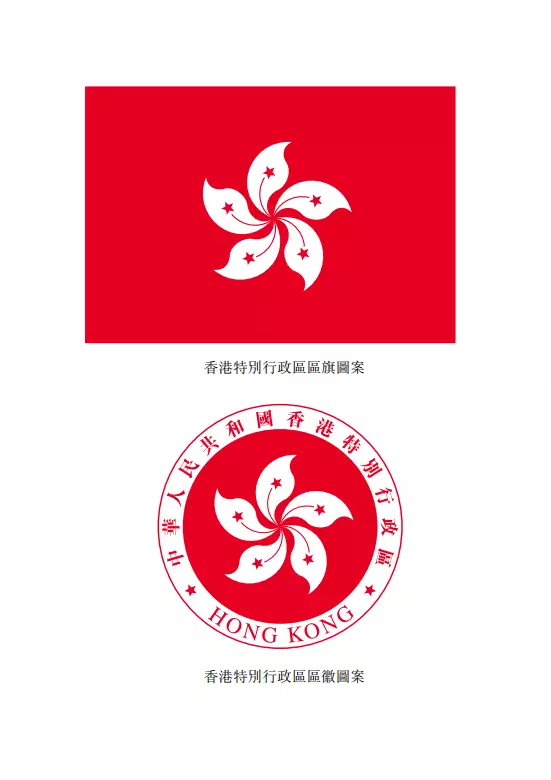
Instrument 6
Explanations on “The Basic Law of the Hong Kong Special Administrative Region of the People’s Republic of China (Draft)” and Its Related Documents (Addressing the Third Session of the Seventh National People’s Congress on 28 March 1990)
Ji Pengfei
Chairman of the Drafting Committee for the Basic Law of the Hong Kong Special Administrative Region of the People’s Republic of China
Fellow Deputies, Through four years and eight months of effort, the Drafting Committee for The Basic Law of the Hong Kong Special Administrative Region of the People’s Republic of China has completed the work of drafting the Basic Law. The Standing Committee of the National People’s Congress has submitted to the current session of the National People’s Congress for examination “The Basic Law of the Hong Kong Special Administrative Region of the People’s Republic of China (Draft)” and three annexes; the draft designs of the regional flag and regional emblem for the Hong Kong Special Administrative Region: “The Decision of the National People’s Congress of the People’s Republic of China on the Method for the Formation of the First Government and the First Legislative Council of the Hong Kong Special Administrative Region (Draft),” which has been worked out by the Drafting Committee on behalf of the National People’s Congress; and “The Proposal by the Drafting Committee for the Basic Law of the Hong Kong Special Administrative Region on the Establishment of the Committee for the Basic Law of the Hong Kong Special Administrative Region under the Standing Committee of the National People’s Congress.” I have been entrusted by the Drafting Committee for the Basic Law of the Hong Kong Special Administrative Region to make the following explanations concerning this legal document.
In accordance with “The Decision of the Third Session of the Sixth National People’s Congress on the Establishment of the Drafting Committee for the Basic Law of the Hong Kong Special Administrative Region of the People’s Republic of China,” at its 11th session the Standing Committee of the Sixth National People’s Congress appointed the members of the Hong Kong Basic Law Drafting Committee. On 1 July 1985, the Drafting Committee was officially established and began its work. After mapping out its work plans and deciding upon the structure of the Basic Law, the Drafting Committee set up five special groups consisting of committee members from both the mainland and Hong Kong. The five groups, namely, the Special Group Concerned with the Relationship between the Central Authorities and the Hong Kong Special Administrative Region; the Special Group Concerned with Fundamental Rights and Duties of Residents; the Special Group Concerned with the Political Structure; the Special Group Concerned with the Economy; and the Special Group Concerned with Education, Science, Technology, Culture, Sports and Religion, were responsible for the drafting work. After these special groups worked out their first draft of provisions of the Basic Law, the General Working Group was set up to make overall adjustment and revision of the draft provisions. In April 1988, the seventh plenary session of the Hong Kong Basic Law Drafting Committee issued “The Draft Basic Law of the Hong Kong Special Administrative Region of the People’s Republic of China for Solicitation of Opinions.” In the next five months, the Committee widely collected opinions from Hong Kong and the provinces, autonomous regions, municipalities directly under the Central Government and relevant departments on the mainland and, based on the collected opinions, the Committee made more than 100 revisions in the draft version. In January 1989, at its eighth plenary session, the Drafting Committee voted by secret ballot on the draft Hong Kong Basic Law and its annexes and related documents to be submitted to the Standing Committee of the National People’s Congress, article by article and document by document. Except for Article 19 in the draft Basic Law, all other provisions, annexes and related documents were adopted by a two-thirds majority. At its sixth session held in February 1989, the Standing Committee of the Seventh National People’s Congress decided to promulgate the Hong Kong Basic Law (Draft), its annexes and other related documents to widely solicit opinions from Hong Kong; from the provinces, autonomous regions and municipalities directly under the Central Government on the mainland; and from central government departments, democratic parties, mass organizations and experts as well as from the general departments of the People’s Liberation Army. After an eight-month opinion-soliciting period followed by a careful study of the opinions collected from all circles, the special groups jointly put forward 24 amendment bills, including the one regarding Article 19 in the Hong Kong Basic Law (Draft). At the ninth plenary session of the Drafting Committee in February this year, those amendment bills were voted upon by secret ballot one by one and all of them were passed by an over two-thirds majority. Then, all relevant provisions in the original draft were replaced by provisions recommended by the amendment bills. With this, the work of drawing up the Hong Kong Basic Law (Draft), its annexes and other related documents was complete.
The collection and selection of designs for the regional flag and regional emblem of the Hong Kong Special Administrative Region was the responsibility of the Committee for Selecting Designs for the Regional Flag and Regional Emblem of the Hong Kong Special Administrative Region, consisting of five drafters of the Basic Law and six experts from both Hong Kong and the mainland. After the selecting committee conducted the first and second rounds of selection from the 7,147 contributed designs, the Basic Law Drafting Committee examined and appraised the candidates recommended by the selecting committee. Since the Drafting Committee failed to decide upon a single set of designs for the regional flag and regional emblem to be submitted to the National People’s Congress for examination, the selecting committee again worked out three sets of candidate designs of the regional flag and regional emblem for the Hong Kong Special Administrative Region through collective modification of certain contributed designs. The draft designs of the regional flag and regional emblem to be submitted to the National People’s Congress for examination were finally selected at the ninth plenary session of the Basic Law Drafting Committee through a secret ballot. Also at the session, the second and third paragraphs under Article 10 of the draft Basic Law regarding the regional flag and regional emblem of the Special Administrative Region were passed. Over this period of more than four years, the Drafting Committee has held nine plenary sessions, 25 meetings of the Chairman and ViceChairmen and two enlarged meetings of the Chairman and Vice- Chairmen; the General Working Group held three meetings; the Special Groups met 73 times; and even the Committee for Selecting Designs for the Regional Flag and Regional Emblem of the Hong Kong Special Administrative Region held five meetings.
In reviewing the work done over this period of more than four years, we must say that drafting of this legal document was conducted in a very democratic and open manner. During the process of drafting the Basic Law, members of the Drafting Committee worked together with one heart and pooled their wisdom and efforts; and each and every article of the document was worked out after investigation, study and full discussion in which views of the majority were followed and those of the minority respected. After every meeting, reporters covering the event were briefed and the Consultative Committee for the Basic Law of the Hong Kong Special Administrative Region was immediately informed of its proceedings. The work of drafting the Basic Law was completed with the close attention and broad participation of the entire nation, especially the compatriots and people from all circles in Hong Kong. What is especially noteworthy here is that the Hong Kong Basic Law Consultative Committee, formed by people from all walks of life in Hong Kong, collected a great amount of opinions and suggestions in Hong Kong on the Basic Law and promptly referred them to the Drafting Committee and has rendered active and effective assistance to the work of drafting the Basic Law from the very beginning. The work of the Consultative Committee has been praised by the drafters.
Fellow Deputies, The draft Basic Law that has been submitted to the current session of the National People’s Congress for examination includes a Preamble and 160 articles in nine chapters. The nine chapters are: Chapter I, General Principles; Chapter II, Relationship Between the Central Authorities and the Hong Kong Special Administrative Region; Chapter III, Fundamental Rights and Duties of the Residents; Chapter IV, Political Structure; Chapter V, Economy; Chapter VI, Education, Science, Culture, Sports, Religion, Labour and Social Services; Chapter VII, External Affairs; Chapter VIII, Interpretation and Amendment of the Basic Law; and Chapter IX, Supplementary Provisions. There are also three annexes, namely, Annex I: Method for the Selection of the Chief Executive of the Hong Kong Special Administrative Region; Annex II: Method for the Formation of the Legislative Council of the Hong Kong Special Administrative Region and Its Voting Procedures; and Annex III: National Laws to be Applied in the Hong Kong Special Administrative Region.
I. On the Guiding Principle of Drafting the Hong Kong Basic Law “One country, two systems” is the fundamental policy of the Chinese Government for bringing about the country’s reunification. In line with this policy, the Chinese Government has formulated a series of principles and policies regarding Hong Kong. The main point is to establish a special administrative region directly under the Central People’s Government when China resumes its sovereignty over Hong Kong. Except for national defence and foreign affairs, which are to be administered by the Central Government, the Hong Kong Special Administrative Region will exercise a high degree of autonomy; no socialist system or policies will be practiced in the Region, the original capitalist society, economic system and way of life will remain unchanged and the laws previously in force in Hong Kong will remain basically the same; Hong Kong’s status as an international financial centre and free port will be maintained; and the economic interests of Britain and other countries in Hong Kong will be taken into consideration. The Chinese Government has written the above principles and policies into the Sino-British Joint Declaration on the Question of Hong Kong and proclaimed that all the principles and policies regarding Hong Kong will remain unchanged for 50 years, which is to be codified in the Basic Law. The concept of “one country, two systems” and all the principles and policies regarding Hong Kong formulated on the basis of this concept provide the fundamental guarantee for the resumption of China’s sovereignty over Hong Kong and the maintenance of Hong Kong’s stability and prosperity; they also conform to the basic interests of the Chinese people, particularly those of the Hong Kong compatriots. Article 31 of China’s Constitution stipulates that “the state may establish special administrative regions when necessary. The systems to be instituted in special administrative regions shall be prescribed by law enacted by the National People’s Congress in the light of the specific conditions.” China is a socialist country and socialism is China’s basic system. To realize China’s reunification, however, another kind of social system, namely, the capitalist system, may be practiced in individual regions of the country. It is on the basis of China’s Constitution and with “one country, two systems” as the guiding principle that all the state principles and policies regarding Hong Kong have been established in the draft Hong Kong Basic Law, which has been submitted to the present session of the National People’s Congress for examination.
II. On the relationship between the Central Authorities and the Hong Kong Special Administrative Region The relationship between the Central Authorities and the Hong Kong Special Administrative Region is one of the important issues defined by the Basic Law and is touched upon not only in Chapter II but also in Chapter I, Chapter VII, Chapter VIII and other chapters. Article 12 of the draft stipulates, “The Hong Kong Special Administrative Region shall be a local administrative region of the People’s Republic of China, which shall enjoy a high degree of autonomy and come directly under the Central People’s Government.” This stipulation defines the legal status of the Hong Kong Special Administrative Region and constitutes the basis for specifying the Region’s limits of power and its relationship with the Central Authorities. The Hong Kong Special Administrative Region, as an inalienable part of the People’s Republic of China, will be a local administrative region directly under the Central People’s Government and at the same time, it will be a special administrative region enjoying a high degree of autonomy and practicing a system and executing policies different from those of the mainland. Therefore, the draft Basic Law contains both provisions embodying the unity and sovereignty of the country and provisions empowering the Special Administrative Region with a high degree of autonomy in the light of Hong Kong’s special circumstances. The power to be exercised by, or the affairs which are the responsibility of the Standing Committee of the National People’s Congress or the Central People’s Government, as prescribed in the draft law, is indispensable to maintaining the state sovereignty. For example, the Central People’s Government will be responsible for the Special Administrative Region’s defence and foreign affairs and the Chief Executive and other principal officials of the Special Administrative Region will be appointed by the Central People’s Government; a small number of national laws relating to defence and foreign affairs as well as other matters beyond the limits of the autonomy of the Special Administrative Region will be applied locally by way of promulgation or legislation by the Special Administrative Region; and in the event that the National People’s Congress Standing Committee decides to declare a state of war or, by reason of turmoil within the Hong Kong Special Administrative Region which endangers national unity or security and is beyond the control of the Special Administrative Region Government, decides that the Region is in a state of emergency, the Central People’s Government may issue an order applying the relevant national laws in Hong Kong. The draft law also stipulates that the Hong Kong Special Administrative Region shall enact laws on its own to prohibit any act of treason, secession, sedition, or subversion against the Central People’s Government, or theft of state secret, to prohibit foreign political organizations or bodies from conducting political activities in the Region, and to prohibit political organizations or bodies of the Region from establishing ties with foreign political organizations or bodies. These stipulations are entirely necessary for maintaining the state sovereignty, unity and territorial integrity as well as for preserving Hong Kong’s longterm stability and prosperity.
The high degree of autonomy to be enjoyed by the Special Administrative Region, as stipulated in the draft, embodies executive, legislative and independent judicial power, including that of final adjudication. The Special Administrative Region, authorized by the Central People’s Government, also has the power to conduct relevant external affairs on its own. This shows that the Hong Kong Special Administrative Region will enjoy extensive autonomy. Regarding the executive power, the draft law, while stipulating that the Special Administrative Region shall, on its own, conduct the administrative affairs of Hong Kong in accordance with the Basic Law, specifically defines the Special Administrative Region’s autonomy in areas such as finance, economy, industry and commerce, trade, transport and communications, development and management of land and natural resources, education, science and technology, culture, sports, public order and control of entry and exit activities. For instance, the draft law stipulates that the Special Administrative Region shall have independent finances, its revenues shall not be handed over to the Central Government, and the Central Government shall not levy taxes in the Region; and the Special Administrative Region may, on its own, formulate monetary and financial policies, the Hong Kong dollar shall be the legal tender in the Region, and the authority to issue Hong Kong currency shall be vested in the Special Administrative Region Government. Also, the draft stipulates that representatives of the Special Administrative Region Government may act as members of delegations of the Chinese Government to participate in negotiations at the diplomatic level affecting Hong Kong; the Special Administrative Region may on its own, using the name “Hong Kong, China,” maintain and develop relations and conclude and implement agreements with foreign states and regions and relevant international organizations in economic, trade, financial and monetary, shipping, communications, tourism, cultural, sports and other appropriate fields.
Regarding the legislative power, the draft stipulates that laws enacted by the Hong Kong Special Administrative Region legislature shall take effect upon the signature and promulgation by the Chief Executive. The laws shall be reported to the National People’s Congress Standing Committee for the record, but they will go into force without being affected by this reporting. The draft also stipulates that only when it considers that any law enacted by the Special Administrative Region legislature is not in conformity with the provisions of the Basic Law regarding affairs within the responsibility of the Central Authorities or regarding the relationship between the Central Authorities and the Region, shall the National People’s Congress Standing Committee return the law in question; the Standing Committee shall not amend it. Any law returned by the National People’s Congress Standing Committee shall immediately be invalidated. These stipulations not only conform with the “one country, two systems” principle and are in line with provisions of the Constitution, but also take into full consideration the need for Hong Kong to enjoy a high degree of autonomy. According to the Constitution, interpretation of laws is among the powers and functions of the National People’s Congress Standing Committee. To take into account Hong Kong’s special circumstances, the draft Basic Law, while stipulating that the power of interpretation of the Basic Law shall be vested in the National People’s Congress Standing Committee, provides that the National People’s Congress Standing Committee shall authorizes the courts of the Hong Kong Special Administrative Region to interpret on their own, in adjudicating cases, the provisions of the Basic Law which are within the limits of the autonomy of the Region. This stipulation will guarantee the power of the National People’s Congress Standing Committee and also facilitate the Hong Kong Special Administrative Region in exercising its autonomy. According to the draft, the Hong Kong Special Administrative Region courts may also interpret other provisions of the Basic Law in adjudicating cases. However, if the courts, in adjudicating cases, need to interpret the provisions of the Basic Law concerning affairs which are the responsibility of the Central People’s Government, or the relationship between the Central Authorities and the Region, and if such interpretation will affect their final judgements on the cases, the courts shall seek an interpretation of the relevant provisions from the National People’s Congress Standing Committee through the Court of Final Appeal of the Region. The courts, in applying those provisions, shall follow the interpretation of the National People’s Congress Standing Committee. This stipulation will provide the basis for the Region’s courts, in adjudicating cases, to comprehend the provisions of the Basic Law concerning affairs which are the responsibility of the Central Government or the relationship between the Central Authorities and the Hong Kong Special Administrative Region, and prevent the courts from making erroneous judgements due to inaccurate understanding.
The draft vests the courts of the Special Administrative Region with independent judicial power, including that of final adjudication. This is certainly a very special situation wherein courts in a local administrative region enjoy the power of final adjudication. Nevertheless, in view of the fact that Hong Kong will practise social and legal systems different from the mainland’s, this provision is necessary. Under the current judicial system and principles, the Hong Kong authorities have never exercised jurisdiction over acts of state such as defence and foreign affairs. While preserving the above principle, the draft stipulates that the courts of the Hong Kong Special Administrative Region shall obtain a certificate from the Chief Executive on questions of fact concerning acts of state such as defence and foreign affairs wherever such questions arise in the adjudication of cases. This certificate shall be binding on the courts. However, before issuing such a certificate, the Chief Executive shall obtain a certifying document from the Central People’s Government. This stipulation not only appropriately solves the question of jurisdiction over acts of state, but also guarantees that the courts of the Region can conduct their functions in a normal way.
In addition, in order to enable the National People’s Congress Standing Committee to heed fully the opinions of the people from all walks of life in Hong Kong when it makes decisions on whether a law enacted by the Special Administrative Region legislature conforms to the provisions concerning affairs within the responsibility of the Central Authorities or to the provisions concerning the relationship between the Central Authorities and the Special Administrative Region, decisions on adding to or deleting from the list of national laws which are applicable in the Hong Kong Special Administrative Region in Annex III and decisions on the interpretation of and amendment to the Basic Law, the ,drafters have recommended that when the Basic Law comes into force, a working committee be set up under the National People’s Congress Standing Committee to submit its views regarding the above questions to the National People’s Congress Standing Committee. The working committee shall be composed of people from the mainland and Hong Kong. To this end, the Hong Kong Basic Law Drafting Committee has drafted the “Proposal by the Drafting Committee for the Basic Law of the Hong Kong Special Administrative Region on the Establishment of the Committee for the Basic Law of the Hong Kong Special Administrative Region under the Standing Committee of the National People’s Congress.”
III. On the Fundamental Rights and Duties of Hong Kong Residents The extensive rights and freedoms enjoyed by the residents of the Hong Kong Special Administrative Region and other people residing in the Region as prescribed in Chapter III of the draft Basic Law include political, economic, cultural, social and family rights and freedoms and the freedom of person. The special features in the provisions concerning Hong Kong residents’ rights and freedoms in the draft Basic Law boil down to the following two basic points:
(1) The draft provides multi-level protection for Hong Kong residents’ rights and freedoms. In accordance with the characteristics of the composition of Hong Kong residents, the draft stipulates not only the general rights and freedoms enjoyed by Hong Kong residents, but also the rights of the permanent residents and Chinese citizens living among them. It also stipulates that people other than Hong Kong residents also enjoy the rights and freedoms of Hong Kong residents in accordance with the law. In addition, while stipulating in explicit terms the fundamental rights and freedoms of Hong Kong residents, the draft also stipulates that Hong Kong residents shall enjoy the other rights and freedoms safeguarded by the laws of the Hong Kong Special Administrative Region. In view of the application in Hong Kong of the International Covenant on Civil and Political Rights, the International Covenant on Economic, Social and Cultural Rights, and international labour conventions, the draft stipulates that those provisions shall remain in force and be implemented through the laws of the Special Administrative Region. In addition to a chapter specially devoted to Hong Kong residents’ rights and freedoms, there are also provisions concerning the issue in other relevant chapters and articles. Thus, extensive, comprehensive and multi-level protection is provided for safeguarding Hong Kong residents’ rights and freedoms.
(2) The rights, freedoms and duties of Hong Kong residents are prescribed in the draft in accordance with the principle of “one country, two systems” and in the light of Hong Kong’s actual situation. They include such specific provisions as protection of private ownership of property, the freedom of movement and freedom to enter or leave the Region, the right to raise a family freely and protection of private persons’ and legal entities’ property. The draft also provides that the systems to safeguard the fundamental rights and freedoms of Hong Kong residents shall all be based on the Basic Law.
IV. On the Political Structure Chapter IV of the draft Basic Law mainly defines the formation and powers of and inter-relationship among the executive, legislature and judiciary, as well as the qualifications, powers and functions of and relevant policies regarding the Chief Executive, principal officials, members of the executive and legislative councils, judges of the courts at all levels and other members of the judiciary, and public servants of the Hong Kong Special Administrative Region. It also provides that district organizations which are not organs of political power may be established in the Region. The political structure of the Hong Kong Special Administrative Region should accord with the principle of “one country, two systems” and aim to maintain stability and prosperity in Hong Kong in line with its legal status and actual situation. To this end, consideration must be given to the interests of the different sectors of society and the structure must facilitate the development of the capitalist economy in the Region. While the part of the existing political structure proven to be effective will be maintained, a democratic system that suits Hong Kong’s reality should gradually be introduced. In accordance with this principle, Chapter IV and Annexes I and II of the Basic Law contain the following major provisions concerning the political structure of the Hong Kong Special Administrative Region:
(1) The relationship between the executive authorities and the legislature. The executive authorities and the legislature should regulate each other as well as co-ordinate their activities. To maintain Hong Kong’s stability and administrative efficiency, the Chief Executive must have real power which, at the same time, should be subject to some restrictions. The draft provides for the Chief Executive to be the head of the Hong Kong Special Administrative Region and accountable to the Central People’s Government and the Hong Kong Special Administrative Region. He or she is to lead the government of the Region, sign bills and budgets and promulgate laws. If the Chief Executive considers a bill passed by the Legislative Council to be not compatible with the overall interests of the Region, he or she may return it to the Legislative Council for reconsideration. If the Chief Executive refuses to sign a bill passed the second time by the Legislative Council, or the Legislative Council refuses to pass a budget or any other important bill introduced by the government, and if consensus still cannot be reached after consultations, the Chief Executive may dissolve the Legislative Council. On the other hand, the Basic Law provides that the government of the Region must abide by the law and be accountable to the Legislative Council. It must implement laws passed by the Legislative Council and already in force, present regular policy addresses to the Council, answer questions raised by members of the Council and obtain approval from the Council for taxation and public expenditure. The Chief Executive must consult the Executive Council before making important policy decisions, introducing bills to the Legislative Council, enacting subordinate legislation, or dissolving the Legislative Council. The Basic Law also stipulates that if the bill returned by the Chief Executive is passed again by the Legislative Council with at least a two-thirds majority, the Chief Executive must sign and promulgate it within one month, unless he or she dissolves the Legislative Council. If the newly elected Legislative Council, after the old one has been dissolved, again passes by a two-thirds majority the original bill in dispute, or it still refuses to pass the original budget or any other important bill introduced by the government, the Chief Executive must resign. If the Chief Executive is found to have committed a serious breach of law or dereliction of duty and if he or she still refuses to resign, the Legislative Council may pass a motion of impeachment through the specified procedures and refer it to the Central People’s Government for decision. The provisions mentioned above embody the relationship of regulation and co-ordination between the executive authorities and the legislature.
(2) The method for the selection of the Chief Executive. The draft stipulates that the Chief Executive shall be selected by election or through consultations and be appointed by the Central People’s Government. The method for selecting the Chief Executive shall be worked out in the light of the actual situation in Hong Kong and applied in a gradual and orderly way. The ultimate goal is the selection of the Chief Executive by universal suffrage upon nomination by a broadly representative nominating committee in accordance with democratic procedures. Based on these provisions, Annex I provides specific rules on selecting the Chief Executive. In the ten years between 1997 and 2007, the Chief Executive will be elected by a broadly representative election committee. If there is need to amend this method of election after that period, such amendments must be made with the endorsement of a two-thirds majority of all the members of the Legislative Council and the consent of the Chief Executive, and they must be submitted to the Standing Committee of the National People’s Congress for approval. The method for selecting the Chief Executive is provided in an annex to make it more amenable to revision when necessary.
(3) The method for forming the Legislative Council and its procedures for voting on bills and motions. According to the draft Basic Law, the Legislative Council will be constituted by election. The method for forming the Legislative Council will be worked out in the light of the actual situation in Hong Kong and applied in a gradual and orderly way. The ultimate goal is the election of all the members of the Legislative Council by universal suffrage. In accordance with these provisions, Annex II provides specific rules on formation of the Legislative Council. The first and second Legislative Council will be formed by members elected by functional constituencies, by the Election Committee or by geographical constituencies through direct elections. During the first 10 years after the Special Administrative Region is established, the number of seats in the Legislative Council for members elected by geographical constituencies through direct elections will be increased with each passing council, and the number of seats elected by the Election Committee will be gradually reduced. When the third Legislative Council is formed, members elected by functional constituencies and geographical constituencies through direct elections will each share half the seats of the Legislative Council. These rules accord with the principle of developing the election system in a gradual and orderly way. Annex II also stipulates that different voting procedures shall be adopted by the Legislative Council in handling bills introduced by the government and motions and bills introduced by individual members of the Legislative Council. The passage of bills introduced by the government requires a simple majority vote of the members of the Legislative Council present. The passage of motions, bills or amendments to government bills introduced by individual members of the Legislative Council requires at least a simple majority vote by each of the two groups of members present, i.e., members returned by functional constituencies and those returned by geographical constituencies through direct elections and by the Election Committee. Such provisions take into consideration the interests of all social strata and will prevent endless debates over government bills, thus helping the government work with efficiency. Ten years after the establishment of the Special Administrative Region, if there is a need to improve the method for forming the Legislative Council and its procedures for voting on bills and motions, such improvements shall be made with the endorsement of a two-thirds majority of all the members of the Legislative Council and the consent of the Chief Executive, and they must be reported to the Standing Committee of the National People’s Congress for the record. The method for forming the Legislative Council and the Council’s procedures for voting on bills and motions are provided in an annex because it is more amenable to revision when necessary.
(4) Qualifications for the Chief Executive of the Hong Kong Special Administrative Region, members of the Executive Council, the President of the Legislative Council, principal government officials, the chief justice of the Court of Final Appeal and the chief judges of the High Court, as well as Hong Kong members of the Basic Law Committee. Relevant provisions in the draft Basic Law stipulate that these posts must be held by Chinese citizens who are permanent residents of the Region with no right of abode in any foreign country. This helps define state sovereignty and reflects the principle of managing Hong Kong by the Hong Kong people. Only in this way can those maintaining the posts mentioned above hold themselves responsible to the State, the Region and the residents of Hong Kong. Based on the same considerations, relevant articles stipulate that the Region’s Legislative Council must be composed of Chinese citizens who are permanent residents of the Region with no right of abode in any foreign country. However, in view of Hong Kong’s specific conditions, permanent residents of the Region who are not of Chinese nationality or who have the right of abode in foreign countries may also be elected members of the Legislative Council of the Region, provided that the proportion of such members does not exceed 20 per cent of the total membership of the Council.
(5) The method for the formation of the first Government and the first Legislative Council of the Hong Kong Special Administrative Region. In line with the principles of state sovereignty and for the benefit of smooth transition, the establishment of the Special Administrative Region will be presided over by a Preparatory Committee set up by the National People’s Congress. Since preparations must be made before the establishment of the first Government and the first Legislative Council and since the Basic Law will not go into effect until 1 July 1997, the Drafting Committee has suggested that the National People’s Congress make a special decision on the method for the formation of the first Government and Legislative Council and that the decision be made public together with the Basic Law. The Drafting Committee has therefore worked out a draft of the decision on behalf of the National People’s Congress. According to this decision, the candidate for the first Chief Executive of the Hong Kong Special Administrative Region will be recommended by a selection committee composed entirely of Hong Kong residents and then referred to the Central People’s Government for appointment. If the composition of the last Hong Kong Legislative Council before the establishment of the Special Administrative Region is in conformity with the provisions of the decision made by the National People’s Congress on the method for the formation of the first Government and the first Legislative Council, those of its members who uphold the Basic Law and pledge allegiance to the Hong Kong Special Administrative Region and who meet the requirements set forth in the Basic Law may, upon confirmation by the Preparatory Committee, become members of the first Legislative Council of the Region. This arrangement is designed to ensure stability throughout the transition period and make the two governments dovetail without a hitch. According to the decision, when assuming office, the Chief Executive, principal officials, members of the Executive Council and the Legislative Council, judges of the courts at all levels and other members of the judiciary must swear to uphold the Basic Law and swear allegiance to the Hong Kong Special Administrative Region of the People’s Republic of China.
V. On Economy, Education, Science, Culture, Sports, Religion, Labour and Social Services
Chapter V of the Basic Law contains stipulations on the economic system and policies of the Hong Kong Special Administrative Region, divided into eight fields of endeavour: public finance, monetary affairs, trade, industry, commerce, land leases, shipping and civil aviation. These stipulations are indispensable to ensuring the normal operation of Hong Kong’s capitalist economic mechanism and maintaining its status as an international financial centre and free port. Concerning monetary affairs, for instance, the draft Basic Law stipulates that no foreign exchange control policies shall be applied in the Hong Kong Special Administrative Region and that markets for foreign exchange, gold, securities, futures and the like shall continue. The free flow of capital within, into and out of Region as well as the free operation of financial businesses and financial markets are safeguarded. It also stipulates that the Hong Kong dollar is the legal tender in the Region and shall be freely convertible and that the authority for its issuance shall be vested in the Government of the Hong Kong Special Administrative Region. As for foreign trade, the draft Basic Law stipulates that all investments from outside the Region shall be protected by law, and the free movement of goods, intangible assets and capital shall be safeguarded. Unless otherwise prescribed by law, no tariff shall be imposed. As a separate customs territory, the Region may, using the name “Hong Kong, China,” participate in relevant international organizations and trade agreements (including preferential trade arrangements), such as the General Agreement on Tariffs and Trade and arrangements regarding international trade in textiles. Export quotas, tariff preferences and other similar arrangements obtained or made by the Hong Kong Special Administrative Region shall be enjoyed exclusively by the Region. The draft Basic Law also stipulates that the Hong Kong Special Administrative Region shall strive to achieve a fiscal balance and avoid deficits in drawing up its budget. The Region may also enact laws on its own concerning the taxation system, using the previously pursued low tax policy as reference. The draft Basic Law also carries detailed stipulations concerning the major trades, land leases, shipping, civil aviation and the like.
Chapter VI of the draft Basic Law carries stipulations on the maintenance and development of Hong Kong’s current systems and policies concerning education, science, culture, sports, religion, labour and social services. These stipulations involve the interests of Hong Kong residents in many aspects of public life and are important for social stability and development.
There are quite a number of articles concerning policies in Chapter V and VI of the draft Basic Law. The Chinese Government has undertaken, in the Sino-British Joint Declaration, to write its basic principles and policies on Hong Kong and their detailed explanations as given in Annex I of the Joint Declaration into Basic Law, and Hong Kong residents from all walks of life have a strong desire for the Basic Law to reflect and protect their interests. Therefore, it was decided in the end that these articles concerning policies should remain in the draft Basic Law, despite the differing opinions expressed over the brevity of articles during the drafting of the law.
Finally, I should like to explain a few points about the draft designs of the regional flag and regional emblem of the Hong Kong Special Administrative Region. The regional flag carries a design of five bauhinia petals, each with a star in the middle, on a red background. The red flag represents the motherland and the bauhinia represents Hong Kong. The design implies that Hong Kong is an inalienable part of China and prospers in the embrace of the motherland. The five stars on the flower symbolize the fact that all Hong Kong compatriots love their motherland, while the red and white colours embody the principle of “one country, two systems.” The regional emblem is round and bears a design similar to the one on the flag, with five red stars on a white bauhinia against a red background, which also symbolizes the principle of “one country, two systems” by the use of red and white. The outer ring of the emblem carries the words “Hong Kong Special Administrative Region of the People’s Republic of China” in Chinese, and “HONG KONG” in English. Fellow Deputies, I hereby present my explanations concerning “The Basic Law of the Hong Kong Special Administrative Region of the People’s Republic of China (Draft),” its annexes and other relevant documents and concerning the draft designs of the regional flag and regional emblem of the Special Administrative Region, to the National People’s Congress for examination.
Instrument 7
* Decision of the National People’s Congress on the Basic Law of the Hong Kong Special Administrative Region of the People’s Republic of China (Adopted at the Third Session of the Seventh National People’s Congress on 4 April 1990
The Third Session of the Seventh National People’s Congress adopts the Basic Law of the Hong Kong Special Administrative Region of the People’s Republic of China, including Annex I: Method for the Selection of the Chief Executive of the Hong Kong Special Administrative Region, Annex II: Method for the Formation of the Legislative Council of the Hong Kong Special Administrative Region and Its Voting Procedures, Annex III: National Laws to be Applied in the Hong Kong Special Administrative Region, and the designs of the regional flag and regional emblem of the Hong Kong Special Administrative Region. Article 31 of the Constitution of the People’s Republic of China provides: “The State may establish special administrative regions when necessary. The systems to be instituted in special administrative regions shall be prescribed by law enacted by the National People’s Congress in the light of the specific conditions.” The Basic Law of the Hong Kong Special Administrative Region is constitutional as it is enacted in accordance with the Constitution of the People’s Republic of China and in the light of the specific conditions of Hong Kong. The systems, policies and laws to be instituted after the establishment of the Hong Kong Special Administrative Region shall be based on the Basic Law of the Hong Kong Special Administrative Region. The Basic Law of the Hong Kong Special Administrative Region of the People’s Republic of China shall be put into effect as of July 1, 1997.
Instrument 8
* Decision of the National People’s Congress on the Establishment of the Hong Kong Special Administrative Region (Adopted at the Third Session of the Seventh National People’s Congress on 4 April 1990)
In accordance with the provisions of Article 31 and sub-paragraph 13 of Article 62 of the Constitution of the People’s Republic of China, the Third Session of the Seventh National People’s Congress decides: 1. The Hong Kong Special Administrative Region is to be established on July 1, 1997.
**2. The area of the Hong Kong Special Administrative Region covers the Hong Kong Island, the Kowloon Peninsula, and the islands and adjacent waters under its jurisdiction. The map of the administrative division of the Hong Kong Special Administrative Region will be published by the State Council separately.
Instrument 9
* Order of the State Council
of the People’s Republic of China No. 221 It is hereby promulgated that in accordance with the Decision of the National People’s Congress on the Establishment of the Hong Kong Special Administrative Region adopted at the Third Session of the Seventh National People’s Congress on 4 April 1990, the map of the administrative division of the Hong Kong Special Administrative Region of the People’s Republic of China was approved at the 56th Executive Meeting of the State Council on 7 May 1997. Appendix: Description of the boundary of the administrative division of the Hong Kong Special Administrative Region of the People’s Republic of China
LI Peng
Premier
1 July 1997
Appendix
Description of the Boundary of the Administrative Division of the Hong Kong Special Administrative Region of the People’s Republic of China The boundary comprises a land and sea sector.
I. The Land Sector
The land sector comprises three sections as follows:
(1) Sha Tau Kok Town
1. The boundary starts at the eastern corner of the base of the Sha Tau Kok pier (“Point 1”, Latitude 22˚32'37.21" North, Longitude 114˚13'34.85" East). From there, it runs directly to the mouth of the ditch running along the eastern side of San Lau Street. It then follows the centre line of the ditch, as far as the point where that line meets the centre line of Chung Ying Street (“Point 2”, Latitude 22˚32'45.42" North, Longitude 114˚13'32.40" East).
2. From Point 2, the boundary follows the centre line of Chung Ying Street as far as the point where that line meets the centre line of Bubu Street (“Point 3”, Latitude 22˚32'52.26" North, Longitude 114˚13'36.91” East).
3. From Point 3, the boundary follows a straight line to the western tip of the base of the foundation of Sha Tau Kok River Bridge in the middle of the river (“Point 4”, Latitude 22˚32'52.83" North, Longitude 114˚13’36.86" East).
(2) Sha Tau Kok Town to Pak Kung Au
From Point 4, the boundary runs upstream along the centre line of the Sha Tau Kok River and thence along the bottom line of the valley east of Pak Kung Au until it reaches the middle of the Pak Kung Au saddle point (“Point 5”, Latitude 22˚33'23.49" North, Longitude 114˚12'24.25" East).
(3) Pak Kung Au to the Mouth of the Shenzhen River The boundary runs from Point 5 along the bottom line of the main valley west of Pak Kung Au as far as the source of the Shenzhen River at Pak Kung Au. It continues along the centre line of the Shenzhen River to the mouth of the river at Shenzhen Bay (otherwise known as Deep Bay). After the realignment of the Shenzhen River, the boundary will follow the new centre line of the river.
II. The Sea Sector
The sea sector comprises three sections as follows:
(1) Shenzhen Bay
From the mouth of the Shenzhen River, the boundary runs along the middle of the southern navigable channel as far as Beacon 84 (otherwise known as “B” Beacon) (“Point 6”, Latitude 22˚30'36.23" North, Longitude 113˚59'42.20" East). From there, it follows straight lines in sequence through the following two points:
1. Beacon 83 (otherwise known as “A” Beacon) in Shenzhen Bay (“Point 7”, Latitude 22˚28'20.49" North, Longitude 113˚56'52.10" East); and
2. “Point 8”, (Latitude 22˚25'43.7" North, Longitude 113˚52'08.8" East), defined as the point where the line between Point 7 and Dongjiaozui at the southernmost tip of Neilingding Island intersects the meridian line of Longitude 113˚52'08.8" East.
(2) Southern Sea Section
From Point 8, the boundary follows a series of straight lines sequentially through the following thirteen points:
1. The boundary first runs southwards along the meridian line of Longitude 113˚52'08.8" East until it reaches Latitude 22˚20' North (“Point 9”, Latitude 22˚20' North, Longitude 113˚52'08.8" East). The boundary runs thence in sequence to:
2. “Point 10” (Latitude 22˚16'23.2" North, Longitude 113˚50'50.6" East), defined as the point one nautical mile northwest of the most northerly point on the coastline of Tai O;
3. “Point 11” (Latitude 22˚16'03.8" North, Longitude 113˚50'20.4" East), defined as the point one nautical mile northwest of the most westerly point on the coastline of Tai O;
4. “Point 12” (Latitude 22˚14'21.4" North, Longitude 113˚49'35.0" East), defined as the point one nautical mile northwest of the tip of the protruding point on the Lantau coastline southwest of Kai Kung Shan;
5. “Point 13” (Latitude 22˚13'01.4" North, Longitude 113˚49'01.6" East), defined as the point one nautical mile west of the most westerly point on Kai Yet Kok off Lantau Island; 6. “Point 14” (Latitude 22˚11'01.9" North, Longitude 113˚49'56.6" East), defined as the point one nautical mile southwest of the most southwesterly point on the coastline at Fan Lau Kok on Lantau Island;
7. “Point 15” (Latitude 22˚08'33.1" North, Longitude 113˚53'47.6" East), defined as the mid-point of a straight line between the most southerly point on the coastline of Tai A Chau in the Soko Islands and the tip of the protruding point at Yinjiaozui on the northern coastline of Dazhizhou;
8. “Point 16” (Latitude 22˚08'12.2" North, Longitude 113˚55'20.6" East), defined as the point one nautical mile south of the most southerly point on the coastline of Tau Lo Chau in the Soko Islands;
9. “Point 17” (Latitude 22˚08'54.5" North, Longitude 113˚56'22.4" East), defined as the eastern point of intersection between the parallel of Latitude 22˚08'54.5" North and an arc sector of one nautical mile radius centred on the most southerly point on the coastline of Tau Lo Chau in the Soko Islands;
10. “Point 18” (Latitude 22˚08'54.5" North, Longitude 114˚14'09.6" East), defined as the western point of intersection between the parallel of Latitude 22˚08'54.5" North and an arc sector of one nautical mile radius centred on the most southwesterly point on the coastline of Mat Chau in the Po Toi Islands;
11. “Point 19” (Latitude 22˚08'18.8" North, Longitude 114˚15'18.6" East), defined as the point one nautical mile due south of Nam Kok Tsui on Po Toi Island;
12. “Point 20” (Latitude 22˚08'54.5" North, Longitude 114˚17'02.4" East), defined as the eastern point of intersection between the parallel of Latitude 22˚08'54.5" North and an arc sector of one nautical mile radius centred on the most southeasterly point at Tai Kok Tau on Po Toi Island;
13. “Point 21”, defined by the coordinates Latitude 22˚08'54.5" North, Longitude 114˚30'08.8" East.
(3) Mirs Bay From Point 21, the boundary then runs in sequential straight lines through the following ten points, then back to Point 1:
1. “Point 22”, defined by the coordinates Latitude 22˚21'54.5" North, Longitude 114˚30'08.8" East;
2. “Point 23” (Latitude 22˚28'07.4" North, Longitude 114˚27'17.6" East), defined as the mid-point of a straight line between the tip of the protruding point on the coastline north of Daluwan and the beacon on Shek Ngau Chau;
3. “Point 24” (Latitude 22˚32'41.9" North, Longitude 114˚27'18.5" East), defined as the mid-point of a straight line between the tip of the protruding point on the coastline southwest of Shuitousha and Kang Lau Shek on Ping Chau Island;
4. “Point 25” (Latitude 22˚33'43.2" North, Longitude 114˚26'02.3" East), defined as the mid-point of a straight line between Chengtoujiao and Chau Mei Kok on Ping Chau Island;
5. “Point 26” (Latitude 22˚34'06.0" North, Longitude 114˚19'58.7" East), defined as the mid-point of a straight line between the tip of the protruding point on the coastline at Beizaijiao and the most northerly point on the coastline of Round Island;
6. “Point 27” (Latitude 22˚34'00.0" North, Longitude 114˚18'32.7" East), defined as the mid-point of a straight line between the tip of the protruding point on the coastline at Zhengjiaozui and the most easterly point on the coastline at Kai Kung Tau on Crooked Island; 7. “Point 28” (Latitude 22˚33'55.8" North, Longitude 114˚16'33.7" East), defined as the mid-point of a straight line between the tip of the protruding point on the coastline at Tangyuanchong and the most northerly point on the coastline of Crooked Island;
8. “Point 29” (Latitude 22˚33'20.6" North, Longitude 114˚14'55.2" East), defined as the mid-point of a straight line between the point where the stream south of Enshang meets the sea and Cheung Pai Tau;
9. “Point 30” (Latitude 22˚33'02.6" North, Longitude 114˚14'13.4" East), defined as the mid-point of a straight line between the point where the stream at Guanluxia meets the sea and Sam Kuk Tsui; and
10. “Point 31” (Latitude 22˚32'37.2" North, Longitude 114˚14'01.1" East), defined as the mid-point of a straight line running due east from Point 1 to the opposite shoreline.
Instrument 10
* Decision of the National People’s Congress on the Method for the Formation of the First Government and the First Legislative Council of the Hong Kong Special Administrative Region
(Adopted at the Third Session of the Seventh National People’s Congress on 4 April 1990)
1. The first Government and the first Legislative Council of the
Hong Kong Special Administrative Region shall be formed in accordance with the principles of State sovereignty and smooth transition.
2. Within the year 1996, the National People’s Congress shall establish a Preparatory Committee for the Hong Kong Special Administrative Region, which shall be responsible for preparing the establishment of the Hong Kong Special Administrative Region and shall prescribe the specific method for the formation of the first Government and the first Legislative Council in accordance with this Decision. The Preparatory Committee shall be composed of mainland members and of Hong Kong members who shall constitute not less than 50 per cent of its membership. Its chairman and members shall be appointed by the Standing Committee of the National People’s Congress.
3. The Preparatory Committee for the Hong Kong Special Administrative Region shall be responsible for preparing the establishment of the Selection Committee for the First Government of the Hong Kong Special Administrative Region (hereinafter referred to as the Selection Committee).
The Selection Committee shall be composed entirely of permanent residents of Hong Kong and must be broadly representative. It shall include Hong Kong deputies to the National People’s Congress, representatives of Hong Kong members of the National Committee of the Chinese People’s Political Consultative Conference, persons with practical experience who have served in Hong Kong’s executive, legislative and advisory organs prior to the establishment of the Hong
Kong Special Administrative Region, and persons representative of
various strata and sectors of society.
The Selection Committee shall be composed of 400 members in the following proportions:
Industrial, commercial and financial sectors 25 per cent
The professions 25 per cent
Labour, grass-roots, religious and other sectors 25 per cent
Former political figures, Hong Kong deputies to the National People’s Congress, and representatives of Hong Kong members of the National Committee of the Chinese People’s Political Consultative Conference 25 per cent
4. The Selection Committee shall recommend the candidate for the first Chief Executive through local consultations or through nomination and election after consultations, and report the recommended candidate to the Central People’s Government for appointment. The term of office of the first Chief Executive shall be the same as the regular term.
5. The Chief Executive of the Hong Kong Special Administrative Region shall be responsible for preparing the formation of the first Government of the Region in accordance with the Basic Law of the Hong Kong Special Administrative Region.
6. The first Legislative Council of the Hong Kong Special Administrative Region shall be composed of 60 members, with 20 members returned by geographical constituencies through direct elections, 10 members returned by an election committee, and 30 members returned by functional constituencies. If the composition of the last Hong Kong Legislative Council before the establishment of the Hong Kong Special Administrative Region is in conformity with the relevant provisions of this Decision and the Basic Law of the Hong Kong Special Administrative Region, those of its members who uphold the Basic Law of the Hong Kong Special Administrative Region of the People’s Republic of China and pledge allegiance to the Hong Kong Special Administrative Region of the People’s Republic of China, and
who meet the requirements set forth in the Basic Law of the Region may, upon confirmation by the Preparatory Committee, become members of the first Legislative Council of the Region.
The term of office of members of the first Legislative Council of the Hong Kong Special Administrative Region shall be two years.
Instrument 11
* Decision of the National People’s Congress Approving the Proposal by the Drafting Committee for the Basic Law of the Hong Kong Special Administrative Region on the Establishment of the Committee for the Basic Law of the Hong Kong Special Administrative Region under the Standing Committee of the National People’s Congress (Adopted at the Third Session of the Seventh National People’s Congress on 4 April 1990) The Third Session of the Seventh National People’s Congress decides:
1. to approve the proposal by the Drafting Committee for the Basic Law of the Hong Kong Special Administrative Region on the Establishment of the Committee for the Basic Law of the Hong Kong Special Administrative Region under the Standing Committee of the National People’s Congress; and 2. to establish the Committee for the Basic Law of the Hong Kong Special Administrative Region under the Standing Committee of the National People’s Congress when the Basic Law of the Hong Kong Special Administrative Region of the People’s Republic of China is put into effect.
Appendix
Proposal by the Drafting Committee for the Basic Law of the Hong Kong Special Administrative Region on the Establishment of the Committee for the Basic Law of the Hong Kong Special Administrative Region Under the Standing Committee of the National People’s Congress
1. Name: The Committee for the Basic Law of the Hong Kong Special Administrative Region under the Standing Committee of the National People’s Congress.
2. Affiliation: To be a working committee under the Standing Committee of the National People’s Congress.
3. Function: To study questions arising from the implementation of Articles 17, 18, 158 and 159 of the Basic Law of the Hong Kong Special Administrative Region and submit its views thereon to the Standing Committee of the National People’s Congress.
4. Composition: Twelve members, six from the mainland and six from Hong Kong, including persons from the legal profession, appointed by the Standing Committee of the National People’s Congress for a term of office of five years. Hong Kong members shall be Chinese citizens who are permanent residents of the Hong Kong Special Administrative Region with no right of abode in any foreign country and shall be nominated jointly by the Chief Executive, President of the Legislative Council and Chief Justice of the Court of Final Appeal of the Region for appointment by the Standing Committee of the National People’s Congress.
Instrument 12
* Decision of the Standing Committee of the National People’s Congress on the English Text of the Basic Law of the Hong Kong Special Administrative Region of the People’s Republic of China (Adopted on 28 June 1990)
The 14th Meeting of the Standing Committee of the Seventh National People’s Congress decides: the English translation of the Basic Law of the Hong Kong Special Administrative Region of the People’s Republic of China, examined and approved under the aegis of the Law Committee of the National People’s Congress, shall be the official English text and shall be equally authentic as the Chinese text. In case of any discrepancy in the meaning of wording between the English text and the Chinese text, the Chinese text shall prevail.
Instrument 13
* Explanations of Some Questions by the Standing Committee of the National People’s Congress Concerning the Implementation of the Nationality Law of the People’s Republic of China in the Hong Kong Special Administrative Region (Adopted at the Nineteenth Session of the Standing Committee of the Eighth National People’s Congress on 15 May 1996)
According to Article 18 of and Annex III to the Basic Law of the Hong Kong Special Administrative Region of the People’s Republic of China, the Nationality Law of the People’s Republic of China shall be applied in the Hong Kong Special Administrative Region from 1 July 1997. Taking account of the historical background and the existing circumstances of Hong Kong, the Standing Committee gives the following explanations concerning the implementation in the Hong Kong Special Administrative Region of the Nationality Law of the People’s Republic of China1. Where a Hong Kong resident is of Chinese descent and was born in the Chinese territories (including Hong Kong), or where a person satisfies the criteria laid down in the Nationality Law of the People’s Republic of China for having Chinese nationality, he is a Chinese national.
2. All Hong Kong Chinese compatriots are Chinese nationals, whether or not they are holders of the “British Dependent Territories Citizens passport” or “British Nationals (Overseas) passport”. With effect from 1 July 1997, Chinese nationals mentioned above may, for the purpose of travelling to other countries and territories, continue to use the valid travel documents issued by the Government of the United Kingdom. However, they shall not be entitled to British consular protection in the Hong Kong Special Administrative Region and other parts of the People’s Republic of China on account of their holding the above mentioned British travel documents.
3. According to the Nationality Law of the People’s Republic of China, the British Citizenship acquired by Chinese nationals in Hong Kong through the “British Nationality Selection Scheme” will not be recognised. They are still Chinese nationals and will not be entitled to British consular protection in the Hong Kong Special Administrative Region and other parts of the People’s Republic of China.
4. Chinese nationals of the Hong Kong Special Administrative Region with right of abode in foreign countries may, for the purpose of travelling to other countries and territories, use the relevant documents issued by the foreign governments. However, they will not be entitled to consular protection in the Hong Kong Special Administrative Region and other parts of the People’s Republic of China on account of their holding the above mentioned documents.
5. If there is a change in the nationality of a Chinese national of the Hong Kong Special Administrative Region, he may, with valid documents in support, make a declaration at the authority of the Hong Kong Special Administrative Region responsible for nationality applications.
6. The Government of the Hong Kong Special Administrative Region is authorised to designate its Immigration Department as the authority of the Hong Kong Special Administrative Region responsible for nationality applications. The Immigration Department of the Hong Kong Special Administrative Region shall handle all nationality applications in accordance with the Nationality Law of the People’s Republic of China and the foregoing provisions.
Instrument 14 *
Decision of the Standing Committee of the National People’s Congress on Treatment of the Laws Previously in Force in Hong Kong in Accordance with Article 160 of the Basic Law of the Hong Kong Special Administrative Region of the People’s Republic of China (Adopted at the Twenty Fourth Session of the Standing Committee of the Eighth National People’s Congress on 23 February 1997)
Article 160 of the Basic Law of the Hong Kong Special Administrative Region of the People’s Republic of China (hereinafter referred to as “the Basic Law”) stipulates: “Upon the establishment of the Hong Kong Special Administrative Region, the laws previously in force in Hong Kong shall be adopted as laws of the Region except for those which the Standing Committee of the National People’s Congress declares to be in contravention of this Law. If any laws are later discovered to be in contravention of this Law, they shall be amended or cease to have force in accordance with the procedure as prescribed by this Law.”
Article 8 stipulates:
“The laws previously in force in Hong Kong, that is, the common law, rules of equity, ordinances, subordinate legislation and customary law shall be maintained, except for any that contravene this Law, and subject to any amendment by the legislature of the Hong Kong Special Administrative Region.”
In accordance with the above provisions, the Standing Committee of the Eighth National People’s Congress examined the proposals made by the Preparatory Committee of the Hong Kong Special Administrative Region on treatment of issues relating to the laws previously in force in Hong Kong, and decides at its Twenty Fourth Session as follows:
1. The laws previously in force in Hong Kong, which include the common law, rules of equity, ordinances, subordinate legislation and customary law, except for those which are in contravention of the Basic Law, are adopted as the laws of the Hong Kong Special Administrative Region.
2. Such of the ordinances and subordinate legislation previously in force in Hong Kong as set out in Annex 1 to this Decision are in contravention of the Basic Law and are not adopted as the laws of the Hong Kong Special Administrative Region.
3. Such provisions of the ordinances and subordinate legislation previously in force in Hong Kong as set out in Annex 2 to this Decision are in contravention of the Basic Law and those provisions are not adopted as the laws of the Hong Kong Special Administrative Region.
4. Such of the laws previously in force in Hong Kong which have been adopted as the laws of the Hong Kong Special Administrative Region shall, as from 1 July 1997, be applied subject to such modifications, adaptations, limitations or exceptions as are necessary so as to bring them into conformity with the status of Hong Kong after resumption by the People’s Republic of China of the exercise of sovereignty over Hong Kong as well as to be in conformity with the relevant provisions of the Basic Law. For example, the New Territories Land (Exemption) Ordinance should conform with the above principles in its application.
Apart from conforming with the above principles, the following shall be observed, that is to say, in the ordinances and subordinate legislation previously in force:
(1) laws relating to foreign affairs in respect of the Hong Kong Special Administrative Region which are inconsistent with the national laws applied in the Hong Kong Special Administrative Region shall be subject to the national laws and shall be consistent with the international rights and obligations of the Central People’s Government;
(2) provisions conferring privileges on the United Kingdom or other Commonwealth countries or territories, other than provisions relating to reciprocal arrangements between Hong Kong and the United Kingdom or other Commonwealth countries or territories, are not retained;
(3) provisions relating to the rights, exemptions and obligations of military forces stationed in Hong Kong by the United Kingdom are retained subject to the provisions of the Basic Law and the Law of the People’s Republic of China on the Garrisoning of the Hong Kong Special Administrative Region of the People’s Republic of China, and shall apply to the military forces stationed in the Hong Kong Special Administrative Region by the Central People’s Government of the People’s Republic of China;
(4) provisions relating to the superior legal status of the English language as compared with the Chinese language shall be construed as providing that both the Chinese and English languages are to be official languages;
(5) provisions applying any English law may continue to be applicable by reference thereto as a transitional arrangement pending their amendment by the Hong Kong Special Administrative Region, provided that they are not prejudicial to the sovereignty of the People’s Republic of China and do not contravene the provisions of the Basic Law.
5. Subject to the provisions of paragraph 4, the names or expressions appearing in the laws previously in force in Hong Kong that are adopted as the laws of the Hong Kong Special Administrative Region shall, unless the context otherwise requires, be construed or applied in accordance with the principles of substitution provided for in Annex 3 to this Decision.
6. If any laws previously in force in Hong Kong which have been adopted as the laws of the Hong Kong Special Administrative Region are later discovered to be in contravention of the Basic Law, they shall be amended or shall cease to have force in accordance with the procedure as prescribed by the Basic Law.
Annex 1
The following ordinances and subordinate legislation previously in force in Hong Kong, which contravene the Basic Law, are not adopted as the laws of the Hong Kong Special Administrative Region:
1. Trustees (Hong Kong Government Securities) Ordinance (Cap 77, Laws of Hong Kong);
2. Application of English Law Ordinance (Cap 88, Laws of Hong Kong);
3. Foreign Marriage Ordinance (Cap 180, Laws of Hong Kong);
4. Chinese Extradition Ordinance (Cap 235, Laws of Hong Kong);
5. Colony Armorial Bearings (Protection) Ordinance (Cap 315, Laws of Hong Kong);
6. Secretary of State for Defence (Succession to Property) Ordinance (Cap 193, Laws of Hong Kong);
7. Royal Hong Kong Regiment Ordinance (Cap 199, Laws of Hong Kong);
8. Compulsory Service Ordinance (Cap 246, Laws of Hong Kong);
9. Army and Royal Air Force Legal Services Ordinance (Cap 286, Laws of Hong Kong);
10. British Nationality (Miscellaneous Provisions) Ordinance (Cap 186, Laws of Hong Kong);
11. British Nationality Act 1981 (Consequential Amendments) Ordinance (Cap 373, Laws of Hong Kong);
12. Electoral Provisions Ordinance (Cap 367, Laws of Hong Kong);
13. Legislative Council (Electoral Provisions) Ordinance (Cap 381, Laws of Hong Kong);
14. Boundary and Election Commission Ordinance (Cap 432, Laws of Hong Kong).
Annex 2
The following provisions in ordinances and subordinate legislation previously in force in Hong Kong, which are in contravention of the Basic Law, are not adopted as the laws of the Hong Kong Special Administrative Region:
1. the definition of “Hong Kong permanent resident” in section 2 of the Immigration Ordinance (Cap 115, Laws of Hong Kong) and the provisions relating to “Hong Kong permanent residents” in Schedule 1 to that Ordinance;
2. any provision giving effect to the British Nationality Act as applied in Hong Kong;
3. provisions relating to election in the Urban Council Ordinance (Cap 101, Laws of Hong Kong);
4. provisions relating to election in the Regional Council Ordinance (Cap 385, Laws of Hong Kong);
5. provisions relating to election in the District Boards Ordinance (Cap 366, Laws of Hong Kong);
6. the Urban Council, Regional Council and District Board Election Expenses Order (sub. leg. A) and the Resolution of the Legislative Council (sub. leg. C) made under the Corrupt and Illegal Practices Ordinance (Cap 288, Laws of Hong Kong);
7. provisions relating to the interpretation and application of the Ordinance in section 2(3), the effect on pre-existing legislation in section 3 and the interpretation of subsequent legislation in section 4 of the Hong Kong Bill of Rights Ordinance (Cap 383, Laws of Hong Kong);
8. provisions relating to the overriding status of the Personal Data (Privacy) Ordinance (Cap. 486, Laws of Hong Kong) in section 3(2) of that Ordinance;
9. major amendments to the Societies Ordinance (Cap 151, Laws of Hong Kong) since 17 July 1992;
10. major amendments to the Public Order Ordinance (Cap 245, Laws of Hong Kong) since 27 July 1995.
Annex 3
Names or expressions in the laws previously in force in Hong Kong that are adopted as the laws of the Hong Kong Special Administrative Region shall generally be construed or applied in accordance with the following principles of substitution:
1. In the case of any provision in which any reference is made to “Her Majesty”, “the Crown”, “the British Government” or “the Secretary of State” or to a similar name or expression, where the content of the provision relates to title to land in Hong Kong or involves affairs provided for in the Basic Law for which the Central People’s Government is responsible or involves the relationship between the Central People’s Government and the Hong Kong Special Administrative Region, the name or expression shall be construed as the Central People’s Government or other competent authorities of the People’s Republic of China. In other cases, the name or expression shall be construed as the Government of the Hong Kong Special Administrative Region.
2. In the case of any provision in which any reference is made to “Her Majesty in Council” or “the Privy Council”, where the content of the provision relates to appellate jurisdiction, the name or expression shall be construed as the Court of Final Appeal of the Hong Kong Special Administrative Region. In other cases, the name or expression shall be dealt with in accordance with the provisions of paragraph 1 hereof.
3. In the case of a Government agency or a semi-official agency bearing a name with the word “Royal”, the word “Royal” shall be removed from its name and the agency shall be construed as the corresponding agency of the Hong Kong Special Administrative Region.
4. Any reference to “the Colony” shall be construed as a reference to the Hong Kong Special Administrative Region and any description of the territories of Hong Kong shall be construed and applied by reference to the map of the administrative division of the Hong Kong Special Administrative Region published by the State Council.
5. Any reference to such name or expression as “the Supreme Court” or “the High Court” shall be construed respectively as a reference to the High Court or the Court of First Instance of the High Court.
6. Any reference to such name or expression as “the Governor”, “the Governor in Council”, “the Chief Secretary”, “the Attorney General”, “the Chief Justice”, “the Secretary for Home Affairs”, “the Secretary for Constitutional Affairs”, “the Commissioner of Customs and Excise” and “Justice” shall be construed respectively as a reference to the Chief Executive of the Hong Kong Special Administrative Region, the Chief Executive in Council, the Administrative Secretary, the Secretary for Justice, the Chief Justice of the Court of Final Appeal or Chief Judge of the High Court, the Secretary for Home Affairs, the Secretary for Constitutional Affairs, the Commissioner of Customs and Excise or Judge of the High Court.
7. Any reference in the Chinese text of any law previously in force in Hong Kong to such name or expression as the Legislative
Council, the Judiciary or the Executive Authorities or the officers of those bodies shall be construed and applied in accordance with the relevant provisions of the Basic Law.
8. In the case of any provision in which any reference is made to “the People’s Republic of China” or “China” or to a similar name or expression, such reference shall be construed as a reference to the People’s Republic of China as including Taiwan, Hong Kong and Macau; and in the case of any provision in which any reference is made to such name or expression as the Mainland, Taiwan, Hong Kong or Macau, whether separately or concurrently, such reference shall be construed respectively as a reference to the Mainland, Taiwan, Hong Kong or Macau, as a part of the People’s Republic of China.
9. In the case of any provision in which any reference is made to “foreign state” or “foreign country” or to a similar term or expression, such reference shall be construed as a reference to any state, country or territory other than the People’s Republic of China, or as a reference to “any place other than the Hong Kong Special Administrative Region”, as the context of the relevant law or provision requires; and in the case of any provision in which any reference is made to “alien” or to a similar term or expression, such reference shall be construed as a reference to a person other than a citizen of the People’s Republic of China.
10. Any reference in any provision to “nothing in this Ordinance shall affect or be deemed to affect the rights of Her Majesty the Queen, Her heirs or successors” shall be construed as a reference to “nothing in this Ordinance shall affect or be deemed to affect the rights of the Central People’s Government or the Government of the Hong Kong Special Administrative Region under the Basic law or other laws”.
Instrument 15
* The Interpretation by the Standing Committee of the National People’s Congress Regarding Paragraph 4 in Article 22 and Category (3) of Paragraph 2 in Article 24 of the Basic Law of the Hong Kong Special Administrative Region of the People’s Republic of China (Adopted at the Tenth Meeting of the Standing Committee of the Ninth National People’s Congress on 26 June 1999)
At its 10th Meeting, the Standing Committee of the Ninth National People’s Congress discussed the State Council’s Proposal for Giving an Interpretation to Paragraph 4 in Article 22 and Category (3) of Paragraph 2 in Article 24 of the Basic Law of the Hong Kong Special Administrative Region of the People’s Republic of China. It is in order to respond to the report submitted by the Chief Executive of the Hong Kong Special Administrative Region in accordance with the relevant provisions of Article 43 and those of Category (2) of Article 48 of the Basic Law of the Hong Kong Special Administrative Region of the People’s Republicof China that the State Council has put forward the proposal. In view of the fact that the issue raised in the proposal concerns the interpretation of the relevant articles of the Basic Law of the Hong Kong Special Administrative Region of the People’s Republic of China by the Court of Final Appeal of the Hong Kong Special Administrative Region in its judgment made on 29 January 1999, that these provisions concern affairs which are the responsibility of the Central Authorities and the relationship between the Central Authorities and the Hong Kong Special Administrative Region, that the Court of Final Appeal, before making its judgment, failed to seek an interpretation of the provisions from the Standing Committee of the National People’s Congress in accordance with the provisions of Paragraph 3 in Article 158 of the Basic Law of the Hong Kong Special Administrative Region of the People’s Republic of China and that the interpretation of the Court of Final Appeal is not in conformity with the original legislative intent, the Standing Committee of the National People’s Congress, after consulting its Committee for the Basic Law of the Hong Kong Special Administrative Region, decides to give the following interpretations to the relevant provisions in the Basic Law of the Hong Kong Special Administrative Region of the People’s Republic of China in accordance with the provisions of Category (4) of Article 67 of the Constitution of the People’s Republic of China and Paragraph 1 in Article 158 of the Basic Law of the Hong Kong Special Administrative Region of the People’s Republic of China:
1. The provisions of Paragraph 4 in Article 22 of the Basic Law of the Hong Kong Special Administrative Region of the People’s Republic China “for entry into the Hong Kong Special Administrative Region, people from other parts of China must apply for approval”, mean that persons from provinces, autonomous regions and municipalities directly under the Central Government, including the children of permanent residents of the Hong Kong Special Administrative Region born in the mainland with Chinese nationality, who request to enter the Hong Kong Special Administrative Region with whatever reason shall, in accordance with the provisions of relevant laws and administrative regulations of the State, apply for approval from the relevant government department in the place of their residence and may only enter the Hong Kong Special Administrative Region with valid certificates issued by relevant authorities. It’s illegal for any persons or children mentioned above to enter the Hong Kong Special Administrative Region without going through due approval procedures in accordance with the provisions of relevant laws and administrative regulations of the State.
2. The first three categories of Paragraph 2 in Article 24 of the Basic Law of the Hong Kong Special Administrative Region of the People’s Republic of China provide: “The permanent residents of the Hong Kong Special Administrative Region shall be: (1) Chinese citizens born in Hong Kong before or after the establishment of the Hong Kong Special Administrative Region; (2) Chinese citizens who have ordinarily resided in Hong Kong for a continuous period of not less than seven years before or after the establishment of the Hong Kong Special Administrative Region; (3) Persons of Chinese nationality born outside Hong Kong of those residents listed in categories (1) and (2)”. Among these people, the persons provided for in Category (3) “Persons of Chinese nationality born outside Hong Kong of those residents listed in categories (1) and (2)” mean that those persons, at the time of their birth, no matter whether they were born before or after the establishment of the Hong Kong Special Administrative Region, whose parents or whose fathers or mothers are Chinese citizens as provided for in Category (1) or Category (2) of Paragraph 2 in Article 24 of the Basic Law of the Hong Kong Special Administrative Region. The original legislative intent elucidated by this Interpretation and the original legislative intent of the other categories of Paragraph 2 in Article 24 of the Basic Law of the Hong Kong Special Administrative Region have been embodied in the Opinions on the Implementation of the Second Paragraph of Article 24 of the Basic Law of the Hong Kong Special Administrative Region of the People’s Republic of China, which were adopted at the Fourth Plenary Meeting of the Preparatory Committee for the Hong Kong Special Administrative Region of the National People’s Congress on 10 August 1996.
After promulgation of this Interpretation, the courts of the Hong Kong Special Administrative Region shall, in applying the relevant articles of the Basic Law of the Hong Kong Special Administrative Region of the People’s Republic of China, follow this Interpretation. This Interpretation does not affect the right of abode in the Hong Kong Special Administrative Region granted to the litigating party in the case through the judgment made by the Court of Final Appeal of the Hong Kong Special Administrative Region on 29 January 1999. As to whether any other person conforms to the provisions of Category (3) of Paragraph 2 in Article 24 of the Basic Law of the Hong Kong Special Administrative Region, the matter shall be decided according to this Interpretation.
Instrument 16
* The Interpretation by the Standing Committee of the National People’s Congress Regarding Annex I (7) and Annex II (III) to the Basic Law of the Hong Kong Special Administrative Region of the People’s Republic of China (Adopted at the Eighth Meeting of the Standing Committee of the Tenth National People’s Congress on 6 April 2004)
At its 8th Meeting, the Standing Committee of the Tenth National People’s Congress examined the motion proposed by the Council of Chairmen requesting examination of the Draft Interpretation by the Standing Committee of the National People’s Congress Regarding Annex I (7) and Annex II (III) to the Basic Law of the Hong Kong Special Administrative Region of the People’s Republic of China. Having consulted the Committee for the Basic Law of the Hong Kong Special Administrative Region under the Standing Committee of the National People’s Congress, the Standing Committee of the National People’s Congress has decided, in accordance with the provisions in Subparagraph (4) of Article 67 of the Constitution of the People’s Republic of China and the provisions in the first paragraph of Article 158 of the Basic Law of the Hong Kong Special Administrative Region of the People’s Republic of China, to make the following interpretation of the provisions of Annex I (7) to the Basic Law of the Hong Kong Special Administrative Region of the People’s Republic of China, under the Method for the Selection of the Chief Executive of the Hong Kong Special Administrative Region, which reads, “If there is a need to amend the method for selecting the Chief Executives for the terms subsequent to the year 2007, such amendments must be made with the endorsement of a two-thirds majority of all the members of the Legislative Council and the consent of the Chief Executive, and they shall be reported to the Standing Committee of the National People’s Congress for approval”, and the provisions of Annex II (III), under the Method for the Formation of the Legislative Council of the Hong Kong Special Administrative Region and its Voting Procedures, which reads, “With regard to the method for Administrative Region and its procedures for voting on bills and motions after 2007, if there is a need to amend the provisions of this Annex, such amendments must be made with the endorsement of a two-thirds majority of all the members of the Council and the consent of the Chief Executive, and they shall be reported to the Standing Committee of the National People’s Congress for the record” :
1. The phrases “subsequent to the year 2007” and “after 2007” stipulated in the two Annexes mentioned above include the year 2007.
2. The provisions in the two Annexes mentioned above that “if there is a need” to amend the method for selecting the Chief Executives for the terms subsequent to the year 2007 or the method for forming the Legislative Council and its procedures for voting on bills and motions after 2007 mean that they may be amended or remain unamended.
3. The provisions in the two Annexes mentioned above that any amendment must be made with the endorsement of a two-thirds majority of all the members of the Legislative Council and the consent of the Chief Executive and shall be reported to the Standing Committee of the National People’s Congress for approval or for the record mean the legislative process that must be gone through before the method for selecting the Chief Executive and the method for forming the Legislative Council and its procedures for voting on bills and motions are to be amended. Such an amendment may become effective only if it has gone through the said process, including the approval finally given by the said Committee in accordance with law or the reporting to the Committee for the record. The Chief Executive of the Hong Kong Special Administrative Region shall present a report to the Standing Committee of the National People’s Congress as regards whether there is a need to make an amendment, and the Committee shall, in accordance with the provisions in Articles 45 and 68 of the Basic Law of the Hong Kong Special Administrative Region of the People’s Republic of China, make a determination in the light of the actual situation in the Hong Kong Special Administrative Region and in accordance with the principle of gradual and orderly progress. The bills on amendments to the method for selecting the Chief Executive and the method for forming the Legislative Council and its procedures for voting on bills and motions and the proposed amendments to such bills shall be introduced by the Government of the Hong Kong Special Administrative Region into the Legislative Council.
4. If no amendment is made to the method for selecting the Chief Executive, the method for forming the Legislative Council and its procedures for voting on bills and motions as stipulated in the two Annexes mentioned above, the provisions relating to the method for selecting the Chief Executive in Annex I will remain applicable to the method for selecting the Chief Executive, and the provisions relating to the method for forming the third term of the Legislative Council in Annex II and the provisions relating to its procedures for voting on bills and motions in Annex II will remain applicable to the method for forming the Legislative Council and its procedures for voting on bills and motions.
This Interpretation is hereby announced.
Instrument 17
* Decision of the Standing Committee of the National People’s Congress on Issues Relating to the Methods for Selecting the Chief Executive of the Hong Kong Special Administrative Region in the Year 2007 and for Forming the Legislative Council of the Hong Kong Special Administrative Region in the Year 2008 (Adopted at the Ninth Session of the Standing Committee of the Tenth National People’s Congress on 26 April 2004)
The Standing Committee of the Tenth National People’s Congress examined at its Ninth Session the “Report on whether there is a need to amend the methods for selecting the Chief Executive of the Hong Kong Special Administrative Region in 2007 and for forming the Legislative Council of the Hong Kong Special Administrative Region in 2008” submitted by Tung Chee-hwa, the Chief Executive of the Hong Kong Special Administrative Region, on 15 April 2004 and, before the Session, had consulted the Hong Kong deputies to the National People’s Congress, the Hong Kong members of the National Committee of the Chinese People’s Political Consultative Conference, different sectors of Hong Kong, the Hong Kong members of the Committee for the Basic Law of the Hong Kong Special Administrative Region under the Standing Committee of the National People’s Congress, and the Constitutional Development Task Force of the Government of the Hong Kong Special Administrative Region, and had also sought the views of the Hong Kong and Macao Affairs Office of the State Council. The Standing Committee of the National People’s Congress was, in the course of the examination, fully aware of the recent concerns of the Hong Kong society about the methods for selecting the Chief Executive and for forming the Legislative Council after the year 2007, including the views of some bodies and people that they wish to see the selection of the Chief Executive by universal suffrage in the year 2007 and the election of all the members of the Legislative Council by universal suffrage in the year 2008.
The Session is of the view that Articles 45 and 68 of the Basic Law of the Hong Kong Special Administrative Region of the People’s Republic of China (hereinafter referred to as “Hong Kong Basic Law”) already expressly provide that the methods for selecting the Chief Executive of the Hong Kong Special Administrative Region and for forming the Legislative Council of the Hong Kong Special Administrative Region shall be specified in the light of the actual situation in the Hong Kong Special Administrative Region and in accordance with the principle of gradual and orderly progress, and that the ultimate aims are the selection of the Chief Executive by universal suffrage upon nomination by a broadly representative nominating committee in accordance with democratic procedures and the election of all the members of the Legislative Council by universal suffrage. The methods for selecting the Chief Executive of the Hong Kong Special Administrative Region and for forming the Legislative Council of the Hong Kong Special Administrative Region shall conform to the above principles and provisions of the Hong Kong Basic Law. Any change relating to the methods for selecting the Chief Executive of the Hong Kong Special Administrative Region and for forming the Legislative Council of the Hong Kong Special Administrative Region shall conform to principles such as being compatible with the social, economic, political development of Hong Kong, being conducive to the balanced participation of all sectors and groups of the society, being conducive to the effective operation of the executive-led system, being conducive to the maintenance of the longterm prosperity and stability of Hong Kong.
The Session is of the view that since the establishment of the Hong Kong Special Administrative Region, Hong Kong residents have enjoyed democratic rights that they have never had before. The first Chief Executive was elected by the Selection Committee, which was composed of 400 members. The second Chief Executive was elected by the Election Committee, which was composed of 800 members. Out of the 60 members of the Legislative Council, the number of members returned by geographical constituencies through direct elections increased from 20 in the Legislative Council in the first term to 24 in the Legislative Council in the second term and will reach 30 in the Legislative Council in the third term to be formed this September. Hong Kong does not have a long history of practising democratic elections. Until now, Hong Kong residents have exercised the democratic right to participate in the selection of the Chief Executive of the Special Administrative Region for less than 7 years. Since the reunification of Hong Kong with the motherland, the number of members of the Legislative Council returned by geographical constituencies through direct elections has already substantially increased. When the set-up is such that half of the members are returned by geographical constituencies through direct elections and half of the members are returned by functional constituencies, the impact on the operation of the Hong Kong society as a whole, especially the impact on the executive-led system, remains to be examined through practice. Further, at present, different sectors of the Hong Kong society still have considerable differences on how to determine the methods for selecting the Chief Executive and for forming the Legislative Council after the year 2007 and have not come to a broad consensus. In the circumstances, conditions do not exist for the selection of the Chief Executive by universal suffrage upon nomination by a broadly representative nominating committee in accordance with democratic procedures as provided for in Article 45 of the Hong Kong Basic Law and the election of all the members of the Legislative Council by universal suffrage as provided for in Article 68 of the Hong Kong Basic Law.
In the light of the above and pursuant to the relevant provisions of the Hong Kong Basic Law and “The Interpretation by the Standing Committee of the National People’s Congress of Article 7 of Annex I and Article III of Annex II to the Basic Law of the Hong Kong Special Administrative Region of the People’s Republic of China”, the Standing Committee of the National People’s Congress makes the following decision on the methods for selecting the Chief Executive of the Hong Kong Special Administrative Region in the year 2007 and for forming the Legislative Council of the Hong Kong Special Administrative Region in the year 2008:
1. The election of the third Chief Executive of the Hong Kong Special Administrative Region to be held in the year 2007 shall not be by means of universal suffrage. The election of the Legislative Council of the Hong Kong Special Administrative Region in the fourth term in the year 2008 shall not be by means of an election of all the members by universal suffrage. The ratio between members returned by functional constituencies and members returned by geographical constituencies
through direct elections, who shall respectively occupy half of the seats, is to remain unchanged. The procedures for voting on bills and motions in the Legislative Council are to remain unchanged.
2. Subject to Article 1 of this Decision not being contravened, appropriate amendments that conform to the principle of gradual and orderly progress may be made to the specific method for selecting the third Chief Executive of the Hong Kong Special Administrative Region in the year 2007 and the specific method for forming the Legislative Council of the Hong Kong Special Administrative Region in the fourth term in the year 2008 according to the provisions of Articles 45 and 68 of the Hong Kong Basic Law and the provisions of Article 7 of Annex I and Article III of Annex II to the Hong Kong Basic Law.
The Session is of the view that developing democracy in the Hong Kong Special Administrative Region in the light of the actual situation and in a gradual and orderly manner according to the provisions of the Hong Kong Basic Law has all along been the resolute and firm stance of the Central Authorities. With the development and progress in all aspects of the Hong Kong society and through the joint endeavours of the Government of the Hong Kong Special Administrative Region and Hong Kong residents, the democratic system of the Hong Kong Special Administrative Region will certainly be able to progress forward incessantly, and ultimately attain the aims of selecting the Chief Executive by universal suffrage upon nomination by a broadly representative nominating committee in accordance with democratic procedures and electing all the members of the Legislative Council by universal suffrage provided for in the Hong Kong Basic Law.
Instrument 20
* Decision of the Standing Committee of the National People’s Congress on Approving
the “Amendment to Annex I to the Basic Law of the Hong Kong Special Administrative Region of the People’s Republic of China Concerning the
Method for the Selection of the Chief Executive of the Hong Kong Special Administrative Region”
(Adopted at the Sixteenth Session of the Standing Committee of the Eleventh National People’s Congress on 28 August 2010)
The Standing Committee of the Eleventh National People’s Congress at its Sixteenth Session decides as follows:
Pursuant to Annex I to the Basic Law of the Hong Kong Special Administrative Region of the People’s Republic of China, “The Interpretation by the Standing Committee of the National People’s Congress of Article 7 of Annex I and Article III of Annex II to the Basic Law of the Hong Kong Special Administrative Region of the People’s Republic of China” and the “Decision of the Standing Committee of the National People’s Congress on Issues Relating to the Methods for Selecting the Chief Executive of the Hong Kong Special Administrative Region and for Forming the Legislative Council of the Hong Kong Special Administrative Region in the Year 2012 and on Issues Relating to Universal Suffrage”, the “Amendment to Annex I to the Basic Law of the Hong Kong Special Administrative Region of the People’s Republic of China Concerning the Method for the Selection of the Chief Executive of the Hong Kong Special Administrative Region proposed by the Hong Kong Special Administrative Region” is approved.
The “Amendment to Annex I to the Basic Law of the Hong Kong Special Administrative Region of the People’s Republic of China Concerning the Method for the Selection of the Chief Executive of the Hong Kong Special Administrative Region” comes into effect on the date of approval.
Instrument 21
* Amendment to Annex I to the Basic Law
of the Hong Kong Special Administrative Region of the People’s Republic of China Concerning the
Method for the Selection of the Chief Executive of the Hong Kong Special Administrative Region
(Approved at the Sixteenth Session of the Standing Committee of the Eleventh National People’s Congress on 28 August 2010)
1. The Election Committee to elect the fourth term Chief Executive in 2012 shall be composed of 1200 members from the following sectors:
Industrial, commercial and financial sectors 300
The professions 300
Labour, social services, religious and other sectors 300
Members of the Legislative Council,
representatives of members of the District
Councils, representatives of the Heung Yee
Kuk, Hong Kong deputies to the National
People’s Congress, and representatives of
Hong Kong members of the National
Committee of the Chinese People’s Political
Consultative Conference 300
The term of office of the Election Committee shall be five years.
2. Candidates for the office of Chief Executive may be nominated jointly by not less than 150 members of the Election Committee. Each member may nominate only one candidate.
Instrument 22
* Proclamation of the
Standing Committee of the National People’s Congress (Eleventh National People’s Congress) No. 15
It is promulgated that pursuant to Annex II to the Basic Law of the Hong Kong Special Administrative Region of the People’s Republic of China, “The Interpretation by the Standing Committee of the National People’s Congress of Article 7 of Annex I and Article III of Annex II to the Basic Law of the Hong Kong Special Administrative Region of the People’s Republic of China” and the “Decision of the Standing Committee of the National People’s Congress on Issues Relating to the Methods for Selecting the Chief Executive of the Hong Kong Special Administrative Region and for Forming the Legislative Council of the Hong Kong Special Administrative Region in the Year 2012 and on Issues Relating to Universal Suffrage”, the “Amendment to Annex II to the Basic Law of the Hong Kong Special Administrative Region of the People’s Republic of China Concerning the Method for the Formation of the Legislative Council of the Hong Kong Special Administrative Region and Its Voting Procedures” is recorded by the Standing Committee of the National People’s Congress.
The “Amendment to Annex II to the Basic Law of the Hong Kong Special Administrative Region of the People’s Republic of China Concerning the Method for the Formation of the Legislative Council of the Hong Kong Special Administrative Region and Its Voting Procedures” comes into effect on the date of promulgation.
This proclamation is hereby made.
Standing Committee of the National People’s Congress
28 August 2010
Instrument 23
* Amendment to Annex II to the Basic Law
of the Hong Kong Special Administrative Region
of the People’s Republic of China Concerning the Method for the Formation of the Legislative Council of the Hong Kong
Special Administrative Region and Its Voting Procedures
(Recorded at the Sixteenth Session of the Standing Committee of the Eleventh National People’s Congress on 28 August 2010)
The fifth term Legislative Council in the year 2012 shall be composed of 70 members, and the composition shall be as follows:
Members returned by functional constituencies 35
Members returned by geographical constituencies through direct elections 35
Note:
* This English translation is prepared by the Department of Justice, Government of the Hong Kong Special Administrative Region. It is for reference purposes and has no legislative effect.
Instrument 24
* Interpretation by the Standing Committee of the National People’s Congress Regarding the First Paragraph of Article 13 and Article 19 of the Basic Law of the Hong Kong Special Administrative
Region of the People’s Republic of China
(Adopted at the Twenty Second Meeting of the Standing Committee of the Eleventh National People’s Congress on 26 August 2011)
The Standing Committee of the Eleventh National People’s Congress deliberated at its 22nd Meeting the Draft Interpretation by the Standing Committee of the National People’s Congress Regarding the first paragraph of Article 13 and Article 19 of the Basic Law of the Hong Kong Special Administrative Region of the People’s Republic of China which was proposed for deliberation by the Chairmen’s Council. The proposal of the Chairmen’s Council was submitted upon the report by the Court of Final Appeal of Hong Kong Special Administrative Region requesting the Standing Committee of the National People’s Congress to interpret the relevant provisions of the Basic Law of the Hong Kong Special Administrative Region of the People’s Republic of China, in accordance with the third paragraph of Article 158 of the Basic Law of the Hong Kong Special Administrative Region of the People’s Republic of China.
The Court of Final Appeal of the Hong Kong Special Administrative Region needs to ascertain, in adjudicating a case involving the Democratic Republic of Congo, whether the Hong Kong Special Administrative Region should apply the rules or polices on state immunity as determined by the Central People’s Government. For this purpose, in accordance with the provisions of the third paragraph of Article 158 of the Basic Law of the Hong Kong Special Administrative Region of the People’s Republic of China, the Court of Final Appeal of the Hong Kong Special Administrative Region seeks an interpretation from the Standing Committee of the National People’s Congress on the following questions: “(1) whether on the true interpretation of the first paragraph of Article 13, the Central People’s Government has the power to determine the rule or policy of the People’s Republic of
China on state immunity; (2) if so, whether on the true interpretation of the first paragraph of Article 13 and Article 19, the Hong Kong Special Administrative Region (HKSAR), including the courts of the HKSAR: (i) is bound to apply or give effect to the rule or policy on state immunity determined by the Central People’s Government under the first paragraph of Article 13; or (ii) on the other hand, is at liberty to depart from the rule or policy on state immunity determined by the Central People’s Government under the first paragraph of Article 13 and to adopt a different rule; (3) whether the determination by the Central People’s Government as to the rule or policy on state immunity falls within “acts of the State such as national defense and foreign affairs” in the first sentence of the third paragraph of Article 19 of the Basic Law; and (4) whether, upon the establishment of the HKSAR, the effect of the first paragraph of Article 13, Article 19 and the status of Hong Kong as a special administrative region of the People’s Republic of China upon the common law on state immunity previously in force in Hong Kong (this is, before 1 July 1997), to the extent that such common law was inconsistent with the rule or policy on state immunity as determined by the Central People’s Government pursuant to the first paragraph of Article 13, was to require such common law to be applied subject to such modifications, adaptations, limitations or exceptions as were necessary to ensure that such common law is consistent with the rule or policy on state immunity as determined by the Central People’s Government, in accordance with Article 8 and Article 160 of the Basic Law and the Decisions of the Standing Committee of the National People’s Congress issued on 23 February 1997 made pursuant to Article 160.” The above request for interpretation by the Court of Final Appeal of the Hong Kong Special Administrative Region complies with the provisions of the third paragraph of Aricle 158 of the Basic Law of the Hong Kong Special Administrative Region of the People’s Republic of China.
Pursuant to Subparagraph (4) of Article 67 of the Constitution of the People’s Republic of China and Article 158 of the Basic Law of the Hong Kong Special Administrative Region of the People’s Republic of China, and after consulting the Committee for the Basic Law of the Hong Kong Special Administrative Region under the Standing Committee of the National People’s Congress, the Standing Committee of the National People’s Congress, in relation to the request for interpretation by the
Court of Final Appeal of the Hong Kong Special Administrative Region, hereby makes the following interpretation of the provisions of the first paragraph of Article 13 and Article 19 of the Basic Law of the Hong Kong Special Administrative Region of the People’s Republic of China and related issues:
1. On question (1) on which an interpretation is sought by the Court of Final Appeal of the Hong Kong Special Administrative Region. According to Subparagraph (9), Article 89 of the Constitution of the People’s Republic of China, the State Council as the Central People’s Government exercises the function and power to conduct the foreign affairs of the State; as the rules or polices on state immunity fall within diplomatic affairs in the realm of the foreign affairs of the state, the Central People’s Government has the power to determine the rules or polices of the People’s Republic of China on state immunity to be given effect to uniformly in the territory of the People’s Republic of China. Based on the above, in accordance with the provisions of the first paragraph of Article 13 of the Basic Law of the Hong Kong Special Administrative Region of the People’s Republic of China that “the Central People’s Government shall be responsible for the foreign affairs relating to the Hong Kong Special Administrative Region”, the conduct of the foreign affairs relating to the Hong Kong Special Administrative Region falls within the power of the Central People’s Government. The Central People’s Government has the power to determine the rules or polices on state immunity to be applied in the Hong Kong Special Administrative Region.
2. On question (2) on which an interpretation is sought by the Court of Final Appeal of the Hong Kong Special Administrative Region. According to the provisions of the first paragraph of Article 13 of the Basic Law of the Hong Kong Special Administrative Region of the People’s Republic of China and Article 1 of this Interpretation, the Central People’s Government has the power to determine the rules or polices on state immunity to be applied in the Hong Kong Special Administrative Region. According to the provisions of Article 19 of the Basic Law of the Hong Kong Special Administrative Region of the People’s Republic of China and Article 3 of this Interpretation, the courts of the Hong Kong Special Administrative Region have no jurisdiction
over the act of the Central People’s Government in determining the rules or polices on state immunity. Therefore, when questions of immunity from jurisdiction and immunity from execution of foreign states and their properties arise in the adjudication of cases, the courts of the Hong Kong Special Administrative Region must apply and give effect to the rules or polices on state immunity determined by the Central People’s Government as being applicable to the Hong Kong Special Administrative Region. Based on the above, in accordance with the provisions of the first paragraph of Article 13 and Article 19 of the Basic Law of the Hong Kong Special Administrative Region of the People’s Republic of China, the Hong Kong Special Administrative Region, including the courts of the Hong Kong Special Administrative Region, is under a duty to apply or give effect to the rules or polices on state immunity that the Central People’s Government has determined, and must not depart from the abovementioned rules or polices nor adopt a rule that is inconsistent with the abovementioned rules or polices.
3. On question (3) on which an interpretation is sought by the Court of Final Appeal of the Hong Kong Special Administrative Region. State immunity concerns whether the courts of a state have jurisdiction over foreign states and their properties and whether foreign states and their properties enjoy immunity in the courts of a state. It directly relates to the state’s foreign relations and international rights and obligations. Therefore, the determination as to the rules or polices on state immunity is an act of state involving foreign affairs. Based on the above, “acts of the State such as national defense and foreign affairs” as stipulated in the third paragraph of Article 19 of the Basic Law of the Hong Kong Special Administrative Region of the People’s Republic of China includes the act of determination by the Central People’s Government as to the rules or policies on state immunity.
4. On question (4) on which an interpretation is sought by the Court of Final Appeal of the Hong Kong Special Administrative Region. According to the provisions of Article 8 and 160 of the Basic Law of the Hong Kong Special Administrative Region of the People’s Republic of China, the laws previously in force in Hong Kong shall be maintained only if there is no contravention of the Basic Law of the Hong Kong Special Administrative Region of the People’s Republic of China.
In accordance with the provisions of Article 4 of the Decision of the Standing Committee of the National People’s Congress Concerning the Handling of the Laws Previously in Force in Hong Kong in Accordance with Article 160 of the Basic Law of the Hong Kong Special Administrative Region of the People’s Republic of China, such of the laws previously in force in Hong Kong which have been adopted as the laws of the Hong Kong Special Administrative Region shall, as from 1 July 1997, be applied subject to such modification, adaptations, limitations or exceptions as are necessary so as to bring them into conformity with the status of Hong Kong after resumption by the People’s Republic of China of the exercise of sovereignty over Hong Kong as well as to be in conformity with the relevant provisions of the Basic Law. The Hong Kong Special Administrative Region, as a local administrative region of the People’s Republic of China that enjoys a high degree of autonomy and comes directly under the Central People’s Government, must give effect to the rules or polices on state immunity as determined by the Central People’s Government. The laws previously in force in Hong Kong relating to the rules on state immunity may continue to be applied after 1 July 1997 only if they comply with the above requirements. Based on the above, in accordance with the provisions of the first paragraph of Article 13 and Article 19 of the Basic Law of the Hong Kong Special Administrative Region of the People’s Republic of China, such of the laws previously in force in Hong Kong concerning the rules on state immunity which have been adopted as the laws of the Hong Kong Special Administrative Region according to the Decision of the Standing Committee of the National People’s Congress Concerning the Handling of the Laws Previously in Force in Accordance with Article 160 of the Basic Law of the Hong Kong Special Administrative Region of the People’s Republic of China, which applied as from 1 July 1997, must be subject to such modifications, adaptations, limitations or exceptions as are necessary so as to be consistent with the rules or polices on state immunity that the Central People’s Government has determined.
The Interpretation is hereby announced.
Note:
* This English translation is reproduced from “The Laws of the People’s Republic of China 2011” compiled by the Legislative Affairs Commission of the Standing Committee of the National People’s Congress of the People’s Republic of China. It is for reference only and has no legislative effect.
Instrument 25
* Decision of the Standing Committee of the
National People’s Congress on Issues Relating to the Selection of the Chief Executive of the Hong Kong Special Administrative Region by Universal Suffrage and on the Method for Forming the Legislative Council of the Hong Kong Special Administrative Region
in the Year 2016
(Adopted at the Tenth Session of the Standing Committee of the Twelfth National People’s Congress on 31 August 2014)
The Standing Committee of the Twelfth National People’s Congress considered at its Tenth Session the Report on whether there is a need to amend the methods for selecting the Chief Executive of the Hong Kong Special Administrative Region in 2017 and for forming the Legislative Council of the Hong Kong Special Administrative Region in 2016 submitted by Leung Chun-ying, the Chief Executive of the Hong Kong Special Administrative Region, on 15 July 2014. In the course of deliberation, the relevant views and suggestions of the Hong Kong community were given full consideration.
The Session points out that according to the Decision of the Standing Committee of the National People’s Congress on Issues Relating to the Methods for Selecting the Chief Executive of the Hong Kong Special Administrative Region and for Forming the Legislative Council of the Hong Kong Special Administrative Region in the Year 2012 and on Issues Relating to Universal Suffrage adopted by the Standing Committee of the Tenth National People’s Congress at its Thirty-first Session on 29 December 2007, the election of the fifth Chief Executive of the Hong Kong Special Administrative Region in the year 2017 may be implemented by the method of universal suffrage; at an appropriate time prior to the selection of the Chief Executive of the Hong Kong Special Administrative Region by universal suffrage, the Chief Executive shall make a report to the Standing Committee of the National People’s Congress as regards the issue of amending the method for selecting the Chief Executive in accordance with the relevant provisions of the Hong Kong Basic Law and the Interpretation
by the Standing Committee of the National People’s Congress of Article 7 of Annex I and Article III of Annex II to the Basic Law of the Hong Kong Special Administrative Region of the People’s Republic of China, and a determination thereon shall be made by the Standing Committee of the National People’s Congress. From 4 December 2013 to 3 May 2014, the Government of the Hong Kong Special Administrative Region conducted an extensive and in-depth public consultation on the methods for selecting the Chief Executive in 2017 and for forming the Legislative Council in 2016. In the course of consultation, the Hong Kong community generally expressed the hope to see the selection of the Chief Executive by universal suffrage in 2017, and broad consensus was reached on important principles such as: the method for selecting the Chief Executive by universal suffrage shall comply with the Hong Kong Basic Law and the relevant Decisions of the Standing Committee of the National People’s Congress and the Chief Executive shall be a person who loves the country and loves Hong Kong. With respect to the methods for selecting the Chief Executive by universal suffrage in 2017 and for forming the Legislative Council in 2016, the Hong Kong community put forward various views and suggestions. It was on this basis that the Chief Executive of the Hong Kong Special Administrative Region made a report to the Standing Committee of the National People’s Congress on issues relating to amending the methods for selecting the Chief Executive in 2017 and for forming the Legislative Council in 2016. The Session is of the view that the report complies with the requirements of the Hong Kong Basic Law, the Interpretation by the Standing Committee of the National People’s Congress of Article 7 of Annex I and Article III of Annex II to the Hong Kong Basic Law and the relevant Decisions of the Standing Committee of the National People’s Congress, and reflects comprehensively and objectively the views collected during the public consultation; and is thus a positive, responsible and pragmatic report.
The Session is of the view that implementing universal suffrage for the selection of the Chief Executive represents a historic progress in Hong Kong’s democratic development and a significant change in the political structure of the Hong Kong Special Administrative Region. Since the long-term prosperity and stability of Hong Kong and the sovereignty, security and development interests of the country are
at stake, there is a need to proceed in a prudent and steady manner. The selection of the Chief Executive of the Hong Kong Special Administrative Region by universal suffrage has its origin in Paragraph 2 of Article 45 of the Hong Kong Basic Law: “The method for selecting the Chief Executive shall be specified in the light of the actual situation in the Hong Kong Special Administrative Region and in accordance with the principle of gradual and orderly progress. The ultimate aim is the selection of the Chief Executive by universal suffrage upon nomination by a broadly representative nominating committee in accordance with democratic procedures.” The formulation of the method for selecting the Chief Executive by universal suffrage must strictly comply with the relevant provisions of the Hong Kong Basic Law, accord with the principle of “one country, two systems”, and befit the legal status of the Hong Kong Special Administrative Region. It must meet the interests of different sectors of the society, achieve balanced participation, be conducive to the development of the capitalist economy, and make gradual and orderly progress in developing a democratic system that suits the actual situation in Hong Kong. Given the divergent views within the Hong Kong community on how to implement the Hong Kong Basic Law provisions on universal suffrage for selecting the Chief Executive, and in light of the constitutional responsibility of the Standing Committee of the National People’s Congress for the proper implementation of the Hong Kong Basic Law and for deciding on the method for the selection of the Chief Executive, the Standing Committee of the National People’s Congress finds it necessary to make provisions on certain core issues concerning the method for selecting the Chief Executive by universal suffrage, so as to facilitate the building of consensus within the Hong Kong community and the attainment of universal suffrage for the selection of the Chief Executive smoothly and in accordance with law.
The Session is of the view that since the Chief Executive of the Hong Kong Special Administrative Region shall be accountable to both the Hong Kong Special Administrative Region and the Central People’s Government in accordance with the provisions of the Hong Kong Basic Law, the principle that the Chief Executive has to be a person who loves the country and loves Hong Kong must be upheld. This is a basic requirement of the policy of “one country, two systems”. It is determined by the legal status as well as important functions and
duties of the Chief Executive, and is called for by the actual need to maintain long-term prosperity and stability of Hong Kong and uphold the sovereignty, security and development interests of the country. The method for selecting the Chief Executive by universal suffrage must provide corresponding institutional safeguards for this purpose.
The Session is of the view that the amendments made to the method for forming the fifth term Legislative Council in 2012 represented major strides towards the direction of enhancing democracy. The existing formation method and voting procedures for the Legislative Council as prescribed in Annex II to the Hong Kong Basic Law will not be amended, and will continue to apply in respect of the sixth term Legislative Council in 2016. This is consistent with the principle of gradual and orderly progress in developing a democratic system that suits Hong Kong’s actual situation and conforms to the majority view in the Hong Kong community. It also helps the various sectors of the Hong Kong community to focus their efforts on addressing the issues concerning universal suffrage for selecting the Chief Executive first, thus creating the conditions for attaining the aim of electing all the members of the Legislative Council by universal suffrage after the implementation of universal suffrage for the selection of the Chief Executive.
Accordingly, pursuant to the relevant provisions of the Basic Law of the Hong Kong Special Administrative Region of the People’s Republic of China, the Interpretation by the Standing Committee of the National People’s Congress of Article 7 of Annex I and Article III of Annex II to the Basic Law of the Hong Kong Special Administrative Region of the People’s Republic of China and the Decision of the Standing Committee of the National People’s Congress on Issues Relating to the Methods for Selecting the Chief Executive of the Hong Kong Special Administrative Region and for Forming the Legislative Council of the Hong Kong Special Administrative Region in the Year 2012 and on Issues Relating to Universal Suffrage, the Standing Committee of the National People’s Congress makes the following decision:
I. Starting from 2017, the selection of the Chief Executive of the Hong Kong Special Administrative Region may be implemented by the method of universal suffrage.
II. When the selection of the Chief Executive of the Hong Kong Special Administrative Region is implemented by the method of universal suffrage:
(1) A broadly representative nominating committee shall be formed. The provisions for the number of members, composition and formation method of the nominating committee shall be made in accordance with the number of members, composition and formation method of the Election Committee for the Fourth Chief Executive.
(2) The nominating committee shall nominate two to three candidates for the office of Chief Executive in accordance with democratic procedures. Each candidate must have the endorsement of more than half of all the members of the nominating committee.
(3) All eligible electors of the Hong Kong Special Administrative Region have the right to vote in the election of the Chief Executive and elect one of the candidates for the office of Chief Executive in accordance with law.
(4) The Chief Executive-elect, after being selected through universal suffrage, will have to be appointed by the Central People’s Government.
III. The specific method of universal suffrage for selecting the Chief Executive shall be prescribed in accordance with legal procedures through amending Annex I to the Basic Law of the Hong Kong Special Administrative Region of the People’s Republic of China: The Method for the Selection of the Chief Executive of the Hong Kong Special Administrative Region. The bill on the amendments and the proposed amendments to such bill shall be introduced by the Hong Kong Special Administrative Region Government to the Legislative Council of the Hong Kong Special Administrative Region in accordance with the Hong Kong Basic Law and the provisions of this Decision. Such amendments shall obtain the endorsement of a two-thirds majority of all the members of the Legislative Council and the consent of the Chief Executive before being submitted to the Standing Committee of the National People’s Congress for approval.
IV. If the specific method of universal suffrage for selecting the Chief Executive is not adopted in accordance with legal procedures, the method used for selecting the Chief Executive for the preceding term shall continue to apply.
V. The existing formation method and voting procedures for the Legislative Council as prescribed in Annex II to the Hong Kong Basic Law will not be amended. The formation method and procedures for voting on bills and motions of the fifth term Legislative Council will continue to apply to the sixth term Legislative Council of the Hong Kong Special Administrative Region in 2016. After the election of the Chief Executive by universal suffrage, the election of all the members of the Legislative Council of the Hong Kong Special Administrative Region may be implemented by the method of universal suffrage. At an appropriate time prior to the election of the Legislative Council by universal suffrage, the Chief Executive elected by universal suffrage shall submit a report to the Standing Committee of the National People’s Congress in accordance with the relevant provisions of the Hong Kong Basic Law and the Interpretation by the Standing Committee of the National People’s Congress of Article 7 of Annex I and Article III of Annex II to the Basic Law of the Hong Kong Special Administrative Region of the People’s Republic of China as regards the issue of amending the method for forming the Legislative Council. A determination thereon shall be made by the Standing Committee of the National People’s Congress.
The Session stresses that it is the consistent position of the central authorities to implement resolutely and firmly the principles of “one country, two systems”, “Hong Kong people administering Hong Kong” and a high degree of autonomy, strictly adhere to the Hong Kong Basic Law and steadily take forward the selection of the Chief Executive by universal suffrage in 2017. It is hoped that the Hong Kong Special Administrative Region Government and all sectors of the Hong Kong community will act in accordance with the provisions of the Hong Kong Basic Law and this Decision and jointly work towards the attainment of the aim of selecting the Chief Executive by universal suffrage.
Instrument 26
* Explanations on the Draft Decision of the Standing Committee of the National People’s Congress on Issues Relating to the Selection
of the Chief Executive of the Hong Kong Special Administrative Region by Universal Suffrage and on the Method for Forming the Legislative Council of the Hong Kong Special Administrative Region in the Year 2016
At the Tenth Session of the Standing Committee of the Twelfth National People’s Congress on 27 August 2014
Li Fei
Deputy Secretary General of
The Standing Committee of the National People’s Congress The Standing Committee of the National People’s Congress,
At the request of the Chairmen’s Council, I hereby provide Explanations on the Draft Decision of the Standing Committee of the National People’s Congress on Issues Relating to the Selection of the Chief Executive of the Hong Kong Special Administrative Region by Universal Suffrage and on the Method for Forming the Legislative Council of the Hong Kong Special Administrative Region in the Year 2016.
In accordance with the provisions of the Basic Law of the Hong Kong Special Administrative Region of the People’s Republic of China (hereinafter referred to as the “Hong Kong Basic Law”) and the Interpretation by the Standing Committee of the National People’s Congress of Article 7 of Annex I and Article III of Annex II to the Basic Law of the Hong Kong Special Administrative Region of the People’s Republic of China, Leung Chun-ying, Chief Executive of the Hong Kong Special Administrative Region, submitted the Report on whether there is a need to amend the methods for selecting the Chief Executive of the Hong Kong Special Administrative Region in 2017 and for forming the Legislative Council of the Hong Kong Special Administrative Region in 2016 (hereinafter referred to as the
“Report by the Chief Executive”) to the NPC Standing Committee on 15 July 2014. On 18 August, the Chairmen’s Council decided to include the consideration of the Report by the Chief Executive in the agenda of the Tenth Session of the Standing Committee of the Twelfth NPC, and entrusted the responsible officials of the relevant departments of the central authorities to listen to the views of the NPC deputies and members of the Chinese People’s Political Consultative Conference from the Hong Kong Special Administrative Region, the Hong Kong members of the Hong Kong Special Administrative Region Basic Law Committee under the NPC Standing Committee, and people from various sectors of the Hong Kong community. Opinions of the Hong Kong and Macao Affairs Office of the State Council were also solicited. On 26 August, the NPC Standing Committee held group discussions on the Report by the Chief Executive.
The members of the NPC Standing Committee pointed out that, as stipulated in Paragraph 2 of Article 45 of the Hong Kong Basic Law, “The method for selecting the Chief Executive shall be specified in the light of the actual situation in the Hong Kong Special Administrative Region and in accordance with the principle of gradual and orderly progress. The ultimate aim is the selection of the Chief Executive by universal suffrage upon nomination by a broadly representative nominating committee in accordance with democratic procedures.” The Decision of the Standing Committee of the National People’s Congress on Issues Relating to the Methods for Selecting the Chief Executive of the Hong Kong Special Administrative Region and for Forming the Legislative Council of the Hong Kong Special Administrative Region in the Year 2012 and on Issues Relating to Universal Suffrage adopted on 29 December 2007 expressly states, “that the election of the fifth Chief Executive of the Hong Kong Special Administrative Region in the year 2017 may be implemented by the method of universal suffrage; that after the Chief Executive is selected by universal suffrage, the election of the Legislative Council of the Hong Kong Special Administrative Region may be implemented by the method of electing all the members by universal suffrage.” The Decision also reaffirms the relevant provisions of the Hong Kong Basic Law and its Interpretation that at an appropriate
time prior to the selection of the Chief Executive of the Hong Kong Special Administrative Region by universal suffrage, the Chief Executive shall make a report to the NPC Standing Committee as regards the issue of amending the method for selecting the Chief Executive, and a determination thereon shall be made by the NPC Standing Committee. The members of the NPC Standing Committee believe that since the year 2017 is approaching, it is now necessary to make a decision on issues relating to the methods for selecting the Chief Executive in 2017 and for forming the Legislative Council in 2016. The Report submitted by the Chief Executive to the NPC Standing Committee is necessary and timely. The Report reflects in a comprehensive and objective manner the views and wishes of the Hong Kong community regarding the methods for selecting the Chief Executive by universal suffrage and for forming the Legislative Council in 2016, which include both consensus and differences. It is a positive, responsible and pragmatic report.
The members of the Standing Committee are of the view that implementing universal suffrage for the selection of the Chief Executive of the Hong Kong Special Administrative Region represents a historic progress in Hong Kong’s democratic development and a significant change in the political structure of the Hong Kong Special Administrative Region. Since the long-term prosperity and stability of Hong Kong and the sovereignty, security and development interests of the country are at stake, there is a need to proceed in a prudent and steady manner, so as to prevent all sorts of possible risks that may arise therefrom. Since the selection of the Chief Executive of the Hong Kong Special Administrative Region by universal suffrage has its origin in the provisions of the Hong Kong Basic Law, the formulation of the method for selecting the Chief Executive by universal suffrage must strictly comply with the relevant provisions of the Hong Kong Basic Law, accord with the principle of “one country, two systems”, and befit the legal status of the Hong Kong Special Administrative Region. It must meet the interests of different sectors of the society, achieve balanced participation, and be conducive to the development of the capitalist economy, with a view to making gradual and orderly progress in developing a democratic system that suits the actual
situation in Hong Kong. The members of the Standing Committee take the view that when formulating the basic policies on Hong Kong, the central authorities have already clearly defined the scope and criteria for the principle of “Hong Kong people administering Hong Kong”, that is, Hong Kong must be administered by the Hong Kong people, with patriots being the mainstay. According to the Hong Kong Basic Law, the Chief Executive of the Hong Kong Special Administrative Region is the head of both the Hong Kong Special Administrative Region and the Hong Kong Special Administrative Region Government, and shall be accountable to both the Hong Kong Special Administrative Region and the Central People’s Government. The Chief Executive must swear to uphold the Basic Law of the Hong Kong Special Administrative Region of the People’s Republic of China and swear allegiance to the Hong Kong Special Administrative Region of the People’s Republic of China. Therefore, the Chief Executive of the Hong Kong Special Administrative Region must be a person who loves the country and loves Hong Kong. This is a basic requirement of the policy of “one country, two systems”. It is determined by the legal status and important functions and duties of the Chief Executive as stipulated in the Hong Kong Basic Law, and called for by the actual need to maintain long-term prosperity and stability of Hong Kong and uphold the sovereignty, security and development interests of the country. The method for selecting the Chief Executive by universal suffrage should provide corresponding institutional safeguards for this purpose.
The members of the NPC Standing Committee take the view that although 17 years have passed since the return of Hong Kong to the motherland, there is still a small number of people in the Hong Kong community who do not properly understand the policy of “one country, two systems”, do not abide by the Hong Kong Basic Law or acknowledge the Central Government’s governing power over Hong Kong. On the issue of universal suffrage for the Chief Executive, there are divergent views within the Hong Kong community. A small number of people have even raised views that are contrary to the Hong Kong Basic Law and openly advocated illegal activities. Such developments will inevitably undermine the rule of law of the Hong Kong Special Administrative Region, the interests of Hong
Kong residents and foreign investors and the long-term prosperity and stability of Hong Kong, and hence merit close attention. The members of the NPC Standing Committee take the view that given its constitutional responsibility for the proper implementation of the Hong Kong Basic Law and for making decision on the method for selecting the Chief Executive, it is necessary for the NPC Standing Committee to make provisions on certain core issues concerning the method of universal suffrage for the selection of the Chief Executive, so as to facilitate the building of consensus within the Hong Kong community and ensure that the selection of the Chief Executive by universal suffrage will proceed on the right track as laid down by the Hong Kong Basic Law and the relevant Decisions of the NPC Standing Committee.
The Hong Kong and Macao Affairs Office of the State Council takes the view that although the views are quite divergent in the Hong Kong community with regard to the specific method of universal suffrage for the selection of the Chief Executive, various sectors of the Hong Kong community generally hope to see the selection of the Chief Executive by universal suffrage in 2017. Therefore, in accordance with the relevant Decision of the NPC Standing Committee adopted on 29 December 2007, the implementation of the selection of the Chief Executive of the Hong Kong Special Administrative Region by universal suffrage in 2017 may be approved. At the same time, it is necessary to make provisions on the core issues concerning the method of universal suffrage for selecting the Chief Executive, which will be conducive to building further consensus in the Hong Kong community. The method for forming the Legislative Council in 2016 may remain unchanged.
Acting in accordance with the provisions of the Hong Kong Basic Law and the views of the members of the NPC Standing Committee on the Report by the Chief Executive, and having taken into full account the views of the Hong Kong and Macao Affairs Office of the State Council and the views of the Report by the Chief Executive, the Chairmen’s Council has introduced the Draft Decision of the Standing Committee of the National People’s Congress on Issues Relating to the Selection of the Chief Executive of the Hong
Kong Special Administrative Region by Universal Suffrage and on the Method for Forming the Legislative Council of the Hong Kong Special Administrative Region in the Year 2016 (Draft Decision). I will now provide Explanations on the Draft Decision as follows.
1. On the selection of the Chief Executive by universal suffrage starting from 2017
In accordance with the Hong Kong Basic Law, the relevant Decision of the NPC Standing Committee on 29 December 2007 and the views of the members of the NPC Standing Committee, Article I of the Draft Decision provides that: “Starting from 2017, the selection of the Chief Executive of the Hong Kong Special Administrative Region may be implemented by the method of universal suffrage.” The major considerations with regard to this provision are:
First, the wording in the Draft Decision is “Starting from 2017, the selection of the Chief Executive of the Hong Kong Special Administrative Region may be implemented by the method of universal suffrage”, meaning that the selection of the fifth Chief Executive in 2017 and all the Chief Executives thereafter may be implemented by the method of universal suffrage.
Second, Article 45 of the Hong Kong Basic Law provides that the ultimate aim is the selection of the Chief Executive by universal suffrage. The relevant Decision of the NPC Standing Committee on 29 December 2007 further provides that “the election of the fifth Chief Executive of the Hong Kong Special Administrative Region in the year 2017 may be implemented by the method of universal suffrage”. Article I of the Draft Decision has made it clear that the selection of the Chief Executive in 2017 and of all the Chief Executives thereafter may be implemented by the method of universal suffrage, which accords with the Hong Kong Basic Law and the above-mentioned Decision of the NPC Standing Committee.
Third, as a result of years of discussion on the issue of universal suffrage for selecting the Chief Executive, the Hong Kong community has reached consensus on four points, i.e., the Hong Kong community
generally hopes to see the implementation of universal suffrage for the selection of the Chief Executive in 2017; it generally agrees that the method of universal suffrage for the Chief Executive should be formulated in accordance with the Hong Kong Basic Law and the relevant Interpretation and Decisions of the NPC Standing Committee; it generally agrees that the successful implementation of universal suffrage for the selection of the Chief Executive will bring about positive impact on the sustained development and the long- term prosperity and stability of Hong Kong; and it generally agrees that Chief Executive candidates should be persons who love the country and love Hong Kong. The implementation of the election of the Chief Executive by the method of universal suffrage as of 2017 meets the common aspiration of the Hong Kong community.
2. On the provisions on the core issues of universal suffrage for the Chief Executive
Article 45 of the Hong Kong Basic Law has already set out quite clear provisions on universal suffrage for selecting the Chief Executive. In accordance with the Hong Kong Basic Law, the views of the members of the NPC Standing Committee and those from others, Article II of the Draft Decision has made the following provisions on the core issues of universal suffrage for the Chief Executive:
(1) On the composition of the nominating committee
Paragraph (1) of Article II of the Draft Decision provides that: “The provisions for the number of members, composition and formation method of the nominating committee shall be made in accordance with the number of members, composition and formation method of the Election Committee for the Fourth Chief Executive.” According to this provision, the nominating committee to be defined by amendments to Annex I to the Hong Kong Basic Law shall follow the current composition of the Election Committee, which consists of 1,200 members from four major sectors in equal proportions, and keep the existing method for selecting the members as provided for by Annex I to the Hong Kong Basic Law. The major considerations with regard to this provision are:
First, considering the legislative intent of the Hong Kong Basic Law, the expression “broadly representative” in the context of “a broadly representative nominating committee”, as provided in Paragraph 2 of Article 45 of the Hong Kong Basic Law, carries the same meaning as that in “a broadly representative Election Committee”, as provided in Annex I to the Hong Kong Basic Law. That is, the committee shall be composed of members from four sectors in equal proportions, the delimitation of the various sectors, the organizations in each sector eligible to return members and the number of such members to be returned by each of these organizations shall be prescribed by the electoral law enacted by the Hong Kong Special Administrative Region, and the committee members shall be elected by corporate bodies in various sectors on their own in accordance with the number of seats allocated and the election method as prescribed by law. The provision in the relevant Decision of the NPC Standing Committee on 29 December 2007 that “the nominating committee may be formed with reference to the current provisions regarding the Election Committee in Annex I to the Hong Kong Basic Law”, indicates clearly the common theme between the nominating committee and the Election Committee as regards formation. Since there remains different understanding in the Hong Kong community on this issue, it is necessary to make further clarifications with a view to properly implementing the provisions of the Hong Kong Basic Law.
Second, the method for forming the Election Committee to elect the Chief Executive was based on the consensus forged during the extensive consultations and discussions when drafting the Hong Kong Basic Law. Past elections for the Chief Executive since the return of Hong Kong have proven that the Election Committee has covered representative figures from all sectors of the Hong Kong community and achieved balanced participation of all sectors, and is therefore in conformity with the actual situation of Hong Kong. Composing the nominating committee in line with the formation of the current Election Committee meets the requirements of both the relevant provisions of the Hong Kong Basic Law and the objective need to ensure balanced participation and fend off various risks during election of the Chief Executive by universal suffrage.
Third, there are relatively more views in the Hong Kong community that the composition of the nominating committee should be decided with reference to the existing method for forming the Election Committee. There are considerable views that the number of members, composition and formation method of the nominating committee should be determined by following the existing provisions of the Election Committee. Bearing in mind that the provisions regarding the Election Committee for the fourth Chief Executive were made in 2010 alongside amendments to the method for selecting the Chief Executive and approved by the NPC Standing Committee, and that the total number of seats of the Election Committee was increased from 800 to 1,200, with such increase being made in equal proportions for all four sectors, and with the endorsement and support from all sides, it is relatively appropriate to provide for the nominating committee to have the same number of members, composition and formation method as the Election Committee.
(2) On the number of Chief Executive candidates
Paragraph (2) of Article II of the Draft Decision stipulates that “The nominating committee shall nominate two to three candidates for the office of Chief Executive in accordance with democratic procedures”. The major considerations with regard to this provision are:
First, the stipulation to have two to three candidates for the office of the Chief Executive is made to ensure a truly competitive election and present voters with real choices. It could also serve to avoid problems such as complicated electoral procedures and high election costs caused by having too many candidates.
Second, since the return of Hong Kong, almost all elections for the Chief Executive were conducted each with a candidacy of two to three. It fits relatively well with the experience gained from previous elections in Hong Kong to set the number of candidates at two to three.
(3) On the need of a Chief Executive candidate to have the
endorsement of more than half of the members of the nominating committee
Paragraph (2) of Article II of the Draft Decision stipulates that “Each candidate must have the endorsement of more than half of all the members of the nominating committee”. The major considerations with regard to this provision are:
First, the nominating committee as provided for by the Hong Kong Basic Law is a specialized institution for nomination. It collectively exercises the power to nominate Chief Executive candidates as an institution, and must therefore reflect the collective will of the institution. The “democratic procedures” stipulated in Paragraph 2 of Article 45 of the Hong Kong Basic Law should follow the democratic principle of majority rule so as to reflect the requirement that the nominating committee exercises power in a collective manner. Hence, it is appropriate to stipulate that a person contending for nomination as the Chief Executive candidate must obtain the support of more than half of the members of the nominating committee.
Second, the nominating committee will comprise members from the four sectors in equal proportions. The stipulation that contenders for nomination as the Chief Executive candidates must obtain the support of more than half of the members of the nominating committee means that candidates need to obtain a certain extent of support from each sector of the nominating committee. This will help fulfill the principle of balanced participation and meet the interests of various sectors of the Hong Kong community.
Third, the Report by the Chief Executive indicates considerable views of the Hong Kong community that a person contending for nomination as the Chief Executive candidate has to obtain support from a certain proportion of members of the nominating committee. Among the views heard by the General Office of the NPC Standing Committee, quite a number of people called for the proportion to be specified. Therefore, the further clarification that a person contending for nomination as the Chief Executive candidate must obtain the endorsement of more than half of the members of the nominating
committee, is consistent with the provisions of the Hong Kong Basic Law, and will facilitate consensus building in the Hong Kong community.
(4) On the method for voting in the election for the Chief Executive Article 26 of the Hong Kong Basic Law stipulates that “Permanent
residents of the Hong Kong Special Administrative Region shall have
the right to vote and the right to stand for election in accordance with law”. On that basis, Paragraph (3) of Article II of the Draft Decision stipulates that “All eligible electors of the Hong Kong Special Administrative Region have the right to vote in the election of the Chief Executive and elect one of the candidates for the office of Chief Executive in accordance with law”. According to this provision, each and every eligible elector shall have the right to directly participate in electing the Chief Executive. It fulfills the principle of universal and equal electoral right and marks a historic step forward in Hong Kong’s democratic development.
(5) On appointment of the Chief Executive
Paragraph 1 of Article 45 of the Hong Kong Basic Law provides that “The Chief Executive of the Hong Kong Special Administrative Region shall be selected by election or through consultations held locally and be appointed by the Central People’s Government.” Based on this provision, Paragraph (4) of Article II of the Draft Decision stipulates that “The Chief Executive-elect, after being selected through universal suffrage, will have to be appointed by the Central People’s Government”. The central authorities, in formulating the basic policies with respect to Hong Kong and the Hong Kong Basic Law, already clearly pointed out that the power of the Central People’s Government to appoint the Chief Executive of the Hong Kong Special Administrative Region is a substantive one. The Central People’s Government has the right to make the final decision on whether to appoint or not to appoint the Chief Executive returned by election held locally in Hong Kong.
3. On proposing amendments to the method for selecting the Chief Executive
The specific method for selecting the Chief Executive is stipulated in Annex I to the Hong Kong Basic Law. To amend the method for selecting the Chief Executive, a bill on amending the method for selecting the Chief Executive as well as relevant amendments to such bill shall be proposed by the Government of the Hong Kong Special Administrative Region in accordance with the relevant Decisions of the NPC Standing Committee. Accordingly, Article III of the Draft Decision stipulates that “The specific method of universal suffrage for the Chief Executive shall be prescribed in accordance with legal procedures through amending Annex I to the Basic Law of the Hong Kong Special Administrative Region of the People’s Republic of China: The Method for the Selection of the Chief Executive of the Hong Kong Special Administrative Region. The bill on the amendments and the proposed amendments to such bill shall be introduced by the Hong Kong Special Administrative Region Government to the Legislative Council of the Hong Kong Special Administrative Region in accordance with the Hong Kong Basic Law and the provisions of this Decision. Such amendments shall obtain the endorsement of a two-thirds majority of all the members of the Legislative Council and the consent of the Chief Executive before being submitted to the Standing Committee of the National People’s Congress for approval.”
4. On continued application of existing provisions relating to the method for selecting the Chief Executive if no amendment is made to the method
Pursuant to the Interpretation made by the NPC Standing Committee in 2004, if no amendment is made to the method, existing provisions relating to the method for selecting the Chief Executive, the method for forming the Legislative Council and the procedures for voting on bills and motions will remain applicable. In 2007, the NPC Standing Committee reaffirmed the above position in its Decision on Issues Relating to the Methods for Selecting the Chief Executive and Forming the Legislative Council of the Hong Kong Special Administrative Region in the Year 2012 and on Issues Relating to Universal Suffrage. In the premises, Article IV of the Draft Decision stipulates that “If the specific method of universal suffrage for selecting the Chief Executive is not adopted in accordance with legal
procedures, the method used for selecting the Chief Executive for the preceding term shall continue to apply.”
5. On the issue of amending the method for forming the Legislative Council in 2016
As pointed out by the Report by the Chief Executive, the Hong Kong community generally agrees that efforts should now be focused on the proper handling of the election of the Chief Executive by universal suffrage; and that as relatively substantial amendments were made to the method for forming the Legislative Council in 2012, there is no need to amend Annex II to the Hong Kong Basic Law regarding the method for forming the Legislative Council in 2016. Upon deliberation, the members of the NPC Standing Committee are of the view that the amended method for forming the fifth term Legislative Council of the Hong Kong Special Administrative Region in 2012 already marked a major step towards greater democracy, and no amendment shall be made to the existing method for forming the Legislative Council and to the procedures for voting as prescribed in Annex II to the Hong Kong Basic Law, which is to say that the current formation method and procedures for voting will continue to apply to the sixth term Legislative Council in 2016. This is consistent with the principle of gradual and orderly progress in developing a democratic system that suits the actual situation of Hong Kong, in conformity with the majority view in the Hong Kong community, and conducive to the efforts of all sectors of the community to first focus on properly handling the selection of the Chief Executive by universal suffrage, and it will create conditions for the attainment of the aim of electing all members of the Legislative Council by universal suffrage after the implementation of universal suffrage for the selection of the Chief Executive. In accordance with the deliberations of the members of the NPC Standing Committee and the views of various sides, Article V of the Draft Decision stipulates that “The existing formation method and voting procedures for the Legislative Council as prescribed in Annex II to the Hong Kong Basic Law will not be amended. The formation method and procedures for voting on bills and motions of the fifth term Legislative Council will continue to apply to the sixth term Legislative Council of the Hong Kong Special Administrative Region
in 2016.” To reflect the consistent position of the central authorities to resolutely and firmly develop the democratic system in Hong Kong, and to push for the attainment of the aim of electing all the members of the Legislative Council by universal suffrage, this article further stipulates that “After the election of the Chief Executive by universal suffrage, the election of all the members of the Legislative Council of the Hong Kong Special Administrative Region may be implemented by the method of universal suffrage. At an appropriate time prior to the election of the Legislative Council by universal suffrage, the Chief Executive elected by universal suffrage shall submit a report to the Standing Committee of the National People’s Congress in accordance with the relevant provisions of the Hong Kong Basic Law and the Interpretation by the Standing Committee of the National People’s Congress of Article 7 of Annex I and Article III of Annex II to the Basic Law of the Hong Kong Special Administrative Region of the People’s Republic of China as regards the issue of amending the method for forming the Legislative Council. A determination thereon shall be made by the Standing Committee of the National People’s Congress.”
You are kindly requested to consider whether the Draft Decision of the Standing Committee of the National People’s Congress on Issues Relating to the Selection of the Chief Executive of the Hong Kong Special Administrative Region by Universal Suffrage and on the Method for Forming the Legislative Council of the Hong Kong Special Administrative Region in the Year 2016 and the above Explanations are in order.
Instrument 26
* Explanations on the Draft Decision of the Standing Committee of the National People’s Congress on Issues Relating to the Selection
of the Chief Executive of the Hong Kong Special Administrative Region by Universal Suffrage and on the Method for Forming the Legislative Council of the Hong Kong Special Administrative Region in the Year 2016
At the Tenth Session of the Standing Committee of the Twelfth National People’s Congress on 27 August 2014
Li Fei
Deputy Secretary General of
The Standing Committee of the National People’s Congress The Standing Committee of the National People’s Congress,
At the request of the Chairmen’s Council, I hereby provide Explanations on the Draft Decision of the Standing Committee of the National People’s Congress on Issues Relating to the Selection of the Chief Executive of the Hong Kong Special Administrative Region by Universal Suffrage and on the Method for Forming the Legislative Council of the Hong Kong Special Administrative Region in the Year 2016.
In accordance with the provisions of the Basic Law of the Hong Kong Special Administrative Region of the People’s Republic of China (hereinafter referred to as the “Hong Kong Basic Law”) and the Interpretation by the Standing Committee of the National People’s Congress of Article 7 of Annex I and Article III of Annex II to the Basic Law of the Hong Kong Special Administrative Region of the People’s Republic of China, Leung Chun-ying, Chief Executive of the Hong Kong Special Administrative Region, submitted the Report on whether there is a need to amend the methods for selecting the Chief Executive of the Hong Kong Special Administrative Region in 2017 and for forming the Legislative Council of the Hong Kong Special Administrative Region in 2016 (hereinafter referred to as the
“Report by the Chief Executive”) to the NPC Standing Committee on 15 July 2014. On 18 August, the Chairmen’s Council decided to include the consideration of the Report by the Chief Executive in the agenda of the Tenth Session of the Standing Committee of the Twelfth NPC, and entrusted the responsible officials of the relevant departments of the central authorities to listen to the views of the NPC deputies and members of the Chinese People’s Political Consultative Conference from the Hong Kong Special Administrative Region, the Hong Kong members of the Hong Kong Special Administrative Region Basic Law Committee under the NPC Standing Committee, and people from various sectors of the Hong Kong community. Opinions of the Hong Kong and Macao Affairs Office of the State Council were also solicited. On 26 August, the NPC Standing Committee held group discussions on the Report by the Chief Executive.
The members of the NPC Standing Committee pointed out that, as stipulated in Paragraph 2 of Article 45 of the Hong Kong Basic Law, “The method for selecting the Chief Executive shall be specified in the light of the actual situation in the Hong Kong Special Administrative Region and in accordance with the principle of gradual and orderly progress. The ultimate aim is the selection of the Chief Executive by universal suffrage upon nomination by a broadly representative nominating committee in accordance with democratic procedures.” The Decision of the Standing Committee of the National People’s Congress on Issues Relating to the Methods for Selecting the Chief Executive of the Hong Kong Special Administrative Region and for Forming the Legislative Council of the Hong Kong Special Administrative Region in the Year 2012 and on Issues Relating to Universal Suffrage adopted on 29 December 2007 expressly states, “that the election of the fifth Chief Executive of the Hong Kong Special Administrative Region in the year 2017 may be implemented by the method of universal suffrage; that after the Chief Executive is selected by universal suffrage, the election of the Legislative Council of the Hong Kong Special Administrative Region may be implemented by the method of electing all the members by universal suffrage.” The Decision also reaffirms the relevant provisions of the Hong Kong Basic Law and its Interpretation that at an appropriate
time prior to the selection of the Chief Executive of the Hong Kong Special Administrative Region by universal suffrage, the Chief Executive shall make a report to the NPC Standing Committee as regards the issue of amending the method for selecting the Chief Executive, and a determination thereon shall be made by the NPC Standing Committee. The members of the NPC Standing Committee believe that since the year 2017 is approaching, it is now necessary to make a decision on issues relating to the methods for selecting the Chief Executive in 2017 and for forming the Legislative Council in 2016. The Report submitted by the Chief Executive to the NPC Standing Committee is necessary and timely. The Report reflects in a comprehensive and objective manner the views and wishes of the Hong Kong community regarding the methods for selecting the Chief Executive by universal suffrage and for forming the Legislative Council in 2016, which include both consensus and differences. It is a positive, responsible and pragmatic report.
The members of the Standing Committee are of the view that implementing universal suffrage for the selection of the Chief Executive of the Hong Kong Special Administrative Region represents a historic progress in Hong Kong’s democratic development and a significant change in the political structure of the Hong Kong Special Administrative Region. Since the long-term prosperity and stability of Hong Kong and the sovereignty, security and development interests of the country are at stake, there is a need to proceed in a prudent and steady manner, so as to prevent all sorts of possible risks that may arise therefrom. Since the selection of the Chief Executive of the Hong Kong Special Administrative Region by universal suffrage has its origin in the provisions of the Hong Kong Basic Law, the formulation of the method for selecting the Chief Executive by universal suffrage must strictly comply with the relevant provisions of the Hong Kong Basic Law, accord with the principle of “one country, two systems”, and befit the legal status of the Hong Kong Special Administrative Region. It must meet the interests of different sectors of the society, achieve balanced participation, and be conducive to the development of the capitalist economy, with a view to making gradual and orderly progress in developing a democratic system that suits the actual
situation in Hong Kong. The members of the Standing Committee take the view that when formulating the basic policies on Hong Kong, the central authorities have already clearly defined the scope and criteria for the principle of “Hong Kong people administering Hong Kong”, that is, Hong Kong must be administered by the Hong Kong people, with patriots being the mainstay. According to the Hong Kong Basic Law, the Chief Executive of the Hong Kong Special Administrative Region is the head of both the Hong Kong Special Administrative Region and the Hong Kong Special Administrative Region Government, and shall be accountable to both the Hong Kong Special Administrative Region and the Central People’s Government. The Chief Executive must swear to uphold the Basic Law of the Hong Kong Special Administrative Region of the People’s Republic of China and swear allegiance to the Hong Kong Special Administrative Region of the People’s Republic of China. Therefore, the Chief Executive of the Hong Kong Special Administrative Region must be a person who loves the country and loves Hong Kong. This is a basic requirement of the policy of “one country, two systems”. It is determined by the legal status and important functions and duties of the Chief Executive as stipulated in the Hong Kong Basic Law, and called for by the actual need to maintain long-term prosperity and stability of Hong Kong and uphold the sovereignty, security and development interests of the country. The method for selecting the Chief Executive by universal suffrage should provide corresponding institutional safeguards for this purpose.
The members of the NPC Standing Committee take the view that although 17 years have passed since the return of Hong Kong to the motherland, there is still a small number of people in the Hong Kong community who do not properly understand the policy of “one country, two systems”, do not abide by the Hong Kong Basic Law or acknowledge the Central Government’s governing power over Hong Kong. On the issue of universal suffrage for the Chief Executive, there are divergent views within the Hong Kong community. A small number of people have even raised views that are contrary to the Hong Kong Basic Law and openly advocated illegal activities. Such developments will inevitably undermine the rule of law of the Hong Kong Special Administrative Region, the interests of Hong
Kong residents and foreign investors and the long-term prosperity and stability of Hong Kong, and hence merit close attention. The members of the NPC Standing Committee take the view that given its constitutional responsibility for the proper implementation of the Hong Kong Basic Law and for making decision on the method for selecting the Chief Executive, it is necessary for the NPC Standing Committee to make provisions on certain core issues concerning the method of universal suffrage for the selection of the Chief Executive, so as to facilitate the building of consensus within the Hong Kong community and ensure that the selection of the Chief Executive by universal suffrage will proceed on the right track as laid down by the Hong Kong Basic Law and the relevant Decisions of the NPC Standing Committee.
The Hong Kong and Macao Affairs Office of the State Council takes the view that although the views are quite divergent in the Hong Kong community with regard to the specific method of universal suffrage for the selection of the Chief Executive, various sectors of the Hong Kong community generally hope to see the selection of the Chief Executive by universal suffrage in 2017. Therefore, in accordance with the relevant Decision of the NPC Standing Committee adopted on 29 December 2007, the implementation of the selection of the Chief Executive of the Hong Kong Special Administrative Region by universal suffrage in 2017 may be approved. At the same time, it is necessary to make provisions on the core issues concerning the method of universal suffrage for selecting the Chief Executive, which will be conducive to building further consensus in the Hong Kong community. The method for forming the Legislative Council in 2016 may remain unchanged.
Acting in accordance with the provisions of the Hong Kong Basic Law and the views of the members of the NPC Standing Committee on the Report by the Chief Executive, and having taken into full account the views of the Hong Kong and Macao Affairs Office of the State Council and the views of the Report by the Chief Executive, the Chairmen’s Council has introduced the Draft Decision of the Standing Committee of the National People’s Congress on Issues Relating to the Selection of the Chief Executive of the Hong
Kong Special Administrative Region by Universal Suffrage and on the Method for Forming the Legislative Council of the Hong Kong Special Administrative Region in the Year 2016 (Draft Decision). I will now provide Explanations on the Draft Decision as follows.
1. On the selection of the Chief Executive by universal suffrage starting from 2017
In accordance with the Hong Kong Basic Law, the relevant Decision of the NPC Standing Committee on 29 December 2007 and the views of the members of the NPC Standing Committee, Article I of the Draft Decision provides that: “Starting from 2017, the selection of the Chief Executive of the Hong Kong Special Administrative Region may be implemented by the method of universal suffrage.” The major considerations with regard to this provision are:
First, the wording in the Draft Decision is “Starting from 2017, the selection of the Chief Executive of the Hong Kong Special Administrative Region may be implemented by the method of universal suffrage”, meaning that the selection of the fifth Chief Executive in 2017 and all the Chief Executives thereafter may be implemented by the method of universal suffrage.
Second, Article 45 of the Hong Kong Basic Law provides that the ultimate aim is the selection of the Chief Executive by universal suffrage. The relevant Decision of the NPC Standing Committee on 29 December 2007 further provides that “the election of the fifth Chief Executive of the Hong Kong Special Administrative Region in the year 2017 may be implemented by the method of universal suffrage”. Article I of the Draft Decision has made it clear that the selection of the Chief Executive in 2017 and of all the Chief Executives thereafter may be implemented by the method of universal suffrage, which accords with the Hong Kong Basic Law and the above-mentioned Decision of the NPC Standing Committee.
Third, as a result of years of discussion on the issue of universal suffrage for selecting the Chief Executive, the Hong Kong community has reached consensus on four points, i.e., the Hong Kong community
generally hopes to see the implementation of universal suffrage for the selection of the Chief Executive in 2017; it generally agrees that the method of universal suffrage for the Chief Executive should be formulated in accordance with the Hong Kong Basic Law and the relevant Interpretation and Decisions of the NPC Standing Committee; it generally agrees that the successful implementation of universal suffrage for the selection of the Chief Executive will bring about positive impact on the sustained development and the long- term prosperity and stability of Hong Kong; and it generally agrees that Chief Executive candidates should be persons who love the country and love Hong Kong. The implementation of the election of the Chief Executive by the method of universal suffrage as of 2017 meets the common aspiration of the Hong Kong community.
2. On the provisions on the core issues of universal suffrage for the Chief Executive
Article 45 of the Hong Kong Basic Law has already set out quite clear provisions on universal suffrage for selecting the Chief Executive. In accordance with the Hong Kong Basic Law, the views of the members of the NPC Standing Committee and those from others, Article II of the Draft Decision has made the following provisions on the core issues of universal suffrage for the Chief Executive:
(1) On the composition of the nominating committee
Paragraph (1) of Article II of the Draft Decision provides that: “The provisions for the number of members, composition and formation method of the nominating committee shall be made in accordance with the number of members, composition and formation method of the Election Committee for the Fourth Chief Executive.” According to this provision, the nominating committee to be defined by amendments to Annex I to the Hong Kong Basic Law shall follow the current composition of the Election Committee, which consists of 1,200 members from four major sectors in equal proportions, and keep the existing method for selecting the members as provided for by Annex I to the Hong Kong Basic Law. The major considerations with regard to this provision are:
First, considering the legislative intent of the Hong Kong Basic Law, the expression “broadly representative” in the context of “a broadly representative nominating committee”, as provided in Paragraph 2 of Article 45 of the Hong Kong Basic Law, carries the same meaning as that in “a broadly representative Election Committee”, as provided in Annex I to the Hong Kong Basic Law. That is, the committee shall be composed of members from four sectors in equal proportions, the delimitation of the various sectors, the organizations in each sector eligible to return members and the number of such members to be returned by each of these organizations shall be prescribed by the electoral law enacted by the Hong Kong Special Administrative Region, and the committee members shall be elected by corporate bodies in various sectors on their own in accordance with the number of seats allocated and the election method as prescribed by law. The provision in the relevant Decision of the NPC Standing Committee on 29 December 2007 that “the nominating committee may be formed with reference to the current provisions regarding the Election Committee in Annex I to the Hong Kong Basic Law”, indicates clearly the common theme between the nominating committee and the Election Committee as regards formation. Since there remains different understanding in the Hong Kong community on this issue, it is necessary to make further clarifications with a view to properly implementing the provisions of the Hong Kong Basic Law.
Second, the method for forming the Election Committee to elect the Chief Executive was based on the consensus forged during the extensive consultations and discussions when drafting the Hong Kong Basic Law. Past elections for the Chief Executive since the return of Hong Kong have proven that the Election Committee has covered representative figures from all sectors of the Hong Kong community and achieved balanced participation of all sectors, and is therefore in conformity with the actual situation of Hong Kong. Composing the nominating committee in line with the formation of the current Election Committee meets the requirements of both the relevant provisions of the Hong Kong Basic Law and the objective need to ensure balanced participation and fend off various risks during election of the Chief Executive by universal suffrage.
Third, there are relatively more views in the Hong Kong community that the composition of the nominating committee should be decided with reference to the existing method for forming the Election Committee. There are considerable views that the number of members, composition and formation method of the nominating committee should be determined by following the existing provisions of the Election Committee. Bearing in mind that the provisions regarding the Election Committee for the fourth Chief Executive were made in 2010 alongside amendments to the method for selecting the Chief Executive and approved by the NPC Standing Committee, and that the total number of seats of the Election Committee was increased from 800 to 1,200, with such increase being made in equal proportions for all four sectors, and with the endorsement and support from all sides, it is relatively appropriate to provide for the nominating committee to have the same number of members, composition and formation method as the Election Committee.
(2) On the number of Chief Executive candidates
Paragraph (2) of Article II of the Draft Decision stipulates that “The nominating committee shall nominate two to three candidates for the office of Chief Executive in accordance with democratic procedures”. The major considerations with regard to this provision are:
First, the stipulation to have two to three candidates for the office of the Chief Executive is made to ensure a truly competitive election and present voters with real choices. It could also serve to avoid problems such as complicated electoral procedures and high election costs caused by having too many candidates.
Second, since the return of Hong Kong, almost all elections for the Chief Executive were conducted each with a candidacy of two to three. It fits relatively well with the experience gained from previous elections in Hong Kong to set the number of candidates at two to three.
(3) On the need of a Chief Executive candidate to have the
endorsement of more than half of the members of the nominating committee
Paragraph (2) of Article II of the Draft Decision stipulates that “Each candidate must have the endorsement of more than half of all the members of the nominating committee”. The major considerations with regard to this provision are:
First, the nominating committee as provided for by the Hong Kong Basic Law is a specialized institution for nomination. It collectively exercises the power to nominate Chief Executive candidates as an institution, and must therefore reflect the collective will of the institution. The “democratic procedures” stipulated in Paragraph 2 of Article 45 of the Hong Kong Basic Law should follow the democratic principle of majority rule so as to reflect the requirement that the nominating committee exercises power in a collective manner. Hence, it is appropriate to stipulate that a person contending for nomination as the Chief Executive candidate must obtain the support of more than half of the members of the nominating committee.
Second, the nominating committee will comprise members from the four sectors in equal proportions. The stipulation that contenders for nomination as the Chief Executive candidates must obtain the support of more than half of the members of the nominating committee means that candidates need to obtain a certain extent of support from each sector of the nominating committee. This will help fulfill the principle of balanced participation and meet the interests of various sectors of the Hong Kong community.
Third, the Report by the Chief Executive indicates considerable views of the Hong Kong community that a person contending for nomination as the Chief Executive candidate has to obtain support from a certain proportion of members of the nominating committee. Among the views heard by the General Office of the NPC Standing Committee, quite a number of people called for the proportion to be specified. Therefore, the further clarification that a person contending for nomination as the Chief Executive candidate must obtain the endorsement of more than half of the members of the nominating
committee, is consistent with the provisions of the Hong Kong Basic Law, and will facilitate consensus building in the Hong Kong community.
(4) On the method for voting in the election for the Chief Executive Article 26 of the Hong Kong Basic Law stipulates that “Permanent
residents of the Hong Kong Special Administrative Region shall have
the right to vote and the right to stand for election in accordance with law”. On that basis, Paragraph (3) of Article II of the Draft Decision stipulates that “All eligible electors of the Hong Kong Special Administrative Region have the right to vote in the election of the Chief Executive and elect one of the candidates for the office of Chief Executive in accordance with law”. According to this provision, each and every eligible elector shall have the right to directly participate in electing the Chief Executive. It fulfills the principle of universal and equal electoral right and marks a historic step forward in Hong Kong’s democratic development.
(5) On appointment of the Chief Executive
Paragraph 1 of Article 45 of the Hong Kong Basic Law provides that “The Chief Executive of the Hong Kong Special Administrative Region shall be selected by election or through consultations held locally and be appointed by the Central People’s Government.” Based on this provision, Paragraph (4) of Article II of the Draft Decision stipulates that “The Chief Executive-elect, after being selected through universal suffrage, will have to be appointed by the Central People’s Government”. The central authorities, in formulating the basic policies with respect to Hong Kong and the Hong Kong Basic Law, already clearly pointed out that the power of the Central People’s Government to appoint the Chief Executive of the Hong Kong Special Administrative Region is a substantive one. The Central People’s Government has the right to make the final decision on whether to appoint or not to appoint the Chief Executive returned by election held locally in Hong Kong.
3. On proposing amendments to the method for selecting the Chief Executive
The specific method for selecting the Chief Executive is stipulated in Annex I to the Hong Kong Basic Law. To amend the method for selecting the Chief Executive, a bill on amending the method for selecting the Chief Executive as well as relevant amendments to such bill shall be proposed by the Government of the Hong Kong Special Administrative Region in accordance with the relevant Decisions of the NPC Standing Committee. Accordingly, Article III of the Draft Decision stipulates that “The specific method of universal suffrage for the Chief Executive shall be prescribed in accordance with legal procedures through amending Annex I to the Basic Law of the Hong Kong Special Administrative Region of the People’s Republic of China: The Method for the Selection of the Chief Executive of the Hong Kong Special Administrative Region. The bill on the amendments and the proposed amendments to such bill shall be introduced by the Hong Kong Special Administrative Region Government to the Legislative Council of the Hong Kong Special Administrative Region in accordance with the Hong Kong Basic Law and the provisions of this Decision. Such amendments shall obtain the endorsement of a two-thirds majority of all the members of the Legislative Council and the consent of the Chief Executive before being submitted to the Standing Committee of the National People’s Congress for approval.”
4. On continued application of existing provisions relating to the method for selecting the Chief Executive if no amendment is made to the method
Pursuant to the Interpretation made by the NPC Standing Committee in 2004, if no amendment is made to the method, existing provisions relating to the method for selecting the Chief Executive, the method for forming the Legislative Council and the procedures for voting on bills and motions will remain applicable. In 2007, the NPC Standing Committee reaffirmed the above position in its Decision on Issues Relating to the Methods for Selecting the Chief Executive and Forming the Legislative Council of the Hong Kong Special Administrative Region in the Year 2012 and on Issues Relating to Universal Suffrage. In the premises, Article IV of the Draft Decision stipulates that “If the specific method of universal suffrage for selecting the Chief Executive is not adopted in accordance with legal
procedures, the method used for selecting the Chief Executive for the preceding term shall continue to apply.”
5. On the issue of amending the method for forming the Legislative Council in 2016
As pointed out by the Report by the Chief Executive, the Hong Kong community generally agrees that efforts should now be focused on the proper handling of the election of the Chief Executive by universal suffrage; and that as relatively substantial amendments were made to the method for forming the Legislative Council in 2012, there is no need to amend Annex II to the Hong Kong Basic Law regarding the method for forming the Legislative Council in 2016. Upon deliberation, the members of the NPC Standing Committee are of the view that the amended method for forming the fifth term Legislative Council of the Hong Kong Special Administrative Region in 2012 already marked a major step towards greater democracy, and no amendment shall be made to the existing method for forming the Legislative Council and to the procedures for voting as prescribed in Annex II to the Hong Kong Basic Law, which is to say that the current formation method and procedures for voting will continue to apply to the sixth term Legislative Council in 2016. This is consistent with the principle of gradual and orderly progress in developing a democratic system that suits the actual situation of Hong Kong, in conformity with the majority view in the Hong Kong community, and conducive to the efforts of all sectors of the community to first focus on properly handling the selection of the Chief Executive by universal suffrage, and it will create conditions for the attainment of the aim of electing all members of the Legislative Council by universal suffrage after the implementation of universal suffrage for the selection of the Chief Executive. In accordance with the deliberations of the members of the NPC Standing Committee and the views of various sides, Article V of the Draft Decision stipulates that “The existing formation method and voting procedures for the Legislative Council as prescribed in Annex II to the Hong Kong Basic Law will not be amended. The formation method and procedures for voting on bills and motions of the fifth term Legislative Council will continue to apply to the sixth term Legislative Council of the Hong Kong Special Administrative Region
in 2016.” To reflect the consistent position of the central authorities to resolutely and firmly develop the democratic system in Hong Kong, and to push for the attainment of the aim of electing all the members of the Legislative Council by universal suffrage, this article further stipulates that “After the election of the Chief Executive by universal suffrage, the election of all the members of the Legislative Council of the Hong Kong Special Administrative Region may be implemented by the method of universal suffrage. At an appropriate time prior to the election of the Legislative Council by universal suffrage, the Chief Executive elected by universal suffrage shall submit a report to the Standing Committee of the National People’s Congress in accordance with the relevant provisions of the Hong Kong Basic Law and the Interpretation by the Standing Committee of the National People’s Congress of Article 7 of Annex I and Article III of Annex II to the Basic Law of the Hong Kong Special Administrative Region of the People’s Republic of China as regards the issue of amending the method for forming the Legislative Council. A determination thereon shall be made by the Standing Committee of the National People’s Congress.”
You are kindly requested to consider whether the Draft Decision of the Standing Committee of the National People’s Congress on Issues Relating to the Selection of the Chief Executive of the Hong Kong Special Administrative Region by Universal Suffrage and on the Method for Forming the Legislative Council of the Hong Kong Special Administrative Region in the Year 2016 and the above Explanations are in order.
* Decision of the Standing Committee of the National People’s Congress on the Continuing Discharge of
Duties by the Sixth Term Legislative Council of the Hong Kong Special Administrative Region
(Adopted at the Twenty First Session of the Standing Committee of the Thirteenth National People’s Congress on 11 August 2020)
The Standing Committee of the Thirteenth National People’s Congress deliberated at its Twenty-first Session the motion submitted by the State Council requesting a decision by the Standing Committee of the National People’s Congress on the continuing operation of the sixth term Legislative Council of the Hong Kong Special Administrative Region. The motion was moved following the relevant report submitted by the Chief Executive of the Hong Kong Special Administrative Region to the Central People’s Government. In response to the severe local situation of the novel coronavirus epidemic, the Chief Executive of the Hong Kong Special Administrative Region in consultation with the Executive Council had decided to postpone the election for the seventh term Legislative Council of the Hong Kong Special Administrative Region for one year. As such, there will be a lacuna in the legislature of the Hong Kong Special Administrative Region. To safeguard the constitutional order and order of the rule of law in the Hong Kong Special Administrative Region and to ensure the normal governmental administration of the Government of the Hong Kong Special Administrative Region and the normal operation of the society, the Standing Committee of the National People’s Congress decides, pursuant to the relevant provisions of the Constitution of the People’s Republic of China and the Basic Law of the Hong Kong Special Administrative Region of the People’s Republic of China, as follows:
After 30 September 2020, the sixth term Legislative Council of the Hong Kong Special Administrative Region is to continue to discharge duties for not less than one year until the seventh term of office of the Legislative Council of the Hong Kong Special Administrative Region begins. After the seventh term Legislative Council of the Hong Kong
term of office remains to be four years.
The decision is hereby announced.
Instrument 29
* Decision of the Standing Committee of the National People’s Congress on Issues Relating to the
Qualification of the Members of the Legislative Council of the Hong Kong Special Administrative Region
(Adopted at the Twenty Third Session of the Standing Committee of the Thirteenth National People’s Congress on 11 November 2020)
The Standing Committee of the Thirteenth National People’s Congress deliberated at its Twenty-third Session the motion submitted by the State Council requesting a decision on issues relating to the qualification of the members of the Legislative Council of the Hong Kong Special Administrative Region. The motion was moved following the request of the Chief Executive of the Hong Kong Special Administrative Region. The Session is of the view that it must be ensured that relevant public officers of the Hong Kong Special Administrative Region, including members of the Legislative Council, meet the legal requirements and conditions on upholding the Basic Law of the Hong Kong Special Administrative Region of the People’s Republic of China and bearing allegiance to the Hong Kong Special Administrative Region of the People’s Republic of China, in order to fully and faithfully implement the principle of “One Country, Two Systems” and the Basic Law of the Hong Kong Special Administrative Region of the People’s Republic of China, safeguard national sovereignty, security and development interests and safeguard the long-term prosperity and stability of Hong Kong. Accordingly, the Standing Committee of the National People’s Congress has approved the motion moved by the State Council on 7 November 2020 and made the following decision pursuant to Articles 52, 54 and 67(1) of the Constitution of the People’s Republic of China, the Basic Law of the Hong Kong Special Administrative Region of the People’s Republic of China, the Decision of the National People’s Congress on Establishing and Improving the Legal System and Enforcement Mechanisms for the Hong Kong Special Administrative Region to Safeguard National Security, the relevant provisions of the Law of the People’s Republic of China on Safeguarding National Security in the Hong Kong Special Administrative Region and
the Interpretation of Article 104 of the Basic Law of the Hong Kong Special Administrative Region of the People’s Republic of China by the Standing Committee of the National People’s Congress, and the Decision of the Standing Committee of the National People’s Congress on the Continuing Discharge of Duties by the Sixth Term Legislative Council of the Hong Kong Special Administrative Region:
1. A member of the Legislative Council of the Hong Kong Special Administrative Region does not meet the legal requirements and conditions on upholding the Basic Law of the Hong Kong Special Administrative Region of the People’s Republic of China and bearing allegiance to the Hong Kong Special Administrative Region of the People’s Republic of China if the member advocates or supports “Hong Kong independence”, refuses to recognize the People’s Republic of China’s sovereignty over Hong Kong and the exercise of the sovereignty, solicits intervention by foreign or external forces in the Hong Kong Special Administrative Region’s affairs, or carries out other activities endangering national security. Once the member is decided as such in accordance with law, he or she is immediately disqualified from being a member of the Legislative Council.
2. This Decision is applicable to the members of the sixth term Legislative Council of the Hong Kong Special Administrative Region whose nominations were decided to be invalid in accordance with law by the Hong Kong Special Administrative Region due to the circumstances mentioned above during the nomination period of the election for the seventh term Legislative Council of the Hong Kong Special Administrative Region originally scheduled for 6 September 2020.
This Decision is applicable to any person standing for an election in respect of or taking up the office of a member of the Legislative Council in future where the circumstances mentioned above apply.
3. The disqualification of the members of the Legislative Council of the Hong Kong Special Administrative Region pursuant to the above provisions is to be announced by the Government of the Hong Kong Special Administrative Region.
Instrument 30
Explanations on the Draft Decision of the National People’s Congress on Improving the Electoral System of
the Hong Kong Special Administrative Region
(Adopted at the Fourth Session of the Thirteenth National People’s Congress on 5 March 2021)
Wang Chen
Vice Chairman of the Standing Committee of The National People’s Congress
Deputies,
Entrusted by the Standing Committee of the National People’s Congress (NPC), I hereby make the following explanations about the Draft Decision of the National People’s Congress On Improving the Electoral System of the Hong Kong Special Administrative Region (SAR).
I. The imperative and importance of improving the electoral system of the Hong Kong SAR
The return of Hong Kong to the motherland put the region once again under the overall governance system of the country. The Constitution of the People’s Republic of China and the Basic Law of the Hong Kong SAR of the People’s Republic of China jointly form the constitutional basis of the Hong Kong SAR. The electoral system of the Hong Kong SAR, which includes the methods for the selection of the Chief Executive and for the formation of the Legislative Council, is an important part of the political structure of the Hong Kong SAR. The electoral system should conform to the policy of “one country, two systems”, meet the realities in the Hong Kong SAR and serve to ensure “patriots administering Hong Kong”. It should be conducive to safeguarding China’s national sovereignty, security and development interests and help maintain the long-term prosperity and stability of Hong Kong. Since Hong Kong’s return, the State has all along fully and faithfully implemented the principles of “one country, two systems”,
“Hong Kong people administering Hong Kong” and a high degree of autonomy, and has administered Hong Kong affairs according to law, upheld the constitutional order in the Hong Kong SAR as established by the Constitution and the Basic Law, supported the development of democracy in the Hong Kong SAR and guaranteed the exercise of democratic rights by Hong Kong residents in accordance with the law. However, it must be noted that in recent years, especially after the turbulence over the amendment bill in 2019, anti-China, destabilizing forces and radical localists in Hong Kong have openly called for “Hong Kong independence”. They used the electoral platforms of the Hong Kong SAR and the deliberation platforms of the Legislative Council and the District Councils or their position as public servants to blatantly carry out anti-China and destabilizing activities. They resorted to every possible means to paralyze the functioning of the Legislative Council and obstruct the law-based administration of the Hong Kong SAR government. They masterminded and perpetrated the so-called “primary election”, in an attempt to obtain a majority in the Legislative Council so that they could step further to grab the power to administer Hong Kong. Some foreign countries and external forces, by way of their own legislative bills or administrative means and through their consular agencies and NGOs in the Hong Kong SAR and other channels, blatantly meddled with Hong Kong affairs. They also grossly imposed so-called “sanctions” on the relevant Chinese personnel and flagrantly emboldened and covered those anti-China, destabilizing forces in Hong Kong. These activities seriously jeopardized the constitutional order and the order of rule of law in the Hong Kong SAR. They posed a grave challenge to the authority of the Constitution, the Basic Law and the Law of the People’s Republic of China on Safeguarding National Security in the Hong Kong SAR. Such activities put China’s national sovereignty, security and development interests into serious jeopardy and severely disrupted social stability of the Hong Kong SAR. They must be resolutely opposed, and forceful measures must be taken to prevent and defuse risks arising therefrom.
The rioting and turbulence that occurred in the Hong Kong society reveals that the existing electoral system in the Hong Kong SAR has clear loopholes and deficiencies, which the anti-China, destabilizing elements jumped on to take into their hands the power to administer the Hong Kong SAR. To remedy the situation, necessary measures must be
taken to improve the electoral system and remove existing institutional deficiencies and risks to ensure the administration of Hong Kong by Hong Kong people with patriots as the main body. This in turn will ensure effective and law-based administration in the Hong Kong SAR and keep the implementation of “one country, two systems” always on the right track.
Back in June 1984, Mr. Deng Xiaoping pointed out that there must be “some requirements or qualifications with regard to the administration of Hong Kong affairs by the people of Hong Kong. It must be required that patriots form the main body of administrators”. According to him, “A patriot is one who respects the Chinese nation, sincerely supports the motherland’s resumption of exercise of sovereignty over Hong Kong, and wishes not to impair Hong Kong’s prosperity and stability.” Hong Kong has been a Chinese territory since ancient times. The Hong Kong SAR is an inalienable part of the People’s Republic of China, a local administrative region with a high degree of autonomy that directly comes under the Central People’s Government. “Patriots administering Hong Kong” is a necessary requirement of the “one country, two systems” policy. All provisions in the Basic Law regarding Hong Kong’s Chief Executive and those working in the executive authorities, the legislature and the judiciary reflect the principle of “Hong Kong people administering Hong Kong” with patriots as the main body. It is stipulated that the Chief Executive, principal officials, members of the Executive Council and of the Legislative Council, judges of the courts at all levels and other members of the judiciary in the Hong Kong SAR must uphold the Basic Law of the Hong Kong SAR and swear allegiance to the Hong Kong SAR of the People’s Republic of China. In a decision released in October 2019, the fourth plenary session of the 19th Central Committee of the Communist Party of China (CPC) called for upholding and improving the system and institutions of “one country, two systems”, improving the SAR’s institutions and mechanisms related to the implementation of the Constitution and the Basic Law, and upholding the “administration of Hong Kong by Hong Kong people” with patriots as the main body. On 27 January 2021, when listening to a 2020 work report from Chief Executive of the Hong Kong SAR, President Xi Jinping noted that Hong Kong’s major shift from chaos to stability has once again demonstrated the unfailing truth that to ensure
the steady practice of “one country, two systems” in Hong Kong in the long run, the principle of “patriots administering Hong Kong” must be always upheld. This is a fundamental principle crucial to the sovereignty, security and development interests of our country and crucial to the sustained prosperity and stability of Hong Kong. Only when the principle of “patriots administering Hong Kong” is observed can the Central Authorities’ overall jurisdiction over the SAR be effectively implemented, the constitutional order as established by the Constitution and the Basic Law be effectively maintained, and the various deep-seated problems be effectively resolved. Only in this way can Hong Kong achieve durable stability and make its due contributions to realizing national rejuvenation. The electoral system of the Hong Kong SAR, including the methods for the selection of the Chief Executive and for the formation of the Legislative Council, must strictly follow and fully reflect the political principle and criterion of the “administration of Hong Kong by Hong Kong people” with patriots as the main body and provide institutional safeguards for this purpose.
II. Overall requirements, important principles, basic approach, and the way to proceed for improving the electoral system of the Hong Kong SAR
The overall requirements for improving the electoral system of the Hong Kong SAR are: following the guidance of Xi Jinping Thought on Socialism with Chinese Characteristics for a New Era; fully implementing the guiding principles of the CPC’s 19th National Congress and the second, third, fourth and fifth plenary sessions of its 19th Central Committee; upholding and improving the system and institutions of “one country, two systems”; fully implementing, reflecting and carrying out the principle of “patriots administering Hong Kong” with proper mechanisms and institutions; keeping the power to administer firmly in the hands of those who love the country and love Hong Kong; and ensuring Hong Kong’s long-term stability and prosperity.
In implementing these overall requirements, it is imperative to observe the following important principles. First, fully and accurately implementing the principles of “one country, two systems”, “Hong Kong administer Hong Kong” and a high degree of autonomy. It is
imperative to uphold and improve the system and institutions of “one country, two systems”, and ensure the administration of Hong Kong by Hong Kong people with patriots as the main body. It is imperative to integrate adherence to the principle of “One Country” with respect for the differences of “Two Systems”, and combine upholding the Central Authorities’ overall jurisdiction over the SAR with safeguarding a high degree of autonomy in the SAR, so as to provide well-established systemic guarantee for “patriots administering Hong Kong”. Second, firmly upholding sovereignty, security and development interests of the State. It is imperative to ensure that the State takes firm control over the improvement of the electoral system of the Hong Kong SAR, fully implement the Law on Safeguarding National Security in the Hong Kong SAR, maintain overall social stability of the Hong Kong SAR, and resolutely prevent, stop and punish interference in Hong Kong affairs by foreign countries and external forces and their use of Hong Kong to conduct acts of secession, subversion, infiltration and sabotage. Third, administering Hong Kong in accordance with the law. It is imperative to maintain the constitutional order of the Hong Kong SAR enshrined in the Constitution and the Basic Law, improve the relevant electoral system and related mechanisms on the track of the Constitution and the Basic Law, and organize relevant elections in strict compliance with the Basic Law, the Law on Safeguarding National Security in the Hong Kong SAR, relevant decisions of the NPC and its Standing Committee as well as local laws of Hong Kong, so as to improve the ability and competence of governance in accordance with the law. Fourth, acting in line with the actual circumstances of Hong Kong. It is imperative to develop a system of democratic elections that fits Hong Kong’s actual conditions and reflects the overall interests of the society. It is imperative to guarantee in accordance with the law the extensive and balanced political participation of the Hong Kong compatriots, and guarantee in accordance with the law the right to vote and the right to be elected which are lawfully enjoyed by Hong Kong permanent residents. It is imperative to unite all that can be united, and build extensive, positive energy in the Hong Kong society. Fifth, improving the governance efficacy of the Hong Kong SAR. It is imperative to improve the system under which the Chief Executive is responsible to the Central People’s Government, and maintain the executive-led governance structure and operational system of the Hong Kong SAR. It is imperative to support the Chief Executive,
the executive authorities, the legislature and the judiciary in exercising power and performing duty in accordance with the law, so as to ensure the smooth and efficient operation of the political and governance systems and mechanisms of the Hong Kong SAR.
The overarching approach for improving the electoral system of the Hong Kong SAR is as follows: The overall design of the system will be centered around the reformation and greater empowerment of the Election Committee of the Hong Kong SAR. The size, composition and formation method of the Election Committee will be adjusted and improved. The Chief Executive will continue to be elected by the Election Committee. The Election Committee will be entrusted with the new function of electing a relatively large share of Legislative Council members and directly participating in the nomination of all candidates for the Legislative Council. Through the Election Committee, the balanced and orderly political participation will be expanded and broader representation ensured in the Hong Kong society. Relevant elements of the election will be adjusted as appropriate, and a mechanism of qualification review will be established throughout the entire process. This design is aimed to form a new democratic electoral system suited to Hong Kong’s realities and with Hong Kong characteristics.
The existing electoral system in the Hong Kong SAR was established in accordance with relevant provisions of the Basic Law of the Hong Kong SAR, interpretations and decisions of the NPC Standing Committee, and relevant provisions of local laws in Hong Kong. Provisions of the Basic Law, including Articles 45 and 68, lay out the principles concerning the electoral system of the Hong Kong SAR, and Annex I and Annex II to the Basic Law as well as relevant amendments make specific and express stipulations. Based on comprehensive analysis and assessment, Central and State Authorities deem it necessary to revise and improve the electoral system of the Hong Kong SAR at the state level, mainly includes revising the method for the selection of the Chief Executive of the Hong Kong SAR and the method for the formation of the Legislative Council of the Hong Kong SAR. At the same time, in order to maintain continuity and stability of relevant systems of the Hong Kong SAR, the revisions to be made this time in improving the electoral system of the Hong Kong SAR may be limited to Annex I and Annex II to the Basic
Law, without revising the main body of the Basic Law. After serious consideration of various factors and discussions with relevant parties, central and state authorities propose a two-step approach, namely, “decision plus amendment”. In the first step, the NPC, in accordance with the relevant provisions of the Constitution, the Basic Law, and the Law on Safeguarding National Security in the Hong Kong SAR, makes the decision on improving the electoral system of the Hong Kong SAR, which lays out the basic principles for revising and improving the electoral system of the Hong Kong SAR as well as the core elements of such revision and improvement. Meanwhile, the NPC authorizes its Standing Committee to amend Annex I and Annex II to the Basic Law in accordance with the decision. In the second step, in accordance with the Constitution, the Basic Law, the Law on Safeguarding National Security in the Hong Kong SAR, and the NPC decision, the NPC Standing Committee amends Annex I: Method for the Selection of the Chief Executive of the Hong Kong Special Administrative Region and Annex II: Method for the Formation of the Legislative Council of the Hong Kong Special Administrative Region and Its Voting Procedures of the Basic Law of the Hong Kong SAR. The amended Annex I and Annex II will contain specific and express provisions on the new democratic electoral system of the Hong Kong SAR. After the amendment of Annex I and Annex II at the state level is completed, the Hong Kong SAR will amend relevant local laws accordingly.
At its 26th session on 27 and 28 February 2021, the Standing Committee of the 13th NPC heard and deliberated on the Report of the State Council on Revising and Improving the Electoral System of the Hong Kong Special Administrative Region and Relevant Recommendations. It endorsed the Report’s recommendations on revising and improving the electoral system of the Hong Kong SAR. On this basis, in accordance with relevant provisions of the Constitution, the Basic Law of the Hong Kong SAR, and the Law on Safeguarding National Security in the Hong Kong SAR as well as relevant decisions of the NPC and its Standing Committee, and in light of the actual conditions in the Hong Kong SAR, the Legislative Affairs Commission of the NPC Standing Committee drew up the Draft Decision of the National People’s Congress on Improving the Electoral System of the Hong Kong Special Administrative Region, which, after deliberation by the NPC Standing Committee, has been
submitted to the Fourth Session of the 13th NPC for deliberation.
III. Overview of the Draft Decision
The Draft Decision of the National People’s Congress on Improving the Electoral System of the Hong Kong Special Administrative Region consists of an introduction and the main body. The introduction briefly explains the purposes and legal basis of the Decision. The relevant decision to be taken by the NPC is based on Article 31 and sub- paragraphs 2, 14 and 16 of Article 62 of the Constitution of the People’s Republic of China and relevant provisions of the Basic Law of the Hong Kong SAR of the People’s Republic of China and the Law of the People’s Republic of China on Safeguarding National Security in the Hong Kong SAR. It takes into full consideration the practical need for improving the relevant electoral system of the Hong Kong SAR and of the reality in the Hong Kong SAR. It will make a new constitutional arrangement for a set of institutions to improve the electoral system of the Hong Kong SAR and advance the democratic political system that fits Hong Kong’s actual conditions. Such an institutional arrangement is in line with the stipulations and principles of the Constitution and the Basic Law of the Hong Kong SAR, and holds solid political and legal ground. It will help ensure that patriots form the main body of administrators in Hong Kong, and guarantee the sound and sustained implementation of “one country, two systems” in Hong Kong.
The main body of the Draft Decision lays out the basic principles for revising and improving the electoral system of the Hong Kong SAR as well as the core elements of such revision and improvement. At the same time, it authorizes the NPC Standing Committee to amend Annex I and Annex II to the Basic Law in accordance with this Decision. During deliberations on revising and improving the electoral system of the Hong Kong SAR, central and state authorities have thought through issues related to making this Decision and then amending Annex I and Annex II to the Basic Law, and have made arrangements accordingly. After the adoption of this Decision by the NPC, the NPC Standing Committee will work, pursuant to this Decision and in coordination with other competent authorities, to promptly launch the procedure of amending Annex I and Annex II to the Basic Law. Upon the promulgation and
entry into force of the amended Annex I and Annex II to the Basic Law, the previous Annex I, Annex II and their amendments will be repealed simultaneously.
The Draft Decision of the National People’s Congress on Improving the Electoral System of the Hong Kong Special Administrative Region and the above Explanations are now submitted for deliberation.
Source: http://www.xinhuanet.com/english/2021-03/05/c_139788111.htm
Instrument 31
* Decision of the National People’s Congress On Improving the Electoral System of the Hong Kong Special Administrative Region
(Adopted at the Fourth Session of the Thirteenth National People’s Congress on 11 March 2021)
The Fourth Session of the Thirteenth National People’s Congress (NPC) deliberated the motion regarding the request for examination of the “Draft Decision of the National People’s Congress On Improving the Electoral System of the Hong Kong Special Administrative Region” submitted by the Standing Committee of the NPC. The session considered that the return of Hong Kong to the motherland put the region once again under the overall governance system of the country, and the Constitution of the People’s Republic of China (PRC) and the Basic Law of the Hong Kong Special Administrative Region (HKSAR) of the PRC jointly form the constitutional basis of the HKSAR. The electoral system of the HKSAR, which includes the methods for the selection of the Chief Executive and for the formation of the Legislative Council (LegCo), is an important part of the political structure of the HKSAR. It should conform to the policy of “one country, two systems”, meet the realities in the HKSAR and serve to ensure that Hong Kong is administered by people who love the country and Hong Kong; be conducive to safeguarding national sovereignty, security, and development interests of the country and maintain the long-term prosperity and stability of Hong Kong. To improve the electoral system of the HKSAR and develop a democratic system suited to the HKSAR’s realities, the NPC has made the following decision pursuant to Articles 31 and 62(2), (14) and (16) of the Constitution of the PRC and the relevant provisions of the Basic Law of the HKSAR of the PRC and the Law of the PRC on Safeguarding National Security in the HKSAR:
1. Improving the electoral system of the HKSAR must fully and faithfully implement the policy of “one country, two systems” under which the people of Hong Kong administer Hong Kong with a high degree of autonomy, uphold the constitutional order in the HKSAR as
established by the Constitution of the PRC and the Basic Law of the HKSAR of the PRC, ensure the administration of Hong Kong by Hong Kong people with patriots as the main body, effectively improve the governance efficacy of the HKSAR, and safeguard the right to vote and the right to stand for election of permanent residents of the HKSAR.
2. The HKSAR shall establish an Election Committee which is broadly representative, suited to the HKSAR’s realities, and representative of the overall interests of its society. The Election Committee shall be responsible for electing the Chief Executive designate and part of the members of the LegCo. The Election Committee shall also be responsible for nominating candidates for the Chief Executive and LegCo members, as well as for other matters.
The Election Committee shall be composed of 1,500 members from the following five sectors: industrial, commercial and financial sectors; the professions; grassroots, labour, religious and other sectors; LegCo members and representatives of district organizations; Hong Kong deputies to the NPC, Hong Kong members of the National Committee of the Chinese People’s Political Consultative Conference and representatives of Hong Kong members of related national organizations.
3. The Chief Executive shall be elected by the Election Committee and appointed by the Central People’s Government.
Candidates for the office of the Chief Executive shall be nominated jointly by not less than 188 members of the Election Committee, among whom the number of members of each sector should be not less than
15. The Election Committee shall elect the Chief Executive designate by secret ballot on a one-person-one-vote basis. The election of the Chief Executive designate shall require a simple majority vote of all the members of the Election Committee.
4. The LegCo of the HKSAR shall be composed of 90 members in each term. Members of the LegCo shall include members returned by the Election Committee, those returned by functional constituencies, and those by geographical constituencies through direct elections.
5. A candidate qualification review committee of the HKSAR shall be established. The committee shall be responsible for reviewing and confirming the qualifications of candidates for the Election Committee members, the Chief Executive, and the LegCo members. The HKSAR shall improve the system and mechanisms related to qualification review, to ensure that the qualifications of candidates are in conformity with the Basic Law, the Law on Safeguarding National Security in the HKSAR, the NPC Standing Committee’s interpretation of Article 104 of the Basic Law, the NPC Standing Committee’s decision on the qualification of HKSAR LegCo members, and provisions of relevant local laws of the HKSAR.
6. The NPC Standing Committee is authorized to, in accordance with the decision on improving the electoral system of the HKSAR, amend Annex I: Method for the Selection of the Chief Executive of the Hong Kong Special Administrative Region and Annex II: Method for the Formation of the Legislative Council of the Hong Kong Special Administrative Region and Its Voting Procedures, to the Basic Law.
7. In accordance with this decision and the Basic Law’s Annex I and Annex II amended by the NPC Standing Committee, the HKSAR shall amend relevant local laws, and organize and regulate election activities accordingly.
8. The Chief Executive of the HKSAR shall submit in a timely manner reports to the Central People’s Government on relevant important situations including the institutional arrangements for elections of the HKSAR and the organization of the elections.
9. The decision shall go into effect as of the date of promulgation.