
Skip to Content Facebook Feature Image

Old photos show Japanese sex workers caged like in prison

News

Old photos show Japanese sex workers caged like in prison
News

News

Old photos show Japanese sex workers caged like in prison

2017-09-12 13:12 Last Updated At:09-13 02:43

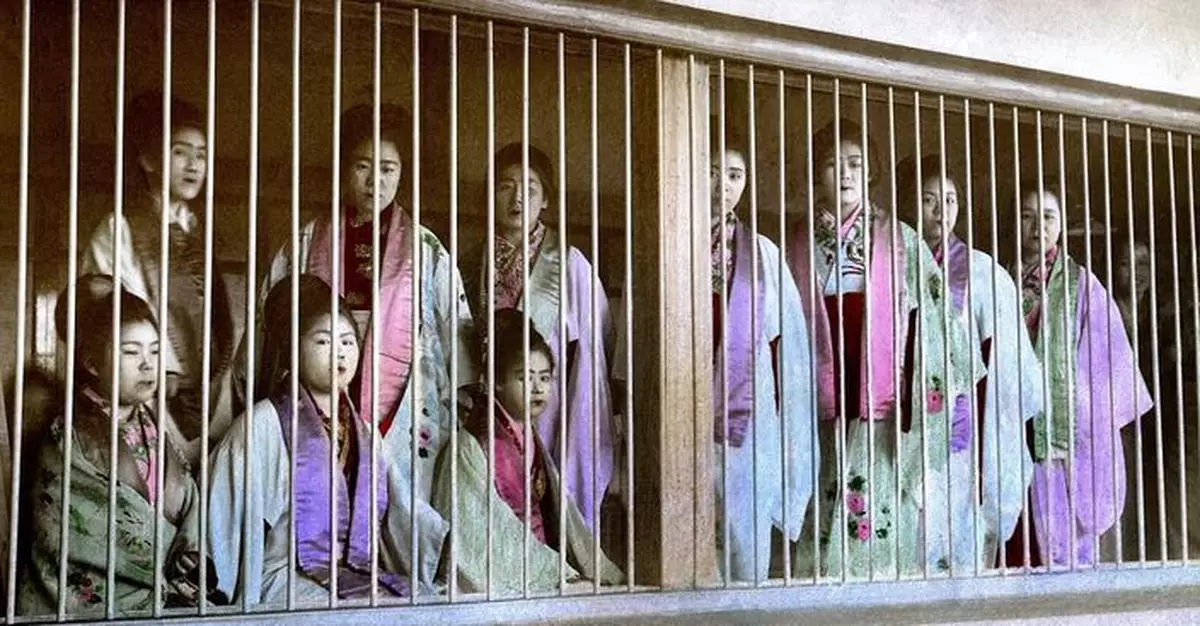
Dated 100 years ago, prostitutes during the Meiji period were held in cages to attract customers in Yoshiwara, a center of brothels at that time. Girls as young as seven years old were sold to the brothels as sex workers to repay family debts.

The photos were taken between 1890 and 1900. The prostitutes were mainly from the countryside. Some lucky ones would be given training in etiquette such as Tea Art classes. However most had to stay in the brothels until some wealthy men paid off their debts and kept them as concubines, or they had enough money to buy back their own freedom.

More Images

The Nobel Prize Nominee Hideyo Noguchi, whose face is on the current 1000 yen banknote, was a big fan of brothels in Yoshiwara. He was reported to have spent a big sum of money for a night of pleasure. Men with different backgrounds were welcomed, while samurais had to remove their swords before getting in.

These brothels were called ‘harimise’, where prostitutes had to sit behind the bars and faced the main streets to let customers choose. Since 1903, sex workers were picked and chosen from their photos. And later in 1916, ‘harimise’ brothels were banned.

NARA, Japan (AP) — In Japan's ancient capital, Nara, deer moved through grass fields and shaded paths, lowering their heads toward visitors holding special crackers made just for them.

Nara this week hosted a Japan–South Korea summit, with Japanese Prime Minister Sanae Takaichi, who is from the city, welcoming South Korean President Lee Jae Myung.

But despite the high-level diplomacy, the deer were still stars of the show.

Tourists around the park stopped to watch or feed the animals with crackers, sold by vendors, that are made from flour and rice husks.

When the deer fix their gazes on visitors, many responded by pulling out crackers and stepping closer.

Not all encounters were gentle. Some deer nudged visitors from behind, sniffing backpacks and shopping bags. Others tried to nibble at coat pockets or chew at clothing when they suspected food was hidden there.

Some visitors hesitated, appearing nervous, but fed the deer anyway. As the animals stepped closer, many tourists recoiled, taking a step back or letting out brief screams. Others lifted their phones to take pictures.

More than 1,000 deer live in the park and surrounding areas. They roam freely across lawns, sidewalks and temple grounds, resting under trees or gathering near food stalls. A few deer were seen wandering into nearby shops.

The deer are protected and are considered sacred according to local Shinto beliefs. Legend has it that a deity arrived in Nara riding a white deer more than a thousand years ago.

Nara was Japan’s first permanent capital in the eighth century and is home to several UNESCO World Heritage sites, including Todaiji temple and Kasuga shrine.

This is a photo gallery curated by AP photo editors.

Deer wait for food from tourists at a park in Nara, western Japan, Wednesday, Jan. 14, 2026, where more than 1,000 free-roaming deer considered sacred in Shinto belief have become one of the city's most popular tourist attractions. (AP Photo/Eugene Hoshiko)

Deer wait for food from tourists at a park in Nara, western Japan, Wednesday, Jan. 14, 2026, where more than 1,000 free-roaming deer considered sacred in Shinto belief have become one of the city's most popular tourist attractions. (AP Photo/Eugene Hoshiko)

Deer are fed by a staff at a park in Nara, western Japan, Wednesday, Jan. 14, 2026, where more than 1,000 free-roaming deer considered sacred in Shinto belief have become one of the city's most popular tourist attractions. (AP Photo/Eugene Hoshiko)

Deer are fed by a staff at a park in Nara, western Japan, Wednesday, Jan. 14, 2026, where more than 1,000 free-roaming deer considered sacred in Shinto belief have become one of the city's most popular tourist attractions. (AP Photo/Eugene Hoshiko)

A deer waits for food from tourists at a park in Nara, western Japan, Wednesday, Jan. 14, 2026, where more than 1,000 free-roaming deer considered sacred in Shinto belief have become one of the city's most popular tourist attractions. (AP Photo/Eugene Hoshiko)

A deer waits for food from tourists at a park in Nara, western Japan, Wednesday, Jan. 14, 2026, where more than 1,000 free-roaming deer considered sacred in Shinto belief have become one of the city's most popular tourist attractions. (AP Photo/Eugene Hoshiko)

A deer stands in a park in Nara, western Japan, Wednesday, Jan. 14, 2026, near a banner reading "Welcome Japan-South Korea Summit Meeting" hoisted at a public building.(AP Photo/Eugene Hoshiko)

A deer stands in a park in Nara, western Japan, Wednesday, Jan. 14, 2026, near a banner reading "Welcome Japan-South Korea Summit Meeting" hoisted at a public building.(AP Photo/Eugene Hoshiko)

A deer waits for food from tourists near Todaiji temple, in Nara, western Japan, Wednesday, Jan. 14, 2026, where more than 1,000 free-roaming deer considered sacred in Shinto belief have become one of the city's most popular tourist attractions. (AP Photo/Eugene Hoshiko)

A deer waits for food from tourists near Todaiji temple, in Nara, western Japan, Wednesday, Jan. 14, 2026, where more than 1,000 free-roaming deer considered sacred in Shinto belief have become one of the city's most popular tourist attractions. (AP Photo/Eugene Hoshiko)

A tourist feeds deer at a park, in Nara, western Japan, Wednesday, Jan. 14, 2026, where more than 1,000 free-roaming deer considered sacred in Shinto belief have become one of the city's most popular tourist attractions. (AP Photo/Eugene Hoshiko)

A tourist feeds deer at a park, in Nara, western Japan, Wednesday, Jan. 14, 2026, where more than 1,000 free-roaming deer considered sacred in Shinto belief have become one of the city's most popular tourist attractions. (AP Photo/Eugene Hoshiko)

Tourists pose for their selfie as a deer waits for food at a park, in Nara, western Japan, Wednesday, Jan. 14, 2026, where more than 1,000 free-roaming deer considered sacred in Shinto belief have become one of the city's most popular tourist attractions. (AP Photo/Eugene Hoshiko)

Tourists pose for their selfie as a deer waits for food at a park, in Nara, western Japan, Wednesday, Jan. 14, 2026, where more than 1,000 free-roaming deer considered sacred in Shinto belief have become one of the city's most popular tourist attractions. (AP Photo/Eugene Hoshiko)

A deer pokes its head into a tourist's bag while looking for food at a park, in Nara, western Japan, Wednesday, Jan. 14, 2026, where more than 1,000 free-roaming deer considered sacred in Shinto belief have become one of the city's most popular tourist attractions. (AP Photo/Eugene Hoshiko)

A deer pokes its head into a tourist's bag while looking for food at a park, in Nara, western Japan, Wednesday, Jan. 14, 2026, where more than 1,000 free-roaming deer considered sacred in Shinto belief have become one of the city's most popular tourist attractions. (AP Photo/Eugene Hoshiko)

A deer peeks behind of a sign at a park in Nara, western Japan, Wednesday, Jan. 14, 2026, where more than 1,000 free-roaming deer considered sacred in Shinto belief have become one of the city's most popular tourist attractions. (AP Photo/Eugene Hoshiko)

A deer peeks behind of a sign at a park in Nara, western Japan, Wednesday, Jan. 14, 2026, where more than 1,000 free-roaming deer considered sacred in Shinto belief have become one of the city's most popular tourist attractions. (AP Photo/Eugene Hoshiko)

Deer stroll at a park in Nara, western Japan, early Wednesday, Jan. 14, 2026, where more than 1,000 free-roaming deer considered sacred in Shinto belief have become one of the city's most popular tourist attractions. (AP Photo/Eugene Hoshiko)

Deer stroll at a park in Nara, western Japan, early Wednesday, Jan. 14, 2026, where more than 1,000 free-roaming deer considered sacred in Shinto belief have become one of the city's most popular tourist attractions. (AP Photo/Eugene Hoshiko)

Police officers stand guard as a deer walks by in Nara, western Japan, Wednesday, Jan. 14, 2026. (AP Photo/Eugene Hoshiko)

Police officers stand guard as a deer walks by in Nara, western Japan, Wednesday, Jan. 14, 2026. (AP Photo/Eugene Hoshiko)

Deer wait for food from tourists at a park in Nara, western Japan, Wednesday, Jan. 14, 2026, where more than 1,000 free-roaming deer considered sacred in Shinto belief have become one of the city's most popular tourist attractions. (AP Photo/Eugene Hoshiko)

Deer wait for food from tourists at a park in Nara, western Japan, Wednesday, Jan. 14, 2026, where more than 1,000 free-roaming deer considered sacred in Shinto belief have become one of the city's most popular tourist attractions. (AP Photo/Eugene Hoshiko)

A deer rests at Todaiji temple in Nara, western Japan, Wednesday, Jan. 14, 2026, in Nara, western Japan, as police officers walk by. (AP Photo/Eugene Hoshiko)

A deer rests at Todaiji temple in Nara, western Japan, Wednesday, Jan. 14, 2026, in Nara, western Japan, as police officers walk by. (AP Photo/Eugene Hoshiko)

Recommended Articles