Japan has a new cafe where customers can enjoy coffee brewed and served by a robot barista.
The robot named Sawyer debuted this week at Henna Cafe in Tokyo's downtown business and shopping district of Shibuya. The shop's name in Japanese means "strange cafe."
Click to Gallery
Robot barista named "Sawyer" makes a coffee at Henn-na Cafe, meaning "Strange Cafe" in Japanese, in Tokyo, Friday, Feb. 2, 2018. The cafe's robot barista brews and serves coffee as the rapidly aging country seeks to adapt to shrinking workforce. The arm robot "Sawyer" debuted this week in Tokyo‘s downtown business and shopping district of Shibuya. (AP Photo/Koji Sasahara)
Robot barista named "Sawyer" makes a coffee at Henn-na Cafe, meaning "Strange Cafe" in Japanese, in Tokyo, Friday, Feb. 2, 2018. The cafe's robot barista brews and serves coffee as the rapidly aging country seeks to adapt to shrinking workforce. The arm robot "Sawyer" debuted this week in Tokyo‘s downtown business and shopping district of Shibuya. (AP Photo/Koji Sasahara)
Robot barista named "Sawyer" makes a coffee at Henn-na Cafe, Japanese meaning "Strange Cafe"in Tokyo, Friday, Feb. 2, 2018. The cafe's robot barista brews and serves coffee as the rapidly aging country seeks to adapt to shrinking workforce. The arm robot "Sawyer" debuted this week in Tokyo‘s downtown business and shopping district of Shibuya. (AP Photo/Koji Sasahara)
Robot barista named "Sawyer" makes a coffee at Henn-na Cafe, Japanese meaning "Strange Cafe"in Tokyo, Friday, Feb. 2, 2018. The cafe's robot barista brews and serves coffee as the rapidly aging country seeks to adapt to shrinking workforce. The arm robot "Sawyer" debuted this week in Tokyo‘s downtown business and shopping district of Shibuya. (AP Photo/Koji Sasahara)
Robot barista named "Sawyer" makes a coffee at Henn-na Cafe, meaning "Strange Cafe" in Japanese, in Tokyo, Friday, Feb. 2, 2018. The cafe's robot barista brews and serves coffee as the rapidly aging country seeks to adapt to shrinking workforce. The arm robot "Sawyer" debuted this week in Tokyo‘s downtown business and shopping district of Shibuya. (AP Photo/Koji Sasahara)
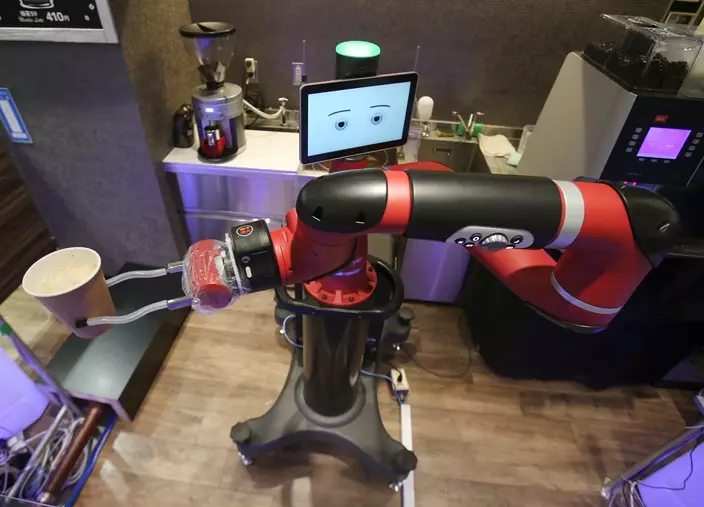
Robot barista named "Sawyer" makes a coffee at Henn-na Cafe, meaning "Strange Cafe" in Japanese, in Tokyo, Friday, Feb. 2, 2018. The cafe's robot barista brews and serves coffee as the rapidly aging country seeks to adapt to shrinking workforce. The arm robot "Sawyer" debuted this week in Tokyo‘s downtown business and shopping district of Shibuya. (AP Photo/Koji Sasahara)
The single-armed robot scans a ticket purchased from a vending machine and greets the customer.
"Would you care for a delicious coffee?" the barista, with a screen showing a pair of cartoon eyes, asks in a flat tone. "I can make one better than human beings around here."
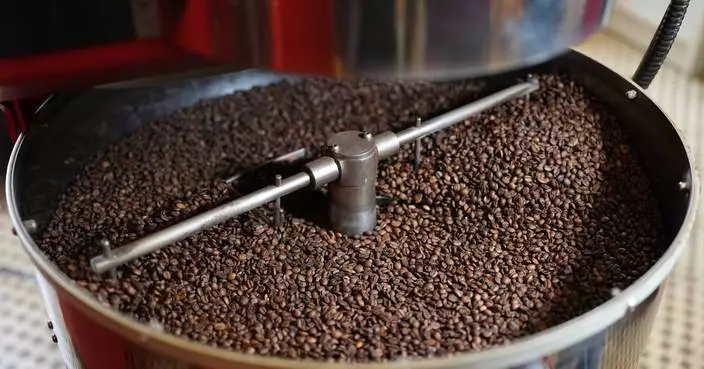
It grinds the coffee beans, fills a filter and pours hot water over a paper cup for up to five people at once. A cup of brewed coffee costs 320 yen ($3) and takes a few minutes.
Sawyer can also operate an automated machine for six other hot drinks including cappuccino, hot chocolate and green tea latte.
Customers, many of them young men, took photos with their smartphones while they waited in line.
The cafe operator, travel agency H.I.S. Co., says robots can increase productivity while also entertaining customers.
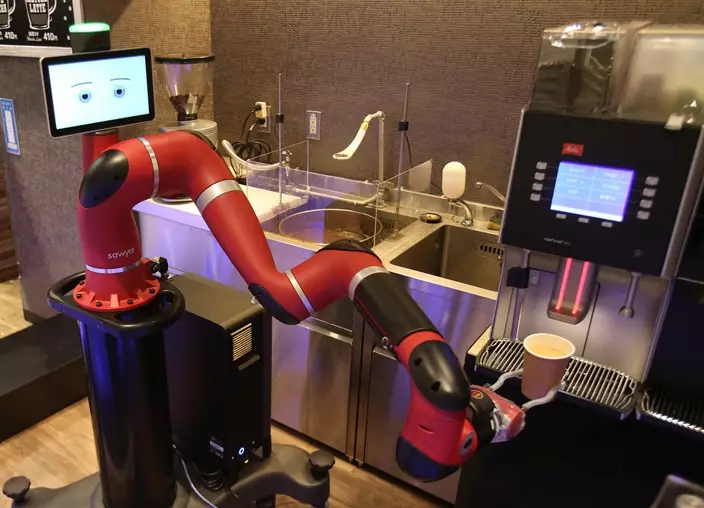
Robot barista named "Sawyer" makes a coffee at Henn-na Cafe, meaning "Strange Cafe" in Japanese, in Tokyo, Friday, Feb. 2, 2018. The cafe's robot barista brews and serves coffee as the rapidly aging country seeks to adapt to shrinking workforce. The arm robot "Sawyer" debuted this week in Tokyo‘s downtown business and shopping district of Shibuya. (AP Photo/Koji Sasahara)
"An essential point is to increase productivity," said Masataka Tamaki, general manager of corporate planning at H.I.S. He said only one person needs to oversee the robot cafe, compared to several people needed at a regular coffee shop, so it can serve better quality coffee at a reasonable price.
Tamaki says it's not just about efficiency. "We want the robot to entertain customers so it's not like buying coffee at a vending machine," he said.
Takeshi Yamamoto, a 68-year-old restaurant employee who works in the neighborhood, said his first experience with the robot cafe was very enjoyable, and his robot-made coffee was delicious.
"It's quite rich, and tastes very good," Yamamoto said, as he took a sip. "You can get machine-made coffee at convenience stores, too, and it's actually good. But here, I had great fun."
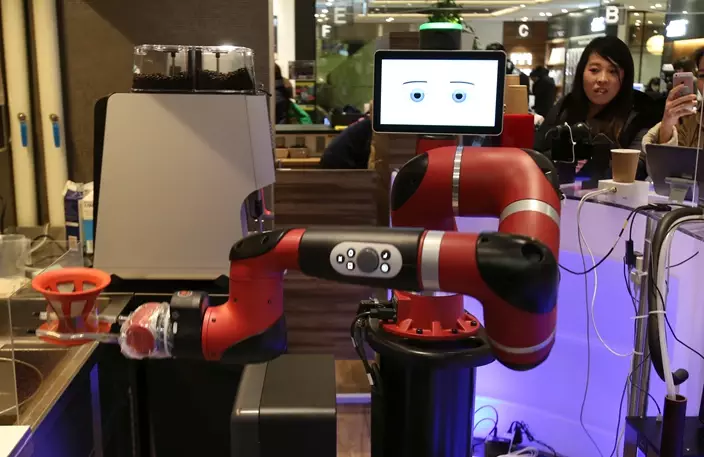
Robot barista named "Sawyer" makes a coffee at Henn-na Cafe, Japanese meaning "Strange Cafe"in Tokyo, Friday, Feb. 2, 2018. The cafe's robot barista brews and serves coffee as the rapidly aging country seeks to adapt to shrinking workforce. The arm robot "Sawyer" debuted this week in Tokyo‘s downtown business and shopping district of Shibuya. (AP Photo/Koji Sasahara)
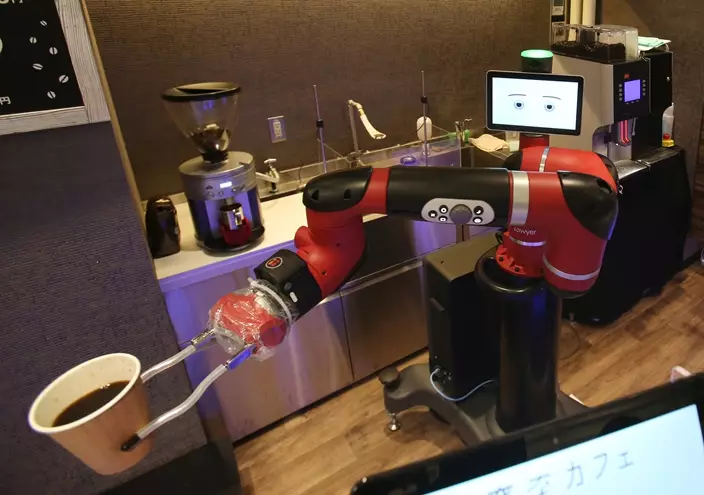
Robot barista named "Sawyer" makes a coffee at Henn-na Cafe, Japanese meaning "Strange Cafe"in Tokyo, Friday, Feb. 2, 2018. The cafe's robot barista brews and serves coffee as the rapidly aging country seeks to adapt to shrinking workforce. The arm robot "Sawyer" debuted this week in Tokyo‘s downtown business and shopping district of Shibuya. (AP Photo/Koji Sasahara)
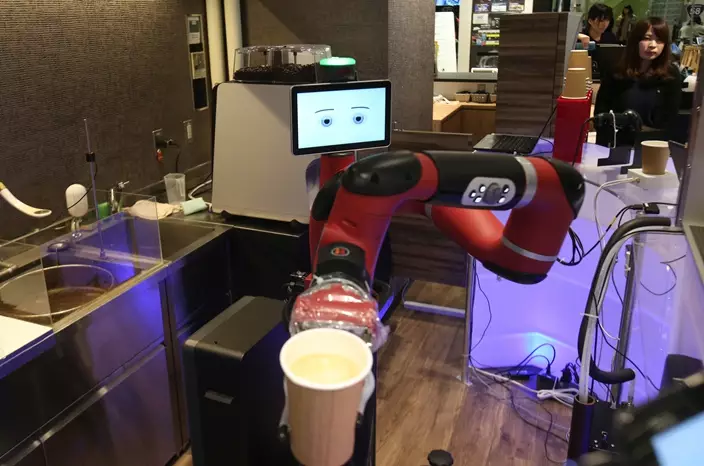
Robot barista named "Sawyer" makes a coffee at Henn-na Cafe, meaning "Strange Cafe" in Japanese, in Tokyo, Friday, Feb. 2, 2018. The cafe's robot barista brews and serves coffee as the rapidly aging country seeks to adapt to shrinking workforce. The arm robot "Sawyer" debuted this week in Tokyo‘s downtown business and shopping district of Shibuya. (AP Photo/Koji Sasahara)
The robotic service agent enterprise, Beijing Yunji Technology Co., Ltd. (referred to as "Yunji Technology") (02670) successfully listed on the Hong Kong stock market last month. Mr. Xie Yunpeng, the vice president of the company, said at the interview with Bastille Post that the company will increase its R&D investment in Hong Kong in the future, develop customized products that meet the requirements of the local and regional market as well as different scenarios, to accumulate core competitive advantages for its future overseas expansion.

Mr. Xie Yunpeng, the vice president of the company, said at the interview with Bastille Post that the company will increase its R&D investment in Hong Kong in the future, develop customized products that meet the requirements of the local and regional market as well as different scenarios. Photo by Bastille Post
According to Mr. Xie's introduction, Yunji Technology was established in 2014, focusing on the R&D, manufacturing, and operation of commercial service robots. Its main products cover three series: "UP", "GOGO", and "Run". Currently, the company has provided robot services for daily use to over 34,000 hotels and more than 150 large general hospitals worldwide. Meanwhile, it is also expanding the markets of industry, parks, and buildings, etc. According to the company's statistics, the number of robot services it provided reached 500 million last year.
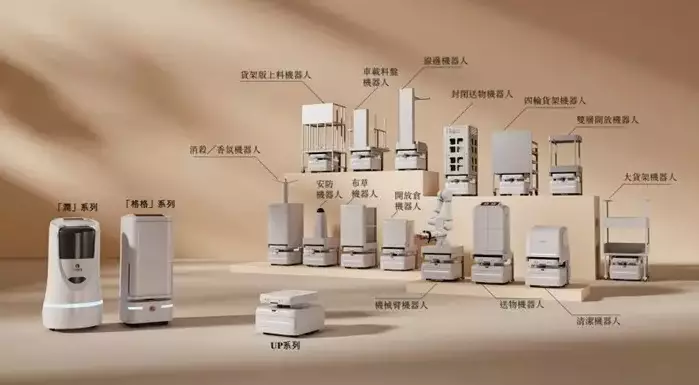
Yunji Technology was established in 2014, focusing on the R&D, manufacturing, and operation of commercial service robots. Its main products cover three series: "UP", "GOGO", and "Run". Currently, the company has provided robot services for daily use to over 34,000 hotels and more than 150 large general hospitals worldwide. Meanwhile, it is also expanding the markets of industry, parks, and buildings, etc. Photo source: The prospectus of Yunji Technology
Mr. Xie pointed out that the company's listing on the Hong Kong stock market can be seen as a positive evaluation of its long-term industrial investment by the capital market, which is conducive to brand enhancement and international expansion. He believed that Hong Kong could successfully play the roles of "super connector" and "super value-adder" for mainland enterprises. Meanwhile, as Hong Kong accelerates its transformation into an international innovation and technology center, such a chance can provide opportunities for Yunji Technology to further develop.
Mr. Xie admitted that the company had faced practical challenges such as the complexity for its products to adapt to localization, differences in technical standards and regulations at home and abroad at the early stage of expansion. Considering Hong Kong as an international platform, the city can precisely become the "best testing ground" for market validation and product model optimization. Since last year, Yunji Technology has launched a series of strategic layouts in Hong Kong: settling in Cyberport and establishing its international business headquarters, jointly building the "PolyU-YUNJI Technology Hotel Digital Intelligence Joint Innovation Lab" with the Hong Kong Polytechnic University, and being listed in Hong Kong's key enterprises and officially on the Hong Kong stock market in October this year. He disclosed that in the future, the company will increase its investment in research and development in Hong Kong to develop customized products that meet the demands of local and regional markets.

Listing on the Hong Kong stock market is merely an initial success. Mr. Xie said that the company will increase its R&D investment in Hong Kong in the future, develop customized products that meet the requirements of the local and regional market, as well as different scenarios. Photo source: FB of the Innovation, Technology and Industry Bureau
During the process of entering the Hong Kong market, Mr. Xie admitted that he encountered a market environment different from that in the Mainland, but he optimistically regarded it as a unique business opportunity. He explained that the Hong Kong market has given rise to new demands in the delivery of disposable products: With the implementation of the "plastic-free" regulation, some guests who did not carry toiletries with them would need to purchase the articles temporarily after checking into their hotels, which led to the demand for using robots to conduct room delivery. Such a condition has provided the company with an opportunity to enter the hotel market and release customized product series.
At the end of October, Yunji Technology accompanied the business delegation led by the Financial Secretary, Mr. Paul Chan, on a visit to Saudi Arabia and signed strategic cooperation agreements with local enterprises. Mr. Xie believed that stepping into the international market is an inevitable choice for Mainland artificial intelligence enterprises. "Yunji Technology has achieved a high level of application maturity and customer satisfaction in the hotel scenario." He said. According to his observation of the current large-scale urban construction situation in Riyadh on the spot, the city has provided dedicated elevators and paths for robots, bringing about greater opportunities than the difficulties previously raised by the agent he had entrusted. In the future, Yunji Technology will continue to explore the localized demands of the Middle East market, deepen product research and development, and optimize product quality accordingly.

At the end of October, Yunji Technology (second from left) accompanied the business delegation led by the Financial Secretary, Mr. Paul Chan, on a visit to Saudi Arabia and signed strategic cooperation agreements with local enterprises. Photo source: Hong Kong Trade Development Council
When analyzing the differences among diverse application scenarios, Mr. Xie pointed out that, as a service space operating 24 hours a day, the hotel would be the ideal scenario for robots to verify their efficiency in the early stage. Up to now, the application value in such an aspect has been widely recognized by the market: robots have become the standard equipment for the opening of new branches of Mainland chain hotels. After fully mastering the features of the hotel scenario and releasing a mature overall solution, the company is now shifting this application system to other scenarios such as hospitals, factories, supermarkets, and buildings, etc.
Previously, Yunji Technology launched the first composite polymorphic robot "UP" in the industry, which features the multi-functionality of one machine and time division multiplexing. With a modular design, the robot can flexibly adapt to different scenarios and respond to the professional demands of various industries.
Mr. Xie emphasized that the cost-effectiveness and commercial feasibility would be the core elements of product design. In the future, the company will integrate both disembodied and embodied intelligence to enhance the content and quantity of individual customer service. He said that the robotics industry is a heavily invested sector with diverse R&D investments and huge educational market costs. After listing on the stock market, the company will use 60% of the raised funds for the investment in enhancing R&D capabilities, focusing on the integration of compound multimodal robots and AI agents, 30% for commercial expansion, bringing AI agents into human life, and transforming question-and-answer services into actions.
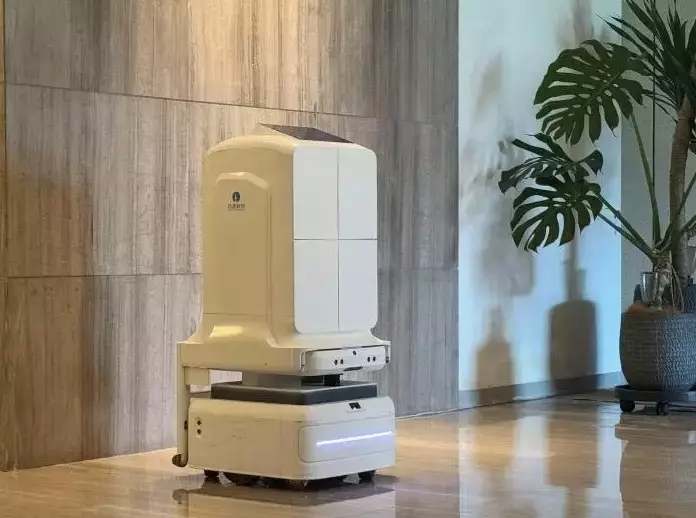
Mr. Xie pointed out that after listing on the stock market, the company will use 60% of the raised funds for the investment in enhancing R&D capabilities, focusing on the integration of compound multimodal robots and AI agents, 30% for commercial expansion, bringing AI agents into human life, and transforming question-and-answer services into actions. Photo source: Yunji Technology
Looking forward to the future development, Yunji Technology will continue to deeply explore the demands of different scenarios and increase the weight of R&D and operation. Besides, the company will reach strategic cooperation and practical solutions with other companies such as Meituan (03690) and Luxshare Precision Industry Co., LTD. (002475). At the same time, the company is also committed to realizing the collaboration with multi-field partners in hospital and overseas scenarios.
Mr. Xie believed that the usage of robots would become a future trend as a part of human production and life. The technology prospect is developing into a deep integration of embodied and disembodied intelligence, which allows everyone to have a dedicated mechanical assistant.