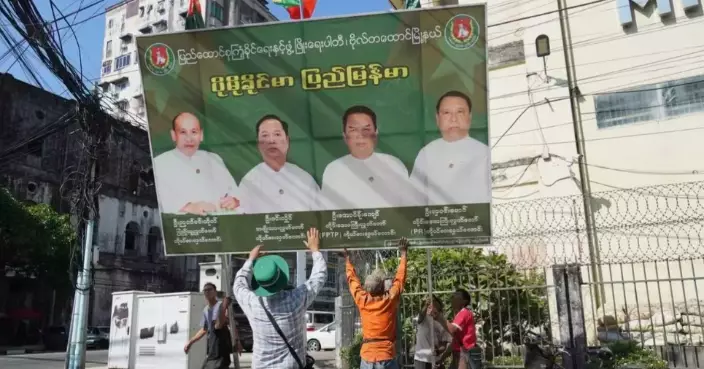
From the age of 5, when she entered a government school in Myanmar, Stella Naw learned about the triumphs of Burman kings and heroes, recited Burman poems and performed Burman dances at school ceremonies.
Without realizing it, she was being torn from her ethnic roots and assimilated into the Southeast Asian country's dominant majority.
Click to Gallery
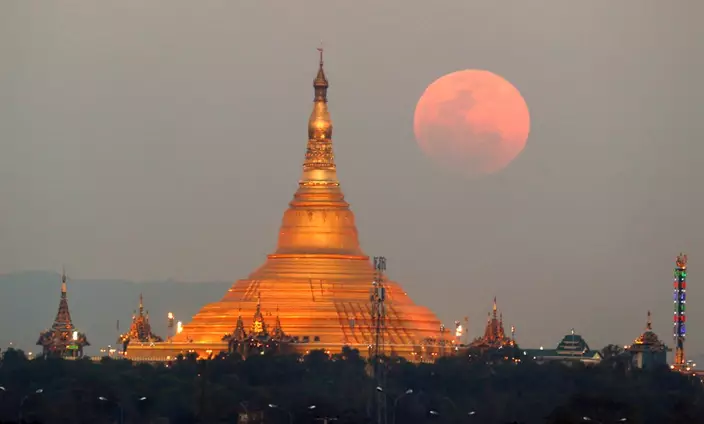
FILE - In this Wednesday, Jan. 31, 2018, file photo, the moon rises behind the Uppatasanti Pagoda in Naypyitaw, Myanmar. Despite hopes that Aung San Suu Kyi’s civilian government would bring change, Myanmar continues to force Burman culture on its ethnic minorities through education, religious proselytization and often coercion. Despite close to 90 percent adherence to Christianity in the northern outlying regions, state-sanctioned Buddhist pagodas dominate the landscape. (AP Photo/Aung Shine Oo, File)
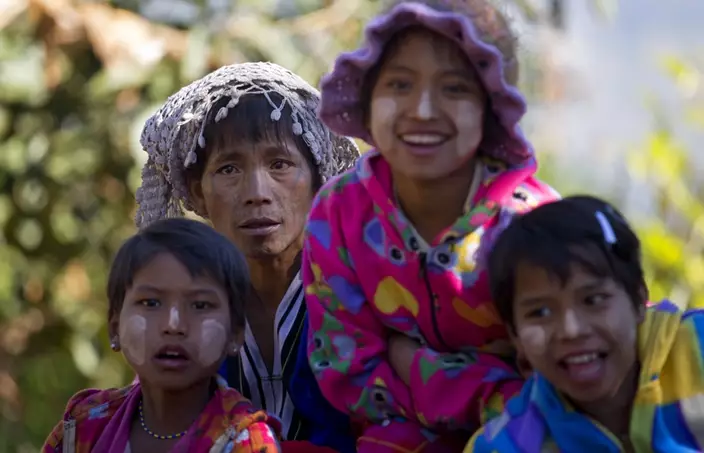
FILE - In this Dec. 18, 2013, file photo, ethnic Chin women of Muun sub-tribe, one with a traditional tattooed face and others with thanaka, a distinctive cosmetic face-paste widely used by Burmese women for a smoother skin, gather in Kyar Do village in Chin State, Myanmar. For decades the Karen, Shan, Mon, Chin and other minority groups have been put through a process they call Burmanization _ an informal system in which education, repressive laws, religious proselytization, economic exploitation and often brutal force are used to wash away their own identity. (AP Photo/Gemunu Amarasinghe, File)
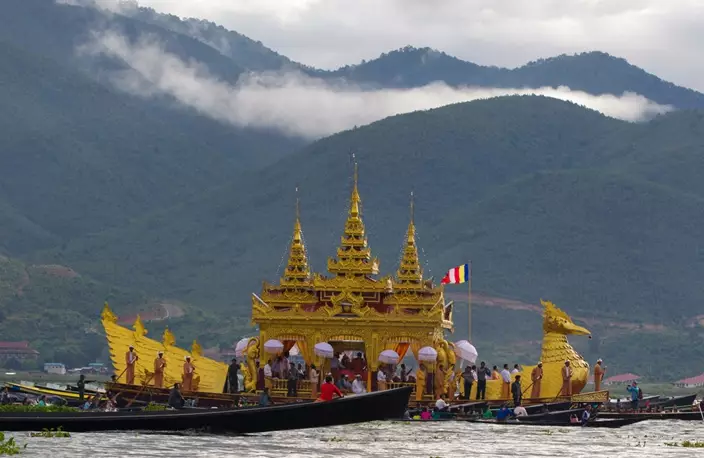
FILE - In this Tuesday, Oct. 3, 2017, file photo, a large boat carrying Buddha images during the annual pagoda festival tours across the Inlay Lake, southern Shan State, Myanmar. Despite hopes that Aung San Suu Kyi’s civilian government would bring change, Myanmar continues to force Burman culture on its ethnic minorities through education, religious proselytization and often coercion. Despite close to 90 percent adherence to Christianity in the northern outlying regions, state-sanctioned Buddhist pagodas dominate the landscape. (AP Photo/Thein Zaw, File)
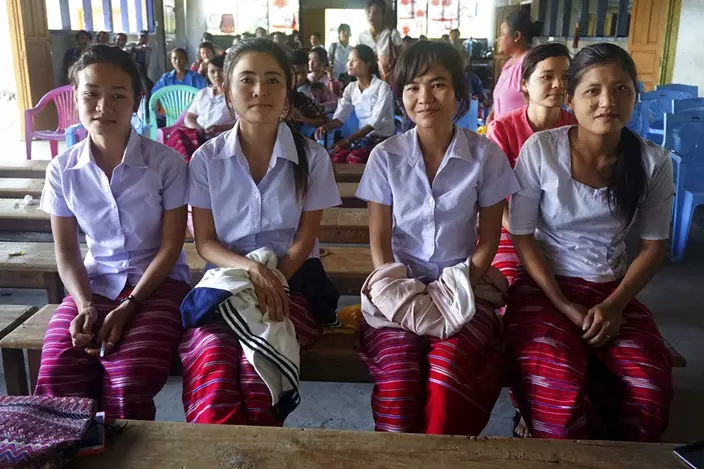
In this Nov. 8, 2017, photo, ethnic Karen school girls attend class at the headquarters of the 2nd Brigade of the Karen insurgents in the Taungoo area at Hto Lwe Wah, in Bago Region, Myanmar. The school includes a dormitory for over 200 students including these Karen young women where education is in Karen, English and Burmese languages. For decades the Karen, Shan, Mon, Chin and other minority groups have been put through a process they call Burmanization _ an informal system in which education, repressive laws, religious proselytization, economic exploitation and often brutal force are used to wash away their own identity. (AP Photo/Denis Grey)
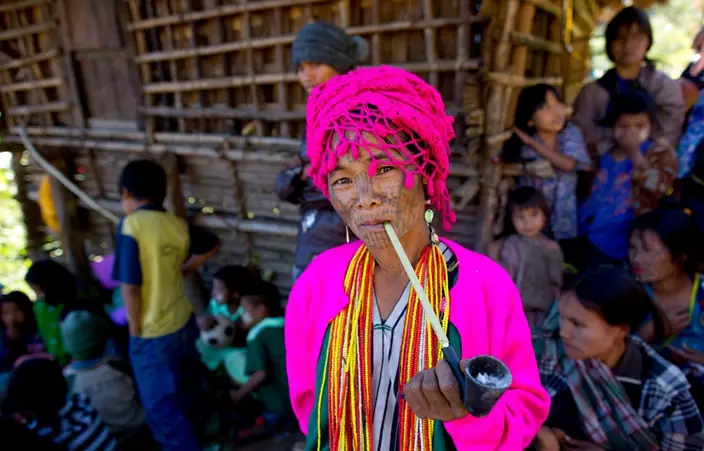
FILE - In this Dec. 18, 2013, file photo, an ethnic Chin women of Muun sub-tribe with traditional tattooed face smokes a pipe with tobacco in Kyar Do village during a soccer tournament for villagers in Chin State, Myanmar. For decades the Karen, Shan, Mon, Chin and other minority groups have been put through a process they call Burmanization _ an informal system in which education, repressive laws, religious proselytization, economic exploitation and often brutal force are used to wash away their own identity. (AP Photo/Gemunu Amarasinghe, File)
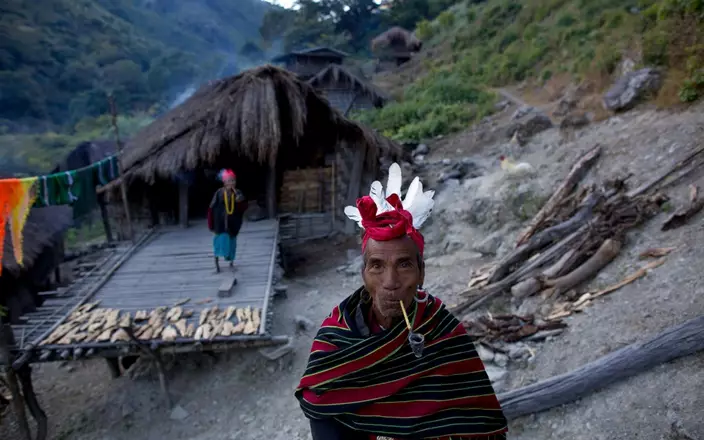
FILE - In this Dec. 18, 2013, file photo, ethnic Chin man Htang Ling Kaw, foreground, leaves the house of neighbor Laing Awi, background, at the Kyar Do village, Chin State, Myanmar. For decades the Karen, Shan, Mon, Chin and other minority groups have been put through a process they call Burmanization _ an informal system in which education, repressive laws, religious proselytization, economic exploitation and often brutal force are used to wash away their own identity. (AP Photo/Gemunu Amarasinghe, File)
FILE - In this Wednesday, Jan. 31, 2018, file photo, the moon rises behind the Uppatasanti Pagoda in Naypyitaw, Myanmar. Despite hopes that Aung San Suu Kyi’s civilian government would bring change, Myanmar continues to force Burman culture on its ethnic minorities through education, religious proselytization and often coercion. Despite close to 90 percent adherence to Christianity in the northern outlying regions, state-sanctioned Buddhist pagodas dominate the landscape. (AP Photo/Aung Shine Oo, File)
"What was missing from my childhood was a chance to learn the culture and history of my own people, the Kachin," says the political analyst and writer. "I was ashamed to speak my own language. I didn't like the sound of my own name."
Naw's experience is shared by many of Myanmar's ethnic minorities, a multitude of more than 130 different groups with their own cultures, histories and languages who make up some 40 percent of the country's population. For decades the Karen, Shan, Mon, Chin and other minority groups have been put through a process they call Burmanization — an informal system in which education, repressive laws, religious proselytization, economic exploitation and often brutal force are used to wash away their own identity.
The recent violent expulsion from the country of nearly 700,000 Muslim Rohingya can be seen as an extreme example of the drive by central authorities to expunge any perceived threat to their dominance and stamp a Burman imprint on vast areas where minorities live. The United Nations calls it a "textbook example of ethnic cleansing."
This Burmanization dashes hopes that the end of direct military rule and election of Myanmar's first civilian government, headed by Aung San Suu Kyi, would usher in a new era of relations with minority groups. On taking power in early 2016, Suu Kyi declared that national reconciliation and a federal constitution would be high priorities.
Instead, the transition to democratic rule and its greater freedoms has come with a rise in nationalism and radical Buddhism. Suu Kyi has not condemned continuing military atrocities against the Kachin and others, and her stock with ethnic minorities has plummeted. Many say she is first and foremost a Burman.
FILE - In this Dec. 18, 2013, file photo, ethnic Chin women of Muun sub-tribe, one with a traditional tattooed face and others with thanaka, a distinctive cosmetic face-paste widely used by Burmese women for a smoother skin, gather in Kyar Do village in Chin State, Myanmar. For decades the Karen, Shan, Mon, Chin and other minority groups have been put through a process they call Burmanization _ an informal system in which education, repressive laws, religious proselytization, economic exploitation and often brutal force are used to wash away their own identity. (AP Photo/Gemunu Amarasinghe, File)
The military — which is constitutionally shielded from civilian oversight of all security matters — has long portrayed itself as Myanmar's savior, the only institution that could keep together a nation at risk of splitting into numerous parts.
It continues to battle the Kachin and groups in northern Shan State, working off the same playbook it has since independence from Britain in 1948 of violently suppressing ethnic insurgencies demanding greater autonomy. Those conflicts have been marked by human rights violations, the displacement of hundreds of thousands of rural people and the entrenchment of the military within ethnic communities.
Less obvious are what ethnic minorities insist are calculated efforts at Burmanization that focus on religion, language, heritage and other aspects of self-identity.
The government denies that it is pursuing such a policy.
Ko Ko Naing, a deputy director in the Ministry of Religious Affairs and Culture, says the government allows ethnic minorities to study their languages outside public schools even though it is not legally obligated to do so.
"That's why I don't see that the majority is Burmanizing the ethnic minority groups," he tells The Associated Press.
FILE - In this Tuesday, Oct. 3, 2017, file photo, a large boat carrying Buddha images during the annual pagoda festival tours across the Inlay Lake, southern Shan State, Myanmar. Despite hopes that Aung San Suu Kyi’s civilian government would bring change, Myanmar continues to force Burman culture on its ethnic minorities through education, religious proselytization and often coercion. Despite close to 90 percent adherence to Christianity in the northern outlying regions, state-sanctioned Buddhist pagodas dominate the landscape. (AP Photo/Thein Zaw, File)
It was also the duty of the government, the official says, to promote Buddhism and build Buddhist pagodas everywhere in the country lest "our religion and country disappear."
In Chin State, where 90 percent of Chin adhere to Christianity, crosses have been destroyed, pastors are intimidated and there is state-sponsored pressure to convert to Buddhism. Kachin State, where more than 90 percent of the Kachin people adhere to Christianity, has among the highest concentrations of pagodas in the country.
The government continues to pursue "a forced assimilation and indoctrination program" through boarding schools run by the military-controlled Ministry of Border Affairs, said Salai Za Uk Ling of the U.S.-based Chin Human Rights Organization. Education is offered free and is of a higher standard than in normal government schools, but activists say school authorities try to coerce students into converting to Buddhism.
Even the predominantly Buddhist Shan, the country's largest ethnic minority, are highly critical of pagodas built in a Burman rather than distinctive Shan style. A local saying sums it up: "When the Chinese conquer they build moats. When the Burmans conquer, they build pagodas."
In this Nov. 8, 2017, photo, ethnic Karen school girls attend class at the headquarters of the 2nd Brigade of the Karen insurgents in the Taungoo area at Hto Lwe Wah, in Bago Region, Myanmar. The school includes a dormitory for over 200 students including these Karen young women where education is in Karen, English and Burmese languages. For decades the Karen, Shan, Mon, Chin and other minority groups have been put through a process they call Burmanization _ an informal system in which education, repressive laws, religious proselytization, economic exploitation and often brutal force are used to wash away their own identity. (AP Photo/Denis Grey)
Still seared in the collective memory is the 1991 demolition of the Kengtung Palace, the grandest among those built by the former rulers of Shan State. In what Shan activists term a case of "cultural sabotage," rubble from the palace was scattered on roads around a military base.
Under the previous military-backed government of President Thein Sein, the regime eased earlier restrictions on teaching non-Burman languages but only allowed it after regular school hours, a policy that continues. Saw True Blood, a member of the Karen Development Network, says that about half of the 2,000 children living in his area of Taungoo in Karen State do not attend the after-school language classes because they are too tired, want to play or take extra tuition in other subjects.
Most Karen children, he says, can speak but not read or write their language. "When I hear my nieces and grandchildren speaking Burmese while they are playing, I tell them to speak Karen and ask, 'Are you Karen or Burman?"
The community leader says authorities tell the Karen that if they want to preserve their culture and identity they have to do it on their own, but at the same time place barriers to achieving this. He quotes a regional military commander as lecturing locals to "forget your ethnic identity, your territory. Just think about the Union."
"This is Burmanization," Saw True Blood says.
FILE - In this Dec. 18, 2013, file photo, an ethnic Chin women of Muun sub-tribe with traditional tattooed face smokes a pipe with tobacco in Kyar Do village during a soccer tournament for villagers in Chin State, Myanmar. For decades the Karen, Shan, Mon, Chin and other minority groups have been put through a process they call Burmanization _ an informal system in which education, repressive laws, religious proselytization, economic exploitation and often brutal force are used to wash away their own identity. (AP Photo/Gemunu Amarasinghe, File)
In recent years, the central government has Burmanized place names across the country, often making them unrecognizable to local people.
Last year, the naming of a new bridge across the Salween River in Mon State sparked demonstrations by the Mon. The bridge was named after General Aung San, the Burman hero of the independence struggle and Suu Kyi's father.
Mon activists say the name bears no relevance to their region, some likening it to a younger sibling being bullied by an older one. "The change of name made people feel a lot of pain in their heart. In spirit it means that the Burmans occupy the Mon," Min Soe Lin, a Mon member of parliament, told Australian researcher Cecile Medall late last year.
There has been some success in recent years at reaching cease-fire deals with ethnic rebel groups, including the Karen, who under the Karen National Union banner fought the world's longest running insurgency until 2012. But even the Karen leaders who signed the pact, which allowed them to keep their arms, have made it clear they have little trust in the truce, and clashes have broken out in recent weeks.
FILE - In this Dec. 18, 2013, file photo, ethnic Chin man Htang Ling Kaw, foreground, leaves the house of neighbor Laing Awi, background, at the Kyar Do village, Chin State, Myanmar. For decades the Karen, Shan, Mon, Chin and other minority groups have been put through a process they call Burmanization _ an informal system in which education, repressive laws, religious proselytization, economic exploitation and often brutal force are used to wash away their own identity. (AP Photo/Gemunu Amarasinghe, File)
In the hills outside Taungoo, senior leaders of the KNU agree the only way ethnic minorities will gain an equal voice in Myanmar is through a constitution that fully enshrines their rights under a genuine federal system. The current charter is highly centralized and was enacted by the military.
"Our grandfathers, fathers had to use military means to defend our culture and identity," says Padoh Eh Wah, a member of KNU Central Standing Committee. "Now we have to fight to have these guaranteed through political means."
Before World War II Myanmar's outer regions were largely left alone as they were not regarded as valuable, a sharp contrast to the ongoing scramble to exploit their forests, minerals and hydro-power by the military and its cronies, says political scientist James C. Scott, author of "The Art of Not Being Governed." Scott says a lack of opportunities in ethnic enclaves has sparked an exodus of minorities seeking a better chance elsewhere, leaving a vacuum that Burmans are filling.
"Is there an impulse to Burmanization? Absolutely," he says. "But I am doubtful how centralized and coordinated it is. I would be surprised if it is closely coordinated across ministries, since nothing much else is."
Ethnic leaders disagree. Naw, the Kachin political analyst, believes that "an organized, systematic, structural campaign by central institutions to Burmanize the country" is being carried out.
Saw True Blood, the Karen community leader, says beyond the threat of armed resistance, there is little stopping Burmans from taking all of his people's land.
"The Burmans have the power, government support, money, education," he says. "So they can get what they want."