A robotic geologist armed with a hammer and quake monitor rocketed toward Mars on Saturday, aiming to land on the red planet and explore its mysterious insides.
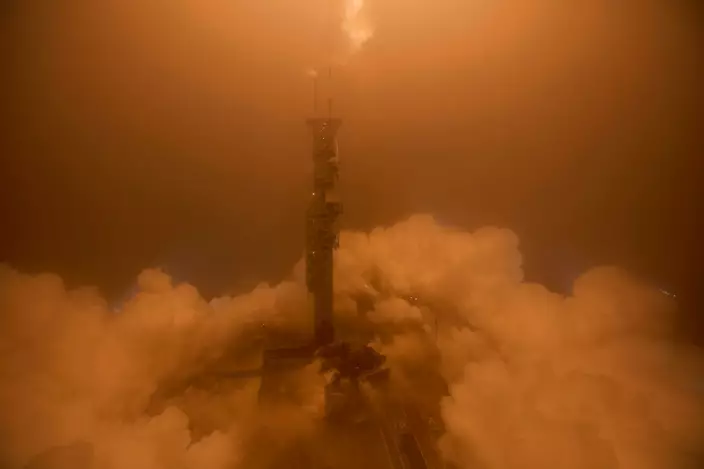
This image provided by NASA, InSight spacecraft launches onboard a United Launch Alliance Atlas-V rocket, Saturday, May 5, 2018, from Vandenberg Air Force Base, Calif. InSight, short for Interior Exploration using Seismic Investigations, Geodesy and Heat Transport, is a Mars lander designed to study the "inner space" of Mars. (Bill Ingalls/NASA via AP)
In a twist, NASA launched the Mars InSight lander from California rather than Florida's Cape Canaveral. It was the first interplanetary mission ever to depart from the West Coast, drawing pre-dawn crowds to fog-socked Vandenberg Air Force Base and rocket watchers down the California coast into Baja.
Click to Gallery
This image provided by NASA, InSight spacecraft launches onboard a United Launch Alliance Atlas-V rocket, Saturday, May 5, 2018, from Vandenberg Air Force Base, Calif. InSight, short for Interior Exploration using Seismic Investigations, Geodesy and Heat Transport, is a Mars lander designed to study the "inner space" of Mars. (Bill Ingalls/NASA via AP)
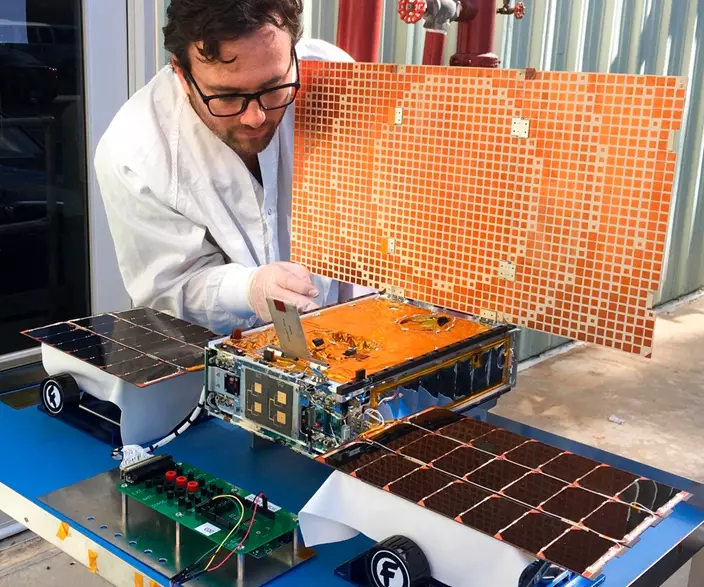
In this undated photo made available by NASA on March 29, 2018, engineer Joel Steinkraus uses sunlight to test the solar arrays on one of the Mars Cube One (Marco) spacecraft at NASA's Jet Propulsion Laboratory in Pasadena, Calif. The Marcos will be the first CubeSats - a kind of modular, mini-satellite - flown into deep space. They're designed to fly along behind NASA's InSight lander on its cruise to Mars. (NASA/JPL-Caltech via AP)
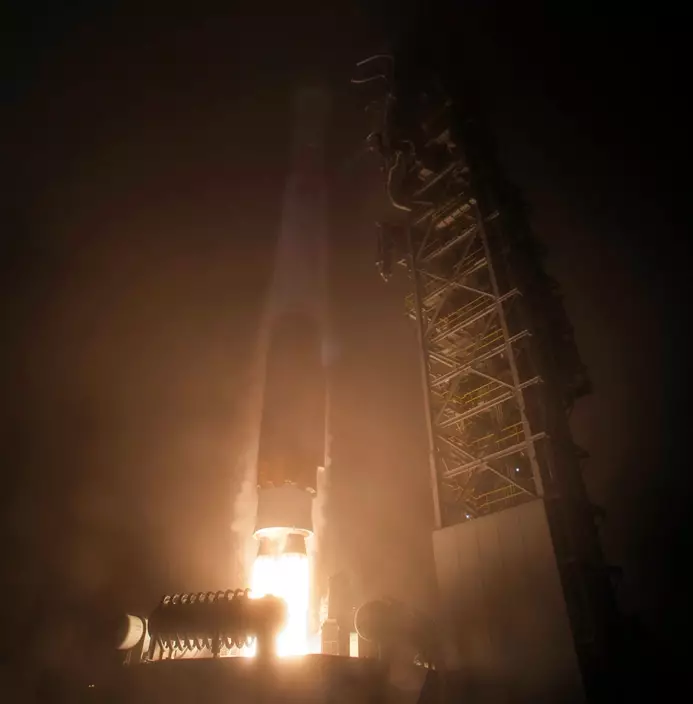
This image provided by NASA, InSight spacecraft launches onboard a United Launch Alliance Atlas-V rocket, Saturday, May 5, 2018, from Vandenberg Air Force Base, Calif. InSight, short for Interior Exploration using Seismic Investigations, Geodesy and Heat Transport, is a Mars lander designed to study the "inner space" of Mars. (Bill Ingalls/NASA via AP)
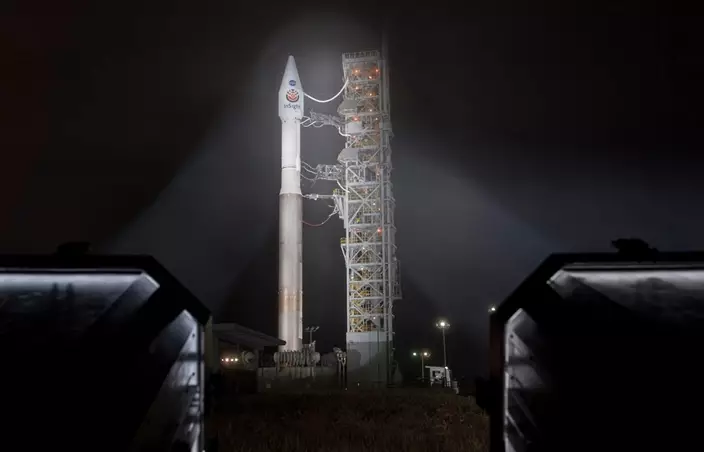
This photo released by NASA shows a United Launch Alliance (ULA) Atlas-V rocket with NASA's InSight spacecraft onboard shortly after the mobile service tower was rolled back, Friday, May 4, 2018, at Vandenberg Air Force Base in Calif. The rocket is set to launch early Saturday. (Bill Ingalls/NASA via AP)
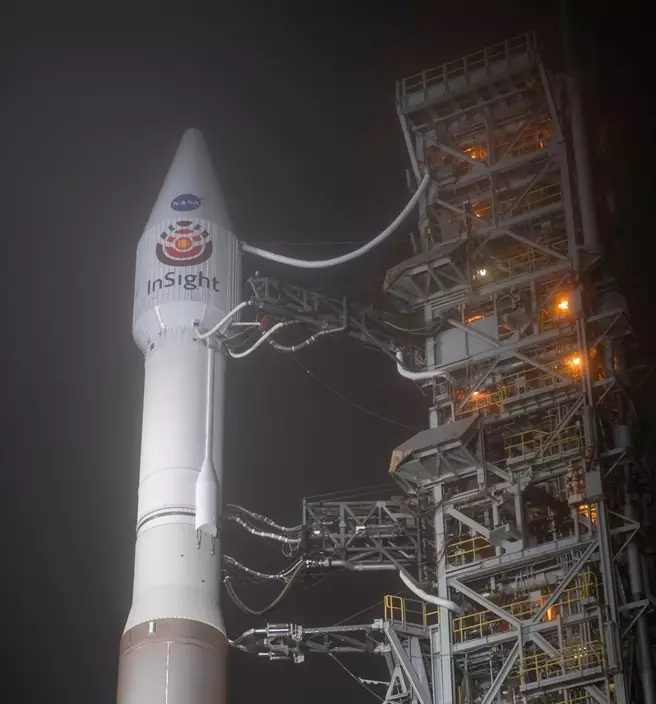
This photo released by NASA shows a United Launch Alliance (ULA) Atlas-V rocket with NASA's InSight spacecraft onboard shortly after the mobile service tower was rolled back, Friday, May 4, 2018, at Vandenberg Air Force Base in Calif. The rocket is set to launch early Saturday. (Bill Ingalls/NASA via AP))
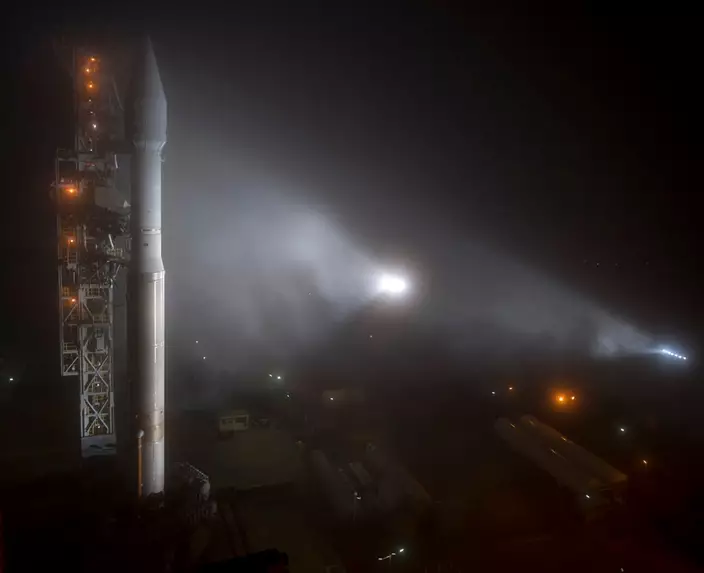
This photo released by NASA shows a United Launch Alliance (ULA) Atlas-V rocket with NASA's InSight spacecraft onboard shortly after the mobile service tower was rolled back, Friday, May 4, 2018, at Vandenberg Air Force Base in Calif. The rocket is set to launch early Saturday. (Bill Ingalls/NASA via AP)
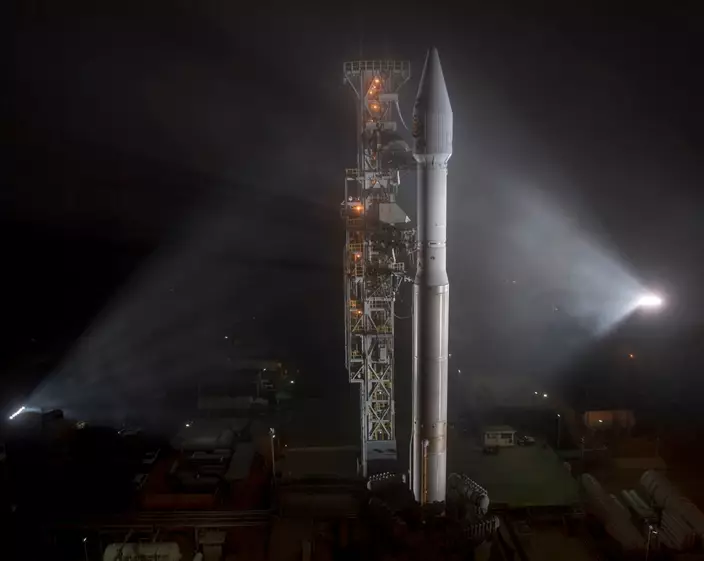
This photo released by NASA shows a United Launch Alliance (ULA) Atlas-V rocket with NASA's InSight spacecraft onboard shortly after the mobile service tower was rolled back, Friday, May 4, 2018, at Vandenberg Air Force Base in Calif. The rocket is set to launch early Saturday. (Bill Ingalls via AP)
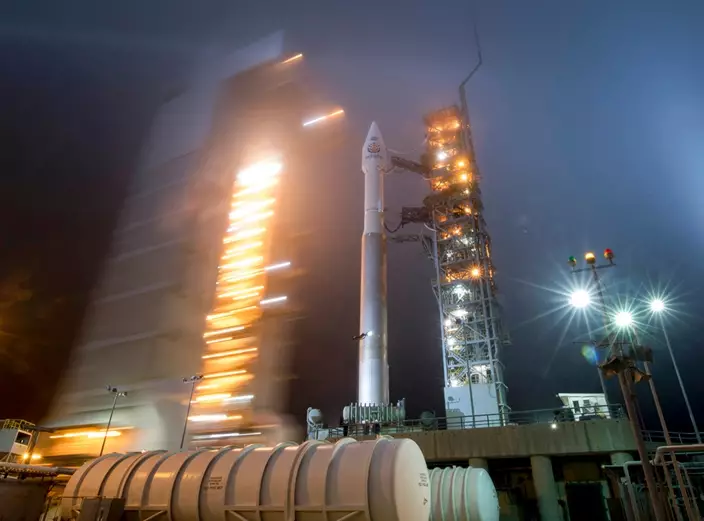
In this photo released by NASA, the mobile service tower at SLC-3 is rolled back to reveal the United Launch Alliance (ULA) Atlas-V rocket with NASA's InSight spacecraft onboard, Friday, May 4, 2018, at Vandenberg Air Force Base in Calif. The rocket is set to launch early Saturday. (Bill Ingalls/NASA via AP)
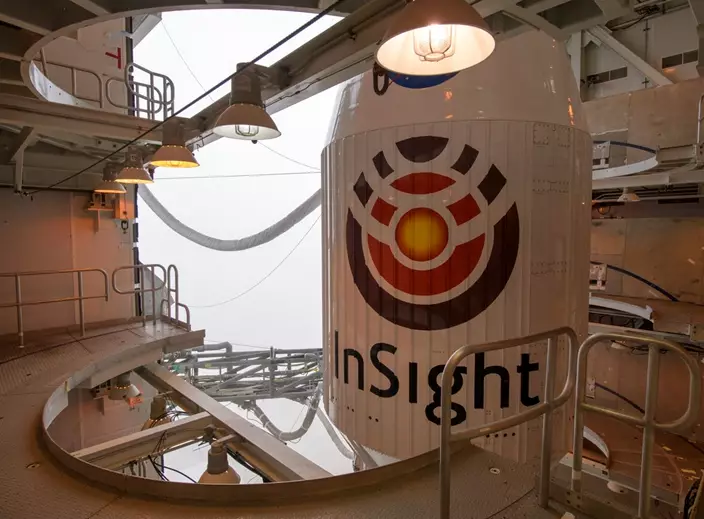
In this image released by NASA, a United Launch Alliance (ULA) Atlas-V rocket with NASA's InSight onboard awaits launch, Friday, May 4, 2018, at Vandenberg Air Force Base, Calif. The rocket is set to launch early Saturday. (Bill Ingalls/NASA via AP)
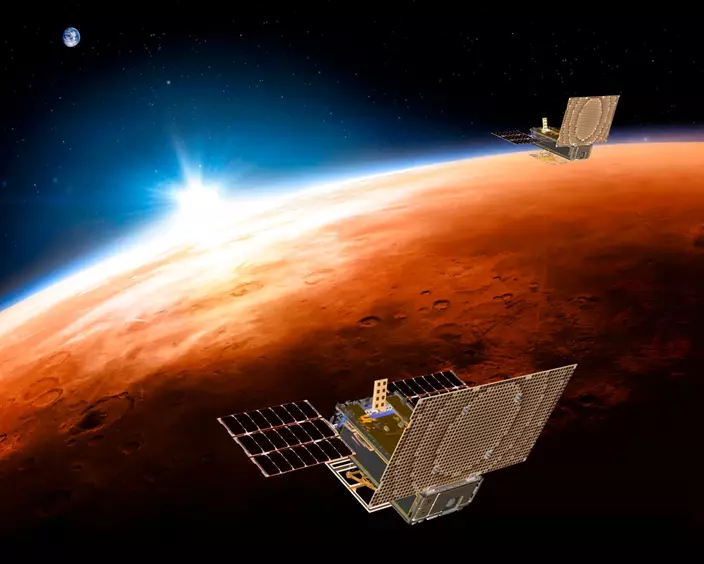
This illustration made available by NASA on March 29, 2018, shows the twin Mars Cube One (Marco) spacecraft flying over Mars with Earth and the sun in the distance. The Marcos will be the first CubeSats - a kind of modular, mini-satellite - flown into deep space. They're designed to fly along behind NASA's InSight lander on its cruise to Mars. (NASA/JPL-Caltech via AP)
In this undated photo made available by NASA on March 29, 2018, engineer Joel Steinkraus uses sunlight to test the solar arrays on one of the Mars Cube One (Marco) spacecraft at NASA's Jet Propulsion Laboratory in Pasadena, Calif. The Marcos will be the first CubeSats - a kind of modular, mini-satellite - flown into deep space. They're designed to fly along behind NASA's InSight lander on its cruise to Mars. (NASA/JPL-Caltech via AP)
"This is a big day. We're going back to Mars!" NASA's new boss, Jim Bridenstine, said following liftoff. "This is an extraordinary mission with a whole host of firsts."
This image provided by NASA, InSight spacecraft launches onboard a United Launch Alliance Atlas-V rocket, Saturday, May 5, 2018, from Vandenberg Air Force Base, Calif. InSight, short for Interior Exploration using Seismic Investigations, Geodesy and Heat Transport, is a Mars lander designed to study the "inner space" of Mars. (Bill Ingalls/NASA via AP)
The spacecraft will take more than six months to get to Mars and start its unprecedented geologic excavations, traveling 300 million miles (485 million kilometers) to get there.
This photo released by NASA shows a United Launch Alliance (ULA) Atlas-V rocket with NASA's InSight spacecraft onboard shortly after the mobile service tower was rolled back, Friday, May 4, 2018, at Vandenberg Air Force Base in Calif. The rocket is set to launch early Saturday. (Bill Ingalls/NASA via AP)
InSight will dig deeper into Mars than ever before — nearly 16 feet, or 5 meters — to take the planet's temperature. It will also attempt to make the first measurements of marsquakes, using a high-tech seismometer placed directly on the Martian surface.
This photo released by NASA shows a United Launch Alliance (ULA) Atlas-V rocket with NASA's InSight spacecraft onboard shortly after the mobile service tower was rolled back, Friday, May 4, 2018, at Vandenberg Air Force Base in Calif. The rocket is set to launch early Saturday. (Bill Ingalls/NASA via AP))
"That's the real payoff of this whole mission and that's still lying ahead of us," said the mission's chief scientist, Bruce Banerdt of NASA's Jet Propulsion Laboratory in Pasadena, California.
Although fog prevented Banerdt from seeing the liftoff of the $1 billion U.S.-European mission, he heard the roar of the rocket and all the blaring car alarms it set off.
This photo released by NASA shows a United Launch Alliance (ULA) Atlas-V rocket with NASA's InSight spacecraft onboard shortly after the mobile service tower was rolled back, Friday, May 4, 2018, at Vandenberg Air Force Base in Calif. The rocket is set to launch early Saturday. (Bill Ingalls/NASA via AP)
"It was just an incredible moment," Banerdt told The Associated Press by phone. Despite the challenges still ahead, "I think I can bask in a little bit of satisfaction and just feeling like we really accomplished something today."
This photo released by NASA shows a United Launch Alliance (ULA) Atlas-V rocket with NASA's InSight spacecraft onboard shortly after the mobile service tower was rolled back, Friday, May 4, 2018, at Vandenberg Air Force Base in Calif. The rocket is set to launch early Saturday. (Bill Ingalls via AP)
Besides InSight, the United Launch Alliance's Atlas V rocket gave a lift to a pair of mini test satellites, or CubeSats, that are trailing InSight to Mars to serve as a potential communication link. Nicknamed WALL-E and EVE from the 2008 animated movie, the twin briefcase-size spacecraft popped off the rocket's upper stage in hot pursuit of InSight, as elated launch controllers applauded and shook hands following the morning's success.
NASA hasn't put a spacecraft down on Mars since the Curiosity rover in 2012. The U.S., in fact, is the only country to successfully land and operate a spacecraft at Mars. It's tough, complicated stuff. Only about 40 percent of all missions to Mars from all countries — orbiters and lenders alike — have proven successful over the decades.
In this photo released by NASA, the mobile service tower at SLC-3 is rolled back to reveal the United Launch Alliance (ULA) Atlas-V rocket with NASA's InSight spacecraft onboard, Friday, May 4, 2018, at Vandenberg Air Force Base in Calif. The rocket is set to launch early Saturday. (Bill Ingalls/NASA via AP)
If all goes well, the three-legged InSight will descend by parachute and engine firings onto a flat equatorial region of Mars — believed to be free of big, potentially dangerous rocks — on Nov. 26. Once down, it will stay put, using a mechanical arm to place the science instruments on the surface.
Banerdt said Mars is ideal for learning how the rocky planets of our solar system formed 4.5 billion years ago. Unlike our active Earth, Mars hasn't been transformed by plate tectonics and other processes, he noted. InSight might also help explain why some planets — like ours — went on to develop life, while others did not.
In this image released by NASA, a United Launch Alliance (ULA) Atlas-V rocket with NASA's InSight onboard awaits launch, Friday, May 4, 2018, at Vandenberg Air Force Base, Calif. The rocket is set to launch early Saturday. (Bill Ingalls/NASA via AP)
Over the course of two Earth years — or one Martian year — NASA expects InSight's three main experiments to provide a true 3-D image of the interior of Mars. Scientists know Mars has an iron core and a crust, but beyond that, the inside is "basically, completely unknown," said Banerdt.
The lander is equipped with a seismometer for measuring marsquakes, a self-hammering probe for burrowing beneath the surface, and a radio system for tracking the spacecraft's position and planet's wobbly rotation, thereby revealing the size and composition of Mars' core.
"InSight, for seismologists, will really be a piece of history, a new page of history," said the Paris Institute of Earth Physics' Philippe Lognonne, lead scientist of the InSight seismometer.
This illustration made available by NASA on March 29, 2018, shows the twin Mars Cube One (Marco) spacecraft flying over Mars with Earth and the sun in the distance. The Marcos will be the first CubeSats - a kind of modular, mini-satellite - flown into deep space. They're designed to fly along behind NASA's InSight lander on its cruise to Mars. (NASA/JPL-Caltech via AP)
Problems with the French-supplied seismometer kept InSight from launching two years ago. California was always part of the plan.
NASA normally launches from Cape Canaveral but decided to switch to California for InSight to take advantage of a shorter flight backlog. This was the first U.S. interplanetary mission to launch from somewhere other than Cape Canaveral.
The fog ruined the view for those gathered at Vandenberg along the central California coast. But it was a marvelous sight farther south. The rocket's bright orange flame was visible for some time as it arced upward across the dark sky west of greater Los Angeles.
Not even two weeks on the job, NASA's new administrator, Bridenstine, observed the launch on monitors at space agency headquarters in Washington.
"I can't think of a better way to start my day!" Bridenstine tweeted.
United Launch Alliance's president, Tory Bruno, also took to Twitter to celebrate. "Next stop: Mars."